
Residual value is the dollar amount (or percentage of MSRP) a leasing company projects your car will be worth when the lease ends. It’s set before you sign, and it directly drives your monthly payment: the higher the residual, the less depreciation you’re paying for each month. It’s also usually the price you’d pay to buy the car at lease-end, which makes it the single most important number on your lease worksheet.
TL;DR:
- Residual value is set by the lessor using market data and forecast models; you cannot negotiate the percentage directly.
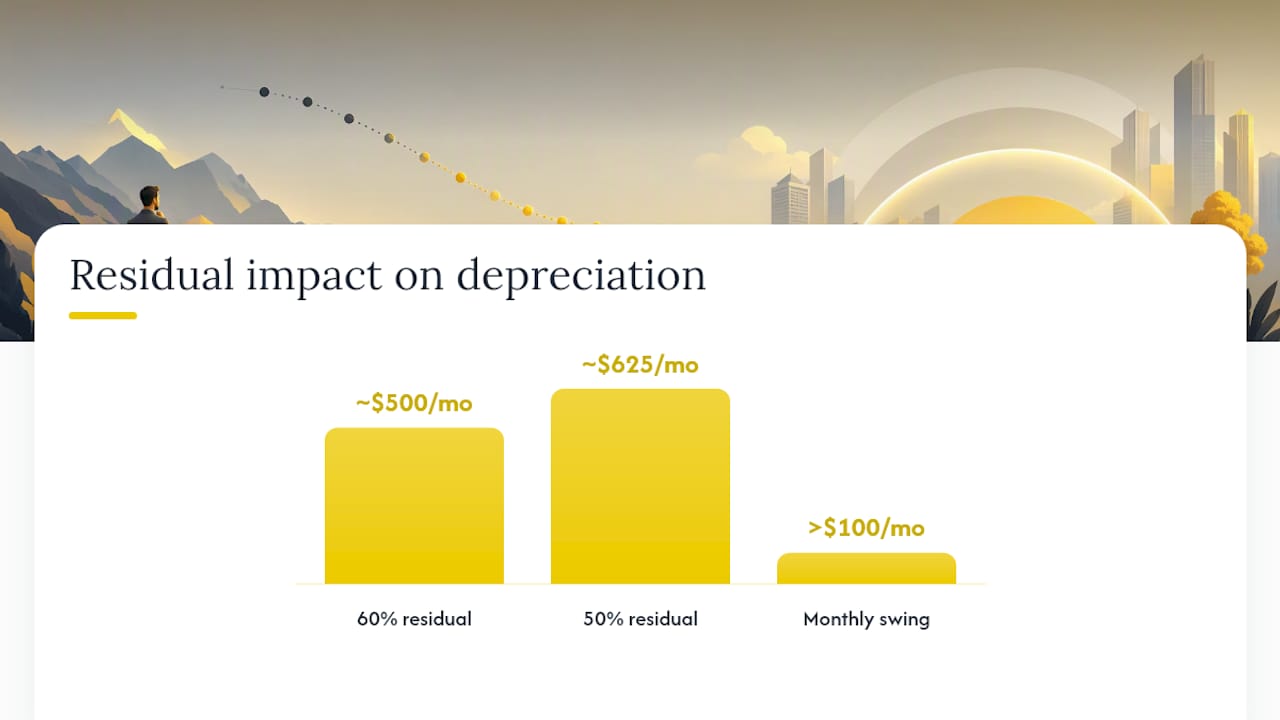
- A 10 percentage point difference in residual percentage can change depreciation costs by over $100 monthly on a typical vehicle.
- Residuals tend to be higher for shorter leases and vehicles in high demand like trucks and SUVs, while electric vehicle residuals can be volatile due to market shifts.
- Always compare residual percentages based on MSRP, not invoice prices, to ensure accurate model and segment comparison.
- Buying at lease end makes sense if current used-car prices exceed your residual’s market value, especially after including taxes and potential penalties.
How Residual Value Drives Your Lease Payment
A lease payment isn’t one number. It’s built from a depreciation charge, a rent charge (the lease version of interest), and taxes or fees layered on top, according to the Consumer Financial Protection Bureau. Residual value determines the first and biggest piece of that stack.
Here’s the math in order:
- Depreciation amount = Capitalized cost (negotiated price plus fees) minus residual value.
- Monthly depreciation charge = Depreciation amount divided by the number of months in the lease.
- Rent charge = (Cap cost plus residual) multiplied by the money factor.
- Base monthly payment = Depreciation charge plus rent charge, then taxes are added per your state’s rules.
Run the numbers on a $45,000 vehicle leased for 36 months. At a 60% residual, the car is worth $27,000 at lease-end, leaving $18,000 to depreciate, roughly $500 a month before rent charge and tax. Drop the residual to 50%, and the car’s projected worth falls to $22,500, pushing depreciation to $22,500, close to $625 a month. That’s a swing of over $100 a month, or several thousand dollars over three years, from a residual difference of just 10 percentage points. Always compare residual as a percentage of MSRP, not a flat dollar figure. It’s the only version that lets you compare a $30,000 sedan quote against a $60,000 SUV quote on equal footing, a point Investopedia’s residual value breakdown lays out clearly with its own worked examples.
What Actually Determines a Car’s Residual Value
Residuals aren’t guesses pulled from thin air. Lessors calculate them using resale data, market forecasting models, and guidebooks that track how specific models hold value over time, and different lessors can land on different numbers for the identical car, according to the Federal Reserve’s leasing guidance.
The variables that move the number most:
- Model and segment demand. Trucks and popular SUVs historically retain value better than niche sedans, which pushes their residuals higher.
- Term length. Shorter leases (24 or 36 months) generally produce higher residual percentages than 48 or 60 month terms, since less time means less predicted wear, per Federal Reserve guidance on residual value.
- Mileage allowance. A 10,000 mile-per-year cap yields a noticeably higher residual than a 15,000-mile cap on the same vehicle.
- Market conditions. Used-car price swings, chip shortages, and EV battery technology shifts can all move projected values, with electric vehicles carrying particularly volatile residuals as newer models and changing incentives reshape resale demand.
- Lessor and program differences. Captive finance arms (Ford Credit, Toyota Financial, etc.) sometimes set residuals differently than independent leasing companies for the same car.
Can You Negotiate the Residual Value?
Short answer: not really. Residuals are set by the lessor or the manufacturer’s captive finance company using their own guidebooks and forecasting, not by the salesperson across the desk from you. Trying to talk someone down on residual percentage is usually a wasted conversation.
What you can negotiate instead:
- Capitalized cost. The negotiated selling price still drives depreciation, so a lower cap cost shrinks your payment even with a fixed residual.
- Money factor. This is the lease’s interest rate equivalent, and it’s often marked up by the dealer beyond what the captive lender actually requires.
- Fees and add-ons. Acquisition fees, disposition fees, and dealer-installed extras are all fair game to question or waive.
- Manufacturer incentives. Lease cash and subvented rates change the math without touching residual at all.
Before you sign, ask the dealer for the exact residual percentage tied to your specific term and mileage combination, not a generic number quoted for a different configuration. Watch for residuals that look unusually generous. Manufacturers sometimes inflate residuals on promotional leases specifically to lower the advertised payment, shifting the risk of a lower actual resale value onto the lessor rather than you, per Checkbook’s leasing explainer. That’s not necessarily bad for you as the lessee, but it does mean the payment isn’t a clean signal of the car’s real depreciation curve.
Pro Tip: Ask for the residual value in writing as a dollar figure, then divide it by MSRP yourself. Dealers sometimes quote residual percentages based on invoice price instead of MSRP, which quietly inflates the number you’re shown.
Should You Buy Out Your Lease or Walk Away?
The residual value set at signing typically becomes your buyout price at lease-end, and deciding whether to pay it takes a few minutes of comparison shopping.
- Check current used-car listings for your exact make, model, trim, and mileage on marketplaces like CarMax, Carvana, or Edmunds. If those prices sit meaningfully above your contract residual, buying out the lease is likely the better move.
- Add in the real costs of buyout, including any purchase-option fee the lessor charges and sales tax, which varies by state and can apply to the full buyout price even though you already paid tax on your monthly payments in some jurisdictions, according to Checkbook’s state tax notes.
- Estimate mileage overage and wear-and-tear charges you’d owe if you returned the car instead. If those penalties come close to the gap between market value and residual, buyout often wins outright.
- Confirm whether your lease is closed-end or open-end. Closed-end leases (the norm for consumer leasing) cap your risk at the residual price regardless of market swings; open-end leases, more common in commercial leasing, can leave you owing the difference if the car’s actual value falls short of the projected residual.
- Decide between buyout, return, or trade-in only after running steps one through three, since a trade-in adds a dealer’s own appraisal into the mix and rarely beats a direct comparison against retail listings.
Red Flags That Signal a Bad Residual Deal
A few habits separate confident lease shoppers from the ones who overpay without realizing it.
- Don’t compare monthly payments across dealers without also comparing residual percentage and MSRP. A lower payment on a higher MSRP car can still mean a worse residual.
- Don’t assume you can talk the residual number down. Spend your negotiating energy on cap cost and fees instead.
- Treat an unusually high residual with mild suspicion. It may signal a manufacturer subsidy rather than a genuinely strong resale forecast.
- Before signing anything, ask the dealer three questions: What’s the residual percentage for this exact term and mileage? Is that residual manufacturer-subsidized? What’s the buyout price in writing?
Why Trust Our Automotive Media On This
Frenzycars covers the resale side of car ownership in detail, from how paint color affects resale value to handling negative equity when trading in a car to how the expiring used EV tax credit is reshaping EV residuals heading into 2026. This article draws on federal consumer-finance guidance and lease-structuring research to keep the math grounded in how leases actually work, not how dealers describe them.

When a High Residual Helps, and When It Doesn’t
A high residual almost always lowers your payment, and for most lessees that’s simply a win. The catch is flexibility. If the market for your model softens, a subsidized residual can leave you locked into a buyout price that no longer reflects the car’s real worth, good for walking away, less good if you’d hoped to keep it. Verify the number, compare it against real used-car listings, and keep residual percentage, not the payment, at the center of every lease conversation.
Research Your Next Lease Before You Sign
Once you understand how residual value moves your payment, the next question is which models actually hold that value. Frenzycars’ car specs pages let you dig into MSRP, trim details, and feature sets for practically any model on the market, the same details that feed into a lessor’s residual math. Pair that with our Best Cars by Category guides, which shortlist models with track records of retaining value better than their segment average. If you’re eyeing an electric vehicle, resale forecasting gets trickier given shifting incentives and battery tech, so check our best electric company car picks before you lock in a term. Spend twenty minutes comparing a couple of models before you walk into a dealership. It’s the cheapest research you’ll do in the entire leasing process.
Sources
- What should I know about leasing versus buying a car? | Consumer Financial Protection Bureau
- Understanding Car Leasing Terms - National (Checkbook)
- Residual value definition and examples | Investopedia