
A balloon auto loan gives you a smaller monthly payment by pushing a large lump sum to the very end of the loan.
TL;DR:
- Balloon auto loans typically set the final balloon payment at 20% to 50% of the car’s original value, often requiring careful planning for repayment.
- While monthly payments are 30% to 45% lower, the total interest paid over the loan’s life is usually higher due to extended financing of a larger balance.
- These loans suit short-term owners, business fleets, or those expecting predictable cash influxes but are risky for buyers without a clear plan to cover the balloon.
- At maturity, options include paying in cash, refinancing, selling the vehicle, or surrendering it, with depreciation impact heavily influencing choices.
- Always verify the exact balloon amount, prepayment rules, mileage penalties, and refinance prospects before signing a balloon loan agreement.
How Balloon Auto Loans Work: Terms, Balloon Factor, and Example Math
A balloon auto loan splits your payments into two uneven chunks. You pay a reduced monthly amount for a set term, typically 24 to 60 months, then owe one final “balloon payment” that clears the rest of the loan. Lenders calculate that final number using a balloon factor, essentially a guaranteed minimum future value, usually set at 20% to 50% of the vehicle’s original price, with 30% to 50% being the norm.
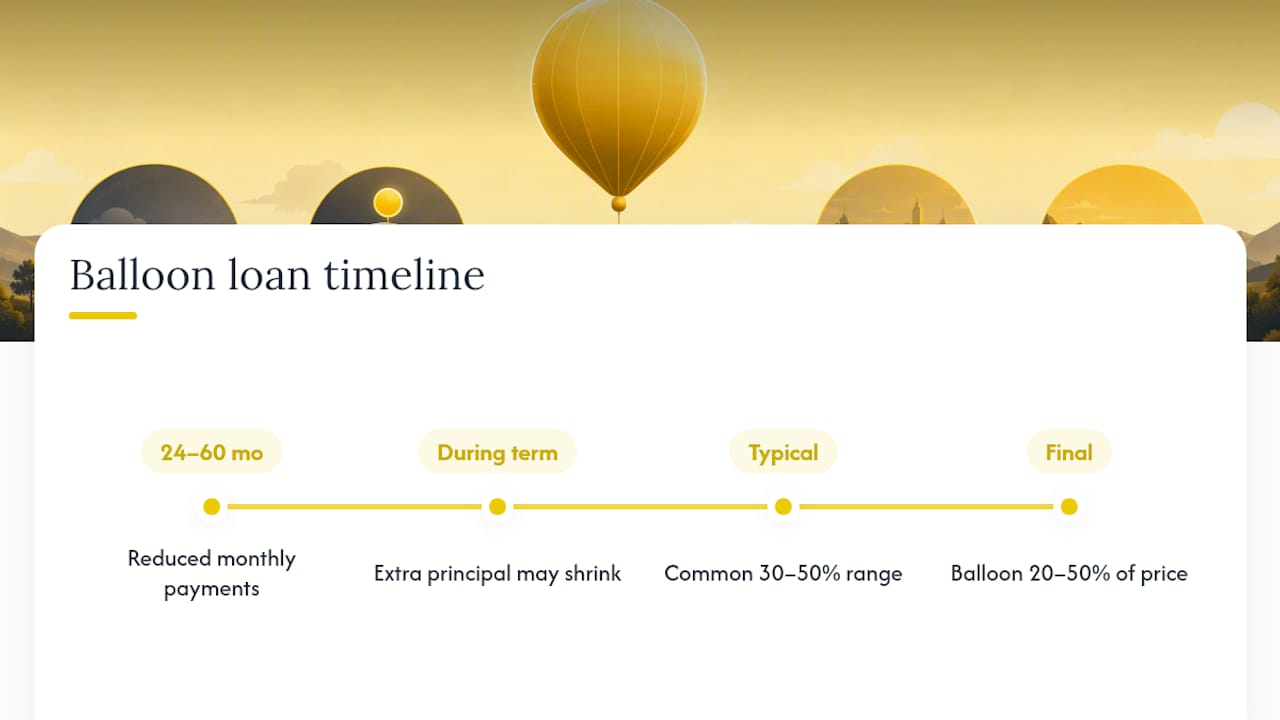
The monthly savings are obvious. The total cost usually is not lower, and often runs slightly higher because interest accrues on a bigger unpaid balance for longer. Extra principal payments can shrink that balloon, but only if your contract explicitly allows it, and only if the lender applies those payments correctly rather than just stretching out your term.
Pros and Cons of Balloon Auto Loans
The appeal of a balloon structure is straightforward: you get more car for less money each month. The catch shows up later, and it shows up big.
The upside:
- Monthly payments run 30% to 45% lower than a comparable traditional loan.
- You can afford a higher trim or newer model without stretching your monthly budget.
- Short-term cash flow improves, which matters for freelancers, seasonal workers, or business owners managing irregular income.
- Fleet operators and small businesses can rotate vehicles more often without tying up capital in full amortization.
The downside:
- Total interest paid over the life of the loan is often higher, not lower, since you’re financing a larger balance for longer.
- Depreciation can outpace your equity, leaving you owing more than the car is worth, a position commonly called being underwater or upside-down.
- Refinancing the balloon at maturity depends on your credit and the market rate at that time, neither of which you control today.
- Many contracts penalize excess mileage or wear and tear, shrinking your options if you planned to trade in rather than pay cash.
Pro Tip: Run the total cost comparison, not just the monthly payment, before signing anything. A lower payment that costs more overall is not a deal, it’s a delay.
Balloon Loans vs. Traditional Auto Loans vs. Leasing
Three financing paths lead to three very different endings. A traditional amortizing loan builds equity steadily and ends with you owning the car outright, no surprises. A lease behaves the opposite way: low payments, no ownership, and a fixed return date with mileage caps. A balloon loan sits in between, and which side it leans toward depends entirely on what you do at maturity.
- Traditional loan: Higher monthly payment, full ownership at the end, equity builds every month.
- Lease: Low monthly payment, no ownership, mileage and wear limits, you walk away or buy at a preset price.
- Balloon loan: Low monthly payment like a lease, but you own the car and owe a lump sum, functioning like a financed purchase with a lease’s cash flow.
If you plan to pay the balloon and keep the car, the loan behaves like a delayed traditional purchase. If you plan to trade or sell at maturity, it behaves more like a lease, minus the built-in mileage protections. A buyer who wants predictable ownership should lean traditional. A buyer who values flexibility and expects to swap vehicles regularly should compare balloon terms against an actual lease before committing to either.
Who Balloon Auto Loans Make Sense For
Balloon financing rewards a specific kind of buyer and punishes another. Knowing which one you are matters more than the interest rate.
Good fits:
- Short-term owners who plan to sell, trade, or refinance before the balloon hits.
- Buyers expecting a known cash inflow, a bonus, a business distribution, or a maturing investment, timed near the loan’s end.
- Business owners rotating fleet vehicles on a predictable schedule.
Poor fits:
- Anyone without meaningful savings or a realistic backup plan for the final payment.
- Buyers with variable or unpredictable income who can’t forecast their finances years out.
- High-mileage drivers, since most balloon contracts penalize wear that erodes the guaranteed future value.
Quick self-check: can you name, right now, exactly how you’ll cover the balloon? If the honest answer is “I’ll figure it out later,” this loan structure is not for you yet.
What Happens When the Balloon Comes Due
Maturity day forces a decision, and waiting until the last month to think about it is the single most common mistake balloon borrowers make. You have four realistic paths, and industry guides consistently point to the same four:
- Pay it in cash. Cleanest option if you planned for it. No new debt, no depreciation risk, loan closed.
- Refinance the balloon. Turns the lump sum into a new smaller loan, but your rate depends on your credit and market conditions at that moment, not today’s terms.
- Sell or trade the vehicle. Works if the car’s market value covers the balloon. If depreciation outpaced the guaranteed value, you’ll need cash to cover the gap.
- Voluntary surrender. A last resort that hands the car back to the lender, but it still shows up on your credit report and can leave you owing a deficiency balance.
Depreciation is the variable that decides which option is actually available to you. A car that held its value gives you real leverage to sell or trade; one that dropped fast can trap you between an expensive refinance and a costly surrender.
Pro Tip: Start checking your car’s market value and your refinance eligibility six months before the balloon date, not six weeks. That window gives you time to choose instead of scramble.
What to Ask Before You Sign a Balloon Contract
A few direct questions to your lender before signing change your risk exposure more than anything else in this article.
- Ask for the exact balloon amount in dollars, not just a percentage, and the formula used to set it.
- Confirm whether extra principal payments actually reduce the balloon, or just shorten the term. Lenders sometimes amend the balloon if you make consistent extra payments, but only if that’s in writing.
- Ask about mileage caps, condition penalties, and how they’re assessed at maturity.
- Request a written payoff example showing the balloon math at signing.
- Ask directly what your refinance options look like if your credit changes.
Walk away if the lender won’t put the balloon formula or prepayment terms in writing. A verbal promise means nothing when the payment is due.
FrenzyCars’ Rubric for Evaluating a Balloon Loan Offer
Ramón, a finance expert, uses a three-question filter before recommending anyone consider a balloon structure: What’s the resale risk on this specific model? Is there a guaranteed cash inflow lined up for the balloon date? And is there a realistic refinance path if plans change?
A buyer eyeing a vehicle with strong resale value and a bonus arriving right when the balloon matures clears all three. Someone financing a fast-depreciating model with no backup plan clears none. Before comparing loan offers, check how your target vehicle holds value using FrenzyCars’ car specs database, and review how your credit score affects refinance terms down the line.
Where to Verify the Rules Yourself
The CFPB’s balloon payment guidance explains which loan types allow balloon structures and what protections apply. FDIC consumer resources let you verify a lender’s standing before signing anything. Lender explainers like SoFi’s balloon loan breakdown offer additional worked examples worth comparing against your own contract.
Why Balloon Loans Get Sold as Affordability When They’re Really a Liquidity Bet
The conventional pitch for balloon auto loans treats the lower payment as the whole story. It isn’t. Industry analysts describe these loans more accurately as liquidity tools, useful when you know cash is coming, not when you simply want a cheaper payment today.
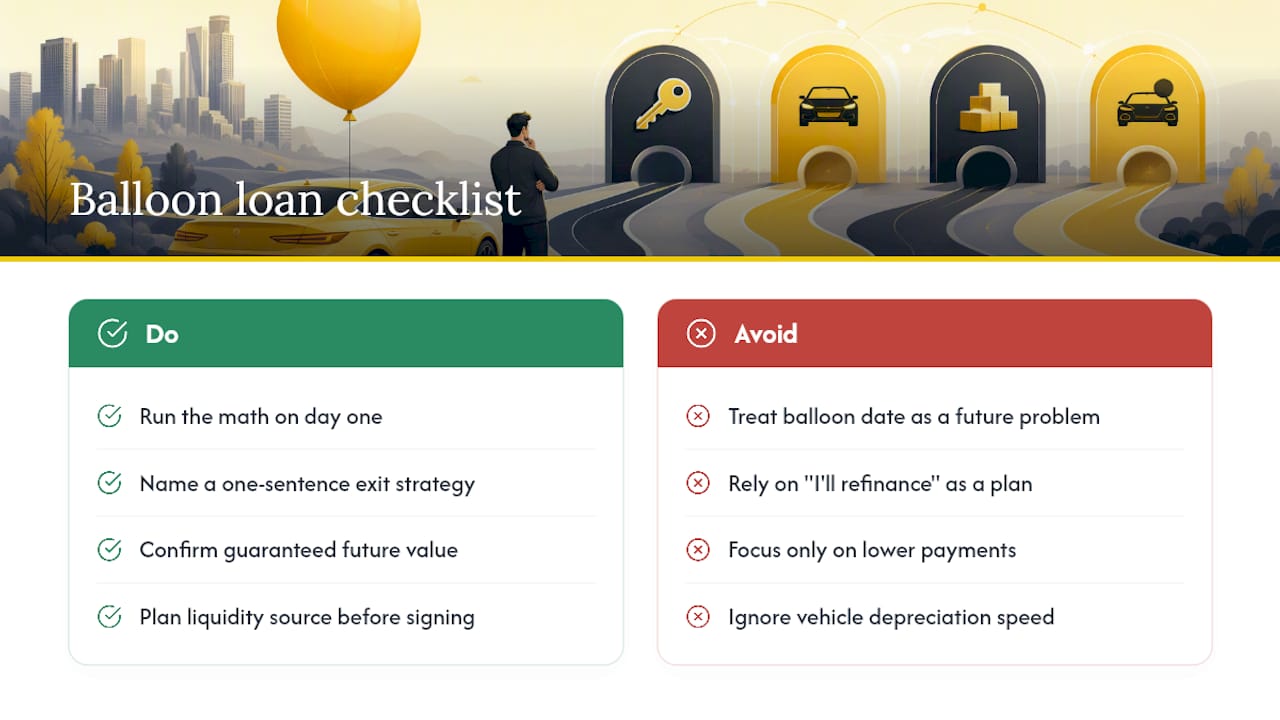
Where most advice falls short is treating the balloon date as a future problem instead of a present one. The math at signing already tells you most of what you need to know: the guaranteed future value, the interest spread versus a traditional loan, and whether your vehicle choice depreciates fast or slow. Run that math on day one, not month forty-seven.
If I had one priority to give a reader considering this structure, it’s this: don’t sign until you can name your exit strategy in one sentence. “I’ll refinance” is not a plan. “I’m selling my other property in March, and that covers the balloon with room to spare” is. The loan itself is neutral. Your certainty about the payoff is what makes it smart or reckless.
This article is general information, not a substitute for advice from a qualified financial advisor. Consult a qualified financial professional about your own circumstances before acting on anything here.
Sources
- What is a balloon payment? When is one allowed? — CFPB
- What is a balloon payment? — Capital One
- Auto Loan Balloon Payments: Risks & When to Avoid | CarSavr
- What to Know About Balloon Auto Loans and Why They’re Risky — Ouachita Valley FCU