
Dealer holdback is a hidden payment automakers send back to dealerships after a car sells, usually worth 1% to 3% of the sticker price. On a $40,000 vehicle, that’s roughly $400 to $1,200 the dealer collects weeks or months after your purchase. You can’t ask for a slice of it directly, but knowing it exists changes how you should negotiate: focus on the out-the-door price, not on guilt-tripping over “invoice.”
TL;DR:
- Most dealers routinely make a profit from dealer holdback, which typically amounts to 1% to 3% of the vehicle’s MSRP, often several hundred to over a thousand dollars.
- Invoice prices and dealer stickers rarely show the full financial benefit dealers receive, as incentives like holdback and manufacturer bonuses are usually hidden in the dealer invoice or not listed at all.
- Selling a vehicle at or near invoice price often still leaves the dealer profitable due to holdback and incentives, especially during end-of-month or model-year clearance periods.
- Negotiators should focus on the out-the-door price and verify the vehicle-specific invoice, rather than chasing discounts based solely on invoice or rebate claims.
- Understanding dealer incentives and timing the purchase around sales targets can provide leverage, but claiming holdback directly is generally not possible.
What Is Dealer Holdback and How Do Manufacturers Structure It?
Manufacturers created holdback decades ago to help dealers manage floor-plan financing costs, the interest dealers pay while a car sits on the lot waiting for a buyer. It functions as a built-in rebate, quietly returned to the dealer after the sale closes, rather than a discount passed to you at the counter.
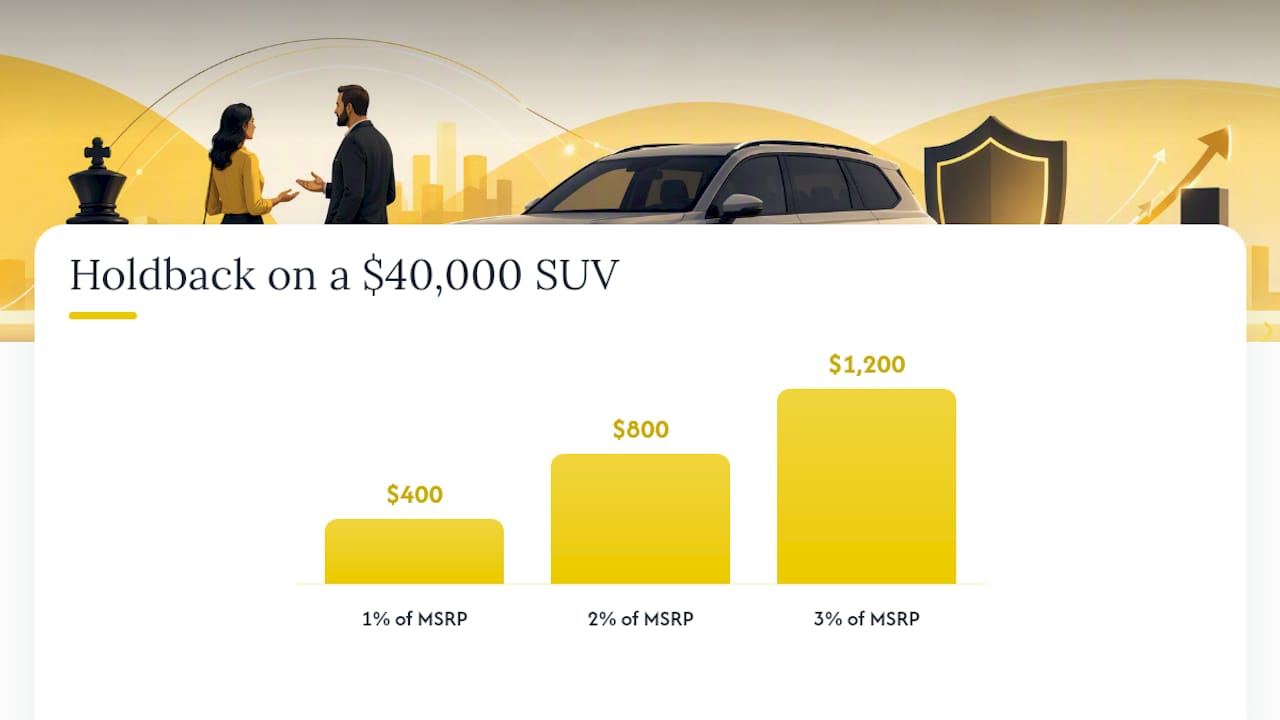
The math varies by automaker. Some calculate holdback as a percentage of the Manufacturer’s Suggested Retail Price (MSRP); others base it on invoice price; a smaller number use a flat dollar figure per vehicle. Most programs land in the 1% to 3% of MSRP range, which is why a $40,000 SUV might carry $400 to $1,200 in holdback money moving from automaker to dealer.
Not every brand plays this the same way:
- Mainstream domestic and Asian brands typically run standard holdback programs in that 1% to 3% band.
- A few luxury nameplates have scaled back or dropped traditional holdback structures over time, often for competitive positioning reasons.
- Policies shift periodically, so the same brand can handle holdback differently than it did a few model years back.
Where Holdback Hides: Invoice, Sticker, and Dealer Cash
The Monroney sticker glued to the window shows MSRP and factory options. It never mentions holdback, dealer cash, or volume bonuses. The dealer invoice, the document salespeople sometimes flash during negotiation, looks more official but still leaves out most of the money flowing back to the dealership.
Here’s how to read what you’re actually being shown:
- Identify the document type first. A generic price sheet is not the same as a vehicle-specific invoice tied to the exact VIN you’re buying.
- Check for a stock, commission, or order number. A real invoice for your specific car carries one; a printout without it may be a sales tool, not a fact sheet.
- Look for a line labeled “DH” or similar. Some invoices flag holdback directly; many don’t, since it’s calculated separately by the manufacturer.
- Assume dealer cash and stair-step bonuses aren’t listed at all. These manufacturer-to-dealer incentives, tied to sales volume or clearing aged inventory, rarely appear on any paper you’ll see.
Even a legitimate invoice, in other words, is not the full financial picture. It’s a starting point for negotiation, not the dealer’s real cost.
Why “Selling at Invoice” Doesn’t Mean the Dealer Lost Money
A dealer who sells you a car at invoice price is rarely breaking even, let alone losing money. Holdback alone often covers a meaningful chunk of overhead on that sale, and manufacturer incentives frequently stack on top of it.
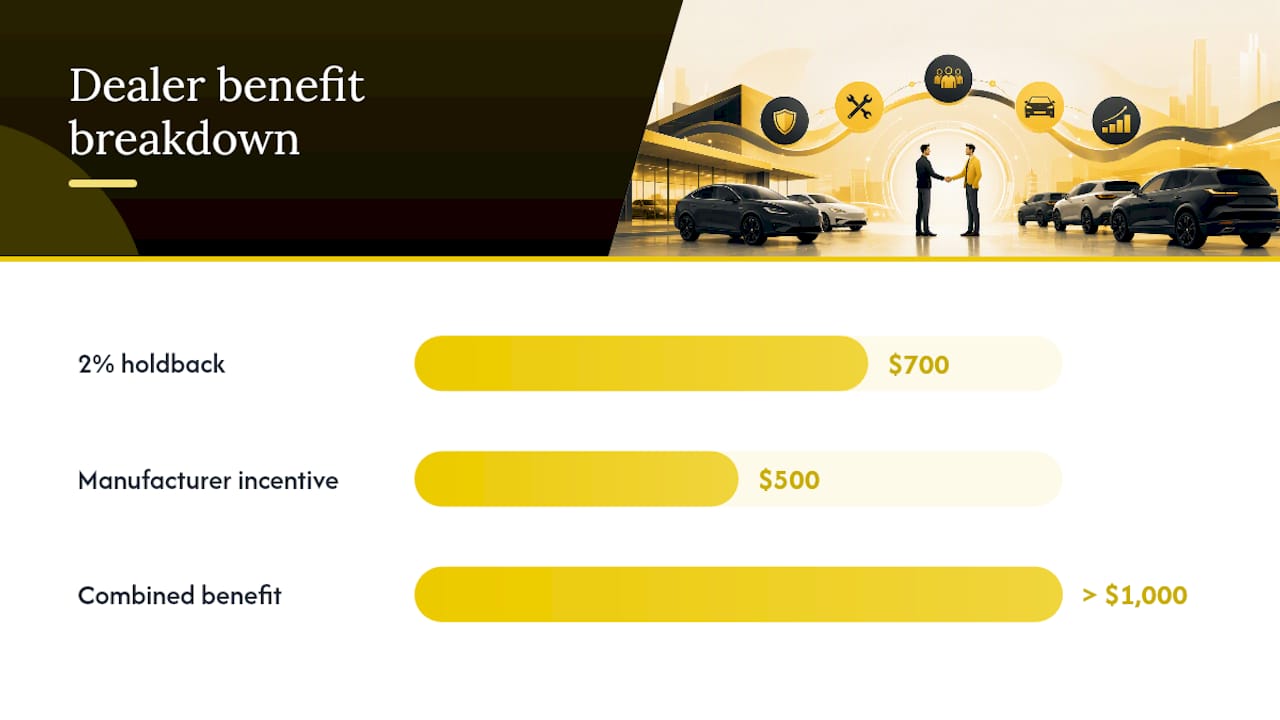
Consider a simplified example: a $35,000 vehicle with 2% holdback puts roughly $700 back in the dealer’s pocket after the sale. Add a $500 manufacturer incentive tied to monthly volume goals, and a deal that looks like a break-even invoice sale actually nets the dealer over $1,000. This is exactly what industry reporting confirms: holdback and incentives routinely make below-invoice deals profitable, not charitable.
Statistic to remember: holdback commonly runs 1% to 3% of MSRP, which on a typical mid-priced new vehicle translates to several hundred to over a thousand dollars in dealer profit that never shows up on any sticker or invoice you’ll see.
Certain conditions make below-invoice pricing more likely:
- End-of-month or end-of-quarter deadlines, when dealers chase volume targets tied to bonus tiers.
- Aged inventory sitting 60 or more days, which costs the dealer in floor-plan interest every extra day it’s unsold.
- Outgoing model years, when the automaker wants lots cleared before new inventory arrives.
Invoice price was never designed to represent the dealer’s true final cost. It’s a negotiating anchor, and a below-invoice deal can still leave real margin on the table for the dealership.
How to Negotiate Using What You Know About Holdback
You can’t demand holdback as a discount. What you can do is negotiate as if you know it exists, which shifts the entire conversation toward the number that actually matters: your out-the-door price.
- Ask for the out-the-door figure first, before discussing trade-ins or financing. This single number includes tax, title, fees, and any add-ons, and it’s the only figure worth comparing across dealers.
- Request the vehicle-specific invoice and check it against the VIN. Confirm it matches your exact car, not a generic model printout.
- Shop at least two or three dealers for the same trim and options. Price variation of several hundred dollars between dealers on identical vehicles is common, and it often reveals who’s chasing a volume bonus that period.
- Time your purchase near month-end or quarter-end. Sales quotas tied to stair-step incentives create real urgency on the dealer’s side during these windows, a pattern Consumer Reports points to when advising buyers to negotiate total price rather than argue line items.
- Watch for signs of manufacturer incentives already baked into the deal, like unusually aggressive pricing on a specific trim or a dealer pushing a particular color or configuration hard.
A workable script: “I’m not asking about your internal numbers. I want your best out-the-door price today, including everything, and I’m comparing it against two other dealers this week.” That framing sidesteps the invoice debate entirely and puts the focus where Consumer Reports and the FTC both recommend: the final price you actually pay.
Pro Tip: Bring a printed OTD quote from a competing dealer to your negotiation. Salespeople respond far faster to a number on paper than to a verbal claim about “another dealer down the street.”
Myths About Dealer Holdback, Debunked
Sales floors run on a few persistent myths. Here’s how to think through each one:
- “If you buy at invoice, we make nothing.” Holdback plus manufacturer incentives usually mean the dealer still profits, even at or below invoice.
- “Holdback belongs to the buyer.” It doesn’t. It’s a manufacturer-to-dealer payment; your leverage comes from negotiating OTD price, not claiming a line item you’re not entitled to.
- “A massive discount means the dealer is losing money.” Often it means the dealer is chasing a volume bonus or clearing aged inventory before a deadline.
- “Every brand handles holdback the same way.” Some luxury brands have reduced or eliminated it, and policies change, so don’t assume every invoice hides the same 1% to 3% cushion.
The Real Takeaway on Holdback
Holdback is one more reason to stop treating “invoice price” like a finish line. It’s a starting point that already assumes the dealer recovers money you’ll never see on paper. Your leverage is the out-the-door number, checked against a real invoice and at least one competing quote.
This approach saves money because it skips the emotional argument entirely, no guilt trips about the dealer “losing money,” no wasted time debating a rebate you can’t claim anyway. Automotive media publications cover pricing mechanics like this because understanding the dealer’s side of the math is what turns a nervous buyer into a confident one. For model-specific research before you walk into a showroom, our car specs by make and model hub is a solid place to start.
Sources
- FTC — Auto Marketplace (consumer guidance)
- Does selling a car at dealer invoice mean the dealer made no money? | Yahoo Autos