White, black, gray, and silver are the safest bets for broad resale appeal in the U.S. But if you want to maximize retained value, the data points somewhere unexpected: yellow, orange, and green consistently outperform the neutral pack. The catch is that vehicle type and local market demand can affect those rankings significantly.
Quick picks for resale-friendly colors:
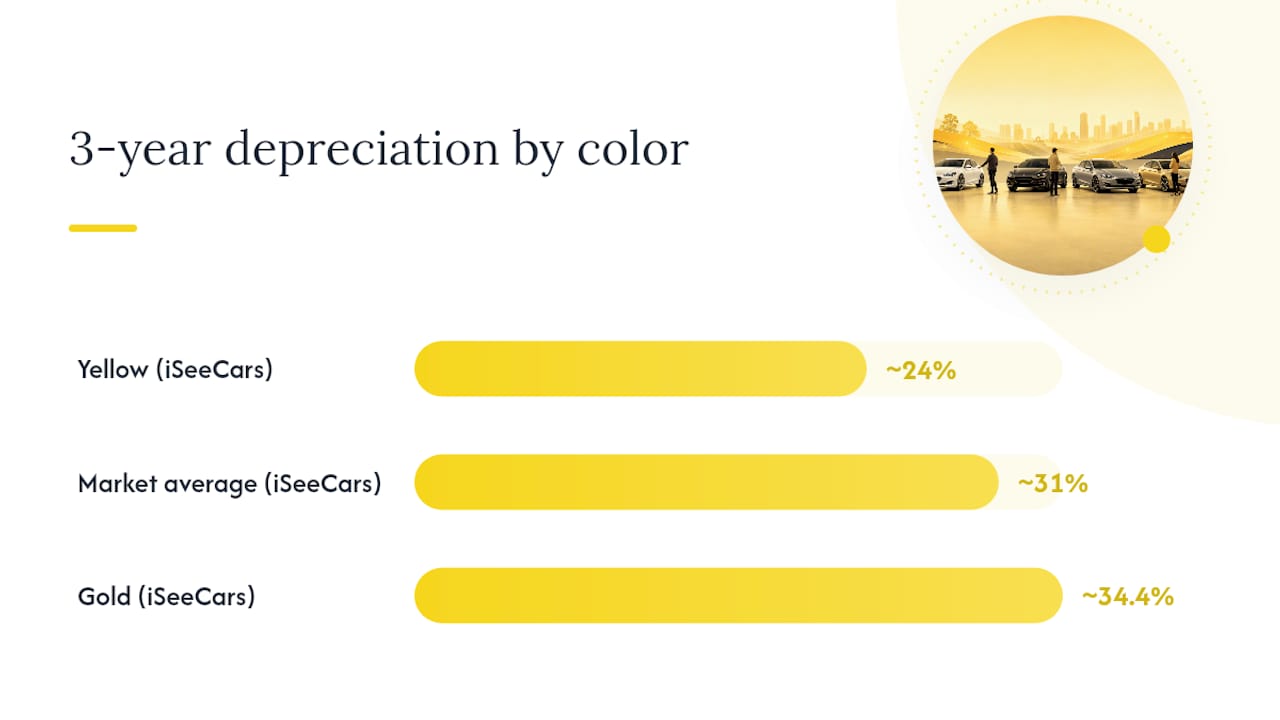
- Yellow, orange, green: Rare enough to command a scarcity premium; iSeeCars data shows yellow depreciates roughly 24% over three years versus a 31% market average.
- White, silver, gray: Safe, liquid, and easy to sell quickly — just don’t expect a premium.
- Brown, gold, purple: Generally the hardest to move and the most likely to sit on a lot.
One rule overrides all of this: a yellow sports car and a yellow minivan live in completely different resale universes.
Key Takeaways
Yellow, orange, and green consistently depreciate less than the market average, while gold and brown are the hardest colors to sell at a strong price.
| Point | Details |
|---|---|
| Bright rare colors outperform | Yellow averages ~24% depreciation vs. ~31% market average over three years, per iSeeCars. |
| Neutrals are safe, not optimal | White, black, gray, and silver sell quickly but rarely command a premium due to high supply. |
| Segment changes everything | Bright colors help sports cars and coupes; earthy tones work better on SUVs and trucks. |
| Gold and brown lose most | Gold depreciates ~34.4% over three years, the worst in the iSeeCars dataset. |
| Check local supply first | Run a regional search on used-car sites before committing — local inventory determines your actual leverage. |
How does car color affect resale value?
Color connects to resale price through three distinct mechanisms, and understanding them helps you choose car color for resale value rather than just guessing.
Supply and demand. Neutrals make up roughly 81% of top-selling colors in the U.S. That saturation means used-car buyers searching for a white sedan have dozens of options and no urgency to pay full price. A buyer hunting for a yellow sports car faces a much thinner supply, which shifts negotiating power toward the seller.
Buyer search behavior. When someone filters a used-car site by color, they’re already self-selecting as a motivated buyer. Rare colors attract a smaller but more committed pool, which tends to compress time-on-market and protect the asking price. Common colors attract more lookers but also more price comparisons.
Perceived condition. Color affects how a car looks on a lot, which directly influences what a buyer is willing to pay. A dark navy or black car shows every swirl mark and water spot; a silver or light gray hides surface imperfections far better. Buyers often unconsciously discount cars that look worn, even when the underlying condition is identical.
Pro Tip: If you’re buying a limited-edition trim or a niche model with a small buyer pool, color matters more than on a mainstream sedan. A rare color on a Porsche 911 or a Ford Bronco can add thousands; the same color on a mid-size family sedan mostly just narrows your buyer pool.
Which colors tend to hold their value best?
Bright, rare colors consistently outperform expectations in resale studies, while the usual neutrals offer safety without upside.
- Yellow: The top performer in iSeeCars’ analysis of over 1.2 million 3-year-old used cars, depreciating roughly 24% versus the 31% market average. That gap translates to several thousand dollars on a $35,000 vehicle.
- Orange: Closely follows yellow for the same reason: low production volume, steady demand from enthusiast buyers.
- Green: Muted or olive greens have gained traction on SUVs and trucks, where they read as outdoorsy rather than flashy.
- White: The most popular new-car color in the U.S. Resale is reliable and fast, though you won’t command a premium over comparable inventory.
- Silver and gray: Slightly less saturated than white and black, which gives them a modest edge in markets where white supply is heavy.
The numbers: Yellow’s ~24% three-year depreciation versus the ~31% market average represents a meaningful spread. On a vehicle originally priced at $40,000, that’s roughly $2,800 in additional retained value.
Kelley Blue Book frames neutrals as the “safe” choice for broad appeal, which is accurate. But safe and optimal aren’t the same thing. The rarity premium for bright colors is real, though it’s fragile: if a manufacturer suddenly floods the market with yellow inventory, or if the color becomes associated with a dated aesthetic, that premium evaporates. Yellow has held its advantage across multiple study cycles, which suggests it’s not a fad, but no color advantage is permanent.
What colors are hardest to sell?
Some colors consistently drag down resale prices, and a few of them are surprisingly common on dealer lots.
- Gold: The worst performer in the iSeeCars dataset, depreciating roughly 34.4% over three years. It reads as dated to most buyers and doesn’t align with any strong enthusiast segment.
- Brown: Low demand across almost every vehicle segment. It occasionally works on luxury SUVs where it reads as earthy and premium, but that’s a narrow exception.
- Purple: Small buyer pool and strong personal taste associations make it hard to price competitively.
- Overproduced neutrals (certain shades of beige/champagne): These combine the worst of both worlds — not rare enough to carry a premium, not popular enough to sell quickly.
Pro Tip: The combination of an unpopular color and an unpopular trim package is the fastest way to destroy resale value. A brown exterior paired with a beige cloth interior on a base trim is genuinely difficult to move. If you’re stuck with an unusual color, at least make sure the trim level and options are mainstream.
The exceptions are real but narrow. A brown or gold vehicle on a collector model, a special edition, or a vehicle with a matching interior package can still sell well to the right buyer. The problem is that “the right buyer” is a small pool, which means longer time-on-market and more price negotiation. If you have a long resale horizon and patience, that’s manageable. If you need to sell quickly, unusual colors on mainstream models are a liability.
Does vehicle type change which color you should choose?
Color impact is segment-specific, and the rankings that apply to sedans can reverse entirely on trucks, SUVs, or sports cars. Carscoops’ reporting on multi-year depreciation data makes this clear, bright colors perform best on coupes and convertibles, while subtler nonstandard shades work better on SUVs and trucks.
- Sports cars and coupes: Yellow, orange, and red carry genuine premiums. Buyers in this segment expect personality from the color.
- SUVs and trucks: Earthy greens, dark blues, and muted browns can outperform generic gray because they align with the outdoor/utility identity of the vehicle. Bright yellow on a full-size truck is a harder sell.
- Luxury sedans and SUVs: White, black, and deep navy dominate because buyers in this segment associate those colors with sophistication. An unusual color on a luxury vehicle can work if it’s a manufacturer-offered special shade, but aftermarket or uncommon factory colors tend to narrow the buyer pool.
- Minivans and family vehicles: Stick to white, silver, and gray. Practicality is the purchase driver, and buyers in this segment rarely pay a premium for color personality.
How to check local demand before you commit:
- Search your target model on AutoTrader or Cars.com filtered by your region and sort by days-on-market. Colors that sit longest are oversupplied locally.
- Check dealer new-car inventory in your area for the same model. If every lot has 15 white examples and two gray ones, gray has a local scarcity edge.
- Look at model and trim specs for your target vehicle to confirm which colors are available at which trim levels — some colors are locked to higher trims, which affects the resale comparison.
How does color affect maintenance and what buyers see?
The condition a car appears to be in at resale matters almost as much as its actual mechanical condition. Color plays a direct role in that perception.
- Black: Shows every scratch, swirl mark, and water spot. Requires the most upkeep to look presentable and typically costs more to recondition before sale.
- White: Hides surface scratches well but shows brake dust, mud, and bird droppings clearly. Relatively easy to keep looking clean with regular washing.
- Silver and light gray: The most forgiving colors for everyday wear. Minor scratches and swirl marks are nearly invisible, and the color doesn’t show dirt between washes.
- Red: Prone to fading in high-UV climates (Arizona, Florida, Texas). A faded red looks significantly older than its age, which affects buyer perception and pricing.
- Dark blue and dark green: Similar to black for showing surface imperfections, though slightly more forgiving.
Pro Tip: If you’re buying in a high-sun climate and plan to keep the car for five or more years, a quality ceramic coating applied early will protect any color from UV fade and reduce reconditioning costs at resale. It’s a few hundred dollars upfront versus a potential $1,000+ paint correction bill later.
One persistent myth worth killing: U.S. auto insurers do not set premiums based on vehicle color. Your rate is driven by your driving record, the vehicle’s make and model, your location, and your coverage choices. If you want to understand how coverage decisions interact with long-term ownership costs, the Frenzycars insurance guide covers that in detail.
Step-by-step checklist for picking a resale-friendly color
The right color is the one that matches your vehicle type, your local market, and your resale timeline. Here’s how to work through it before you sign anything.
- Set your resale horizon. Holding three years? Rarity-premium colors like yellow and orange have the best track record. Holding seven or more years? Neutrals are safer because color trends shift.
- Search local used-car listings. Run your target model on AutoTrader or Cars.com filtered to within 100 miles. Note which colors have the most listings and which have the fewest.
- Match color to trim level. Confirm the color you want is available on a mainstream trim. An unusual color locked to a base trim is a double resale problem.
- Check segment norms. Sports car? Bright colors work. SUV or truck? Earthy or muted nonstandard shades. Minivan? Neutral only.
- Estimate reconditioning costs. Dark colors cost more to detail and correct before resale. Factor that into your total cost of ownership.
- Consider a vinyl wrap. If you love a color that’s risky for resale, a quality wrap lets you enjoy it now and remove it before selling, revealing the factory color underneath.
- Document everything. Keep paint correction records, wash logs, and any ceramic coating receipts. Documented maintenance supports a higher asking price regardless of color.
Pro Tip: Two quick filters that take under five minutes: search your exact model and color on best used cars under $20k to see real market pricing by color, and check days-on-market on Cars.com to see which colors move fastest in your zip code.
FrenzyCars data snapshot: what the studies actually show
The core finding across major analyses is consistent: there’s a meaningful depreciation spread between the best and worst colors over a three-year period, and bright, rare colors tend to sit at the favorable end.
| Study / Source | Key Finding | Dataset |
|---|---|---|
| iSeeCars | Yellow depreciates ~24% vs. ~31% market average; gold worst at ~34.4% | 1.2M+ 3-year-old used cars |
| Forbes / Edmunds | White/black/gray/silver = ~81% of top-selling colors; bright colors under 1% each | Edmunds new-car color-share data |
| Kelley Blue Book | Neutrals are safe broad-appeal choices; popularity alone doesn’t guarantee resale premium | KBB used-car pricing analysis |
How to read these figures: The iSeeCars dataset is large enough to be statistically meaningful, but it averages across all segments and regions. Use the segment guidance above to apply these numbers to your specific vehicle type.
FrenzyCars editorial note: This guide was reviewed by Ramón, Frenzycars’ automotive editorial lead, who covers resale strategy, used-car market trends, and vehicle ownership costs.
What the data misses about color and resale
Most color-resale guides stop at the depreciation table and call it done. That’s the wrong place to stop.
The iSeeCars numbers are real and the rarity logic is sound, but the practical question isn’t “which color depreciates least on average?” It’s “which color gives me the best outcome on this vehicle in this market?” Those are different questions. A yellow Corvette in Miami is a fast sale at a premium. A yellow Corolla in rural Ohio is a slow sale at a discount. The average hides both outcomes.
There’s also a timing dimension most buyers ignore. The rarity premium for bright colors exists because manufacturers produce very few of them. If you’re buying a model year where yellow was a limited-production option, that scarcity is baked in. If the manufacturer decides to expand yellow availability next year, your resale advantage shrinks. Checking current production volumes for your target color isn’t something most buyers do, but it’s worth a five-minute call to a dealer.
Finally, personal satisfaction is a legitimate variable. Kelley Blue Book makes this point directly: if you’re going to own a car for five years, driving something you genuinely like matters. A color that costs you $1,500 at resale but makes every commute slightly better is a reasonable trade. Run the numbers, then make the call with your eyes open. For a full picture of how to maximize what you get back, the Frenzycars trade-in guide covers negotiation tactics that apply regardless of color.
Sources
- Iseecars
- What’s the Best Color for Car Resale? | Chase
- How hot hues and cold colors affect a car’s resale value, study says | Forbes
- Best Car Colors for 2025 - Kelley Blue Book