
Getting the trade in car best value means securing the highest realistic offer your vehicle can command after preparation, timing, and negotiation. Dealers calculate trade-in offers using Actual Cash Value (ACV), which runs 18–22% below private-party market prices. That gap is not a surprise tactic. It reflects dealer reconditioning costs and wholesale auction benchmarks. Knowing this number before you walk into any dealership is the single most powerful thing you can do. Kelley Blue Book remains the industry standard for benchmarking your vehicle’s worth before any conversation begins.
What factors determine trade in car best value?
Vehicle age, mileage, and condition drive the largest share of any trade-in appraisal. A car with 80,000 miles will always appraise lower than the same model at 45,000 miles, regardless of how clean it looks. Condition is the variable you can actually control before the appointment.
Make and model matter more than most owners realize. Average new vehicles retain about 44.7% of MSRP after 5 years, but top models like the 2026 Toyota Tacoma retain up to 63%. Choosing a high-retention model at purchase can mean $4,000 or more in additional equity at trade-in time. That is a financial decision made years before you ever visit a dealership.
Market conditions also shift trade-in values quarter to quarter. Used car demand rises and falls with new car inventory, interest rates, and seasonal buying patterns. Selling into a strong used car market can add hundreds to your offer without any extra effort on your part.
Documentation is the underrated factor. Service records, spare keys, and the original owner’s manual all signal responsible ownership to an appraiser. These items influence subjective appraisal decisions beyond what any inspection checklist captures.
Key factors that affect your appraisal include:
- Mileage: Every 10,000 miles above average reduces offer amounts noticeably.
- Condition: Dents, stains, and worn tires lower the appraiser’s confidence in resale potential.
- Make and model: High-demand vehicles with strong resale histories command better ACV offers.
- Market timing: Q1 and Q2 typically produce stronger used car values than late Q3 or Q4.
- Documentation: Complete service records and accessories add perceived and real value.
How to prepare your car to maximize trade-in offers
A clean, well-maintained vehicle signals lower risk and prompts better appraisal offers. Simple maintenance like topping off fluids, inflating tires, and vacuuming can increase appraisal results significantly. Major mechanical repairs, on the other hand, rarely yield a worthwhile return on investment at trade-in time. Spend your money and time where it shows.
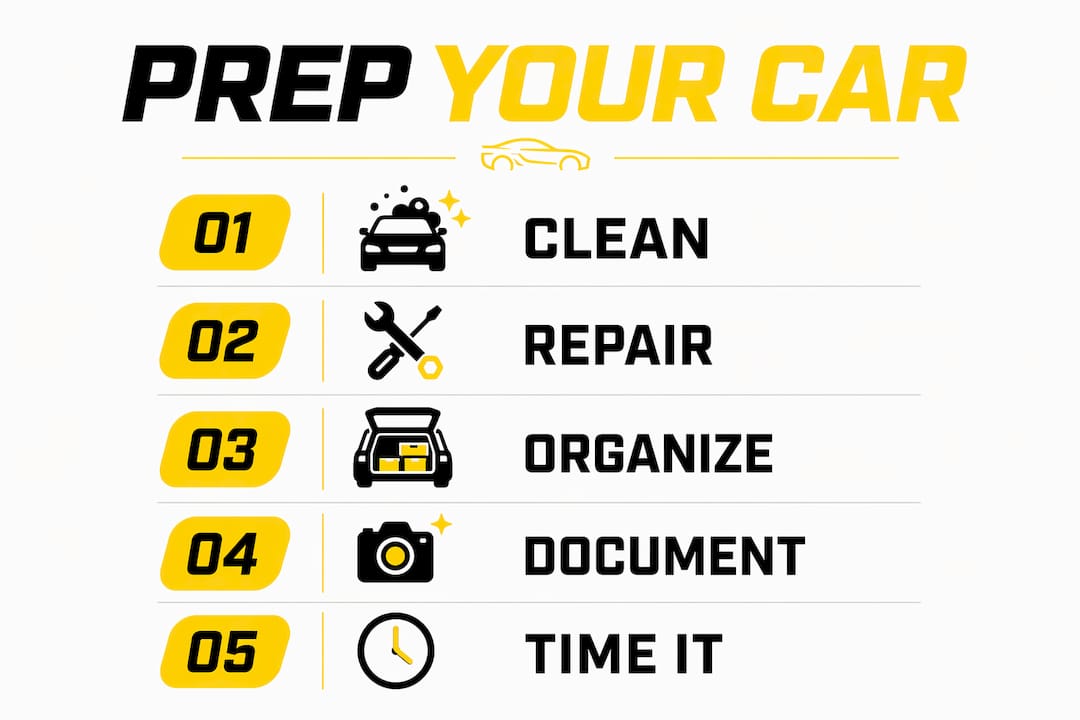
Cleaning and detailing
A professional detail costs $100–$200 and can shift an appraiser’s perception from “rough” to “well-kept.” Wash the exterior, clean the wheels, shampoo the carpets, and wipe down every interior surface. Remove all personal items. An appraiser who walks up to a clean car starts the mental valuation higher.
Minor repairs worth doing
Fix cracked windshields, replace burned-out bulbs, and touch up small paint chips. These repairs cost little but remove easy deductions from an appraiser’s checklist. Skip engine work or transmission repairs. The cost almost never comes back in a higher offer.
Documents and accessories
Organizing service records, spare keys, and the owner’s manual can add hundreds to your appraisal. Bring every receipt you have for oil changes, tire rotations, and brake work. These prove the car was cared for, which matters to an appraiser making a judgment call.
| Preparation step | Estimated cost | Potential value increase |
|---|---|---|
| Professional detail | $100–$200 | $200–$500 |
| Windshield chip repair | $50–$100 | $100–$300 |
| Tire inflation and fluid top-off | $0–$20 | $100–$200 |
| Gather service records | $0 | $200–$400 |
| Replace burned-out bulbs | $10–$30 | $50–$150 |
Pro Tip: Focus your prep budget on appearance and documentation first. Dealers price reconditioning into every offer, so a car that looks ready to sell cuts their assumed cost and raises your number.
When is the best time to trade in your car?
Q1 and Q2 are prime trade-in windows because used car values trend higher in the early months of the year. Tax refund season drives retail demand, and dealers need inventory to meet that demand. Trading in during january through june puts you on the right side of that cycle.
Mileage milestones create natural deadlines. Crossing 100,000 miles drops trade-in value sharply in most appraisal models. If your odometer is approaching a round number, trade before you hit it. The difference between 98,500 miles and 101,000 miles can be $1,000 or more on the same vehicle.
Positive equity is the most critical timing signal. The best time to trade is when your car’s book value exceeds your loan payoff amount. That positive equity becomes a down payment on your next vehicle, reducing your financing costs immediately. Trading while underwater on a loan forces you to roll negative equity into a new loan, which compounds over time.
Watch these timing signals before scheduling your appraisal:
- Your loan balance is below the vehicle’s current book value.
- Your mileage is approaching a major threshold (75,000 or 100,000 miles).
- The calendar is in Q1 or Q2, when used car demand peaks.
- New model year inventory is arriving, which can soften used car prices if you wait.
How do you negotiate the best trade-in price?
Separating the trade-in negotiation from the new car purchase is the single most effective tactic available to you. Negotiating trade-in separately prevents dealers from hiding costs by adjusting numbers across the deal. When both transactions are bundled, a dealer can give you $500 more on the trade while adding $500 to the new car price. You never see the shift.
Follow these steps to negotiate with confidence:
- Get your baseline value first. Use Kelley Blue Book’s trade-in tool to establish your vehicle’s fair range before any dealer visit.
- Collect written offers from multiple sources. Online buyers provide written quotes that function as floor prices in dealer negotiations.
- Present competing offers directly. Dealers often increase offers by $500–$2,000 to match or beat competing bids. A written offer from another buyer is your most powerful negotiating tool.
- Ask one direct question. “Is that your best offer?” forces the appraiser to either defend the number or improve it. Most buyers never ask.
- Set a floor and be ready to walk. Know the minimum you will accept before you arrive. If the dealer cannot meet it, leave. Another offer is always available.
Selling privately typically nets 15–25% more than a dealer trade-in. On a $20,000 vehicle, that gap runs $3,000–$5,000. Trade-ins win on convenience and sales tax benefits, but knowing the private-sale ceiling gives you a realistic upper limit for negotiations.
Pro Tip: Print or screenshot your online written offers and bring them to the dealership. A physical document on the desk changes the conversation. Dealers respond to proof, not claims.
Key Takeaways
Securing the highest trade-in value requires combining vehicle preparation, market timing, and disciplined negotiation before you set foot in a dealership.
| Point | Details |
|---|---|
| Know your ACV baseline | Dealer offers run 18–22% below private-party value; use Kelley Blue Book to set realistic expectations. |
| Prepare appearance first | Detailing and minor repairs cost under $300 and can return $500–$1,000 in appraisal value. |
| Trade in Q1 or Q2 | Used car demand peaks early in the year, producing stronger trade-in offers from dealers. |
| Separate the transactions | Negotiate your trade-in before discussing the new car purchase to prevent dealer profit-shifting. |
| Use written competing offers | A printed offer from another buyer forces dealers to match or beat the number. |
The trade-in trap most owners walk right into
I have watched car owners leave thousands of dollars on the table, and it almost always comes down to the same mistake: they bundle the trade-in with the new car deal before they have a firm number on either. Dealers are trained to work the monthly payment, not the individual line items. When you focus on “can I afford $450 a month,” you stop watching what happens to the trade-in value and the purchase price separately.
The second trap is emotional. Owners who love their car expect the appraiser to share that feeling. They do not. The appraiser sees a wholesale unit with reconditioning costs. Your job is to reduce those assumed costs through preparation and documentation, not to argue about sentimental value.
What actually works is treating the trade-in as a standalone financial transaction. Get three written offers before you visit a dealer. Know your payoff amount. Know your book value. Walk in with a floor price and the willingness to leave. I have seen that posture alone add $1,500 to an offer within minutes. Dealers respect buyers who know their numbers.
One detail most guides skip: the condition of your tires matters more than owners expect. Appraisers note tire tread depth immediately. Four tires with visible wear signal $600–$800 in reconditioning costs to a dealer. If your tires are borderline, replacing them before the appraisal can pay for itself. That is the kind of specific, experience-based calculation that separates a good trade-in outcome from a great one.
Frequently asked questions
What is the best way to find my car’s trade-in value?
Use Kelley Blue Book’s trade-in tool to get a baseline range, then collect written offers from multiple sources to establish a real-world floor price before visiting any dealer.
How much less is a dealer trade-in versus a private sale?
Dealer trade-in offers run 18–22% below private-party market value. On a $20,000 vehicle, that gap typically falls between $3,000 and $5,000.
When should I trade in my car for the highest value?
Trade during Q1 or Q2 when used car demand peaks, and always trade before crossing major mileage milestones like 75,000 or 100,000 miles.
Should I negotiate my trade-in separately from the new car purchase?
Yes. Separating the two transactions prevents dealers from shifting profit between line items, which protects the value you receive on your trade-in.
Does cleaning my car really affect the trade-in appraisal?
A clean, well-maintained vehicle signals lower reconditioning costs to the appraiser. Professional detailing and minor repairs can increase appraisal offers by $500 or more.