
Put down 20% on a new car and 10% on a used one if you can swing it. That’s the long-standing rule of thumb, and it still holds up mathematically, but it’s not what most buyers actually do. Edmunds data from the second quarter of 2026 shows the average new-car down payment sitting closer to 11.6% of the purchase price. The trade-off is simple: more cash down means smaller payments and less interest, but drain your savings to hit an arbitrary percentage and you’re one car repair away from real trouble.
TL;DR:
- Most buyers are financing larger portions of their cars than the traditional 10% or 20%, with new-car down payments averaging around 11.6%.
- Raising your down payment by $1,000 can lower your monthly payments by approximately $15 to $18 and improve your loan’s interest rate tier.
- Using trade-in equity, rebates, or gift funds can count toward your down payment, but negative equity rolls into the new loan if not carefully managed.
- For a $35,000 car, increasing from 10% to 20% down can save about $68 per month and roughly $600 in total interest over the loan term.
- Credit score influences how much you should put down, as stronger credit offers more flexible terms, while fair or poor credit may require a larger down payment to qualify or secure better rates.
How Much Should Your Car Loan Down Payment Be?
The 20%/10% split isn’t a random number pulled from a finance textbook. It’s a buffer against depreciation. A new car typically loses about 20% of its value in the first year, which means a buyer who finances the full sticker price is underwater the moment they drive off the lot. Put 20% down, and your loan balance roughly tracks the car’s actual worth instead of racing ahead of it.
Used cars depreciate more slowly in that first year, so the 10% benchmark works as a reasonable floor rather than a hard rule.
Reality looks different. Edmunds put the average new-vehicle down payment at $5,815, or 11.6% of purchase price, in Q2 2026, while the average amount financed climbed to $44,156 at roughly a 7.0% APR. Buyers are choosing to keep more cash in hand and finance more of the car, a trend that shows up alongside longer loan terms across the industry.
Here’s what those percentages look like in real dollars:
| Vehicle Price | 10% Down | 20% Down |
|---|---|---|
| $30,000 | $3,000 | $6,000 |
| $40,000 | $4,000 | $8,000 |
| $50,000 | $5,000 | $10,000 |
- A $30,000 car needs $3,000 to $6,000 down depending on which rule you follow.
- A $40,000 car pushes that range to $4,000 to $8,000.
- A $50,000 car requires $5,000 to $10,000, a gap wide enough to change your monthly payment by well over $100.
How Your Down Payment Changes Your Monthly Payment and Approval Odds
A bigger down payment shrinks the loan principal, and that shrinks two things at once: what you owe every month and what you pay in interest over the life of the loan. The math compounds. A smaller loan means less interest accrues even before you factor in any rate difference.
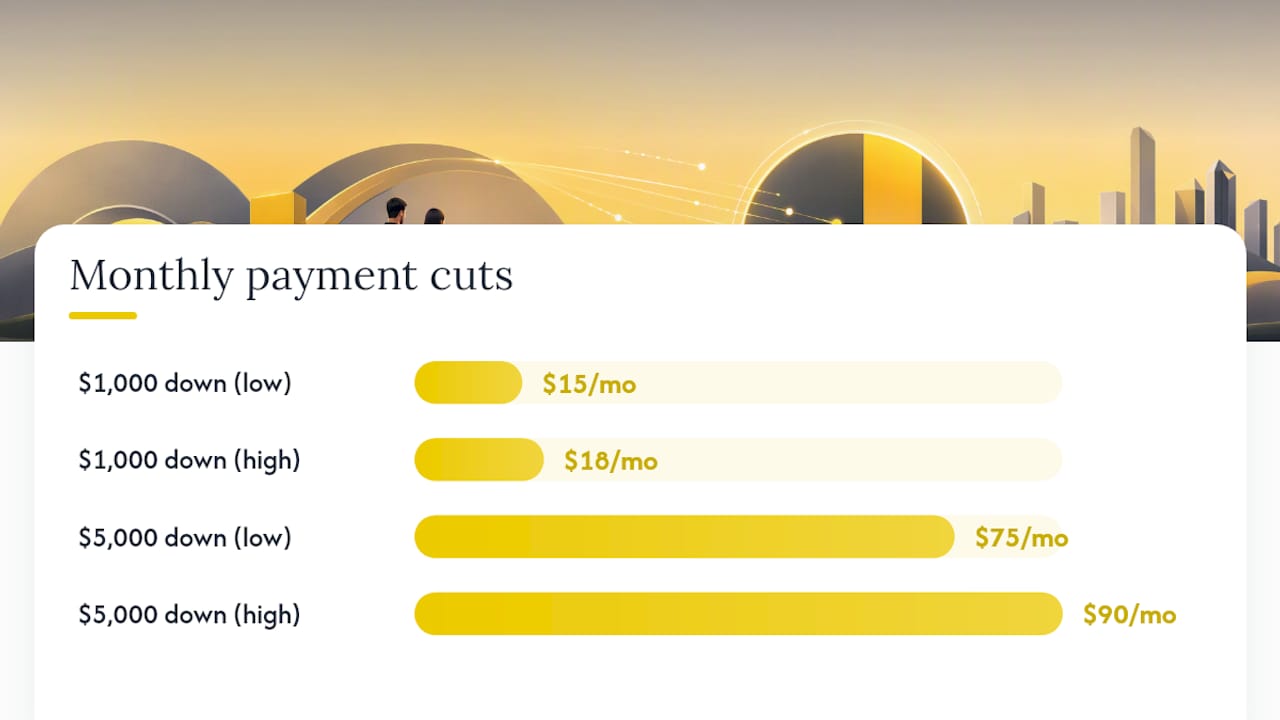
The CFPB puts a rough number on it: every $1,000 you add to your down payment can lower your monthly payment by about $15 to $18, depending on your rate and term. Put another $5,000 down and you might shave $75 to $90 off your monthly bill, with the exact number moving depending on your APR and loan length.
There’s a second lever most buyers miss: loan-to-value ratio, or LTV. This is the loan amount divided by the car’s value. Lenders use LTV to price risk, and a lower LTV, the kind a larger down payment produces, often qualifies you for a better rate tier. This matters most for borrowers with average or below-average credit, where a bigger down payment can be the difference between an approval and a denial, or between a subprime rate and a merely mediocre one.
Every $1,000 down can cut your monthly payment by $15 to $18 — and a lower loan-to-value ratio can move you into a better rate tier, especially with weaker credit.
- Lower principal means lower monthly payments and less total interest.
- Lower LTV can unlock better rate tiers, particularly for subprime and near-prime borrowers.
- The savings scale with your loan term. Longer terms magnify the interest difference between 10% and 20% down.
What Actually Counts as a Down Payment
Cash is the obvious answer, but it’s not the only one. Trade-in equity, manufacturer rebates, and sometimes gifted funds all count toward your down payment total. A dealer will typically apply your trade-in’s value directly against the new car’s price, functioning exactly like cash at the negotiating table.
The catch is negative equity. If you owe more on your trade-in than it’s worth, that difference usually rolls into your new loan rather than disappearing. That raises your financed amount and your LTV at the exact moment you were trying to lower both. If you’re rolling in negative equity, running the actual trade-in math before you sign anything saves you from a nasty surprise on your new loan’s balance.
- Cash from savings or a bonus
- Trade-in equity (positive only. Negative equity adds to your loan)
- Manufacturer rebates and incentives
- Gift funds from family, where the lender allows it
Pro Tip: Never fully drain your emergency fund to hit a down payment target. A car loan you can service comfortably beats a bigger down payment that leaves you with no cushion for a $600 repair bill.
When a Zero-Down or Low-Down Deal Actually Makes Sense
When financing costs nothing, the usual math around interest savings doesn’t apply the same way, and keeping your cash liquid can be the smarter move.
Outside that narrow case, low-down and zero-down deals cost more over time. You’re financing a bigger balance, your monthly payment runs higher, and you’re more likely to owe more than the car is worth for the first year or two of ownership.
If a low down payment is your only realistic option right now, a few moves limit the damage:
- Choose the shortest loan term your budget can handle. It limits how long you’re exposed to negative equity.
- Add gap insurance, which covers the difference between what you owe and what the car is worth if it’s totaled or stolen.
- Consider a cosigner with stronger credit to improve your rate, which softens the cost of financing more.
- Look at a less expensive vehicle so the dollar gap between loan and value stays smaller from day one.
How to Pick the Right Down Payment for Your Budget
Skip the percentage debate for a second and work the problem from your own numbers outward.
Step 2: Run real scenarios, not guesses. Plug your actual expected APR and loan term into a down payment calculator for auto loans and compare monthly payments and total interest across a few down payment amounts.
Step 3: Land on a number that keeps you flexible. You want enough equity that you’re not deeply upside-down if you need to sell or trade in within two years, but not so much cash tied up that you can’t handle a surprise expense.
- Confirm your emergency fund can survive the purchase before locking in any number.
- Compare at least two or three down payment scenarios side by side.
- Weight your decision toward flexibility, not just the lowest possible payment.
If You Can’t Hit the Recommended Down Payment
Coming up short on cash doesn’t mean you’re stuck with a bad deal, it means you have a few different paths worth weighing.
Leasing sidesteps the down payment problem almost entirely, since most leases require little or no money down. The trade-off is you build no equity and face mileage limits and a payment that never ends unless you buy the car at lease-end. Buying with a small down payment gets you an asset, eventually, but costs more in interest along the way.
A cosigner with strong credit can unlock a better rate even when your own down payment is thin, which offsets some of the extra interest you’d otherwise pay. The risk sits entirely on the cosigner’s credit report if you miss payments, so it’s not a decision to make casually.
- Leasing: low upfront cost, no equity built, mileage restrictions apply.
- Cosigner: better rate access, but real credit risk for the other person.
- Refinance later: if rates drop or your credit improves, refinancing can lower your payment down the road even after starting with a small down payment.
What 10% vs. 20% Down Actually Costs on a $35,000 Car
Numbers make this concrete faster than percentages do. On a $35,000 car at a 6.5% APR over 60 months, moving from 10% down to 20% down saves roughly $68 a month and about $600 in total interest over the life of the loan.
| Down Payment | Amount Financed | Approx. Monthly Payment | Approx. Total Interest |
|---|---|---|---|
| 10% ($3,500) | $31,500 | Higher | Higher (by ~$600) |
| 20% ($7,000) | $28,000 | ~$68 less/month | Lower |
Stretch that same loan to 72 or 84 months and the interest gap widens further, since you’re paying finance charges over a longer stretch and carrying negative equity risk longer too. Run your own numbers with a down payment calculator for auto loans before you commit to a term, since the loan length matters almost as much as the down payment itself.
Does Your Credit Score Change How Much You Need to Put Down?
Credit score doesn’t set a hard down payment minimum the way some buyers assume, but it shapes how much a down payment matters. Borrowers with strong credit can sometimes qualify for competitive rates with little money down, because the lender is already taking on less risk through the interest rate itself.
Borrowers with fair or poor credit face a different equation. A lender looking at a thin or damaged credit file leans harder on LTV as a risk signal, since a lower loan balance relative to the car’s value offsets some of the credit risk on paper.
This is where the interaction between credit and down payment gets underrated. Two buyers with identical credit scores can walk away with different APRs purely based on how much cash they brought to the deal. A deeper look at how credit scores shape car financing breaks down exactly where the rate tiers tend to shift.
The practical takeaway: if your credit sits in the fair range, treat your down payment as leverage. It’s one of the few variables you control directly, unlike your credit history, which takes months or years to move.
How to Actually Save for a Down Payment
Most people don’t fail to save because they lack discipline. They fail because the goal is vague. “Save for a car” doesn’t work the way “save $4,000 by October” does.
Start with the number, not the habit. That gives you a concrete monthly target instead of a vague intention.
Automating a transfer into a separate savings account on payday removes the temptation to skip a month. A dedicated account also keeps the money mentally separate from your regular checking balance, so you’re less likely to dip into it for something unrelated.
Selling a current vehicle, cutting one recurring subscription, or redirecting a tax refund are the fastest ways to close a down payment gap without stretching your timeline. None of these require a spreadsheet obsession, just a clear target and a place to put the money where it’s not easy to touch.
Banks vs. Credit Unions vs. Dealership Financing: Down Payment Expectations
Not every lender treats down payments the same way, and the differences show up before you even sign anything.
Credit unions often show more flexibility on both down payment size and rate, especially for members with an established account history, since they’re generally working with a smaller risk pool they know better.
Dealership financing, arranged through the dealer’s network of lenders, is where you’ll see the widest range. Dealers can offer zero-down promotions tied to manufacturer incentives, but they can also push higher down payments on buyers with weaker credit to make a deal work on paper. The rate you’re quoted at a dealership is frequently negotiable in ways a bank’s posted rate isn’t, which cuts both ways depending on how prepared you walk in.
Getting quotes from more than one type of lender before you’re standing at the dealership finance desk gives you a real comparison point instead of taking whatever number shows up on the paperwork.
How Down Payment Size Shifts Rates and Approval by Borrower Type
The relationship between down payment, interest rate, and approval odds isn’t the same for every borrower, it bends based on where you already stand.
A borrower with excellent credit and stable income has the most flexibility. A smaller down payment barely moves their rate, because the lender’s risk assessment is already anchored by the credit file. For this borrower, the down payment decision is mostly about monthly cash flow preference, not approval risk.
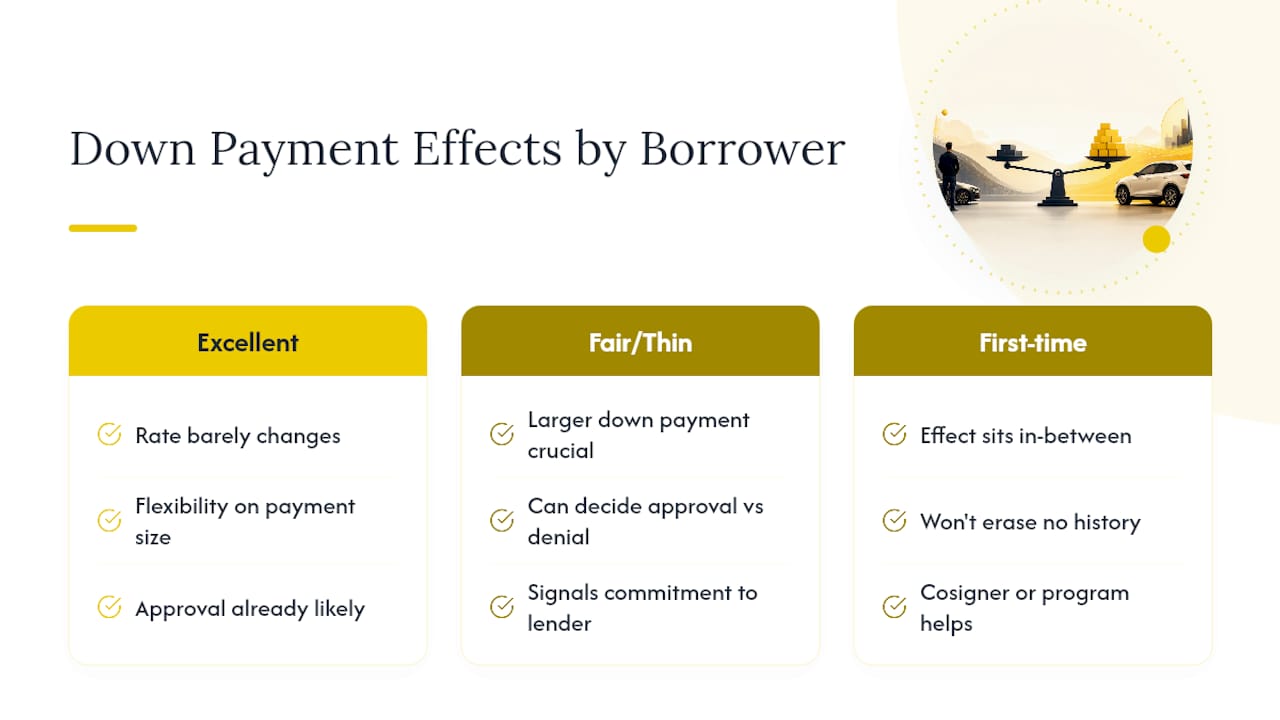
A borrower with fair or thin credit sits in the opposite position. Here, a larger down payment can be the deciding factor between approval and denial, or between a workable rate and one that makes the loan barely affordable. Lenders read a substantial down payment as a signal of commitment and reduced exposure, which can offset a mediocre credit file more than most buyers realize.
First-time buyers with no credit history often fall somewhere in between. A down payment won’t erase the lack of credit history, but combined with a cosigner or a structured first-time buyer loan program, it narrows the gap enough to get workable terms instead of a predatory rate.
Are There Tax Benefits Tied to a Car Loan Down Payment?
For most personal car purchases, no. A down payment on a personal vehicle doesn’t generate a tax deduction or credit on its own, regardless of size. The IRS doesn’t treat the down payment amount as a deductible expense for personal-use vehicles.
Where taxes do enter the picture is on the vehicle side, not the down payment side. Some electric vehicle purchases qualify for federal tax credits depending on the model, price cap, and buyer income, and those credits can effectively function like a larger down payment by reducing what you owe after the fact. If you’re cross-shopping EVs, checking current EV pricing and incentive eligibility before you finalize a down payment amount can change your math entirely.
Business use is the other exception. If a vehicle is used for business purposes, there are depreciation and expense rules that can apply to the vehicle’s cost, but those rules involve the vehicle’s use and classification, not the down payment amount itself, and they require careful documentation to claim properly.
Why the “Just Put 20% Down” Advice Misses the Real Decision
It was built to solve one specific risk: depreciation outpacing your loan balance. It was never built to account for someone’s actual cash position, job stability, or how close they are to their next emergency expense.
What gets underestimated is how much the loan term matters relative to the down payment. Down payment and term aren’t separate decisions. They’re the same decision made twice.
If you’re weighing your options, the two most useful next steps are understanding how your credit score actually moves your rate and getting preapproved before you set foot on a lot. Whatever number you land on, run it against your real budget, not the guideline, and keep your emergency fund intact.
Research Your Next Car Before You Commit to a Payment
Choosing the right down payment only works if you’re also choosing the right car for your budget. Frenzycars’ Car Specs hub lets you compare pricing across makes and models before you ever talk to a lender, so you know whether a $30,000 or $40,000 target actually fits what you’re shopping for. Pair that with the Best Cars by Category lists if a lower-priced model would let you hit 20% down without touching your savings. Once you’ve settled on a price range, walk through the preapproval process so you’re negotiating with real numbers instead of a dealer’s estimate. Start with the specs, then get preapproved before you set foot on a lot.
This article is general information, not a substitute for advice from a qualified financial advisor. Consult a qualified financial professional about your own circumstances before acting on anything here.
Sources
- How does a down payment affect my auto loan? — CFPB
- Nearly 1 in 4 New-Vehicle Buyers in Q2 Stretched Loans to 84 Months or Longer, a Record, According to Edmunds
- How much should a car down payment be — Santander Consumer USA
- How much down payment is needed for a car? — Investopedia