
The federal used EV tax credit is gone for 2026 purchases. It expired for any vehicle acquired after September 30, 2025, so buyers shopping now can’t claim a used EV tax credit in 2026 no matter what a dealer’s sticker says. The only exception: if you bought a qualifying used EV on or before that date, you may still be able to claim it on the return you file this year. Check your paperwork and Form 8936 before assuming otherwise.
TL;DR:
- The used EV tax credit expired for any vehicle purchased after September 30, 2025, so buyers in 2026 cannot claim it regardless of dealer claims.
- Only used EVs bought on or before the deadline are eligible for the old credit, which required dealer reporting, specific vehicle age, and income limits.
- To claim the credit, buyers must submit Form 8936 with proper dealer documentation, VIN accuracy, and correct sale details on their tax return.
- Although the federal used EV credit is gone, incentives for home chargers and state utility rebates remain available and often easier to claim.
- The used EV market in 2026 will be driven more by supply factors like lease-offs and vehicle condition than by tax credits, emphasizing the importance of battery health and warranties.
Who Still Qualifies for the Used EV Tax Credit Before the Cutoff
If your purchase closed on or before September 30, 2025, you’re working with the old rules, not a 2026 program. The Previously Owned Clean Vehicle Credit under IRC Section 25E never applied to just any used EV, and the eligibility tests were specific:
- The vehicle had to be at least two model years older than the year you bought it, purchased from a licensed dealer, never a private-party sale.
- Sale price couldn’t exceed the federally specified maximum limit established for eligibility.
- The dealer had to report the sale to the IRS with the VIN attached.
- Your modified adjusted gross income had to stay under the applicable limits for your filing status as set by tax regulations.
- You could only claim this credit once every three years.
The credit itself was capped at the lesser of a fixed dollar amount or a percentage of the sale price, and it was nonrefundable. That last detail tripped up plenty of buyers. If your tax liability was smaller than the credit, you didn’t get the difference back as a refund. That mattered even more for buyers who took the credit as an upfront discount instead of waiting to file.
How Do You Claim the Credit on Your Return?
For a qualifying pre-deadline purchase, the paperwork runs through Form 8936 and its accompanying Schedule A. Here’s the sequence:
- Confirm you have the dealer’s seller report, the document listing VIN, battery capacity, sale date, and sale price.
- Complete Schedule A (Form 8936) to calculate the credit based on sale price and vehicle eligibility.
- Transfer that figure to the main Form 8936 and attach both to your return.
- Enter the VIN exactly as it appears on your title and the dealer report. A typo here is the single most common cause of a rejected e-file.
Most consumer tax software walks you through Form 8936 if you answer the EV purchase questions correctly during intake, but the software won’t catch a missing or inaccurate dealer report on its own.
Pro Tip: If your used EV purchase happened in the final weeks before September 30, 2025, call the dealer’s finance office now and confirm they actually filed the seller report with the IRS. Some smaller, independent lots were slow to submit these, and a missing report can sink your claim even if everything else checks out.
What Happens if the Dealer Already Took the Credit?
Buyers who took the credit as an instant discount at the point of sale, rather than waiting to file, dealt with a transfer arrangement instead of a straight tax claim. That’s a meaningfully different process, and it comes with its own failure points.
- If you transferred the credit to the dealer, your tax return still needs Form 8936 attached to reconcile that transfer, even though you already got the money upfront.
- The VIN and sale price on your return must match what the dealer reported to the IRS. A mismatch, even a minor one, tends to trigger an IRS notice requesting clarification.
- Because the credit is nonrefundable, some buyers with limited tax liability discovered at filing time that they owed money back after taking the full discount at the dealer.
If your dealer’s numbers don’t match yours, contact their finance department first, keep copies of everything, and be ready to amend if the mismatch can’t be resolved before the filing deadline.
What Incentives Are Still Available for EV Buyers in 2026?
The federal used EV tax credit is dead, but it’s not the only lever left on the table. A handful of programs still put real money back in an EV owner’s pocket in 2026.
- The federal residential charging equipment credit under Section 30C can still apply to qualifying home charger installations, depending on when the equipment goes into service.
- State and utility incentives vary widely. The Alternative Fuels Data Center’s incentive database lets you search by state for rebates, tax exemptions, and reduced registration fees tied to EV ownership.
- Utility companies in many states still offer rebates for installing a home charger or shifting charging to off-peak hours, and those programs often move faster than a federal tax credit ever did.
- Some state programs stack with local utility rebates, something the expired federal credit never allowed.
These are often simpler to claim than the old federal credit ever was. No dealer paperwork, no VIN matching, no nonrefundable-credit math.
How the Credit’s Expiration Is Changing Used EV Prices
Expect the used EV market in 2026 to be shaped more by supply than by tax policy. A wave of EVs leased between 2023 and 2025 is rolling off those leases now, pushing more inventory onto dealer lots at the same time the federal purchase incentive disappeared. That combination tends to put downward pressure on prices, particularly for mainstream models without strong resale demand.
With the tax credit off the table, the things worth paying attention to are the fundamentals:
- Battery health and remaining range, since that’s the single biggest driver of long-term value on any EV.
- Manufacturer battery warranty coverage, typically eight years or 100,000 miles, and how much of it is left.
- Certified pre-owned programs, which often include extended coverage that offsets the loss of the federal discount.
- Days on lot. A vehicle sitting for months is more room to negotiate than any expired credit ever gave you.
Pre-Purchase Checklist for Used EV Buyers
Before you sign anything, work through this list at the dealership.
- Ask for the seller’s report and confirm it lists the correct VIN, battery capacity, sale date, and price.
- Verify the delivery date on your paperwork. Anything after September 30, 2025 has zero federal credit eligibility, period.
- Run a battery health check or request the vehicle’s state-of-health reading if the dealer has diagnostic access.
- Confirm the remaining manufacturer warranty in writing, not verbally.
- Check charging compatibility with your home setup or nearby public network.
- Walk away from any dealer still advertising a “$4,000 federal tax credit” on a 2026 purchase. That’s an expired program, and citing it is a red flag about how the rest of the deal will be handled.
Pro Tip: Screenshot any advertisement claiming a federal used EV tax credit before you visit the lot. If a salesperson tries to build one into the negotiated price, you’ll have proof of the original claim if you need to dispute the final numbers.
FrenzyCars Perspective: Buy on Fundamentals, Not a Tax Credit That No Longer Exists
The federal used EV tax credit ended for 2026 buyers, and no amount of dealer optimism changes that. What actually protects your wallet now is the stuff that always mattered more anyway: battery health, warranty coverage, and knowing what a fair price looks like for the specific model in front of you. That’s where FrenzyCars’ battery lifespan research and model-specific guides earn their keep, especially for buyers trying to separate a genuinely good used EV from one riding on an outdated incentive story.
Skip the Guesswork: Compare Used EVs Directly on FrenzyCars
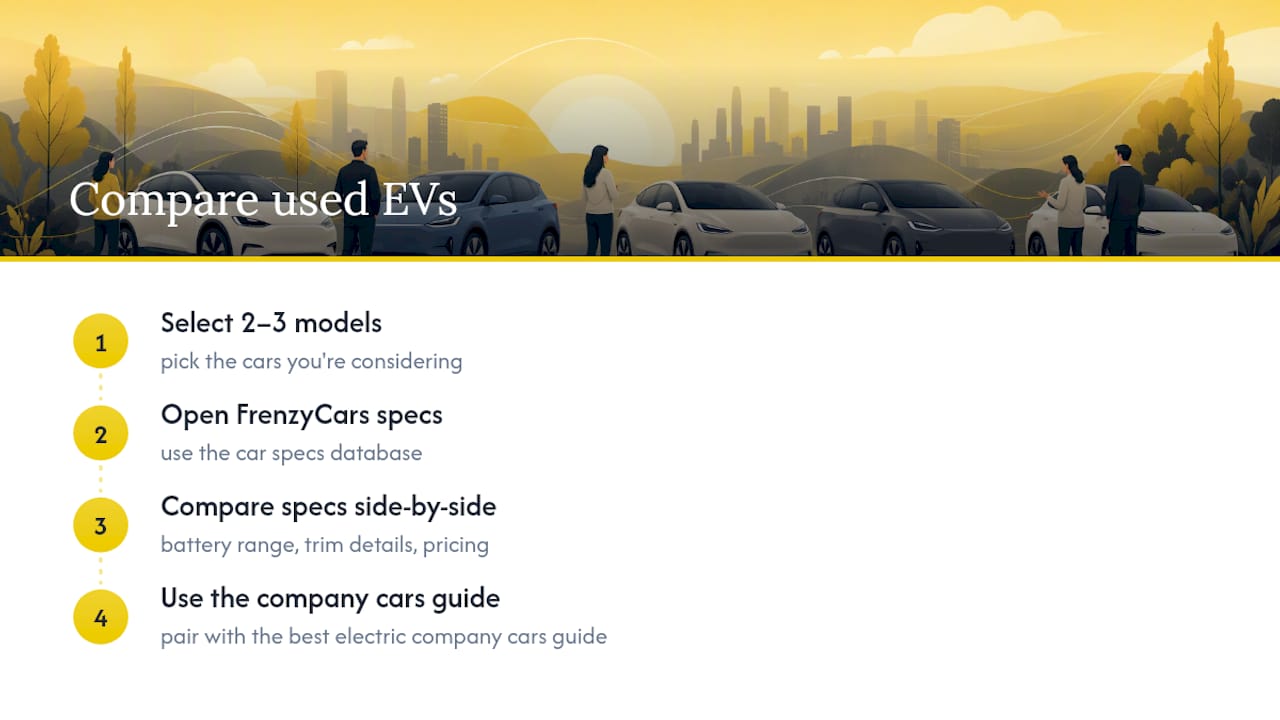
With the federal credit gone, the smartest move isn’t chasing a rebate that no longer exists. It’s picking the right EV for the money you’re actually spending. FrenzyCars’ car specs database lets you compare battery range, trim details, and pricing across models side by side, so you’re evaluating the vehicle instead of a tax incentive that expired months ago. Pair that with the best electric company cars guide if you’re weighing options built specifically for the post-credit market. Start by pulling up two or three models you’re considering on the specs database and comparing real range figures before you ever set foot on a lot.
This article is general information, not a substitute for advice from a qualified financial advisor. Consult a qualified financial professional about your own circumstances before acting on anything here.
Sources
- Alternative Fuels Data Center: Federal laws and incentives (AFDC)
- IRS: Used clean vehicle credit
- 26 USC 25E: Previously‑owned clean vehicles (U.S. Code online)