
If you’re shopping for an electric vehicle in 2026, the federal purchase credit is gone. The IRS confirms that the New Clean Vehicle Credit, the Used Clean Vehicle Credit, and the Commercial Clean Vehicle Credit all stopped applying to vehicles acquired after September 30, 2025. One federal incentive survives: the Section 30C charger credit, but only for equipment placed in service by June 30, 2026. Beyond that, your savings now come from state programs, local rebates, and utility deals.
TL;DR:
- Only purchase contracts signed and payments made on or before September 30, 2025, can still qualify for the old federal EV credits, regardless of vehicle delivery dates.
- The Section 30C charger credit remains available until June 30, 2026, but it requires meeting specific location, wage, and apprenticeship requirements for maximum benefits.
- After June 30, 2026, federal incentives for both vehicle and charging equipment are set to expire entirely, making state rebates and utility deals more important for savings.
- Qualifying for the charger credit involves precise documentation, including proof of the placed-in-service date, eligibility of the location, and PWA compliance for business installations.
- Since federal purchase credits are ending, consumers should focus on comparing real costs, state, and utility incentives rather than waiting for new federal programs.
What Changed: Why the Federal EV Tax Credit 2026 Landscape Looks So Different
The purchase credits didn’t phase out gradually. They ended on a hard date. Legislation passed in 2025 cut off the new-vehicle credit, the used-vehicle credit, and the commercial clean vehicle credit for anything acquired after September 30, 2025. That word, “acquired,” matters more than most buyers realize.
The IRS distinguishes between when you signed a deal and when the car actually landed in your driveway. If you had a binding contract and made a payment, such as a deposit, a trade-in, or another form of consideration, on or before September 30, 2025, you may still qualify for the old credit even if the vehicle wasn’t delivered until later. Fueleconomy backs this up: the contract date and payment date are what count, not the delivery date.
That’s a meaningful distinction if you ordered a vehicle over the summer and it’s just now showing up at the dealership. Before you assume you’re out of luck, or assume you’re covered, check three things:
- Your purchase contract’s execution date and whether it was legally binding
- Proof of payment made on or before September 30, 2025 (deposit receipt, financing agreement, trade-in paperwork)
- The dealer’s time-of-sale report, which dealers were required to submit to the IRS at the point of sale
If you’re unsure whether your paperwork qualifies, ask the dealer in writing for confirmation rather than relying on a verbal promise. Our breakdown of the used EV credit cutoff walks through real scenarios of who did and didn’t preserve eligibility.
The Section 30C Charger Credit: The Federal Incentive Still Standing in 2026
While purchase credits are done, the Alternative Fuel Vehicle Refueling Property Credit under Section 30C is still alive, and it’s arguably the most underused EV incentive right now. It applies to home and business charging equipment, not the vehicle itself.
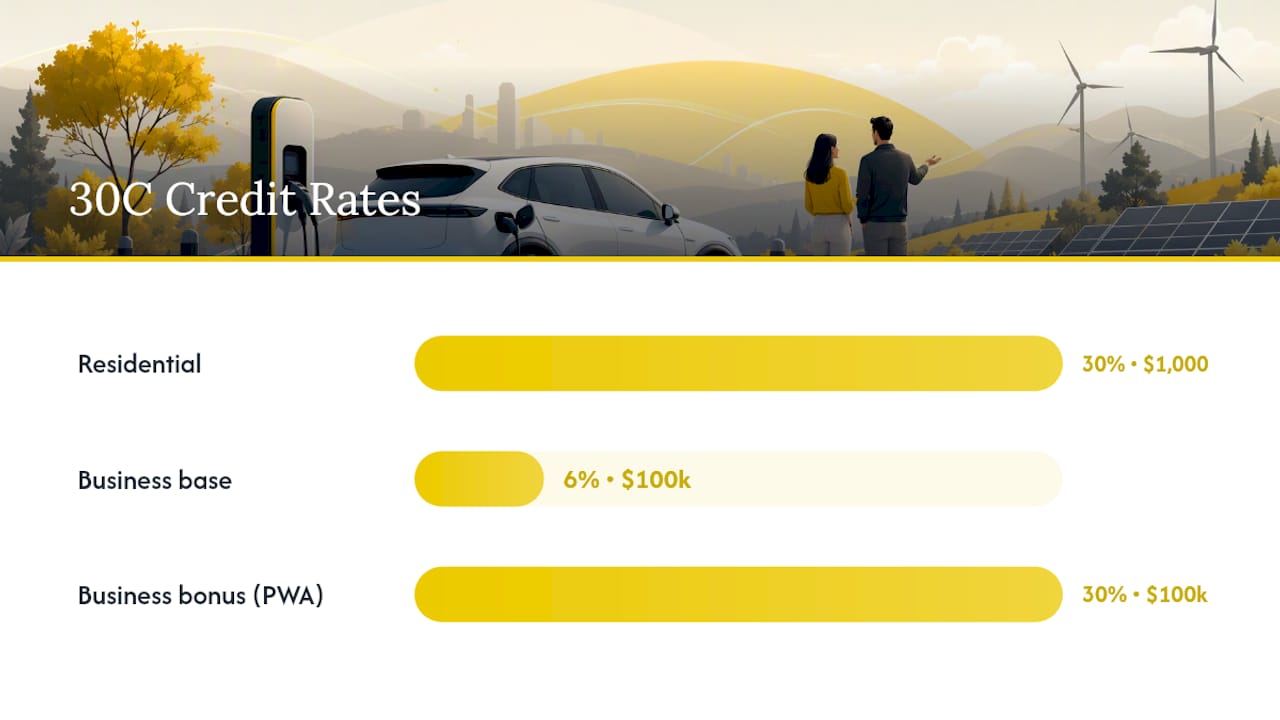
Here’s how the math breaks down for property placed in service between January 1, 2023, and June 30, 2026, according to the IRS:
- Residential: 30% of the cost, capped at $1,000 per item
- Business (base rate): 6% of the cost, capped at $100,000 per item
- Business (bonus rate): 30% of the cost, capped at $100,000 per item, if prevailing wage and apprenticeship (PWA) requirements are met
Pro Tip: The credit caps apply per item, not per property. A business installing multiple charging ports can potentially claim the credit for each individual port separately.
Eligible costs include the charging port itself, related equipment like conduit and panel upgrades tied directly to the charger, and in some cases battery storage that supports the charging system. But there’s a catch that trips up a lot of homeowners: the property generally has to sit in an eligible census tract, typically a low-income or non-urban area as defined by the IRS. Check the IRS’s eligibility page for individuals and its GEOID list before you assume your address qualifies. Tax-exempt entities, including municipalities and nonprofits, can access the credit’s value through elective pay even though they don’t owe federal income tax.
After June 30, 2026, this credit disappears too, per both the IRS and the statutory text in 26 USC §30C. If you’re planning a home or business charger install, that date is your real deadline.
How to Claim Your Credit: Forms and Filing Checklist
Form 8911 is the form you’ll file to claim the Section 30C credit, whether you’re a homeowner or a business. The instructions for Form 8911, updated for the June 30, 2026 termination date, walk through the calculation and required attachments. If you’re one of the buyers who preserved eligibility for a purchase credit through a pre September 30, 2025 contract, you’d still use Form 8936 for that legacy claim, not 8911.
Here’s the practical sequence for filing correctly:
- Confirm your placed-in-service date. For a charger, this is when the equipment became operational, not when you paid for it.
- Gather your invoices and receipts. Keep itemized costs for the charger, installation labor, and any panel or wiring upgrades directly tied to it.
- Verify your census tract eligibility using the IRS Appendix B GEOID list before you file, not after.
- Collect PWA documentation if you’re claiming the 30% business rate, including contractor certifications and payroll records.
- File Form 8911 with your tax return for the year the property was placed in service, attaching supporting documentation as instructed.
- Retain everything for at least three years in case of an audit request.
Any of these can turn a claimed credit into a denied one.
Business vs. Residential Charger Rules: Why the Rate Gap Is So Wide
That gap exists entirely because of prevailing wage and apprenticeship compliance, and it’s why businesses need to plan before, not after, construction starts.
| Rule | Residential | Business |
|---|---|---|
| Base rate | 30% | 6% |
| Bonus rate (with PWA) | Not applicable | 30% |
| Per-item cap | $1,000 | $100,000 |
| Location restriction | Eligible census tract | Eligible census tract |
| Deadline | Placed in service by June 30, 2026 | Placed in service by June 30, 2026 |
Meeting PWA requirements means paying workers the locally prevailing wage and using a set ratio of registered apprentices on the installation. Publication 6028 notes that businesses claiming the 30% rate need contractor certifications and payroll records collected as the work happens, not reconstructed later.
Pro Tip: Before signing a contractor for a business charging installation, ask directly whether they’ve documented PWA compliance on prior projects. A contractor unfamiliar with the paperwork can cost you the 24 percentage point difference even if the physical work is flawless.
State, Local, and Utility Incentives Worth Checking Before You Buy
With the federal purchase credit gone, this is where the real 2026 savings hide. The AFDC’s incentive database tracks state and local programs, and many state energy offices run their own rebate portals worth bookmarking.
Utility incentives generally fall into three categories:
- Point-of-sale rebates applied directly at purchase or installation
- Charger installation rebates covering part of hardware and labor costs
- Ongoing bill credits for charging during off-peak hours
Search the AFDC tool by ZIP code, since incentives often vary block by block depending on utility territory. Document your eligibility before you buy: some programs require pre-approval, and applying after installation can disqualify you entirely. If you’re timing a charger install alongside a federal 30C claim, apply for state or utility rebates first, since some require proof you haven’t already maxed out a separate program’s funding cap. These offers can shift the total cost of an EV or charger installation by hundreds or thousands of dollars, so it’s worth ten minutes of searching before you sign anything.
What a Home Charger Actually Costs in 2026
Budget realistically before assuming the tax credit will offset most of your cost. Hardware for a Level 2 charger typically runs a few hundred to over a thousand dollars, and installation labor adds more, especially if your electrical panel needs an upgrade or the run to your garage requires trenching.
The residential 30C credit caps out at $1,000, so on a $2,500 installation you’re covering the rest yourself unless a state or utility rebate fills the gap. That’s exactly why stacking incentives matters more in 2026 than it did when the vehicle credit made the charger cost feel like an afterthought.
Before committing, walk through this checklist:
- Get a site survey to confirm your panel has capacity for the new circuit
- Check whether your municipality requires a permit for the installation
- Collect at least two electrician quotes that separately itemize hardware and labor
- Confirm your expected “placed in service” date falls before June 30, 2026
Pro Tip: Ask your electrician to note the exact placed-in-service date on your final invoice. That single line item makes documenting the credit dramatically easier at tax time.
Who Actually Qualifies: Individual and Business Eligibility Rules for 2026
For individuals, the surviving 30C credit requires that the charging equipment be installed at your main home, not a second property or rental you don’t occupy, and that the address falls within an eligible census tract. There’s no income limit tied to this residential charger credit. That’s a notable shift from the old vehicle purchase credits, which had income caps of $150,000 for single filers and $300,000 for joint filers.

Businesses face a different set of tests. The property has to be used in a trade or business, placed in a qualifying location, and depreciable under normal tax rules. Tax-exempt organizations, including nonprofits, schools, and municipal fleets, can still access the credit’s cash value through elective pay, effectively treating a nonrefundable credit like a refund even without federal tax liability to offset.
One nuance worth flagging: if you already claimed a vehicle purchase credit under the old rules through a preserved binding contract, that doesn’t disqualify you from also claiming the 30C charger credit for your home installation. They’re separate credits governed by separate forms, Form 8936 for the vehicle and Form 8911 for the charger, and nothing in current law bars claiming both when each independently qualifies.
Do Income Limits Still Matter for the 2026 EV Tax Credit?
Income phase-outs were a defining feature of the now-expired purchase credits. Single filers above $150,000 in modified adjusted gross income, and joint filers above $300,000, were locked out of the new-vehicle credit, while the used-vehicle credit capped out at $75,000 for single filers and $150,000 for joint filers. Those thresholds are effectively moot now for anyone acquiring a vehicle after September 30, 2025, since the credit itself no longer exists for new purchases.
The one place income limits could still matter is for buyers who preserved eligibility through a binding contract executed before the cutoff. If your qualifying contract and payment predate September 30, 2025, the original income thresholds for that credit type still apply when you file. That means high earners who locked in a purchase before the deadline still need to check their income against the old caps, even though the general public no longer has to think about them.
For the Section 30C charger credit that’s still live through June 30, 2026, there is no personal income limit at all. That’s a practical opening for higher-income households who no longer qualify for a vehicle credit but can still capture a residential charger credit if their home sits in an eligible census tract. It’s a smaller dollar amount than the old $7,500 vehicle credit, but it’s real money with none of the income gatekeeping that defined the purchase-side program.
Vehicle Eligibility Rules: Assembly, Battery Sourcing, and Why They Still Matter
Even though the purchase credit has expired for new acquisitions, understanding the old eligibility framework still matters for two groups: buyers finalizing a preserved pre cutoff contract, and readers trying to understand why credit amounts varied so much before September 2025.
The rules required final assembly in North America as a baseline test. From there, two separate sourcing requirements determined the dollar amount: a critical-minerals threshold, requiring a rising percentage of the battery’s minerals to come from the U.S. or a free-trade partner, and a battery-components threshold, requiring a rising share of components to be manufactured or assembled in North America. Meeting one threshold qualified a vehicle for half the credit; meeting both unlocked the full amount. The AFDC’s vehicle credit summary notes these thresholds climbed year over year between 2023 and 2026, which is why the same model could qualify for the full credit one year and only half the next.
If you’re one of the buyers relying on a preserved contract, the sourcing rules in effect on your contract date, not today’s rules, generally determine what you can claim. That’s another reason to keep your original purchase paperwork rather than assuming the rules you read about now apply retroactively to your deal.
Can You Combine the EV Tax Credit With Other Federal Incentives in 2026?
The Section 30C charger credit doesn’t compete with most other federal tax benefits. You can generally claim it alongside credits like the Residential Clean Energy Credit for solar panels or a home battery system, since they cover different property and are claimed on different forms. A household installing solar, a battery, and an EV charger in the same year could potentially file for multiple credits simultaneously, provided each item meets its own requirements.
Where things get more restrictive is within federal vehicle-related programs themselves. Since the New Clean Vehicle Credit, Used Clean Vehicle Credit, and Commercial Clean Vehicle Credit have all ended for new acquisitions, there’s little federal vehicle-credit stacking left to consider for anyone buying today. If you preserved eligibility through a binding pre cutoff contract, that vehicle credit still can’t be combined with a second federal vehicle credit for the same purchase, since only one credit type applies to a given vehicle.
Businesses have one more layer to consider: the 30C charger credit and depreciation deductions on the same equipment interact in ways that require basis adjustments. If you claim the credit, you generally have to reduce the depreciable basis of the property by the credit amount claimed. That’s a detail worth raising with a tax professional rather than assuming full depreciation and a full credit stack independently.
What Might Change Next: Credit Amounts and Deadlines Beyond 2026
The one certain date on the calendar is June 30, 2026, when Section 30C itself expires under current law, per both the IRS and 26 USC §30C. Nothing in current statute schedules a replacement federal purchase credit or a phase-in of a new incentive after that date. Barring new legislation, federal EV purchasing rebates simply won’t exist past the current framework.
That doesn’t mean the incentive landscape is frozen. Congress has changed EV credit rules multiple times over the past few years, and state legislatures move even faster, often introducing or expanding rebate programs specifically to fill gaps left by federal cutbacks. Some states have already signaled intent to expand their own EV rebate programs as the federal purchase credit disappears, treating it as an opportunity to attract EV buyers who’d otherwise sit out the market.
For now, the practical takeaway is to stop waiting for a new federal EV tax credit to materialize and start building your 2026 purchase decision around what’s confirmed: the charger credit through June 30, and whatever your state or utility currently offers. Revisit AFDC’s incentive listings periodically, since state and utility programs update far more frequently than federal law does, and a rebate that didn’t exist in January could easily appear by summer.
How the 2025 Legislative Changes Reshaped What You Can Claim in 2026
The legislation that ended the purchase credits didn’t just cut off future buyers. It changed the practical calculus for anyone who was mid-purchase when the law passed. Dealers had to rapidly update time-of-sale reporting, and the IRS issued guidance clarifying that binding contracts and payments made on or before September 30, 2025, would be grandfathered in even if delivery slipped past that date.
That grandfathering provision is the single most consequential detail for anyone still trying to claim an old credit in 2026. It’s also frequently misunderstood. A verbal agreement or a refundable reservation deposit generally doesn’t count as a binding contract. What counts is a legally enforceable agreement paired with genuine consideration, documented in writing, ideally with the dealer’s time-of-sale report as backup.
The same legislative package left Section 30C largely intact but locked in its own hard stop at June 30, 2026, rather than letting it drift indefinitely. That’s a deliberate design choice: lawmakers wanted the charger incentive to wind down on a predictable schedule rather than end abruptly like the purchase credits did. If you’re weighing a charger installation now, that predictability is actually useful. You know your deadline today; you’re not waiting on another announcement to find out it already passed.
FrenzyCars’ Take: Plan Around What’s Actually Available
Chasing a federal credit that no longer exists wastes time you could spend comparing what actually saves you money in 2026: total cost of ownership, state rebates, and utility deals. If you believe you preserved eligibility under a pre cutoff contract, verify your paperwork now, not at tax time. For everyone else, our model comparison guides can help you weigh options with today’s incentive landscape in mind, not yesterday’s.
Compare Your Options Before You Commit
Figuring out which EV still makes financial sense without the federal purchase credit means comparing real specs, not guessing. Frenzycars’ car specs by make and model let you check range, charging speed, and pricing side by side before you talk to a dealer. If you’re not sure which category fits your budget or driving needs, the best cars by category pages break down top picks across price points and body styles. Start by pulling up two or three models you’re considering and comparing their real-world costs, including insurance and maintenance, against what you’d pay for a comparable gas vehicle. That’s the comparison that actually matters now that the tax credit isn’t doing the heavy lifting for you.
This article is general information, not a substitute for advice from a qualified financial advisor. Consult a qualified financial professional about your own circumstances before acting on anything here.
Sources
- Clean vehicle tax credits | Internal Revenue Service
- Tax Credits for Electric Vehicles and Charging Infrastructure | Alternative Fuels Data Center (AFDC)
- 26 USC 30C: Alternative fuel vehicle refueling property credit