
Yes, you can refuse nearly every dealer add-on, and the most effective move is to negotiate your out-the-door price before you ever step into the finance office. Under the FTC’s CARS Rule (effective July 30, 2024), dealers must obtain your express, informed consent before charging for any add-on product. That means no buried line items, no “mandatory” packages, and no charges for products you never agreed to buy.
Here’s what to do the moment you sit down to sign:
- Ask for a printed, itemized contract before touching any e-sign device.
- Cross-reference every line item against what you actually agreed to purchase.
- Refuse each unwanted add-on by name, in writing, and initial the removal.
- If the dealer insists the add-ons are non-negotiable, you are legally entitled to walk away.
Pro Tip: Get your financing preapproved by a bank or credit union before visiting the dealership. A preapproved loan eliminates one of the finance office’s most powerful tools: controlling your monthly payment to hide add-on costs.
Key Takeaways
Refusing dealer add-ons in writing, negotiating the out-the-door price first, and filing a complaint with the FTC if charged without consent are the three actions that protect U.S. car buyers most effectively under the CARS Rule.
| Point | Details |
|---|---|
| Negotiate out-the-door price first | Agree on the total vehicle price before entering the finance office to prevent add-on packing. |
| Demand a printed contract | E-sign devices can hide terms; always request a full printed contract before signing anything. |
| Refuse add-ons by name in writing | Initial each removal on the contract to create a documented record of your refusal. |
| Buy coverage elsewhere after the sale | GAP, VSCs, and protection plans are available from insurers and third parties at a fraction of dealer prices. |
| File with the FTC if charged without consent | The CARS Rule (effective July 30, 2024) gives you a legal basis to dispute unauthorized add-on charges. |
Which dealer add-ons should you actually pay for?
The finance office is where dealers recover the margin they gave up on the vehicle price. Consumer Reports notes that new-car gross margins can be razor-thin, so F&I products are where the real money gets made. Knowing what each add-on actually costs, and what the same coverage runs elsewhere, is the fastest way to save on car add-ons.
| Add-On | Clear Consumer Benefit? | Typical Dealer Price | Typical Markup Shape | Better Alternative | Buy at Dealer? |
|---|---|---|---|---|---|
| Extended warranty (VSC) | Yes, if car is out of factory warranty | $1,500 | Three hundred percent over cost | Third-party VSC providers or manufacturer directly | Consider — negotiate hard or buy after sale |
| GAP insurance | Yes, if you owe more than the car’s value | $400–$900 | 200–400% over insurer cost | Your auto insurer or lender (often $20–$40/year added to policy) | No — buy from insurer |
| VIN etching | Marginal — insurers rarely reduce premiums for it | $200–$400 | Very high; DIY kit costs under $25 | DIY kit from an auto parts store | No — avoid |
| Undercoating / rustproofing | Minimal on modern vehicles with factory coatings | $200 | High; factory coatings already applied | Skip entirely on new cars; aftermarket shop for older vehicles | No — avoid on new cars |
| Paint / fabric protection | Minimal; factory clear coat is already protective | $200–$800 | Very high; product cost is negligible | DIY ceramic coating or fabric spray | No — avoid |
| Wheel & tire protection | Moderate if you drive in pothole-heavy areas | $300 | Moderate to high | Third-party tire protection plans | Consider — compare quotes first |
| Prepaid maintenance plan | Moderate if you plan to stay at the dealership for service | $500 | Moderate | Your manufacturer’s recommended service schedule at independent shops | Consider — only if price matches actual service cost |
| Theft / alarm protection | Low — modern vehicles have factory security | $200 | High | Factory alarm already included; aftermarket GPS tracker costs under $100 | No — avoid |
| Dealer-installed electronics / tint | Varies by product | $200 | High — dealer labor rates apply | Independent installer or auto parts store | No — shop independently |
| Documentation / prep fees | No product delivered — administrative cost only | $100 | Pure margin; cost to dealer is near zero | Negotiate down or refuse; some states cap these fees | Negotiate — never pay the sticker amount |
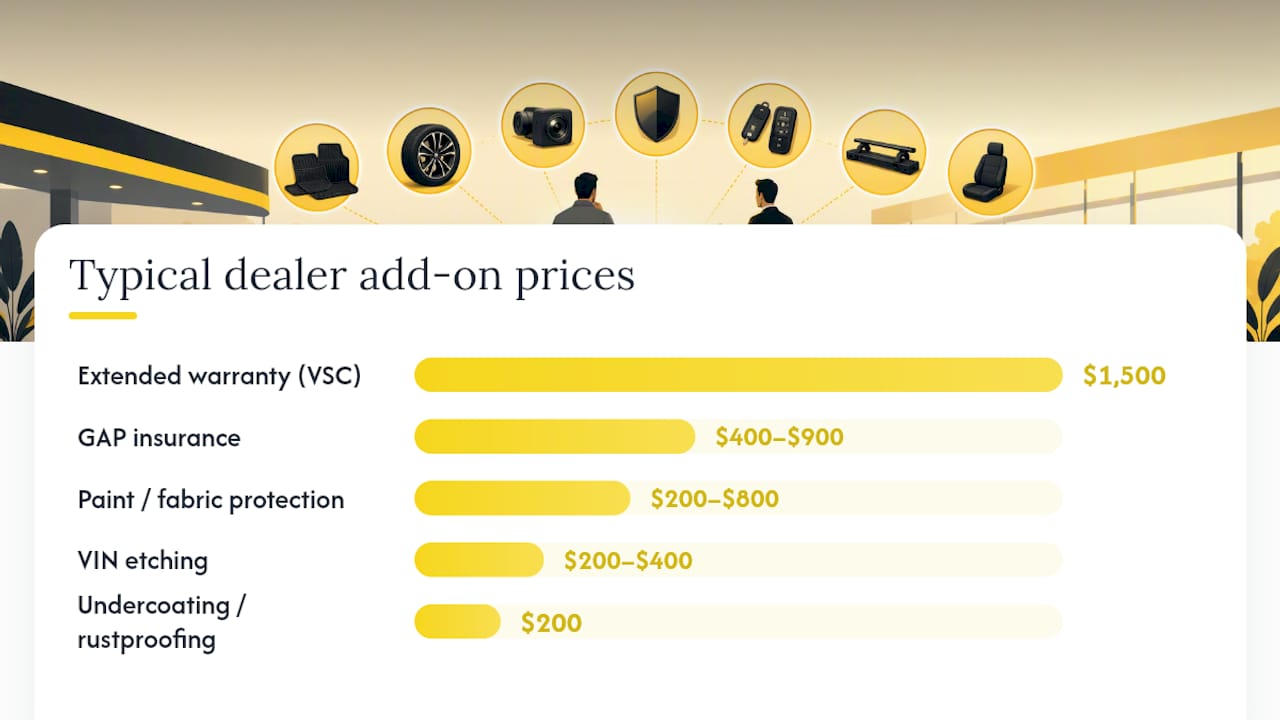
A few notes on the entries that deserve more nuance:
Extended warranties (VSCs): The NIHFCU buyer’s guide points out that dealer-sold VSCs are often the same underlying contract you can buy directly from the administrator at a lower price. If you want one, wait until after the sale and shop providers like Endurance or CARCHEX independently. For used cars, check the Frenzycars guide to extended car warranty companies before committing to anything in the finance office.
GAP insurance: Dealers routinely mark this up by several hundred dollars over what your auto insurer charges. Your insurer or lender will almost always offer the same protection for a fraction of the cost. The Frenzycars explainer on how GAP insurance works walks through exactly when you need it and where to buy it.

Prepaid maintenance: These plans sound convenient but frequently cover only what the manufacturer already requires at intervals you’d pay for anyway. Run the math against your manufacturer’s scheduled maintenance costs at an independent shop before agreeing.
Pro Tip: Independent buyer guides document markups of 300–500% on common F&I products. If you decide you want a product, tell the finance manager you’ll buy it after the sale from a third party — that alone often significantly drops the dealer’s price.
What are your legal rights under the FTC CARS Rule?
The FTC’s Combating Auto Retail Scams (CARS) Rule became effective July 30, 2024, and it changed the legal landscape for car buyers in a concrete way. Dealers are now prohibited from charging for add-ons without your express, informed consent. They must disclose the offering price of the vehicle, itemize any add-on charges separately, and cannot represent that an add-on is required when it isn’t.
Here’s what the rule specifically requires dealers to do:
- Disclose the “offering price” — the actual price a buyer can pay to purchase the vehicle, excluding only government fees.
- Obtain express, informed consent for every add-on charge before it appears on the contract.
- Prohibit add-ons that provide no benefit — dealers cannot charge for products or services that deliver no real value to the consumer.
- Maintain accurate advertising — no bait-and-switch pricing between what’s advertised and what appears in the finance office.
The FTC has already used this authority. In August 2024, the agency took action against Asbury Automotive Group, one of the largest dealer groups in the country, alleging payment-packing and unauthorized add-ons. Survey evidence in that complaint showed that a large majority of buyers at certain dealerships experienced unauthorized add-ons in their contracts. The FTC also alleged that Asbury used e-sign devices to obscure contract terms, making it harder for buyers to spot charges they never agreed to.
If you believe a dealer violated the CARS Rule, here’s how to act:
- Document everything. Save the signed contract, any printed or emailed quotes, and all communications with the dealer.
- Contact the dealer in writing first. Request removal of the unauthorized charge and a corrected contract. Put a deadline on your request (10 business days is reasonable).
- File a complaint with the FTC at Reportfraud. Include the dealer’s name, location, the specific charge, and copies of your contract.
- File with your state attorney general. Most states have consumer protection divisions that handle auto dealer complaints independently of the FTC.
- Contact the CFPB if the unauthorized charge was added to a financed amount — the Consumer Financial Protection Bureau handles financing-related deception.
How do you refuse add-ons in the finance office?
Refuse them explicitly, by name, before you sign anything. The finance manager’s job is to present add-ons as a package and make individual refusals feel awkward or complicated. Your job is to treat each line item as a separate negotiation.
Start with the out-the-door price agreed in writing before you enter the finance office. That number is your anchor. Anything that appears in the finance contract above it is an add-on you did not agree to.
That single sentence resets the dynamic. Most finance managers will comply because refusing to provide a printed contract is itself a CARS Rule violation. Once you have the contract in hand, go line by line. For each add-on you didn’t request:
If the finance manager says the add-on is mandatory or “already installed”:
That’s the hard-push script. It works because walking away is a real option, and the finance manager knows it. A deal that closes without add-ons is still a deal. A buyer who leaves costs the dealership the entire vehicle sale.
The sequence that protects you:
- Negotiate the out-the-door price on the vehicle first, in writing, before entering the finance office. Use a car comparison shopping checklist to arrive with competing offers.
- Bring your preapproved financing terms. This removes the dealer’s ability to manipulate your monthly payment to hide add-on costs, a tactic the FTC documented in the Asbury case.
- Request a printed contract. Refuse to sign any e-sign device until you’ve read every page.
- Refuse add-ons line by line. Initial each removal.
- If the dealer insists, ask for the sales manager. If the add-ons remain, leave.
Pro Tip: Your single strongest piece of leverage is a competing offer from another dealer or a preapproved loan from your bank. Finance managers know that a buyer with outside financing and a competing quote has no reason to accept a packed contract.
What should you check on the contract before signing?
Every line on the sales and finance contract is a commitment. Read it as if the dealer made a mistake on every page, because sometimes they did, and sometimes it wasn’t a mistake.
Checklist — verify every item before signing:
- Out-the-door price: Does the total match the number you negotiated? This includes vehicle price, taxes, title, registration, and any fees you agreed to.
- Add-on line items: Is every add-on listed separately with its price? Did you authorize each one? If a line item appears that you didn’t agree to, stop and ask for it to be removed before proceeding.
- APR and loan term: Does the interest rate match your preapproved offer or the rate you were quoted? A higher APR than expected is a red flag.
- Total financed amount: Does it match the vehicle price plus only the fees and add-ons you agreed to? A higher total suggests something was added without your consent.
- VIN and odometer: Confirm the VIN matches the car you’re buying and the odometer reading matches what you saw on the lot.
- Trade-in credit: If you’re trading in a vehicle, verify the credit amount matches the agreed figure.
- Dealer fees (itemized): Documentation fees, dealer prep fees, and similar charges should be listed individually. Many are negotiable; some states cap them.
Red flags that suggest payment packing or hidden add-ons:
- The finance manager hands you a tablet or e-sign device without offering a printed contract first.
- The contract runs more pages than expected, with unfamiliar line items buried near the end.
- Add-on consent forms are undated, unsigned, or pre-checked.
- The monthly payment is presented first, with the total price minimized or omitted.
- You’re told an add-on is “required by the lender” — lenders do not require dealer-sold VSCs, GAP from the dealer, or paint protection.
On documentation: keep your signed contract, all addenda, and any written quotes for at least six years. That covers most state statutes of limitations for consumer fraud claims and gives you a paper trail if a dispute arises years later when a VSC claim is denied.
The FTC has warned specifically about e-sign interfaces that scroll past key terms without displaying them fully. If you’re handed a device, ask for every page to be displayed in full before you sign. Better yet, ask for paper.
Already charged for an add-on you didn’t want? Here’s how to get a refund
Discovering an unauthorized add-on after you’ve driven off the lot is frustrating, but it’s recoverable. Move quickly, document everything, and escalate in order.
Step 1: Contact the dealer in writing. Call first to establish the conversation, then follow up with an email or certified letter the same day. State the specific add-on, the amount charged, and that you did not authorize it. Request a corrected contract and a refund or credit to your loan within 10 business days.
Step 2: Contact your lender. If the charge was rolled into a financed amount, call your lender and explain that an unauthorized charge was added to the loan. Lenders will often adjust the payoff amount if the dealer added unauthorized charges, because the lender’s own compliance exposure increases when a loan includes fraudulent line items.
Step 3: Send a formal demand letter. Use this as your template:
Subject: Demand for Refund — Unauthorized Add-On Charge
Dear [Dealer Name / Finance Manager],
On [date], I purchased a [Year/Make/Model], VIN [number], at your dealership. My contract includes a charge of $[amount] for, which I did not authorize and did not agree to purchase. Under the FTC’s CARS Rule (16 CFR Part 463), dealers are prohibited from charging for add-ons without express, informed consumer consent.
I request that this charge be removed from my contract and that a refund of $[amount] be issued within 10 business days. If I do not receive a response by [date], I will file complaints with the FTC, the CFPB, and my state attorney general, and will pursue recovery in small claims court.
Please confirm receipt of this letter.
Sincerely, [Your Name, Address, Phone, Email]
Step 4: File regulatory complaints. The FTC’s ReportFraud portal is the primary channel for CARS Rule violations. File with the CFPB if financing is involved, and with your state attorney general’s consumer protection office. Include your signed contract, loan statements showing the charge, and copies of all dealer communications.
Step 5: Small claims court. If the dealer refuses to refund and the amount is within your state’s small claims limit (typically $5,000–$10,000), this is a viable and often effective route. Bring your signed contract, proof of payment, your written refund demand, and the dealer’s response (or non-response). The FTC’s enforcement record, including the Asbury Automotive action, establishes that unauthorized add-on charges are a recognized legal harm — that context strengthens your position even in a local court.
Why do dealers push add-ons so aggressively?
The short answer: the vehicle itself barely pays the bills. Consumer Reports documents that dealership gross profit on new vehicle sales can be as low as 1–2% of the sale price. On a $40,000 car, that’s $400–$800 in gross margin before overhead. The F&I office is where dealerships actually make money.
Here’s how the incentive structure works:
- F&I commission: Finance managers typically earn a percentage of the profit on every add-on they sell. A single VSC or GAP policy can generate more commission than the entire vehicle sale.
- Third-party markups: Dealers buy VSCs, GAP policies, and protection products from third-party administrators at wholesale prices, then mark them up 200–400% before presenting them to buyers.
- Volume bonuses: Some F&I administrators pay dealers volume bonuses when they hit monthly sales targets for specific products, creating pressure to push certain add-ons regardless of buyer need.
- Payment focus: By steering the conversation toward monthly payments rather than total price, finance managers can insert add-ons without the buyer noticing the total cost increase.
The practical consequence for you: the finance office is the highest-pressure environment in the dealership, and the finance manager is its most skilled salesperson. They have practiced responses to every refusal. The buyer who arrives with a preapproved loan, a written out-the-door price, and a printed contract checklist removes most of the tools the finance manager relies on.
Independent buyer guides document markups of 300–500% on common F&I products, which means the finance manager has enormous room to negotiate if you push back. A product offered at $900 may cost the dealer $200. That gap is your negotiating room.
The Frenzycars take on dealer add-ons
The conventional advice is to “just say no” to everything in the finance office. That’s mostly right, but it misses a nuance worth stating plainly: a small number of add-ons are genuinely useful for specific buyers. GAP coverage on a heavily financed vehicle is real protection. A VSC on a used car with a spotty service history can pay for itself. The problem isn’t that add-ons exist. The problem is that dealers price them at multiples of their actual cost and present them as a package rather than individual choices.
What we recommend at Frenzycars: negotiate the vehicle price to a final out-the-door number before you enter the finance office. Then treat the finance office as a separate transaction. Refuse every add-on by default. If you decide you want one after reviewing it, negotiate the price down or buy it after the sale from a third-party provider. That sequence keeps you in control and prevents the finance manager from using add-on revenue to offset a vehicle discount you already earned.
The emotional pressure in the finance office is real and deliberate. You’ve spent hours choosing a car, you’re excited, and the finance manager knows that walking away at that point feels costly. It isn’t. Another dealer has the same car, or close to it. Your preapproved loan works anywhere. The willingness to leave is the most effective tool a buyer has, and it costs nothing to use.
Browse car specs by make and model on Frenzycars before your visit so you arrive knowing exactly what you want. Preparation is the best defense against a high-pressure finance office.
Sources
The sources below are the primary references for the legal standards and consumer rights covered in this article. The FTC’s rule text and consumer alerts carry the most legal weight; the complaint portals are where you act if a dealer violates your rights.
- FEDERAL TRADE COMMISSION 16 CFR Part 463 RIN 3084 6AB72 Combating Auto Retail Scams Trade Regulation Rule
- Car dealerships can’t charge you for add-ons you don’t want | Consumer Advice
- FTC Takes Action Against Auto Dealer Group Asbury Automotive for Discriminating Against Black and Latino Consumers and Charging for Unwanted Add-Ons | Federal Trade Commission
- Just say no to these car dealership extras | Consumer Reports
- 14 Common add-ons. Should you buy them from the dealer?
Which agency to contact first: For unauthorized add-on charges, start with the FTC at ReportFraud.ftc.gov. If the charge was added to a financed loan, file simultaneously with the CFPB. For discriminatory pricing or state-law violations, contact your state attorney general’s consumer protection office.
This article is general information, not a substitute for advice from a qualified lawyer. Consult a qualified legal professional about your own circumstances before acting on anything here.