It depends on where you charge, not how much you paid. An EV with reliable home charging and more than 12,000 miles a year almost always beats an equivalent gas car over a 5 year hold, largely because home charging access cuts lifetime ownership costs by roughly $10,000 on average. Skip home charging, finance a high purchase premium, or drive under 8,000 miles a year, and the math flips fast. The rest of this guide breaks down incentives, charging, maintenance, insurance, depreciation, and fees so you can run your own numbers instead of trusting a sticker price.
TL;DR:
- Home charging access reduces lifetime ownership costs by around $10,000 for drivers who clock more than 12,000 miles annually; without it, EVs may not be cheaper than gas cars.
- Federal and state incentives can significantly lower purchase prices if paperwork requirements are met precisely at sale time, but they vary by location and change frequently.
- Charging costs differ widely based on electricity rates and charging methods, with home charging being the cheapest, while public fast charging is the most expensive per mile.
- EV insurance costs are higher mainly due to vehicle value, battery costs, and advanced safety features, but shopping around and choosing the right trim can mitigate premiums.
- Factors like local utility rates, charging habits, and battery degradation influence true ownership costs more than sticker prices or vehicle models.
What Tax Credits and Rebates Cut the Cost to Own an EV?
The federal clean vehicle tax credit is the biggest lever most buyers overlook until tax season. The IRS spells out eligibility rules and the exact claiming process, including income caps, vehicle price ceilings, and dealer reporting requirements that have to be met at the point of sale, not after. Miss the paperwork and the credit disappears. States and utilities stack rebates on top, often for both the vehicle and the home charger, though availability changes by zip code and by year.
Before you sign anything, collect this:
- The dealer’s IRS time-of-sale report confirming the vehicle qualifies.
- Your state’s current EV purchase incentive and charger rebate program pages.
- Utility-specific charger rebates, which sometimes require enrollment in a time-of-use rate plan.
- Proof of installation costs if you’re claiming a charger credit separately from the vehicle credit.
Incentives shift the effective purchase price more than any dealer discount will, and they expire or change on legislative timelines, so verify eligibility the week you buy, not the week you researched.
How Do You Turn the Purchase Price Gap Into an Annual Cost?
An EV that costs $6,000 more upfront isn’t automatically $6,000 more expensive to own. Spread that premium across a loan term and it becomes a manageable annual number you can compare directly against fuel and maintenance savings.
- Divide the price premium by your loan term in years to get a rough annual capital cost (a $6,000 gap over 5 years is $1,200 a year before interest).
- Add the extra interest from financing a larger loan amount. A higher rate or a longer term inflates that number and pushes the break-even point further out.
- Subtract any tax credit or rebate applied at purchase before you calculate the premium, since that’s your true out-the-door gap.
- Factor in trade-in timing. Trading in a gas car when used EV supply is tight can swing your net price by more than the incentive itself.
Run this calculation before comparing charging or maintenance costs. Everything downstream assumes you know your real annual capital cost.
Why Does EV Insurance Cost More, and Can You Fix That?
EV premiums run higher than comparable gas models most of the time, and it’s rarely about the electric motor itself. Insurers price in higher vehicle values, specialized collision repair labor, and battery pack replacement costs that dwarf a typical engine repair. Trim level matters more than people expect, too. The advanced driver assistance features that come standard on higher trims add sensor and camera replacement costs after even a minor fender incident.
A few moves actually move the number:
- Get quotes on the exact trim you’re buying, not a base-model estimate, since ADAS packages change pricing significantly.
- Ask insurers directly whether they cover OEM battery components or default to aftermarket parts.
- Check whether your local repair network has EV-certified technicians. Sparse networks mean longer claims and higher labor rates.
- Bundle policies or raise your deductible if your driving record supports it.
Frenzycars breaks down what’s actually driving these premiums in our EV insurance rates guide, which is worth reading before you get quotes.
What Registration Fees and Surcharges Apply to EVs?
Plenty of states charge EV owners extra annual fees to offset the gas tax revenue they’re not collecting at the pump. These show up as EV-specific registration surcharges, higher registration brackets tied to vehicle value, or in some states, a road-usage fee calculated separately from your base registration.
None of these numbers are large individually. Over a 5 year hold, though, they add up to real money that most buyers forget to budget for.
- Check your state DMV site directly. Third-party estimates are frequently outdated.
- Look specifically for “EV fee,” “alternative fuel fee,” or “road usage charge” line items separate from standard registration.
- Some states waive or discount inspection fees for EVs since there’s no emissions test required.
Add these fees to your 5 year ownership spreadsheet the same day you calculate your loan payment. They’re easy to forget and they never go away.
Is EV Maintenance Actually Cheaper Than Gas?
Routine maintenance is where EVs deliver their most reliable savings. No oil changes, no transmission service, no spark plugs, no exhaust system to fail. That eliminates a meaningful chunk of what a gas car costs you every year in scheduled maintenance.
EVs aren’t maintenance-free, though. You’ll still rotate tires on a regular schedule (often more frequently, since EV torque wears tread faster), replace cabin air filters, and service brakes eventually, though regenerative braking tends to stretch brake pad life considerably compared to a gas car. AFDC’s maintenance guidance confirms EVs cut engine-specific service but don’t eliminate wear items entirely.
The real financial risk sits with the battery. Degradation is gradual and rarely dramatic, but outright replacement outside a warranty window is a five-figure repair. Warranty lengths vary by manufacturer, so check the specific terms before you buy, and read Frenzycars’ battery lifespan breakdown for what real-world degradation actually looks like.
Pro Tip: If you’re buying used, ask the dealer for a battery health report and get the exact warranty transfer conditions in writing. Some manufacturers void battery warranties on transfer if maintenance records are incomplete.
How Much Does It Cost to Charge an EV Per Mile?
The formula is simple: battery capacity in kWh times your electricity rate in dollars per kWh gives you the cost of a full charge. Divide that by your real-world range, and you get a cost per mile you can compare directly against a gas car’s fuel economy.
Here’s what that looks like using national averages. A 72 kWh battery charged at a typical residential rate costs somewhere around $8 to $9 for a full charge at home, depending on your local utility rate. The Department of Energy’s AFDC shows an example where electricity priced at 10.7 cents per kWh and a vehicle using 27 kWh per 100 miles works out to roughly $0.03 per mile, a fraction of what most gas vehicles cost to drive the same distance.
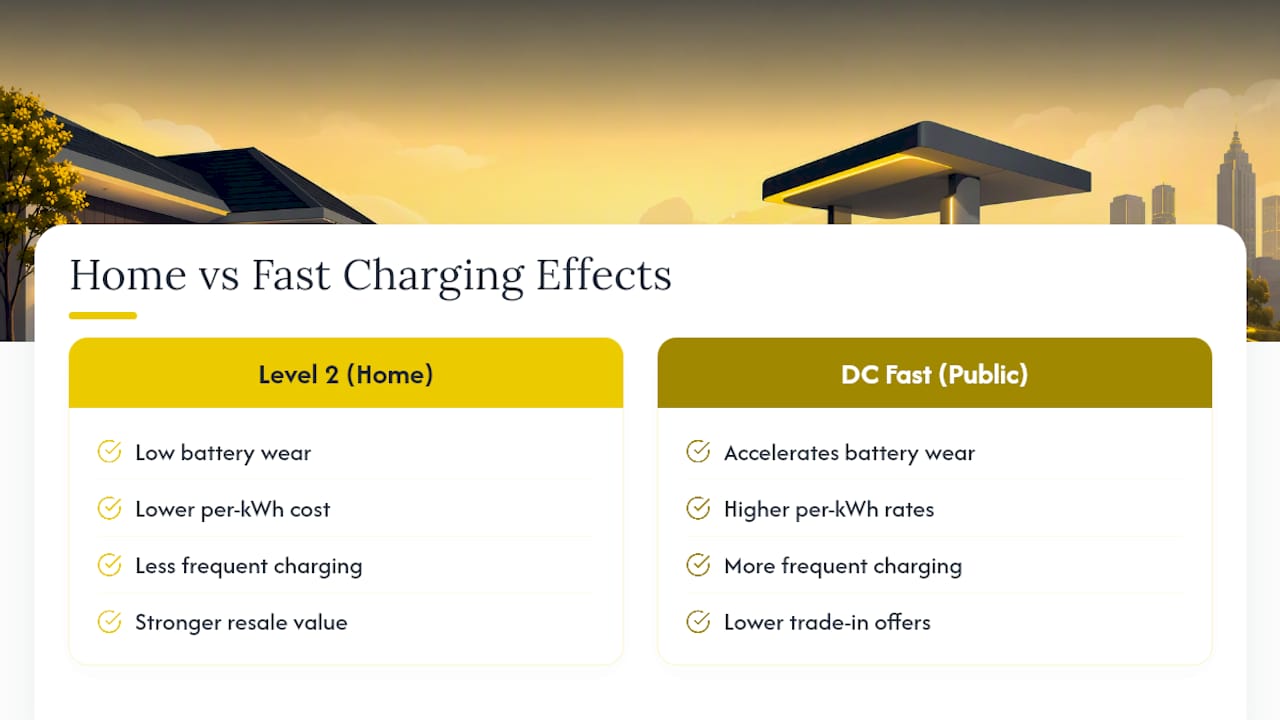
The charging mix changes everything. Home charging is consistently your cheapest option. Public Level 2 charging typically runs higher due to network fees, and DC fast charging is the most expensive per kWh by a wide margin, sometimes several times the home rate.
- Home Level 2 charging: cheapest, most predictable, best for daily commuting.
- Public Level 2: convenient but usually carries a per-session or per-kWh premium.
- DC fast charging: fastest, priciest, best reserved for road trips rather than routine use.
Time-of-use utility plans can shave charging costs further if you shift most charging to off-peak overnight hours, and optimized strategies like vehicle-to-home charging have been shown to cut owner costs by roughly $3,800 over the vehicle’s life in many U.S. counties, though that requires compatible hardware and utility program enrollment.
What Drives EV Depreciation and Resale Value?
EVs have historically depreciated faster than comparable gas cars, though that gap has been narrowing as the market matures. A few forces drive it: early production oversupply on certain models, sudden manufacturer price cuts that instantly devalue existing inventory, buyer anxiety around battery health, and aggressive new-model pricing that makes last year’s version look expensive by comparison.
Building the depreciation line into your own 5 year TCO worksheet takes three steps:
- Estimate today’s purchase price after incentives, using your out-the-door number from the financing calculation above.
- Research comparable 5-year-old resale values for the same model and trim, adjusting for mileage and battery health disclosures.
- Subtract the resale estimate from your adjusted purchase price. That difference is your depreciation cost, and it should appear only once in your worksheet, never double-counted alongside a separate “battery risk” line.
Battery warranty and documented condition swing resale offers substantially. Cosmetic damage matters here too. A look at how cosmetic defects affect used EV resale value is worth a read if you’re weighing whether to fix minor body damage before selling.
Three 5-Year Ownership Scenarios: When Does an EV Actually Win?
The numbers change dramatically depending on who’s driving and where they charge. Here’s how three common buyer profiles shake out over a 5 year hold.
A driver with no home charging access and fewer than 8,000 miles a year is the toughest case for an EV to win. The purchase premium doesn’t get amortized over enough miles, and reliance on public charging erases most of the per-mile savings. This buyer often comes out roughly even or slightly behind a comparable gas car.
A driver with reliable home charging and more than 12,000 miles a year is the clearest win case. Fuel savings compound fast at that mileage, and UMich’s Center for Sustainable Systems found home charging access alone can swing lifetime costs by a substantial amount in favorable cases.
A premium long-range EV buyer sits in the middle. Higher purchase price and insurance costs eat into savings, but strong resale value on well-regarded models can offset a chunk of that gap by year five.
- Home charging plus high annual mileage: likely advantage.
- No home charging plus a sizable purchase premium: likely disadvantage.
- Everything else: run your own numbers using your actual electricity rate, mileage, and insurance quote.
Some analyses find EVs cheaper on the whole while others show modest premiums, and the deciding factor is almost always local energy prices and charging access, not the vehicle itself.
A Practical Checklist Before You Buy an EV
Before you sign a loan, confirm the inputs that actually determine your outcome:
- Verify you have reliable, ideally dedicated, home charging access, or a realistic plan to install it.
- Get insurance quotes on the exact trim and model you’re buying, not a generic estimate.
- Check the battery warranty terms and whether they transfer if you buy used.
- Estimate your annual mileage honestly and map out your likely charging mix.
- Calculate your amortized purchase premium before comparing it to fuel savings.
Frenzycars’ hybrid vs. electric decision guide is a good next stop if you’re still weighing whether an EV fits your driving pattern at all, and the insurance and battery guides linked above cover the two line items buyers underestimate most often.
Does Where You Live Change Your Charging Costs?
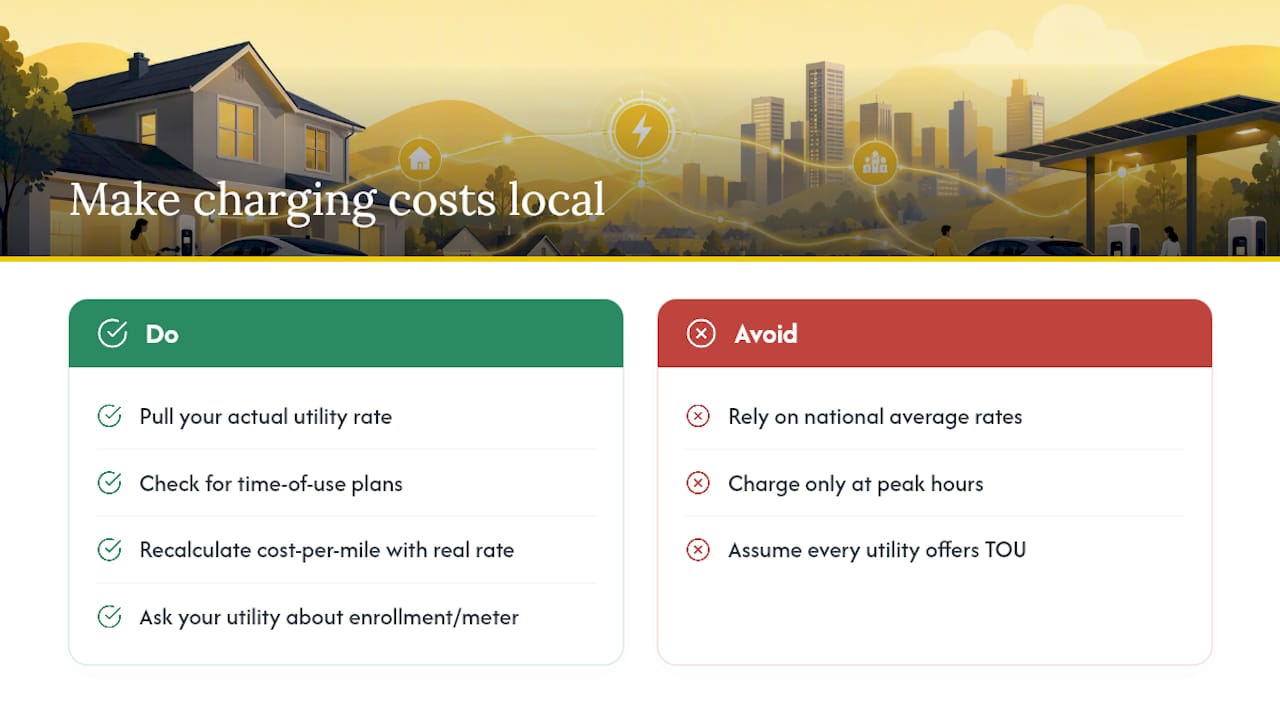
Electricity rates vary enormously by state, and that variance matters more for EV owners than for almost any other utility decision they’ll make. A household paying a high per-kWh rate in one region can pay double what a household in a low-cost region pays for the exact same charging habits, based on EIA’s electricity price data. That gap alone can determine whether an EV beats a gas car on fuel costs in your specific zip code.
Time-of-use pricing adds another layer. Many utilities charge less for electricity used overnight or during off-peak hours, sometimes at half the daytime rate. Plug in when you get home from work at 6 p.m. on a standard plan, and you’re paying peak rates. Shift that same charging session to midnight, and the cost per mile drops noticeably, sometimes enough to change your annual fuel savings by several hundred dollars.
Not every utility offers a time-of-use option, and not every EV owner can shift their charging schedule around work hours or household needs. Check with your utility provider directly. Some require enrollment, some install a separate meter, and some just need you to schedule charging through your car’s app or a smart charger.
The practical takeaway: don’t use a national average electricity rate to plan your own budget. Pull your actual utility rate, check whether a time-of-use plan is available, and recalculate your cost per mile using your real number. The formula from the charging section above works the same way regardless of what rate you plug in. It’s the input that changes, not the math.
What Do Public Charging Memberships and Fees Actually Cost?
Public charging networks don’t operate like a single gas station chain with one price everywhere. Some charge a flat per-session fee, some bill by the kWh, and some charge by the minute, which penalizes slower-charging vehicles regardless of how much energy they actually receive.
Membership programs are where the real savings hide, though they only pay off if you charge in public regularly. Most networks offer a discounted per-kWh rate for members paying a small monthly fee, versus a higher pay-as-you-go rate for guests. If you’re relying on public charging just occasionally, for road trips or when home charging isn’t available, the pay-per-use rate is usually cheaper overall since you avoid the recurring membership cost.
Idle fees are the hidden cost most new owners get hit with at least once. Leave your car plugged in after it finishes charging at a fast charging station, and many networks start billing a per-minute penalty to free up the stall for the next driver. It’s a small fee per incident, but it adds up for owners who aren’t used to monitoring charge status.
A few things worth checking before you rely on any network regularly:
- Compare per-kWh membership rates against your realistic public charging frequency before signing up.
- Read the idle fee policy for any network you use often.
- Check whether your vehicle’s app or a plug-in adapter gives you access to multiple networks, since sticking to one network limits your options on longer trips.
If you’re mostly a home charger who occasionally needs a public station, skip the membership and pay as you go. If you don’t have home charging and lean on public infrastructure daily, the math usually favors joining.
Does Battery Degradation Raise Your Long-Term Costs?
Battery capacity fades gradually over the life of an EV, and that fade has real cost implications even when it never triggers an outright replacement. A battery that’s lost a meaningful chunk of its original capacity delivers less range per charge, which means more frequent charging stops and, for owners who rely partly on public infrastructure, more exposure to the higher per-kWh rates those stations charge.
Degradation rates vary by battery chemistry, climate, and charging habits. Frequent DC fast charging accelerates wear more than routine Level 2 home charging does, and reliance on public fast charging can erase most of an EV’s energy cost advantage while accelerating battery wear at the same time. That’s a double cost: you pay more per charge and you need to charge more often.
The good news is that most manufacturers back their battery packs with warranties running several years or a substantial mileage threshold, and outright failure inside that window is rare. The real cost shows up later, at trade-in or resale, when a buyer’s diagnostic check reveals meaningfully reduced capacity. That shows up as a lower offer, not a repair bill, but it’s still money out of your pocket over the ownership period.
Ask for a battery health report before buying used, and if you’re buying new, favor a charging habit that leans on Level 2 home charging for daily use and saves fast charging for road trips. It’s the single easiest way to protect both your range and your eventual resale value.
Research Your Next Move With Frenzycars
Running these numbers on paper only gets you so far. Frenzycars exists to help you go from “EVs are cheaper on average” to “is this specific car cheaper for me,” with model specs, curated best-of lists, and guides built around the exact levers covered above: charging access, insurance quotes, and battery condition. If you already know you want an EV, our best electric company car picks is a solid starting point for narrowing trims worth quoting.
If you’re still comparing specific models side by side, the car specs and pricing hub lets you pull the exact numbers your TCO worksheet needs instead of relying on national averages. And before you finalize insurance, it’s worth checking Frenzycars’ coverage guides to make sure you’re not overpaying for coverage you don’t need. Start with the model page for whatever you’re cross-shopping, and build your own 5 year comparison from there.
A Closing Note From Ramón
Run the numbers before you trust a sticker price. Check your home charging access, calculate your real 5 year TCO, and get insurance quotes on the exact trim before you sign anything. Purchase price comparisons alone miss the two variables that actually decide this: where you charge and how far you drive.
Sources
- Credits for new clean vehicles purchased in 2023 or after | IRS
- Electric and gasoline vehicle total cost of ownership across US cities | Center for Sustainable Systems
- Vehicle-to-home charging can cut costs and greenhouse gas emissions across the USA | Nature Energy