
A money factor is the small decimal number that lease companies use in place of an interest rate to calculate your lease’s finance charge, called the rent charge. It moves your monthly payment up or down just like an APR would on a loan, so the single most useful thing you can do before signing anything is request the full lease worksheet and ask the dealer directly for the buy rate, the true wholesale cost before any markup.
TL;DR:
- The lease’s rent charge depends on both the residual value and the adjusted capitalized cost, not just the depreciating amount of the vehicle.
- Calculating the money factor from your lease worksheet involves dividing the difference between base payment and depreciation charge by the sum of the adjusted cap cost and residual value.
- The commodity of the money factor can be converted to an approximate APR by multiplying it by 2,400, with a typical competitive rate around 0.00150 or lower.
- Dealers often markup the official buy rate set by captives, so asking for the buy rate and comparing offers can reveal hidden profit margins.
- Always verify that the worksheet discloses both the residual value and the money factor, and check that no hidden fees inflate the lease’s total cost.
What Is a Money Factor in a Car Lease?
Every lease payment is made of two separate charges bolted together, and the money factor only touches one of them. The first piece is the depreciation charge, which covers the amount the car is expected to lose in value while you drive it. The second piece is the rent charge, which is the finance cost, and that’s where the money factor lives.
The rent charge formula is: (adjusted capitalized cost + residual value) × money factor. The “adjusted cap cost” is essentially the negotiated price of the car after your down payment, trade-in credit, and any rolled-in fees. The residual value is what the leasing company predicts the car will be worth at lease end. Add those two numbers together, multiply by the money factor, and you get your monthly finance charge.
Why express financing cost as a tiny decimal like 0.00125 instead of a percentage? Partly tradition, partly convenience for lease math, but the practical effect is that it hides the real cost from casual shoppers. A number like 0.00200 sounds harmless. Converted to an APR, as you’ll see below, it’s a lot easier to judge.
A few structural points matter here:
- The rent charge is calculated on the sum of adjusted cap cost and residual, not just the depreciating balance, which is different from how loan interest works.
- Manufacturer captive lenders (Toyota Financial, Honda Financial, Ford Credit, and similar) set base money factors by credit tier and often subsidize them during promotional lease programs.
- The money factor and the residual value are usually printed on the same worksheet, and both come from the captive lender’s rate sheet for that specific model and trim.
Because the rent charge depends on both cap cost and residual, two leases with identical monthly payments can have very different underlying money factors. A lease with a high residual and a slightly higher money factor might cost the same, or less, than one with a low residual and a “good” rate. That’s the trap of shopping by payment alone.
How to Calculate Money Factor From Your Lease Worksheet
You don’t need to trust the dealer’s math. If you have the lease worksheet, or even just a proposed monthly payment and a few other numbers, you can check the money factor yourself.
Start by collecting these figures, all of which should appear on a proper worksheet:
- Gross capitalized cost: the negotiated vehicle price plus any fees rolled into the lease.
- Cap cost reduction: your down payment, rebates, and trade-in equity applied upfront.
- Adjusted capitalized cost: gross cap cost minus cap cost reduction.
- Residual value: the car’s projected value at lease end, usually a percentage of MSRP.
- Lease term: the number of months, commonly 24, 36, or 39.
- Base monthly payment: before tax.
Once you have those, the math runs in two stages. First, find the depreciation charge:
Depreciation charge = (Adjusted cap cost − Residual value) ÷ Lease term
Then find the rent charge by subtracting depreciation from the base payment, and reverse-engineer the money factor with this formula:
Money factor = (Monthly payment − Depreciation charge) ÷ (Adjusted cap cost + Residual value)
Here’s a real-number pass through it. Say a car has an adjusted cap cost of $32,000, a residual value of $19,000 after a 36-month term, and the dealer quotes a base payment of $475 before tax.
Depreciation charge = ($32,000 − $19,000) ÷ 36 = $361.11
Rent charge = $475 − $361.11 = $113.89
Money factor = $113.89 ÷ ($32,000 + $19,000) = $113.89 ÷ $51,000 = 0.00223
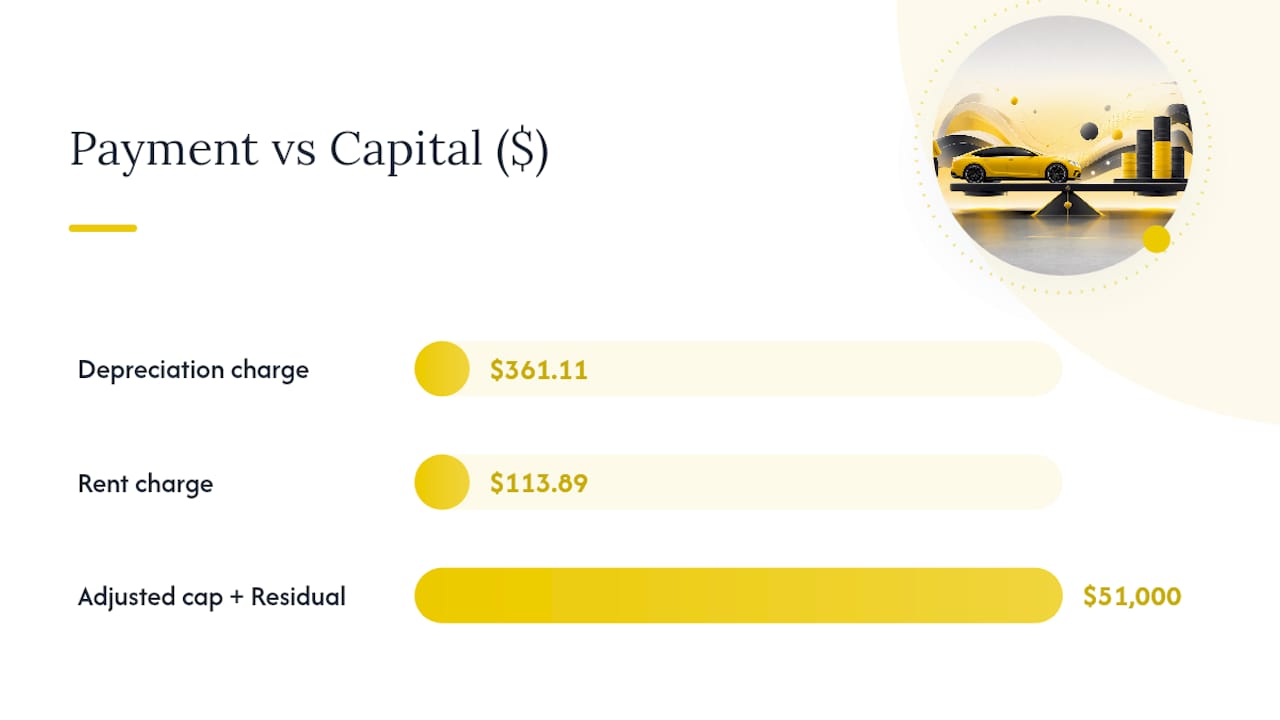
That 0.00223 is the number you compare against the captive lender’s published buy rate for that credit tier. If the dealer’s paperwork shows something noticeably higher, you’ve likely found a markup.
Money Factor to APR: Converting and Benchmarking the Rate
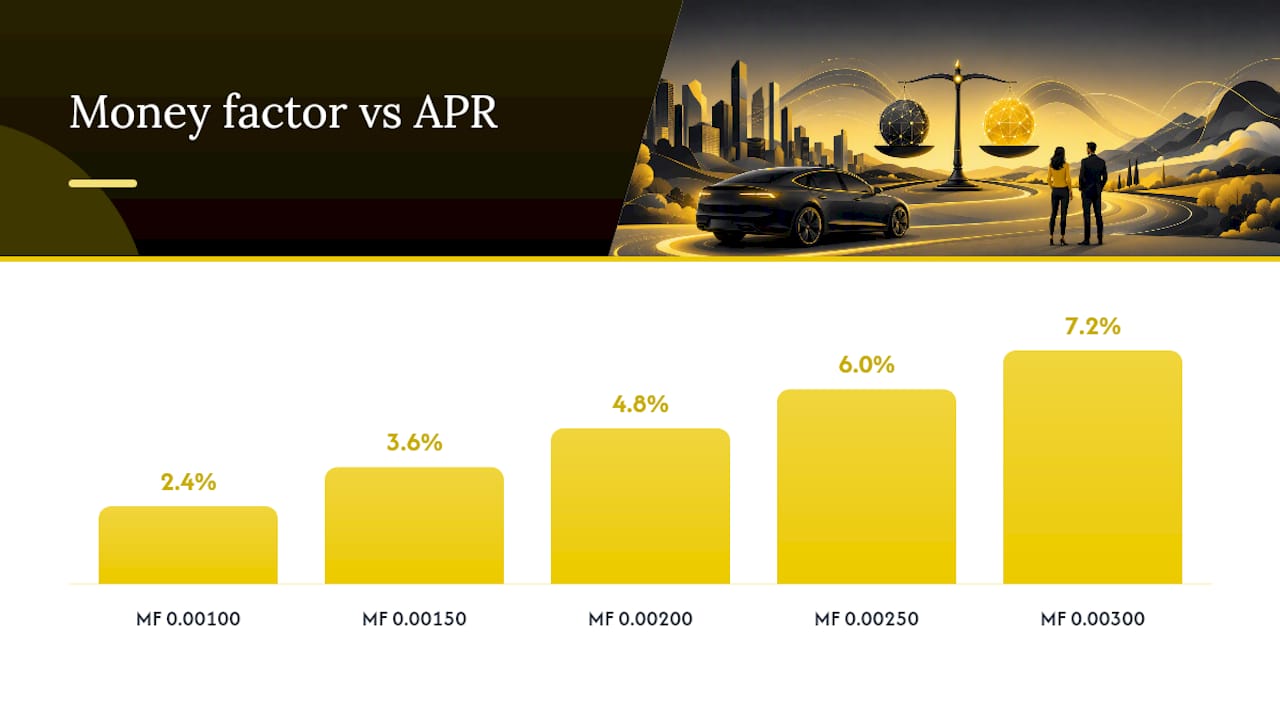
Multiply the money factor by 2,400 and you get an approximate APR, which is the shortcut most finance people use to sanity-check a lease against loan rates. A money factor of 0.0015 converts to roughly 3.6% APR, and a money factor of 0.00223 from the example above converts to about 5.35% APR.
That multiplier isn’t arbitrary. It comes from converting a monthly decimal into an annualized percentage rate using the standard relationship between the two figures, and it’s accurate enough for comparison shopping even though it isn’t a perfect legal APR calculation.
| Money factor | Approximate APR |
|---|---|
| 0.00100 | 2.4% |
| 0.00150 | 3.6% |
| 0.00200 | 4.8% |
| 0.00250 | 6.0% |
| 0.00300 | 7.2% |
A quarter point of money factor, roughly 0.00010, can shift a 36-month lease’s total finance cost by well over a hundred dollars, and the difference compounds when the adjusted cap cost and residual are both high, since the rent charge scales off their sum, not just the depreciating balance.
Where do you find a benchmark? Captive lenders don’t publish public rate sheets for consumers, but strong-credit shoppers in recent years have generally seen money factors translating to APRs in the low single digits on subsidized lease specials, while standard, non-promotional leases for buyers with average credit often land higher. Treat any number under roughly 0.00150 as competitive for a mainstream brand and anything above 0.00300 as worth questioning, unless your credit tier or the vehicle segment explains the gap.
One limitation worth remembering: converting to APR tells you how the finance rate compares to a loan, but it does not capture differences in residual value, mileage allowance, or fees. Two leases with identical converted APRs can still have very different total costs once you factor those in.
Negotiating the Buy Rate and Spotting Dealer Markup
The money factor you’re quoted often isn’t the real cost of money. Captive lenders extend a buy rate, the actual wholesale financing cost tied to your credit tier, and dealers are frequently permitted to add a markup on top, called the sell rate, and pocket the difference as extra profit. This works exactly like markup on auto loan interest rates, and it’s legal as long as it’s disclosed, though many buyers never think to ask about it.
Your credit tier drives the buy rate more than almost anything else in the negotiation. Lenders publish internal tier grids, commonly labeled something like Tier 1 through Tier 5 or by score bands, and a jump from a low 600s score to the mid 700s can meaningfully lower your buy rate eligibility. FrenzyCars’ guide to credit scores and car buying breaks down how those tiers work and what score thresholds tend to matter most.
Here’s what to actually ask for at the table:
- “What is the buy rate for my credit tier on this model and term?”
- “Can I see the lease worksheet, including money factor, residual, and adjusted cap cost, in writing?”
- “Is there a markup on the money factor, and if so, how much?”
- “Can you match the manufacturer’s advertised lease special money factor?”
Pro Tip: Print out or screenshot any advertised lease special before you go in. Captive lenders sometimes post promotional money factors online for specific trims, and having that number in hand makes it much harder for a dealer to claim “that’s just how it is” on the sell rate.
If a dealer won’t disclose the buy rate or hedges with vague answers, you have real leverage. Ask for the quote in writing and take it home before deciding. Compare it against a second dealership’s worksheet for the same model, since captive lenders set the buy rate, not the individual dealer, so the base number should be consistent across dealers even if the markup isn’t. Walking away costs you nothing and often produces a callback with a better number within a day.
Common Lease Mistakes and Red Flags to Watch For
Payment-only advertising is the single biggest trap in lease shopping. An ad or a text quote that shows only a monthly figure gives you no way to check the math, and that incompleteness is common enough that you should treat any payment-only offer as provisional until you see the worksheet.
Watch for these gaps and issues before you sign:
- Missing money factor or residual on the worksheet. If either is left blank or the dealer says it’s “not something we share,” that’s a signal to push harder or walk.
- Fees quietly rolled into adjusted cap cost. Acquisition fees, extended warranties, and add-ons like paint protection inflate the cap cost, which raises both your depreciation charge and your rent charge since the money factor is applied to that inflated number. FrenzyCars covers this pattern in its guide to dealer add-ons.
- Sales tax treatment varies by state. Some states tax only the monthly payment, others tax the full vehicle price upfront, and a few tax the trade-in value differently than a purchase would. This changes how two otherwise identical lease quotes compare across state lines.
- No mileage or wear-and-tear disclosure. A low money factor doesn’t help you if the mileage allowance is unrealistically tight for your driving habits.
Before signing anything, run through a short checklist: confirm the money factor and residual are both printed on the worksheet, recompute the rent charge yourself, verify no unexplained fees sit inside the adjusted cap cost, and confirm the mileage allowance matches your actual driving needs.
Why FrenzyCars’ Lease Math Approach Works
This breakdown is built around the same worksheet math dealers and captive lenders actually use, not simplified marketing explanations. The goal is arming you with the exact formulas so you can verify a quote in the time it takes to sit at the finance desk.
A few related reads worth checking before your next lease negotiation:
- The credit score guide for understanding how your tier affects the buy rate you’ll be offered.
- The negative equity breakdown if you’re rolling a trade-in into a new lease’s cap cost.
- The dealer holdback guide for negotiation leverage beyond just the money factor.
- The comparison shopping checklist to line up residual, term, and mileage across multiple quotes side by side.
Quick action list before you negotiate: pull your credit report and know your tier, request the full worksheet in writing, recompute the money factor yourself, and get a second dealer’s numbers on the identical trim for comparison.
Where to Verify These Numbers Yourself
Chase’s lease money factor explainer confirms the core rent charge formula used throughout this guide. LegalClarity’s lease payment breakdown walks through the APR conversion math in more technical detail. LeaseGuru’s money factor guide covers buy rate versus markup specifically. For broader consumer protection context on financing versus leasing disclosures, the FTC’s consumer guidance and the Consumer Financial Protection Bureau’s auto loan resources are both worth a look, alongside Consumer Reports for independent cost comparisons.
A Practical Take on Money Factor Negotiation
Get the worksheet and compute the money factor before you discuss anything else at the finance desk. It’s the fastest way to know whether you’re negotiating from real numbers or a payment someone built backward to hit a target. I’d accept a slightly higher money factor only when it comes paired with a genuinely better residual or a manufacturer incentive that lowers the depreciation side more than the rent charge costs you.
Sources
- What Is The Lease Money Factor? | Chase
- How to Calculate a Car Lease Rate and Monthly Payment - LegalClarity
- Lease Money Factor Calculator | Car Finance Tools
- Leaseguru