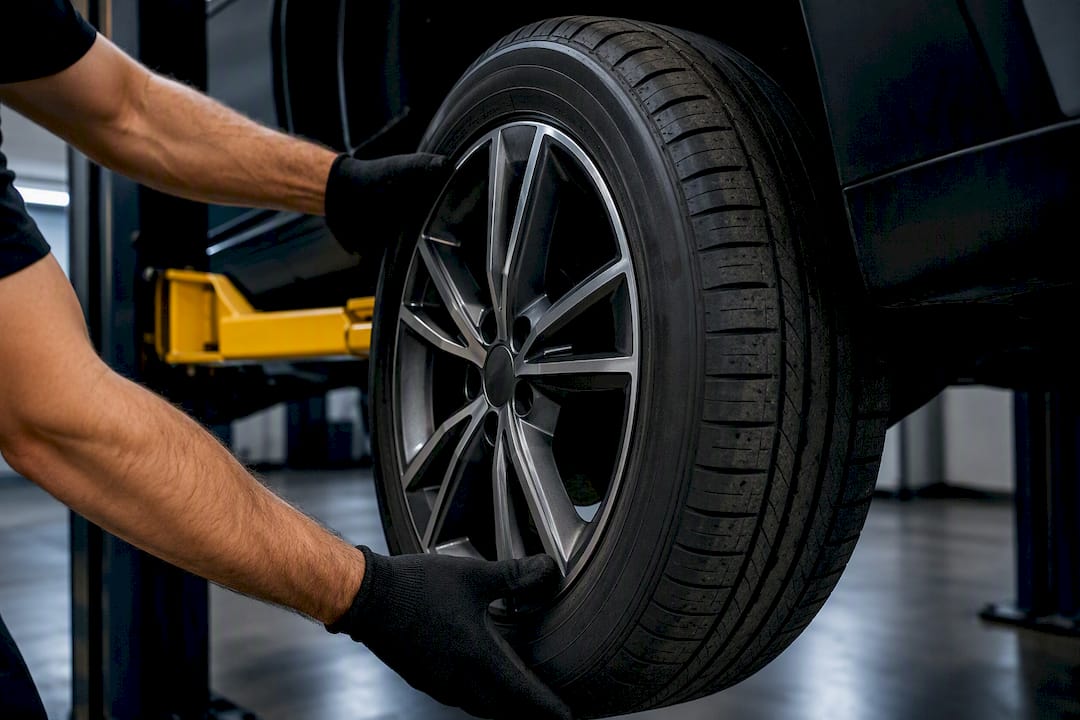
Front-wheel-drive cars need a forward cross, rear-wheel and four-wheel-drive vehicles need a rearward cross, and many all-wheel-drive vehicles do best with an X-pattern. Directional tires break that rule entirely: they stay on the same side of the car, front to back, no exceptions. Staggered setups often can’t rotate side to side at all. Whatever pattern applies, plan on rotating roughly every 5,000 to 8,000 miles, and always defer to your owner’s manual over any generic chart.
TL;DR:
- Non-directional tires should be rotated using the appropriate pattern based on vehicle type, such as forward cross for front-wheel drive or rearward cross for rear-wheel drive, to prevent uneven wear.
- Directional tires and staggered setups require side-to-side or front-to-rear rotations respectively, and should never be crossed to avoid damaging the tread pattern and reducing grip.
- Tire rotation intervals generally range from 5,000 to 8,000 miles, with specific recommendations like Tesla at 6,250 miles and Kia at 8,000 miles, depending on manufacturer guidelines.
- Always follow the vehicle’s owner manual for exact torque specs and rotation rules, especially for AWD and vehicles with specialized setups like dual wheels or full-size spares.
- Performing a tire rotation includes checking tire pressure, inspecting for uneven wear or damage, and re-torqueing lug nuts after 25 to 50 miles to ensure safety and optimal tire life.
What Are the Different Tire Rotation Patterns?
Every tire rotation pattern is really just a map of which corner goes where. Get the direction of that map wrong and you can accelerate wear instead of slowing it down. Here’s how the four main patterns break down.
Forward cross is the standard for front-wheel-drive cars. The rear tires move straight forward to the front, while the front tires cross diagonally to the rear: front-left goes to rear-right, front-right goes to rear-left, rear-left goes to front-left, rear-right goes to front-right. FWD cars chew through front tires faster because the front end handles steering, braking, and most of the power. Crossing the rears forward evens that out.
Rearward cross flips the logic for rear-wheel-drive and four-wheel-drive vehicles. The front tires move straight back, and the rear tires cross diagonally to the front. RWD and 4WD trucks put more wear on the rear axle from power delivery, so this pattern compensates in the opposite direction from forward cross.
X-pattern (sometimes called full cross) moves every tire diagonally: front-left to rear-right, front-right to rear-left, and vice versa for the rears. Some AWD manuals call for this because power distribution shifts constantly between axles, and a full cross spreads wear more evenly across all four positions. Other AWD manufacturers actually specify forward or rearward cross instead, so this is one spot where checking your own manual matters more than following a general rule.
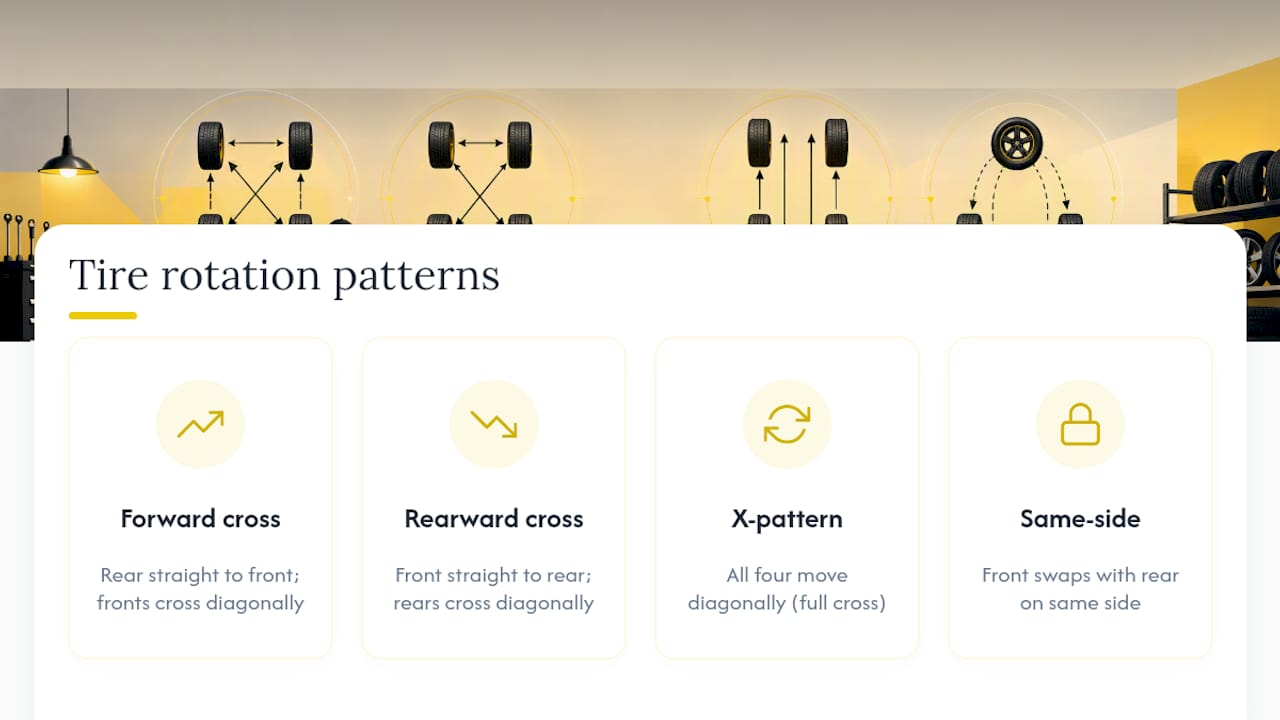
Same-side, front-to-back rotation is for directional tires and staggered wheel setups. Instead of crossing anything, the front tire simply swaps with the rear tire on the same side. It’s less aggressive at evening out wear, but it’s the only safe option when the tire’s tread design or size won’t allow crossing.
Dual rear-wheel trucks and vehicles with a full-size spare use variations on these same four patterns, just with extra positions added into the rotation sequence.
How to Rotate Tires Safely (Step by Step)
Rotating your own tires isn’t complicated, but skipping a step is how people end up with a stripped lug or a wheel that comes loose on the highway. Here’s a safe sequence to follow.
Tools you’ll need: a floor jack, jack stands, a torque wrench, wheel chocks, a tire-pressure gauge, and a marker or chalk to label tire positions before you start.
- Park on level, solid ground and chock the wheels you’re not lifting.
- Loosen (but don’t remove) each lug nut while the tire is still on the ground.
- Mark each tire’s current position with chalk so you can confirm the new layout matches your chosen pattern.
- Jack up the vehicle at the manufacturer’s specified lift points and set it on jack stands before removing any wheel.
- Pull the wheels off in a consistent order so you don’t lose track of which tire goes where.
- Reinstall each tire in its new position according to your pattern, hand-threading every lug nut before lowering the car.
- Lower the vehicle and torque the lug nuts to your manufacturer’s spec in a star pattern, not a circle.
- Check tire pressure against the door-jamb sticker and reset or recalibrate the TPMS system if your vehicle requires it.
Pro Tip: Re-torque every lug nut after driving 25 to 50 miles. Wheels settle slightly after reinstallation, and a quick check with the torque wrench catches anything that loosened during that first short drive.
Tesla’s service manual documents this exact re-torque step along with TPMS recalibration procedures, which is worth a look even if you don’t drive a Tesla, since the logic applies broadly.
What About Directional Tires and Staggered Wheels?
Not every car gets to use the standard crossing patterns, and forcing one onto the wrong setup can actually hurt your tires instead of helping them.
- Directional tires have tread designed to rotate in one direction only, visible as an arrow or “rotation” marking on the sidewall. These can only move front to back on the same side. Cross one to the opposite side and the tread pattern fights the road instead of working with it, cutting into wet-weather grip.
- Staggered setups, common on many sports cars and performance trims, run wider tires in the rear than the front. Different diameters mean the tires physically can’t swap axles, so rotation is often limited to side-to-side swaps on the same axle, or skipped entirely.
- Full-size spares get folded into the rotation on some vehicles, particularly trucks, so all five tires wear at a similar rate over the life of the set. Check your manual to see if this applies to you.
- Dual rear-wheel trucks rotate in triangular patterns per side rather than a simple cross, since each rear position has an inner and outer tire. These setups also need extra attention to balance and alignment after rotation, since dual-wheel wear patterns are harder to spot by eye.
Kia’s owner’s manual guidance specifically calls out directional and staggered tires as exceptions that shouldn’t be cross-rotated, which lines up with what most manufacturers specify.
How Often Should You Rotate Your Tires?
Most manufacturers land somewhere between 5,000 and 8,000 miles, but the exact number varies by brand and vehicle. Tesla recommends rotating every 6,250 miles on the Model 3, while Kia specifies 8,000 miles for many of its models. The gap comes down to drivetrain layout, tire design, and how the manufacturer weighted rotation against other maintenance intervals.
By the numbers: Manufacturer guidance generally clusters around a 5,000 to 8,000 mile windows for rotation, though individual owner’s manuals can specify a tighter or looser interval depending on the vehicle.
Beyond mileage, tread depth tells you what mileage can’t. Replace a tire once tread hits 4/32 of an inch on most manufacturer guidance, and rotate sooner if you notice a depth difference of roughly 1/32 to 2/32 of an inch between tires on the same axle. If you’re seeing cupping, feathering, or wear concentrated on one edge of the tread, that’s usually an alignment or suspension issue rotation alone won’t fix.
FrenzyCars Practical Checklist for a Safer Rotation
A little prep before you crack a lug nut saves a lot of frustration under the car. Run through this before you start:
- Lay out your jack, stands, torque wrench, chocks, and pressure gauge within reach before jacking anything up.
- Wear gloves and eye protection, and work on a flat, hard surface, never gravel or a slope.
- Mark each tire’s position with chalk before removal so the new pattern is easy to verify.
While the tires are off the car, take the extra two minutes to actually look at what you’re dealing with. Check sidewalls for bulges or cuts, measure tread depth at a few points across the tire, glance at the brake pads through the caliper opening, and spin each wheel by hand to feel for any wobble that might point to a balance problem.
Pro Tip: If a tire’s wear pattern looks lopsided even after rotation, or a wheel doesn’t spin smoothly by hand, stop and get it checked by a shop with a balancer. That’s not something a home garage setup can diagnose reliably.
A torque wrench isn’t optional gear here, and neither is that re-torque check after a short drive.
Is DIY Rotation Right for You, or Should You Call a Shop?
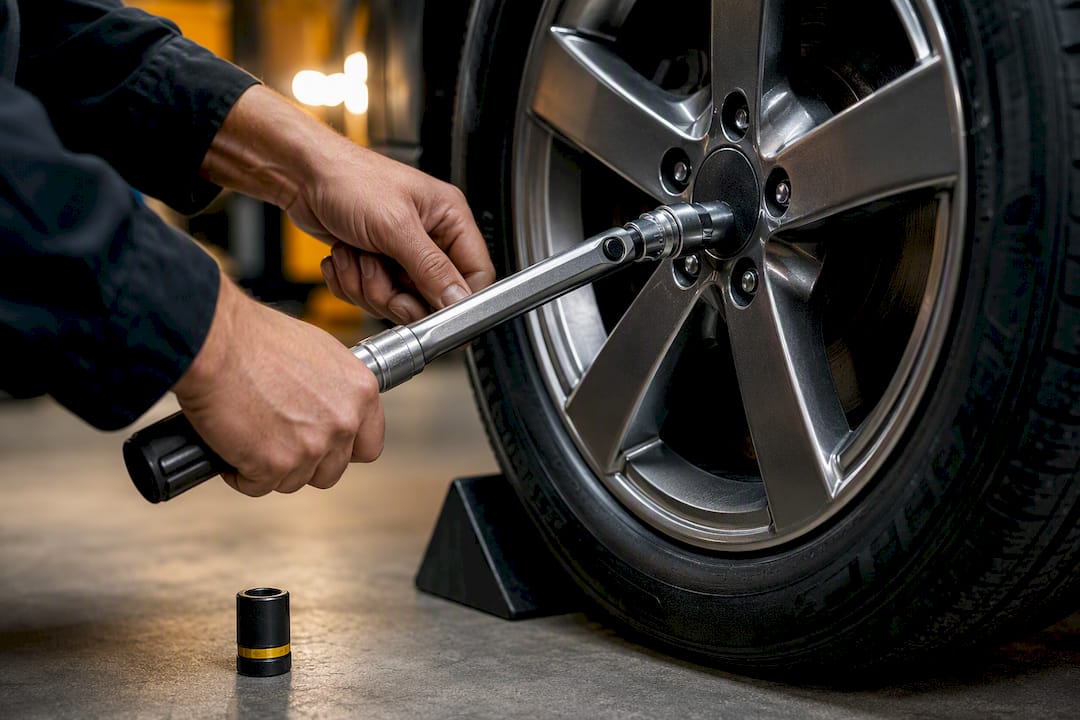
A rotation takes most DIYers 30 to 45 minutes once they’ve done it a couple of times, and the skill ceiling is low if you’re comfortable with a jack and a torque wrench. Where shops earn their fee is the extras: a lift that gets all four corners off the ground at once, calibrated torque tools, and a trained eye for alignment or balance issues you’d otherwise miss. If your car has a pattern you’re unsure about, or you notice uneven wear you can’t explain, that’s the moment to stop guessing and let a shop take a look. Follow your owner’s manual first. It beats any general chart, including this one.
Where to Find Model-Specific Torque Specs and More
Every vehicle has its own quirks, and a rotation pattern chart only gets you so far without the exact torque numbers and manual notes for your specific model. Frenzycars keeps detailed specs by make and model so you’re not guessing at lug torque or rotation intervals your manufacturer actually specifies. If you’re weighing which vehicle to buy next and want to know how rotation needs and maintenance costs differ across categories, the best cars by category guide breaks that down before you commit to anything. Pair a rotation with a broader tune-up using the performance maintenance checklist, and if uneven wear keeps showing up no matter how carefully you rotate, read up on how alignment affects tire life before you replace anything. Start with your model’s spec page, then build your maintenance routine from there.
Sources
Generic rotation charts get you most of the way there, but your vehicle’s own documentation should always have the final word. The Tire Industry Association publishes consumer guidance on rotation frequency and treats it as a standard safety inspection point, not just a wear-management chore. For a broader look at typical intervals and the directional-tire rule across vehicle types, the Wikipedia overview of tire rotation is a solid starting point. When it’s time to get specific, pull up your own owner’s manual. Kia and Tesla both publish their exact rotation intervals, torque specs, and TPMS steps online, and those numbers override anything generic you’ll find elsewhere, including this article.
- Tire rotation — Kia Owner’s Manual (web help)
- Tire Rotation — Tesla Service Manual (Model 3, 2024)
- Tire rotation — Wikipedia