
Out the door price is the total dollar amount you actually pay to drive a car off the lot, including tax, title, registration, and every dealer fee. It’s the only number worth negotiating. Lock a written out the door quote before you say a word about monthly payments, financing, or trade-in value, since those talks are where dealers rebuild the margin you just cut. Sales tax and registration fees vary by state, but everything else on that quote is up for discussion.
TL;DR:
- Most dealer-added fees like documentation, advertising, and dealer prep are negotiable or removable, but government fees such as sales tax and registration are fixed by the state.
- Always calculate and compare your out the door total before discussing financing or trade-ins to avoid hidden costs inflated by longer loan terms or rolled-in add-ons.
- Get the detailed, itemized out the door quote in writing beforehand, and be prepared to walk away if the dealer refuses to provide transparent pricing or insists on bundling fees.
- Use preapproval letters and independent trade-in valuations to negotiate separately, ensuring clear control over your total vehicle purchase cost.
- Avoid unnecessary add-ons and extra fees after the initial price negotiation, as they often have little real value and can significantly inflate the final amount.
What Does Out the Door Pricing Actually Include?
An itemized out the door quote separates two very different categories of charges, and knowing which is which is the whole game.
The first category is government fees. Sales tax, title, and registration are set by your state and county, and no dealer can waive them. NerdWallet’s breakdown of OTD pricing confirms these are the fixed core of any all-inclusive pricing quote, alongside the negotiated sales price itself.
The second category is where dealers make their money back. These charges have no legal floor, and plenty of them can be reduced or removed if you push.
- Documentation (“doc”) fee — covers paperwork; ranges widely by state and dealer, and is often negotiable.
- Destination/freight charge — usually fixed by the manufacturer, not the dealer, so it rarely moves.
- Dealer prep fee — often duplicates work already covered by destination charges; worth challenging.
- Advertising fee — a regional cost some dealers pass on; frequently negotiable or waivable.
- VIN etching, nitrogen tires, paint sealant — classic add-ons with thin real cost behind them.
- Extended warranties and service contracts — optional, and never required to buy the car.
What usually stays outside the out the door number: loan interest, insurance premiums, and future maintenance. Those are ownership costs, not purchase costs, and they belong in a separate conversation.
How Do You Calculate Your Out the Door Price?
The math isn’t complicated, but doing it before you walk into a dealership changes the entire conversation. Here’s the sequence:
- Start with the negotiated vehicle price. Use the number you agreed on, not MSRP, unless negotiations haven’t happened yet.
- Add sales tax. This is a percentage of the price set by your state and sometimes your county or city.
- Add title and registration fees. These are flat or tiered fees your state DMV sets.
- Add destination and any legitimate dealer fees. Include the doc fee only if you couldn’t get it reduced.
- Add any accepted add-ons, priced individually, never bundled into “one low payment.”
- Subtract your down payment and trade-in credit to land on the cash due or the amount you’ll finance.
Here’s how that plays out on a $30,000 vehicle. In a state with a moderate sales tax rate, once you layer in tax, title, registration, and typical dealer fees, the realistic out the door total lands around $33,500 to $34,500, according to one dealer’s own cost breakdown.
Before you visit a dealership, run your own numbers through an online OTD calculator as a cross-check. Expect small differences from dealer quotes since local fees and doc fee amounts vary, but a wildly different total is a red flag worth questioning.
How Do You Negotiate the Out the Door Price?
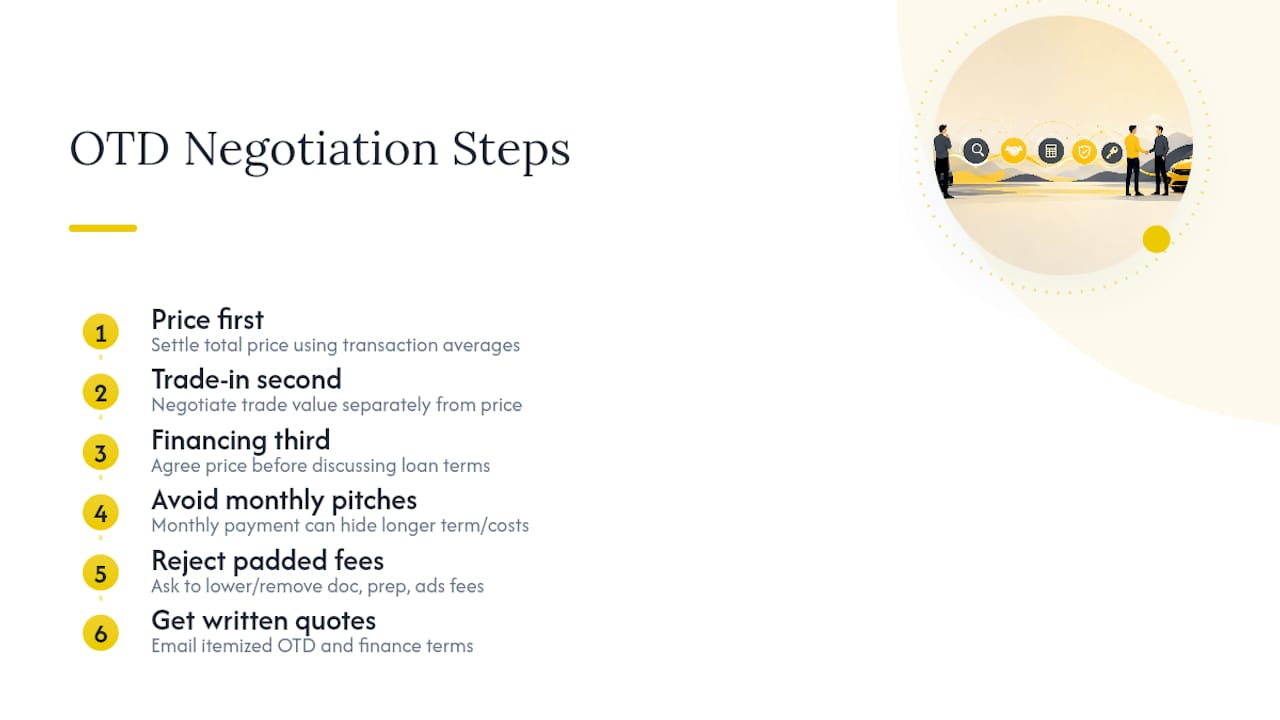
Negotiate one variable at a time. Price first, trade-in second, financing third, and never let a dealer collapse all three into a single monthly number. Consumer Reports recommends working from average transaction price data rather than invoice price, and settling that number completely before anything else enters the discussion.
Monthly payment talk is where good deals quietly die. A dealer can hit your target monthly number while stretching the loan term to 72 or 84 months, or by rolling in add-ons you never agreed to. Bankrate’s guidance on OTD negotiation is blunt about this: a payment that feels affordable can still hide a much higher total cost once term and interest are factored in. Keep the conversation on the total price until that’s final. Only then talk financing.
Not every fee on the sheet is fixed. Dealers routinely pad doc fees, prep charges, and advertising fees, and many will drop or shrink them if you’re firm about the out the door total you’re willing to pay, per reporting on trade-in and fee negotiation. Try direct language: “I’ll agree to this price if the doc fee comes down to X” or “Remove the nitrogen tire fee and we have a deal.”
Competing quotes are your strongest leverage. Email two or three dealers for their best out the door price on the same trim and options, and let them know you’re comparing. Being genuinely willing to walk away, and saying so calmly, does more work than any script.
Pro Tip: Ask the dealer to email you the itemized OTD quote before you drive in. A number they’ll put in writing is a number they’ll usually honor.
Before signing anything, insist on getting these in writing: the full itemized OTD breakdown, explicit opt-outs for any add-on you declined, and the financing terms (APR, term length, total interest) as a separate document.
Why Financing and Trade-Ins Stay Separate From OTD
Loan interest has nothing to do with your out the door price. It’s the cost of borrowing money, and it depends entirely on your APR and loan term. Bankrate notes that financing is effectively its own transaction. Once your OTD is locked, compare loan offers side by side on rate, term, and total interest paid, not just the monthly figure.
Get preapproved by a bank or credit union before you visit the lot. That preapproval becomes your benchmark against whatever the dealer’s finance office offers, and it stops them from being your only option.
- Value your trade-in independently first, using KBB, Carvana, or CarMax before you ever mention it to the dealer.
- Negotiate the trade-in as its own line item, after the OTD price is settled, not blended into it.
- Apply the trade-in credit to your already-agreed OTD number rather than letting the dealer fold it into a “revised” price.
What Should You Bring to the Dealership?
Show up prepared and the negotiation moves faster and in your favor.
- Bring your documents. ID, proof of insurance if required in your state, your loan preapproval letter, and a printed trade-in valuation.
- Know your numbers. Set a firm OTD ceiling, decide the maximum doc fee you’ll accept, and know the APR and loan term you’re comparing against.
- Ask direct questions. Try: “Can you send me the full itemized out the door price in writing?” and “Which of these fees can be removed or reduced?”
- Watch for red flags. A dealer who won’t put the OTD number in writing, who keeps steering back to monthly payment, or who bundles add-ons without itemizing them, is telling you to walk.
FrenzyCars’ Take: Skip the Add-Ons, Protect the Budget
The fastest way to blow a car budget isn’t the sticker price. It’s the pile of add-ons stacked on afterward, things like paint sealant, fabric protection, or a “market adjustment” that has no basis in cost. Question every add-on individually and ask what it actually does before agreeing to pay for it.
Resources have broken down exactly how to avoid overpaying for dealer add-ons, and how optional packages actually work so you know which ones add real value. Reading both before you negotiate turns guesswork into a plan.
Where to Go Next Before You Call a Dealer
Frenzycars is the resource car buyers turn to before they ever step into a showroom, because getting the out the door number right starts with knowing exactly what you’re buying. Check current car specs by make and model to confirm MSRP and standard equipment against whatever the dealer quotes, so you’re negotiating from accurate numbers instead of a sales sheet.
If you’re still narrowing down which car to buy, the best cars by category guide helps you settle on a target model and trim before you request quotes. And if you’re planning to finance, comparing car insurance options for new drivers ahead of time gives you one more real cost to weigh against that final OTD number, since a low price with a high premium isn’t actually a good deal.
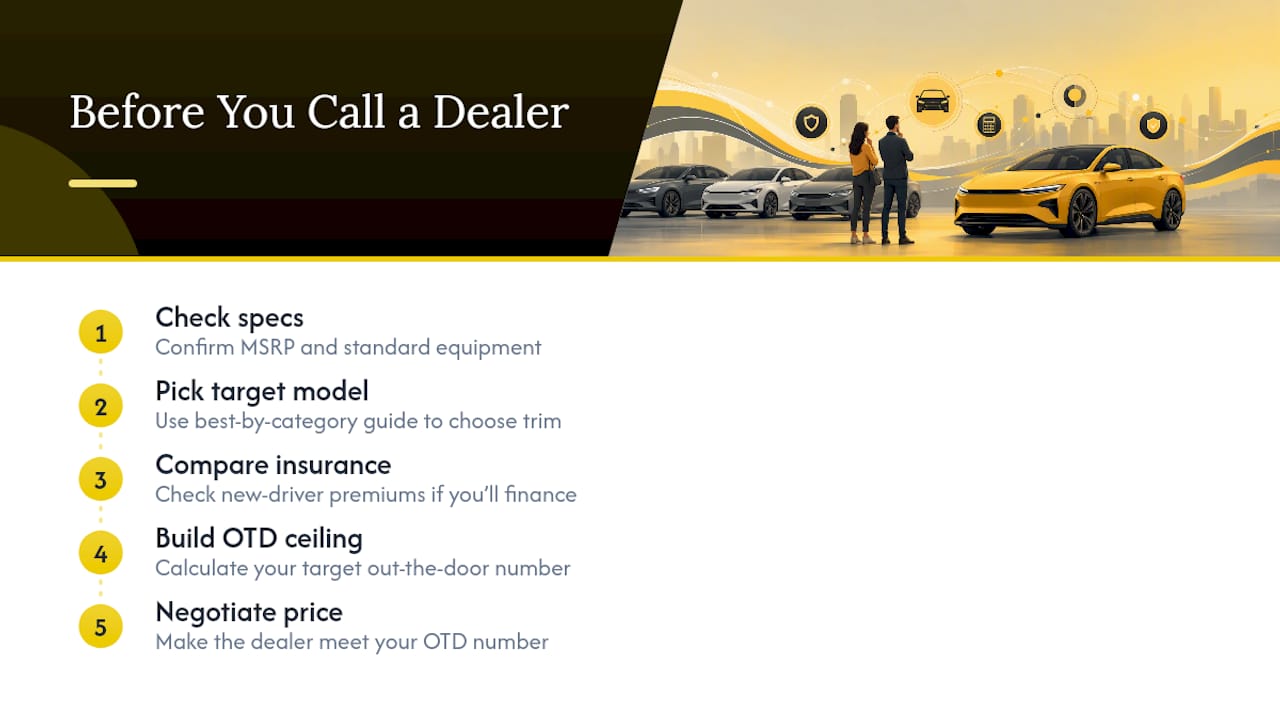
Start with the specs page, build your target OTD ceiling, then go make the dealer meet your number.
Sources
- Should you negotiate OTD price or monthly payment? | Bankrate
- How to negotiate a new car price effectively | Consumer Reports
- Out‑the‑Door price on a car: What you’re really paying