
A preapproved car loan gives you a conditional borrowing limit and a real negotiating edge at the dealership, backed by a hard credit check rather than a soft guess. The tradeoff is small: your score dips slightly, and the offer isn’t the final loan until underwriting confirms your income and the vehicle. For most buyers who plan to purchase within a couple of months, it’s worth doing.
TL;DR:
- Preapproval involves a hard credit check and provides a specific borrowing limit, offering stronger negotiation leverage compared to soft prequalification estimates.
- Applying to multiple lenders within a 14-day window minimizes the credit score impact and allows comparison of APR, loan term, and maximum approved amount.
- A preapproved loan amount helps set a realistic budget, improves bargaining power, and speeds up the purchasing process once you find the right vehicle.
- Lenders differ in approval criteria: banks often have stricter underwriting, credit unions offer better rates, and online lenders accept broader credit profiles.
- A preapproval offer is valid for 30 to 60 days and should be used within a few weeks of shopping for maximum effectiveness.
Preapproval vs. Prequalification: Which Should You Use When?
The two terms get used interchangeably, but they’re not the same product. Prequalification runs a soft credit check, so it doesn’t touch your score, and it hands you a ballpark estimate of what you might borrow. Preapproval goes further: it typically requires a hard credit inquiry and returns a specific borrowing limit and estimated rate, conditional on verifying your paperwork.
Here’s how to use each one:
- Prequalify first if you’re still browsing and want a rough budget without any score impact.
- Get preapproved once you’re seriously shopping and ready to make an offer within a few weeks.
- Never skip preapproval entirely if you plan to negotiate hard on price. A soft estimate carries no weight at the finance desk.
Top Benefits of Getting Preapproved
A firm number changes how you shop. Instead of guessing what a monthly payment might look like, you already know your ceiling, which means you can calculate the full out-the-door price, taxes and fees included, before you ever step on a lot.
The bigger shift is psychological. Walking in preapproved turns you into something closer to a cash buyer, and salespeople treat cash buyers differently than they treat someone still hoping to qualify for financing.
- You get budget certainty before you fall in love with a car you can’t actually afford.
- You gain leverage to negotiate the vehicle’s price instead of getting steered toward monthly payment tricks.
- You can compare your bank’s or credit union’s rate against the dealer’s offer and pick whichever is cheaper.
- You close faster once you find the right vehicle, since financing is already lined up.
Pro Tip: Ask the dealer’s finance manager to beat your preapproved rate in writing before you sign anything. If they can’t, you’ve already got the better deal in hand.
Step-by-Step: How to Get Preapproved for a Car Loan
Getting preapproved isn’t complicated, but skipping a step usually costs you money or time later.
- Pull your credit reports from all three bureaus and dispute any errors before applying. A wrong late payment can knock your rate up a full percentage point or more.
- Calculate a realistic loan amount. Don’t just price the car. Add roughly 10% for taxes, registration, and fees so you’re not surprised at the out-the-door total.
- Gather your documents: government ID, Social Security number, recent pay stubs, proof of address, and employer information.
- Apply to two or three lenders within the same 14-day window. Credit scoring models generally treat multiple auto loan inquiries submitted close together as a single event, so shopping around doesn’t multiply the damage to your score.
- Compare the offers on four points, not just the rate: APR, loan term, maximum approved amount, and the expiration date on each offer.
- Pick the best overall deal and keep the paperwork ready to bring to the dealership.
Bankrate recommends comparing at least three lenders before settling, since rate spreads between lenders on the same borrower profile can be wider than people expect.
Which Lenders to Apply to and How They Differ
Not every lender fits every buyer, and the differences matter more than most people assume going in.
- Banks often give existing customers a relationship discount on the rate, but underwriting tends to be stricter, especially on credit history.
- Credit unions frequently beat bank rates and offer more borrower-friendly terms, though you typically need to join as a member first.
- Online lenders move fast, often returning a decision in minutes, and tend to accept a broader range of credit profiles.
- Manufacturer finance arms dangle promotional rates, sometimes near 0%, but usually restrict them to specific trims, model years, or credit tiers.
If your credit history is thin, a lender that works with limited-history borrowers can matter more than chasing the lowest advertised rate. FrenzyCars’ guide to credit score’s role in car buying breaks down what actually moves your rate before you apply.
Documents and Details Lenders Will Ask For
Have this ready before you start an application, and the process moves in minutes instead of days.
- Government-issued ID and your Social Security number.
- Proof of income: recent pay stubs, a W-2, 1099s, or bank statements if you’re self-employed.
- Proof of residence, such as a utility bill or lease.
- Employer name, address, and how long you’ve worked there.
- Your target loan amount and preferred term.
- Vehicle details or trade-in information, if you already have a car picked out.
- Proof of insurance, which some lenders request before finalizing.
Timing, Credit Impact, and How Long Preapprovals Last
A hard inquiry from a preapproval application usually knocks a few points off your FICO score, often five points or less, and it stays on your credit report for two years.
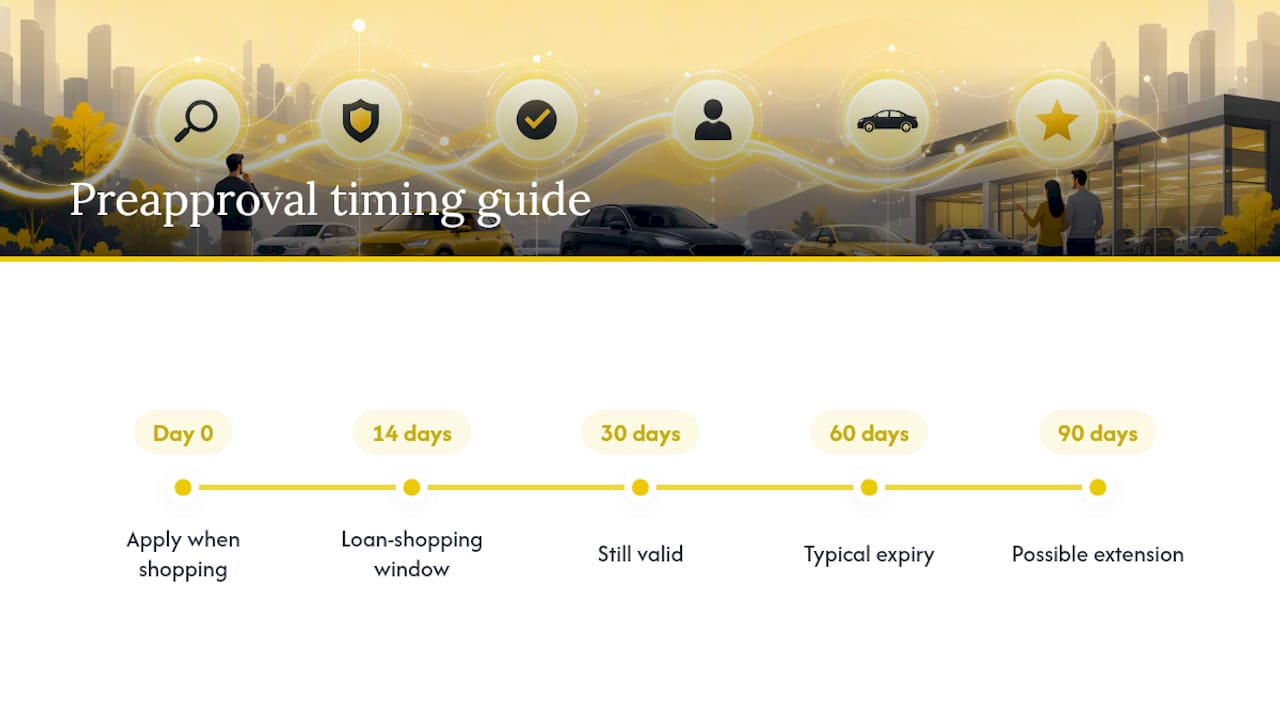
The good news: scoring models expect people to shop around for auto loans. Submit your applications within roughly a 14-day window, and most models count them as a single inquiry instead of several. Wait weeks between applications, though, and each one counts separately.
Preapproval offers typically expire in 30 to 60 days, though some lenders extend that window to 90 days. Apply too early and your offer lapses before you find the right car. Apply too late and you’re negotiating without a number in hand. The sweet spot is starting preapproval once you’re actively looking, not months ahead of time.
How to Use a Preapproval at the Dealership
Bring your preapproval letter into the finance office and let it do the talking. It proves you can close the deal, which shifts the entire conversation from “can you afford this car” to “what’s the best price.”
- Lead with the out-the-door price, not the monthly payment. The CFPB confirms you can negotiate the dealer’s rate and ask them to match or beat your preapproved offer.
- Expect the dealer’s finance team to still run their own checks on income and the specific vehicle before anything is final.
- Don’t treat your approved limit as a target to spend. Calculate total ownership costs, insurance and fuel included, before deciding how much of that ceiling to actually use.
If Your Preapproval Is Denied or the Offer Is Weak
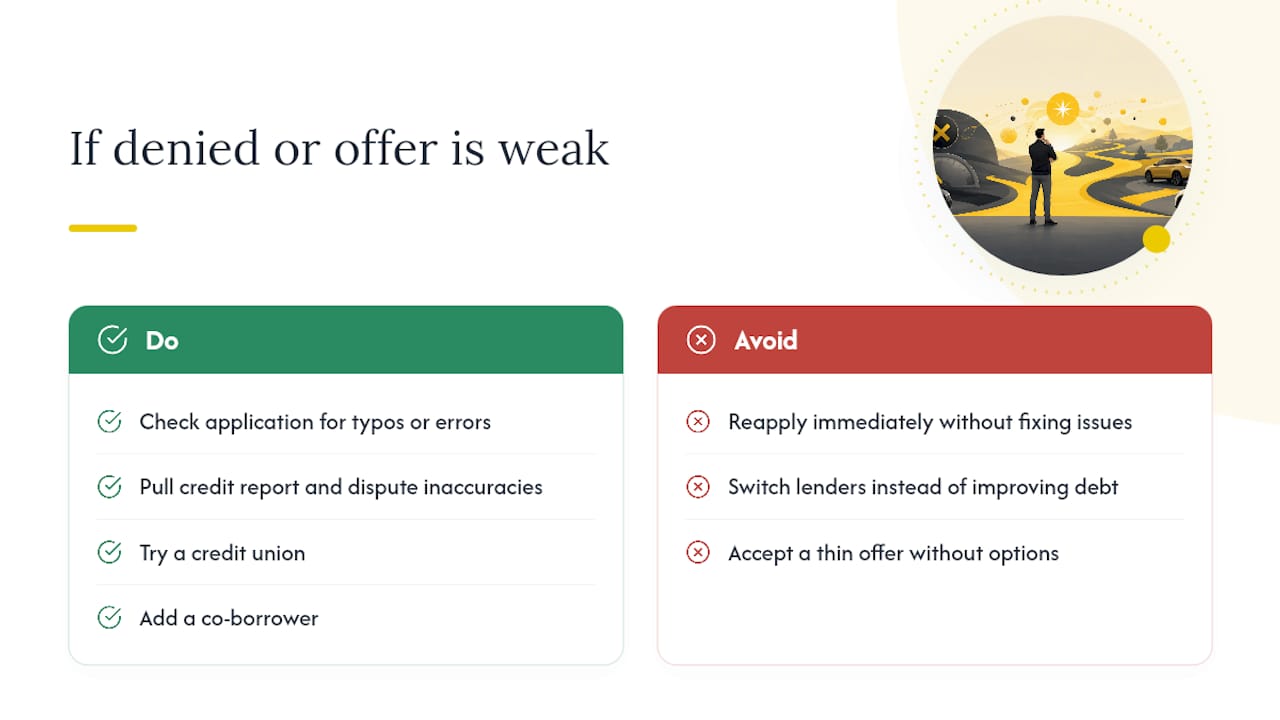
Start by checking the application itself for a typo or mismatched income figure, then pull your credit report and dispute anything inaccurate. If the numbers are accurate but the offer is thin, try a credit union, add a co-borrower, or increase your down payment.
Pro Tip: If buying isn’t urgent, spend 60 to 90 days paying down revolving debt before reapplying. That single move often improves your rate more than switching lenders does.
FrenzyCars Perspective: Matching Preapproval to Car Selection
A preapproval number is only useful once you translate it into an actual short list of vehicles. A $28,000 approval might mean a well-optioned new compact SUV or a lightly used midsize sedan with lower mileage, and the right call depends on how you weigh depreciation against warranty coverage.
- Run your approved amount against FrenzyCars’ Car Comparison Shopping Checklist to narrow trims and model years that fit.
- If you’re leaning used, work through the Used Car Test Drive Checklist before you commit any of that budget.
- Rolling in a trade? Check your equity position with FrenzyCars’ negative equity guide before it eats into your new loan.
A Quick Perspective on When and How to Use Preapproval
Preapproval works best applied one to four weeks before you actually buy, not months in advance, and shopped across lenders inside that same 14-day window every time. Treat the number as a negotiating tool aimed at price, never as a target you’re obligated to spend.
Ready to match your preapproved budget to a real vehicle? Browse car specs by make and model on FrenzyCars to see what your approved amount actually buys, or check best cars by category if you’re still narrowing down what fits your life.
Sources
- How to get preapproved for a car loan — Bankrate
- Auto loan preapproval vs. prequalification — LendingTree
- Auto loan prequalification vs preapproval — USSFcu