Six transmission families matter in sports cars: manual (synchromesh, close-ratio, and dog-box variants), dual-clutch (DCT), torque-converter automatic, CVT, sequential/racing gearboxes, and automated manuals (AMT). Manuals win on driver engagement, DCTs win on shift speed and lap times, torque-converter automatics win on daily comfort in high-power cars, and CVTs mostly stay out of true sports cars because they can’t deliver the punch drivers want. Sequential racing gearboxes and AMTs sit at the extremes: one built for the track, the other built to hit a price point.
Here’s how the article breaks down the comparison:
- Shift speed and responsiveness
- Driver involvement and engagement
- Efficiency and fuel economy
- Weight and packaging
- Cost and complexity
- Typical durability and maintenance needs
- Best use: track versus street
Key Takeaways
Transmission choice shapes a sports car’s speed, feel, and long-term ownership cost as much as the engine does, and no single type wins across every priority.
| Point | Details |
|---|---|
| Manuals maximize engagement | Synchromesh street manuals and dog-box track variants deliver unmatched driver control, at the cost of shift speed. |
| DCTs win on lap times | Dual-clutch preselection keeps torque interruption minimal, but repairs can run expensive if the mechatronic unit fails. |
| Torque-converter autos suit daily power | Modern lock-up strategies close the gap with DCTs while staying smoother in traffic and easier to live with. |
| CVTs rarely fit sports cars | Continuous ratios favor efficiency over the crisp, linear power delivery enthusiasts expect. |
| Racing gearboxes inform road tech | F1’s seamless-shift and NASCAR’s rear-mounted transaxle designs shaped paddle-shift and packaging trends now common on the street. |
Why Transmission Choice Matters in a Sports Car
A transmission isn’t a convenience feature in a sports car. It’s a performance component that decides how quickly power actually reaches the pavement, and how much of the experience is left in the driver’s hands.
Shift speed directly affects acceleration numbers. A gearbox that completes a shift in milliseconds keeps the engine in its power band without the momentary torque drop you feel in a slower shifting manual. That’s why dual-clutch cars routinely post quicker 0 to 60 times than their manual counterparts, even when the engines are identical. Continuity of torque delivery, not raw horsepower, is often the difference on paper.
Engagement is the other half of the equation, and it’s subjective in a way lap times aren’t. Some drivers want to work the clutch pedal and feel the mechanical connection of an H-pattern shifter. Others want paddles at their fingertips and zero distraction from steering inputs. Neither preference is wrong, but they lead to very different gearbox choices.
Weight and packaging matter more than most buyers realize. A heavier automatic or DCT unit sits differently in the chassis than a lighter manual, and that shifts the car’s center of gravity and front-to-rear balance. Engineers building a genuine track car often default to a manual or sequential unit specifically because of the weight savings, not just the driving feel.
Electrification is starting to blur these lines. In hybrid performance cars, an electric motor can fill in torque gaps during a gear change, which changes what a transmission even needs to do. You can see this shift already reshaping how manufacturers pair gearboxes with hybrid powertrains in newer performance models.
Pro Tip: On a test drive, don’t just floor it in a straight line. Roll into a slow parking lot maneuver, then accelerate hard from a stop. That combination exposes low-speed clutch behavior and shift response better than any spec sheet.
Manual Transmissions: Synchromesh, Close-Ratio, and Dog-Box Designs
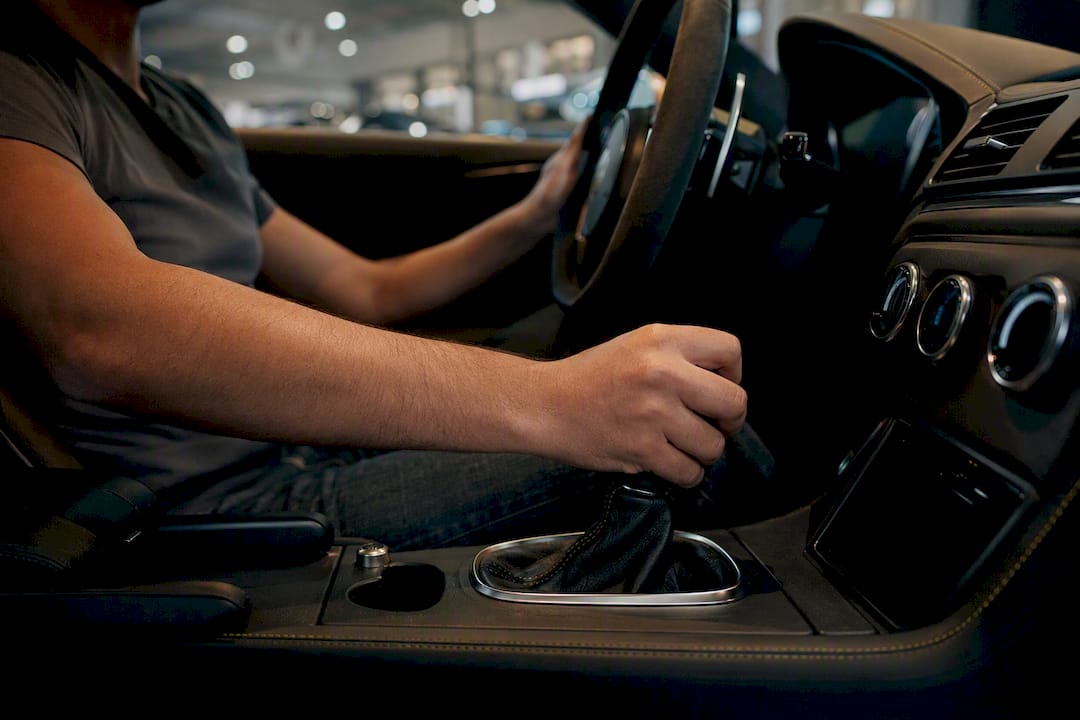
A manual transmission gives you full mechanical control over gear selection through a clutch pedal and shift lever, and it remains the benchmark for driver engagement even as it disappears from most new car lineups.
Street manuals rely on synchromesh, a system of friction rings that match gear speeds before engagement so shifts happen smoothly without grinding. Manual transmissions built this way are forgiving for daily driving, which is exactly why they dominate street cars even in performance trims. Close-ratio gearsets, common in sports-car-specific manual boxes, pack the gear ratios tighter together so the engine stays closer to its powerband between shifts. That comes at the cost of a shorter overall spread, meaning higher revs at highway speed and more frequent shifting on a back road.
Dog-box and sequential-style manuals skip synchronizers entirely. Gears engage through dog rings, which lock together almost instantly rather than gradually syncing speeds. That makes shifts faster and allows clutchless upshifts in some setups, but it also makes the gearbox noisier and less forgiving of a lazy shift. This is why you find dog-boxes in dedicated track cars and motorsport applications rather than daily drivers.
The trade-offs break down like this:
- Driver engagement: unmatched by any automated system, since the driver controls clutch feel, timing, and rev matching directly.
- Shift speed: slower than DCT or sequential units, bottlenecked by human reaction time and clutch travel.
- Weight: typically the lightest option, which helps with balance and reduces unsprung and rotating mass.
- Durability: clutch wear is the main service item, with replacement intervals varying wildly based on driving style, sometimes 30,000 miles for a commuter, far less for someone who tracks the car often.
Resale value on manual sports cars has actually held up well in recent years as enthusiasts chase the increasingly rare stick-shift option. Lightweight, track-focused coupes and lower-power roadsters are where manuals still make the most sense today. They’re less common on high-horsepower flagship models, where manufacturers assume most buyers want the quicker, hands-off alternative.
Dual-Clutch Transmissions: Why They Dominate Modern Performance Cars
A dual-clutch transmission uses two separate clutches, one handling odd gears and the other even gears, so the next gear is already preselected and waiting before you ask for it. That’s the entire trick behind why DCTs feel instantaneous.
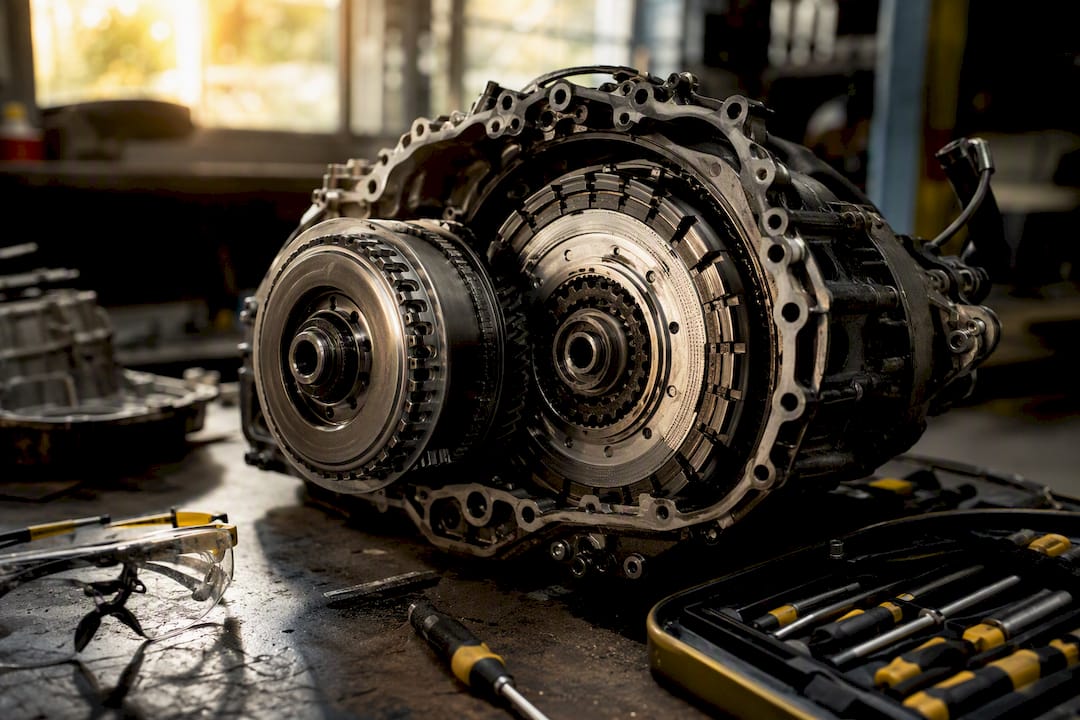
When you pull a paddle, the transmission simply swaps which clutch is engaged rather than disengaging power, selecting a gear, and reengaging the way a traditional manual or torque-converter automatic does. The result is a shift that interrupts torque delivery for a fraction of a second instead of the noticeable pause you feel in a manual. This is also the same principle borrowed loosely from racing gearboxes, where paddle-shift systems proved that removing the driver’s manual clutch input could make shifts both faster and more consistent.
Performance advantages are the whole reason DCTs took over the sports car segment through the 2010s and beyond:
- Shift times measured in tens of milliseconds, far quicker than any human-operated clutch.
- Consistent, repeatable shifts lap after lap, which matters enormously for lap-time consistency on track.
- Integrated launch control that manages both clutches and engine output simultaneously for optimized standing starts.
- Minimal torque interruption, which keeps acceleration curves smoother and often quicker on paper than a manual in the same car.
The trade-offs are real, though. DCTs are mechanically complex, with two clutch assemblies, dual input shafts, and a mechatronic control unit that adds both weight and cost. Some early dual-clutch systems, particularly dry-clutch designs used in lower-power applications, could feel jerky at parking-lot speeds or in stop-and-go traffic, a known complaint from owners of early dry-clutch DCT models. Repairs, when something does go wrong with the mechatronic unit or a clutch pack, tend to be expensive relative to a manual clutch job, sometimes running into several thousand dollars depending on the vehicle.
You’ll find DCTs as the default gearbox in most modern high-performance road cars, often paired with launch control and multiple drive modes that adjust shift aggressiveness. Porsche’s PDK is probably the most widely recognized example of this transmission family reaching mainstream popularity, proving that a dual-clutch unit could satisfy both track-day lap times and everyday usability in the same car.
Pro Tip: Test a DCT in slow traffic before you judge it on the highway. Roll it forward from a dead stop a few times, gently. If you feel a hesitation or a slight lurch, that’s the low-speed clutch calibration showing its limits, and it’s worth knowing before you buy.
Torque-Converter Automatics in Modern Sports Cars
A torque-converter automatic uses a fluid coupling instead of a mechanical clutch to transmit power, and modern versions have closed the performance gap with dual-clutch transmissions far more than most enthusiasts expect.
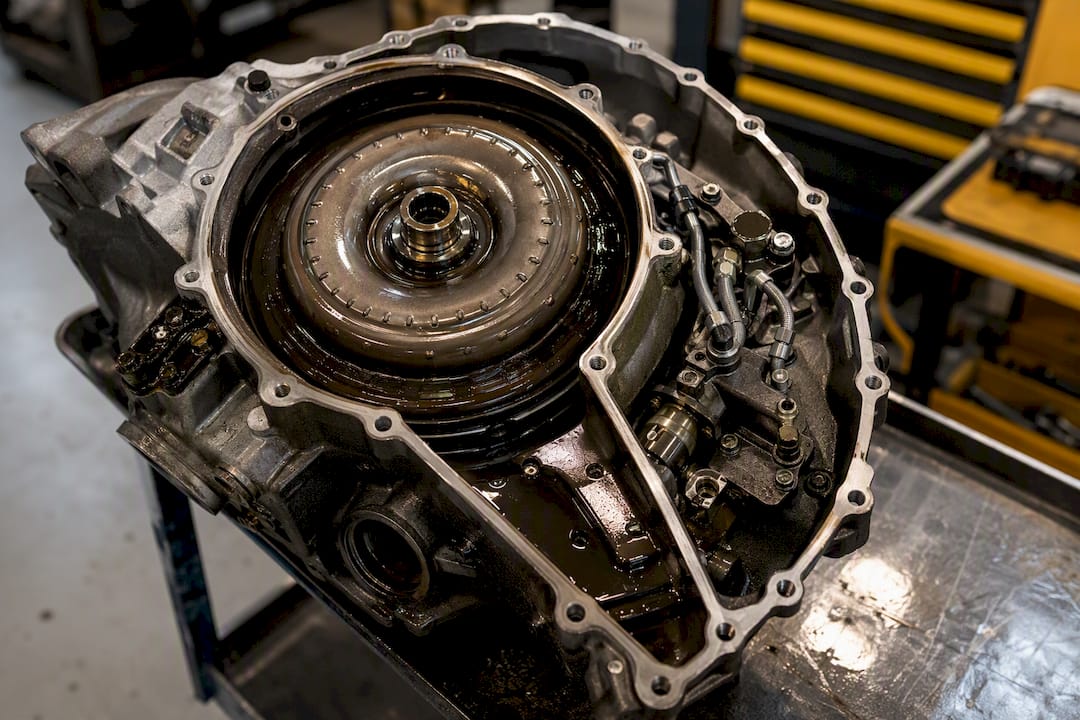
The torque converter itself multiplies engine torque at low speeds through a system of spinning fluid, then a lock-up clutch engages once the car is moving to eliminate the slip and improve efficiency. Where older automatics felt soft and slow to respond, today’s eight, nine, and ten-speed units use quicker, more aggressive lock-up strategies and tighter gear spacing to mimic the crispness of a DCT. Some of that responsiveness traces directly back to lessons learned from motorsport-derived paddle-shift logic, filtered down into consumer-grade transmission software.
Why do manufacturers still choose a torque-converter design for flagship performance cars instead of going all-in on DCTs? Smoothness and low-speed refinement are the biggest reasons. A torque converter doesn’t have the clutch judder issue that can plague dry-clutch DCTs, and it handles the constant modulation of stop-and-go traffic more gracefully.
The trade-offs sit at the opposite end from a manual:
- Weight: generally heavier than a DCT or manual due to the torque converter, planetary gearsets, and additional cooling requirements.
- Efficiency: modern lock-up strategies have closed most of the historical fuel economy gap versus manuals, though DCTs still tend to edge them out slightly.
- Maintenance: transmission fluid changes and filter service are the primary upkeep items, with intervals commonly falling between 30,000 and 60,000 miles depending on the manufacturer and driving conditions.
Grand tourers and high-power luxury performance cars are where torque-converter automatics make the most sense. If you’re covering serious highway miles and want a transmission that disappears into the background during a commute but still snaps off quick shifts on a mountain road, this is usually the better daily compromise over a DCT.
Why CVTs Rarely Show Up in True Sports Cars
A continuously variable transmission uses a belt or chain running between two variable-diameter pulleys, or in some designs a toroidal system, to deliver an essentially infinite range of gear ratios rather than fixed steps.
That continuous ratio adjustment is fantastic for fuel economy because the engine can sit at its most efficient RPM regardless of road speed, which is exactly why CVTs took over compact and hybrid economy cars. But it works against everything a sports-car driver wants. Instead of a satisfying climb through the rev range with distinct shift points, a CVT tends to produce a droning, disconnected sensation as the engine holds a steady RPM while road speed climbs. Enthusiasts often describe it as the transmission feeling numb, and that reputation has stuck hard.
There are exceptions worth knowing about. A handful of hybrid performance vehicles pair CVT-like continuously variable behavior with electric motor assistance, using software to simulate stepped gear ratios and mask the droning effect. It’s a clever workaround, but it’s still rare in anything marketed as a genuine sports car.
Resale perception hasn’t done CVTs any favors either. Sports-car buyers shopping the used market tend to treat a CVT as a mark against the car, regardless of how well-engineered a specific unit might be, which keeps CVTs largely absent from serious performance nameplates.
Sequential Racing Gearboxes vs. Road Transmissions
Racing sequential gearboxes and road transmissions solve completely different problems, even though a paddle shifter on a road car and a paddle shifter on a race car look nearly identical to a passenger.
A sequential race gearbox uses dog rings and straight-cut gears rather than synchronizers, letting the transmission engage the next gear almost instantly once the dog teeth line up. Formula One cars run eight-speed semi-automatic sequential gearboxes with paddle-shift actuation, and their seamless-shift technology trims shift interruption down to just 2 to 3 milliseconds, a gap so small the driver barely perceives a break in acceleration. The driver still initiates every shift by pulling a paddle, but the ECU and hydraulic actuators handle the mechanical work, a hybrid of manual input and automated execution that has no real equivalent in consumer cars. KERS and other energy-recovery systems can layer on top of that, adding roughly 120 horsepower for short bursts during a race.
Regulations shape this technology as much as engineering does. Fully automatic gearboxes, along with driver aids like launch control and traction control, were banned in Formula One during the 2000s specifically to keep driver skill central to the sport and to control development costs, and gear ratios are often locked for an entire season rather than adjusted race to race. NASCAR took a different path in 2022, when its Next Gen car introduced a five-speed sequential manual transaxle mounted at the rear of the chassis, replacing the older four-speed manual and shifting weight distribution for both safety and handling. Xtrac’s P1334 transaxle, the unit specified for that application, is rated to handle 750 Nm of torque and includes an externally adjustable, nitrogen-charged preload differential, engineering details that reflect just how far removed race-spec hardware is from anything bolted into a road car.
That racing technology does trickle down, just not in its raw form. Paddle-shift ergonomics, launch-control logic, and rear-mounted transaxle layouts all migrated from motorsport into road-going performance cars over the past two decades, softened and adapted for street reliability rather than raw lap time.
Automated Manuals and Single-Clutch Systems
An automated manual transmission, often called an AMT or single-clutch automated system, takes a conventional manual gearbox and replaces the clutch pedal and shift lever with hydraulic or electromechanical actuators controlled by a mechatronic unit.
Mechanically, it’s essentially a manual transmission with robots doing the clutch work instead of your left foot. That makes it cheaper to produce than a dual-clutch system, since it only needs one clutch and a simpler control unit rather than two clutch packs and dual input shafts. The catch is shift quality. Because there’s no second clutch preselecting the next gear, an AMT has to fully disengage, shift, then reengage for every gear change, producing a noticeable head-nod pause that dual-clutch owners never experience.
The trade-offs are straightforward:
- Cost: meaningfully cheaper than a DCT to manufacture and often to repair, which is why it shows up in budget performance segments.
- Shift speed: slower and less refined than a DCT, with a perceptible jolt between gears under hard acceleration.
- Market position: mostly found in entry-level sports cars and budget-focused performance trims where manufacturers need paddle-shift convenience at a lower price point.
AMTs have mostly faded from mainstream sports cars as DCT costs have come down, but they still pop up occasionally in lower-priced performance models where a manufacturer wants to offer an automated option without the expense of a full dual-clutch unit.
How to Choose a Transmission for a Sports Car
Picking the right transmission starts with being honest about what you actually do with the car, not what sounds appealing in a showroom. A weekend track car, a canyon-carving weekend toy, and a daily-driven performance sedan each point toward a different answer.
Start by ranking your own priorities. Are you chasing driver engagement above everything else? Do you care about consistent lap times more than the process of getting them? Is daily usability, comfort in traffic, ease of parking, non-negotiable? Does your maintenance budget allow for an expensive mechatronic repair down the road? And finally, how much does resale value factor into your decision three or five years out?
Once you know your priority order, a test drive becomes a diagnostic tool rather than a formality. Work through these checks in order:
- Low-speed smoothness. Creep the car forward from a stop several times. A DCT or AMT that hesitates or lurches here will do it every time you’re in traffic, not just occasionally.
- Launch behavior. If the car has launch control, try it in a safe, legal location. A DCT or sequential unit should feel violent but controlled; a torque-converter automatic will feel smoother but slightly less immediate.
- Clutch pedal feel (manuals only). Check where the friction point engages and whether it’s consistent across multiple stops. A vague or inconsistent bite point often signals wear.
- Paddle responsiveness. Pull a paddle mid-corner or under load and see how quickly the car responds. Any delay longer than a beat is worth noting.
- Parking and garage usability. If you’ll park this car daily, spend a few minutes doing exactly that during your test drive rather than assuming it’ll be fine.
Matching your priorities to a transmission family gets simpler once you’ve done that homework. If pure engagement is the goal, a manual or dog-box unit is the only real answer, and no automated system replicates that feeling. If you want the fastest, most consistent lap times a road car can offer, a DCT or sequential gearbox wins outright. If daily comfort with serious power on tap matters most, a modern torque-converter automatic is usually the better long-term companion, especially in a grand tourer you’ll actually drive often.
Shopping the used market adds another layer of scrutiny. Watch for a manual clutch that engages high in the pedal travel or slips under load, both signs it’s near the end of its life. On DCT-equipped cars, listen for clunks during low-speed shifts and ask specifically about mechatronic unit history, since that’s the most expensive failure point. A burnt, sour smell from the transmission fluid dipstick or fill port on any automatic usually means overheating or degraded fluid, neither of which is cheap to fix. Beyond the mechanical checks, always ask for documented service history and confirm whether the car has received any manufacturer software or ECU updates, since transmission shift logic is frequently revised after a model’s initial launch to fix early complaints.
Maintenance and Reliability by Transmission Family
Ownership costs vary dramatically depending on which transmission family you choose, and that difference deserves as much attention as the driving experience itself.
Manual transmissions are the simplest to maintain. Clutch replacement is the main wear item, and depending on driving style, that can mean anywhere from under 20,000 miles for aggressive drivers to well over 60,000 for gentler ones. Cable or hydraulic clutch actuation systems occasionally need bleeding or cable adjustment, but these are inexpensive jobs compared to what other transmission types require.
DCTs demand more specialized care. Fluid and filter changes for the mechatronic unit typically fall in the 40,000 to 60,000 mile range depending on manufacturer guidance, and clutch pack wear, while usually more durable than expected, becomes an expensive repair once it starts slipping. Torque-converter automatics need regular fluid changes as well, generally every 30,000 to 60,000 miles, along with periodic filter service, and lock-up clutch wear is worth monitoring in high-mileage examples. CVTs have their own specific belt or chain service intervals that owners need to track closely, since a failed CVT belt is typically not a repair, it’s a full unit replacement. Sequential racing gearboxes, if you’re dealing with a genuine track-only car, require frequent visual inspections and periodic full rebuilds that go well beyond anything a street car needs.
Here’s the rough cost hierarchy from least to most expensive to maintain over a car’s life: manual, then torque-converter automatic, then DCT, then CVT, with dedicated racing sequential units sitting entirely outside normal ownership economics due to specialized rebuild requirements.
Driving style changes all of this math. Aggressive launches, repeated hard acceleration runs, and track days accelerate wear across every transmission type, but they hit clutch-based systems (manual and DCT) hardest since clutch material is a consumable by design. Stop-and-go traffic, meanwhile, is tougher on torque-converter automatics and CVTs than most owners realize, since it keeps the transmission working through its least efficient operating range constantly.
Pro Tip: Before buying any used performance car, ask the seller for dated receipts showing fluid changes, clutch replacements, or software updates, not just a verbal “it’s been maintained.” A car with a paper trail is worth more even if the sticker price is identical to one without.
For anyone shopping now, working through a performance car maintenance checklist before you commit to a purchase will save you from discovering a transmission problem after the sale rather than before it.
How I Weigh Engagement Against Speed
Most buyers ask which transmission is “best,” but that’s the wrong question. The right one is which transmission matches what you’ll actually be doing with the car most weekends, not on the one track day a year you might squeeze in.
If I had to draw a line, I’d say engagement wins for anyone who considers driving itself the hobby, and lap-time convenience wins for anyone who considers driving fast the hobby. Those sound similar, but they lead to opposite transmission choices. A manual rewards you even when you’re going slow. A DCT only really shows its value when you’re pushing hard.
Resale is the wildcard nobody weighs correctly. Manuals have become a genuine collector’s premium in a market flooded with automated options, so buying one today isn’t just a driving-feel decision, it’s a financial one too. Balance both, and you’ll rarely regret the choice five years down the road.
Ready to Match a Transmission to Your Next Sports Car?
Comparing gearboxes on paper only gets you so far. Once you’ve decided which transmission family fits your priorities, whether that’s a manual for pure engagement or a DCT for consistent track performance, the next step is checking how specific models deliver on that promise. Browse car specs by make and model to compare transmission options, horsepower figures, and drivetrain layouts side by side before you commit to a test drive.
Sources
- Manual transmission