TL;DR:
- Hybrid powertrains combine an internal combustion engine with electric motors to improve efficiency. They adapt to driving conditions by blending power sources, especially benefiting city driving with regenerative braking. Maintenance costs are generally lower, but high-voltage battery replacement remains a significant expense outside warranty.
A hybrid powertrain is defined as a system that pairs an internal combustion engine (ICE) with one or more electric motors to power a vehicle more efficiently than either source could alone. The two power sources work together under the direction of an onboard control system, which continuously decides whether to use electric power, gasoline power, or both based on driving conditions. This dynamic blending is the core of hybrid powertrain operation. Most drivers never notice the switching. The result is better fuel economy, lower emissions, and reduced wear on mechanical components. Understanding how hybrid engines function helps you make a smarter buying decision and get more from the vehicle you already own.
How hybrid powertrain works explained: the core system
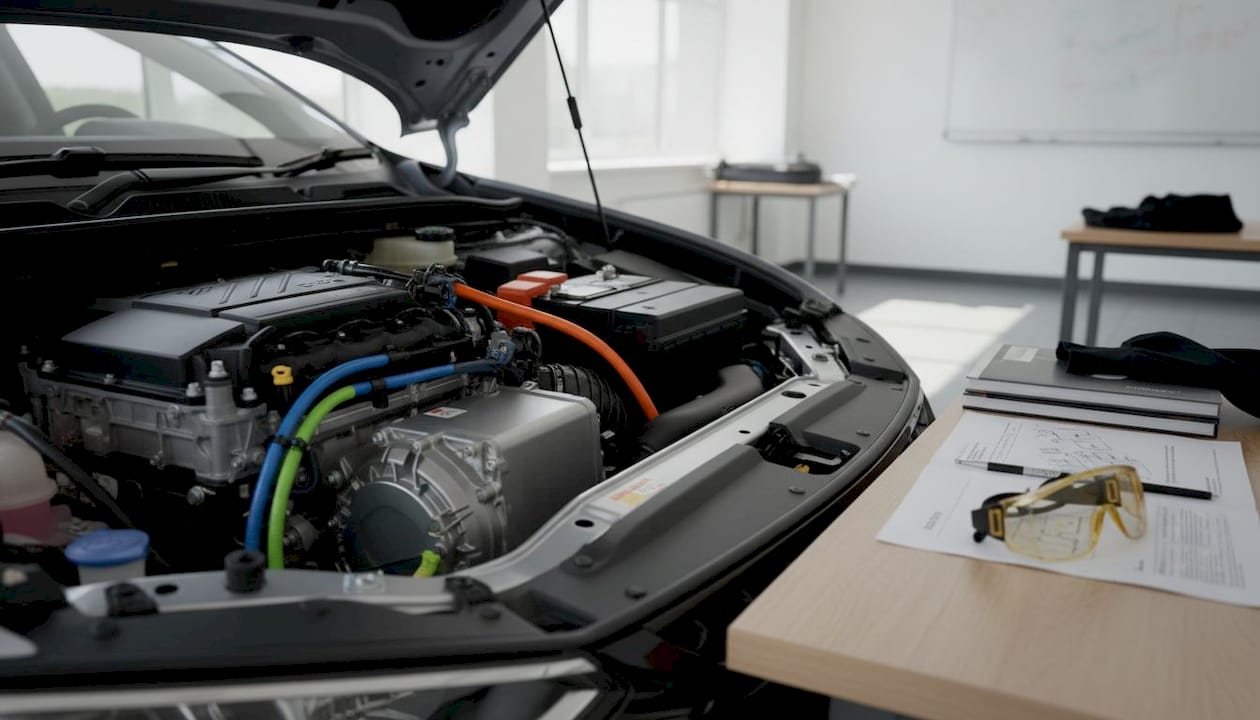
A hybrid powertrain has five core components: the internal combustion engine, the electric motor, a high-voltage battery pack, a power control unit, and the regenerative braking system. Each component has a specific role, and the control unit ties them together in real time.

The ICE works exactly as it does in a conventional car. It burns gasoline to generate mechanical power. The electric motor draws energy from the battery pack and adds torque when the engine needs support, such as during acceleration. The power control unit reads speed, throttle input, battery charge level, and load, then routes power from the right source at the right moment.
The high-voltage battery pack stores energy recovered during braking and surplus energy from the engine. Hybrids self-charge through regenerative braking and engine power, so you never need to plug in a standard hybrid. That self-sufficiency is one of the most misunderstood facts about hybrid powertrain technology.
What are the main types of hybrid powertrain architectures?
Hybrid systems are not all built the same way. The architecture determines how the engine and motor interact, and it has a direct impact on fuel economy, performance, and complexity.
Parallel hybrid
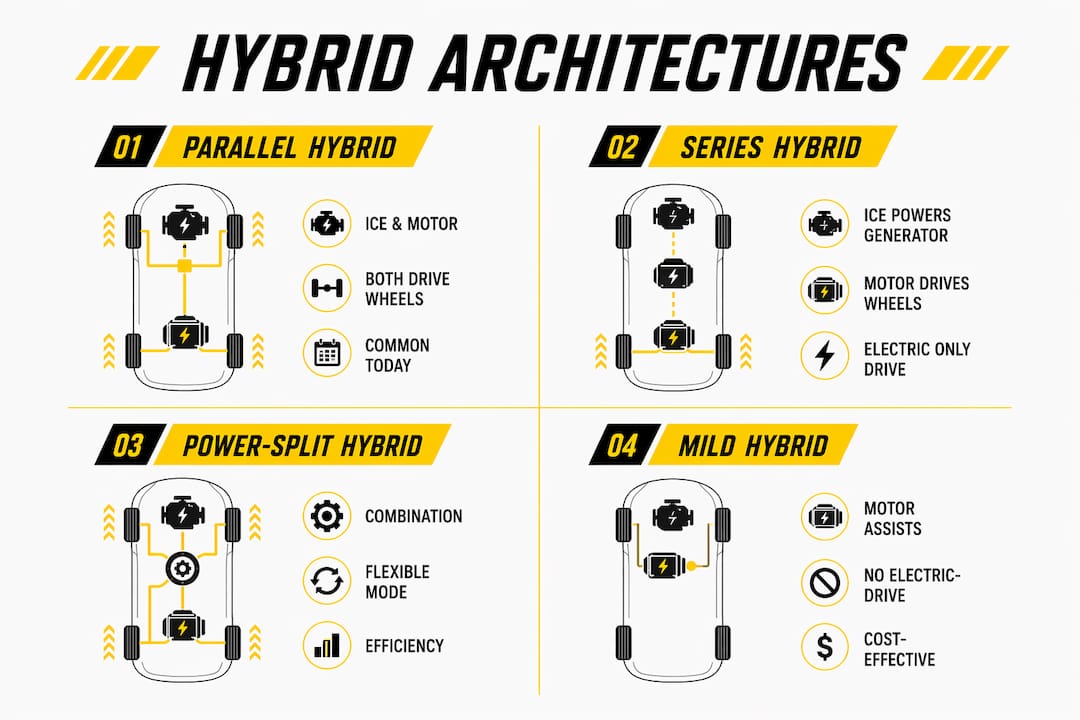
Parallel hybrids are the most common architecture in production vehicles today. Both the ICE and the electric motor connect directly to the drivetrain, so either or both can drive the wheels at the same time. This setup works well across a wide range of driving conditions because the system can lean on whichever source is more efficient at any given moment.
Series hybrid
In a series hybrid, the ICE never drives the wheels directly. Instead, it runs a generator that produces electricity, and the electric motor does all the driving. This architecture works best in stop-and-go traffic because the engine can run at a steady, efficient speed regardless of vehicle speed.
Power-split (series-parallel) hybrid
Power-split systems combine both approaches. The ICE can drive the wheels directly or power a generator, depending on conditions. This architecture gives the control system more flexibility and is widely used in full hybrid vehicles.
Mild hybrid
Mild hybrids use a small electric motor to assist the ICE but cannot drive the wheels on electric power alone. The motor reduces engine load during acceleration and recovers some braking energy. Fuel savings are real but smaller than in full hybrid systems.
| Architecture | Electric-only driving | ICE role | Best use case |
|---|---|---|---|
| Parallel | Yes (limited) | Drives wheels directly | Mixed city and highway |
| Series | Yes (full) | Runs generator only | Stop-and-go city driving |
| Power-split | Yes (moderate) | Drives wheels or generator | All-around driving |
| Mild hybrid | No | Always active | Highway and light urban |
Pro Tip: If you drive mostly in the city, a series or power-split hybrid will deliver the biggest fuel savings. A mild hybrid suits drivers who spend most of their time on the highway.
How does regenerative braking work in hybrid vehicles?
Regenerative braking is the process that turns wasted energy into stored electricity. In a conventional car, braking converts kinetic energy into heat through friction. That energy disappears. In a hybrid, the electric motor reverses its role during braking and acts as a generator.
When you lift off the throttle or press the brake pedal, the motor creates resistance against the wheels. That resistance slows the car while simultaneously producing electricity. The electricity flows into the battery pack for later use. Regenerative braking significantly reduces brake wear because the motor handles much of the deceleration before the friction brakes engage.
The practical result is that brake pads and rotors last considerably longer in hybrid vehicles than in conventional ones. Drivers who frequently brake hard in traffic get the most benefit. The system works automatically, so no special technique is required.
Pro Tip: Smooth, gradual deceleration maximizes regenerative braking recovery. Lifting your foot off the accelerator early before a stop gives the motor more time to generate electricity before the friction brakes take over.
Key driving habits that affect regenerative braking output:
- Anticipate stops early and coast before braking
- Avoid sudden, hard braking when traffic allows
- Use engine braking on downhill sections to recover energy continuously
- Keep battery charge from reaching 100% so the system has room to store recovered energy
What are the practical benefits of hybrid powertrains for drivers?
Fuel economy is the most direct benefit. Hybrid vehicles improve fuel economy by 40% or more over conventional gasoline vehicles, depending on the model and driving conditions. That number is not uniform across all situations. It reflects the real advantage hybrids deliver in the right environment.
City driving maximizes hybrid benefit because stop-and-go traffic is exactly where regenerative braking and electric-only operation shine. Highway driving at constant speed gives the electric motor less opportunity to contribute, so fuel savings are smaller. If your commute runs through dense urban traffic, a hybrid powertrain pays back its cost premium faster than it would for a highway commuter.
Emission reductions follow directly from lower fuel consumption. Less gasoline burned means fewer grams of CO2 per mile. For drivers in areas with strict emissions regulations or congestion charges, this has a financial value beyond fuel savings.
The onboard computer manages power blending to protect the engine from unnecessary strain. The electric motor handles low-speed torque demands, which are the hardest on a gasoline engine. That reduced mechanical stress extends engine life and lowers the frequency of wear-related repairs. You can read more about how scheduled maintenance works to understand where hybrid systems change the standard service timeline.
Factors that influence how much benefit you get from a hybrid powertrain:
- Driving environment. City driving delivers the largest fuel economy gains.
- Climate. Cold temperatures reduce battery efficiency and lower electric-only range.
- Driving style. Smooth, anticipatory driving maximizes regenerative braking recovery.
- Vehicle load. Heavier loads increase energy demand and reduce efficiency gains.
- Battery state of health. An aging battery stores less energy and reduces electric assist capacity.
What are common maintenance considerations and trade-offs?
Hybrid ownership changes the maintenance picture in meaningful ways, both positive and negative. Understanding both sides prevents surprises.
On the positive side, reduced mechanical stress on the engine lowers engine wear compared to conventional vehicles. The electric motor handles demand peaks, so the ICE runs in a narrower, more efficient operating range. Brake pads and rotors last longer because regenerative braking does most of the work. These savings add up over years of ownership.
Standard maintenance tasks still apply. Oil changes, air filters, cabin filters, and tire rotations remain on the schedule. The hybrid system does not eliminate these needs. It reduces their frequency in some cases, but it does not replace them.
The largest financial risk in hybrid ownership is high-voltage battery replacement, which can be costly outside of warranty coverage. This is the one area where hybrid maintenance costs can exceed those of a conventional vehicle. The good news is that many hybrid batteries last well over 100,000 miles with normal use. Heat, age, and neglect are the main factors that shorten battery life.
Pro Tip: Check the manufacturer’s battery warranty before you buy. Many automakers offer 8-year or 100,000-mile coverage on the high-voltage battery. Buying a certified pre-owned hybrid with remaining battery warranty is one way to reduce this risk. Frenzycars covers certified used car value in detail if you want to weigh that option.
| Maintenance area | Hybrid impact | Risk level |
|---|---|---|
| Brake pads and rotors | Last longer due to regenerative braking | Low |
| Engine wear | Reduced due to electric motor assist | Low |
| Oil changes | Still required, possibly less frequent | Low |
| High-voltage battery | Costly to replace outside warranty | High |
| Tires | No change from conventional vehicles | Standard |
Key Takeaways
A hybrid powertrain delivers its greatest fuel economy advantage in city driving, where regenerative braking and electric-only operation reduce gasoline consumption by up to 40% compared to conventional vehicles.
| Point | Details |
|---|---|
| Core system design | A hybrid pairs an ICE with an electric motor, managed by a control unit that blends power sources in real time. |
| Best architecture for city driving | Series and power-split hybrids deliver the largest fuel savings in stop-and-go traffic. |
| Regenerative braking value | The motor acts as a generator during braking, recovering energy and extending brake pad life. |
| Battery replacement risk | High-voltage battery replacement is the biggest maintenance cost risk; check warranty coverage before buying. |
| Driving habits matter | Smooth, anticipatory driving and city commuting maximize the fuel economy and cost benefits of hybrid ownership. |
What I’ve learned from years of watching hybrid ownership play out
Most buyers focus on the fuel economy number and stop there. That is the wrong lens. The real question is whether your driving pattern matches what a hybrid powertrain does best.
Drivers who commute 30 miles each way on the freeway at 70 mph will see modest fuel savings. The electric motor has little opportunity to contribute at constant highway speeds. The same vehicle driven by someone navigating urban traffic every day will show a dramatically different result. The technology is the same. The context is everything.
The battery anxiety I hear from buyers is usually overstated. Hybrid batteries regularly exceed 100,000 miles without replacement, and most automakers back them with long warranties. The real risk is buying a used hybrid outside of warranty with no service history. That is where battery replacement costs become a genuine concern.
One thing buyers consistently overlook is how the reduced brake wear changes the long-term cost picture. Brake jobs are not cheap. A hybrid that extends brake pad life by two or three service intervals saves real money over five years of ownership. That saving rarely appears in the fuel economy comparison, but it belongs there.
Hybrid technology is not a compromise. It is a well-engineered system that rewards drivers who understand how it works. The more you know about why fuel economy ratings differ from real-world results, the better positioned you are to evaluate whether a hybrid fits your life.
Hybrid vehicle specs and comparisons on Frenzycars
Knowing how hybrid powertrains work is the foundation. Choosing the right hybrid model for your driving life is the next step. Frenzycars publishes detailed car specs by make and model across the full hybrid range, so you can compare powertrain configurations, fuel economy figures, and battery specs side by side. If you want a shortcut, the best cars by category section organizes top hybrid picks by use case, from family haulers to urban commuters. Both resources are built for drivers who want facts, not guesswork from a dealership floor.