
The best rear-wheel drive sports cars right now are the Mazda MX-5 Miata, Toyota GR86, Subaru BRZ, Ford Mustang GT, Chevrolet Corvette Stingray, BMW M2, and Porsche 911 Carrera — covering every price tier from under $30K to six figures. J.D. Power’s 2026 quality and reliability scores place the Porsche 911 at 91/100 and the Corvette at 89/100, the two highest-scoring sports cars in that study. Below is the quick-scan shortlist, followed by full model breakdowns.
- Mazda MX-5 Miata (~$30K) — the gold standard for handling-per-dollar; lowest ownership costs in the segment
- Toyota GR86 (~$30–35K) — naturally aspirated, predictable chassis, strong reliability pedigree
- Subaru BRZ (~$30–35K) — near-identical twin to the GR86 with a tactile manual gearbox
- Ford Mustang GT (~$42–55K) — V8 muscle with broad trim options and real straight-line punch
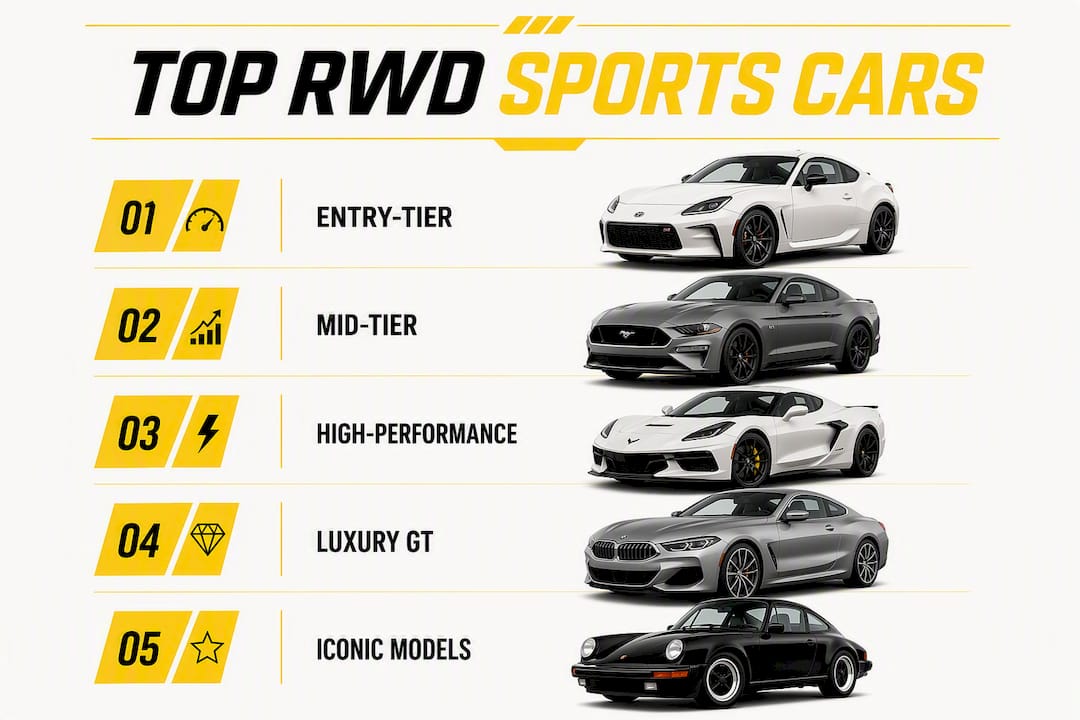
- Chevrolet Corvette Stingray (~$68K+) — mid-engine supercar pace at a fraction of European rivals’ prices
- BMW M2 (~$65–75K) — the sharpest compact track coupe in the segment
- Porsche 911 Carrera (~$115K+) — benchmark grand tourer; best resale value in the class
- Nissan Z (~$42–55K) — heritage coupe with modern power and honest value
- Lexus LC (~$100K+) — the most refined grand tourer on this list
- Genesis G70 2.5T (~$38–47K) — luxury dynamics at a price that embarrasses the competition
What are the top rear-wheel drive sports cars right now?
The models below are ranked roughly by price tier, from accessible entry points to high-performance flagships. Each entry includes a quick-specs callout, honest pros and cons, and a buyer’s note.
Mazda MX-5 Miata
MSRP: ~$30,000 | Engine: 2.0L naturally aspirated four-cylinder, 181 hp | 0–60: ~5.7 sec | Drivetrain: RWD
Lightweight RWD sports cars like the MX-5 are repeatedly cited as the best entry point for driver engagement on a budget, and the Miata earns that reputation every year. Annual maintenance estimates run around $429, making it one of the cheapest sports cars to own long-term.
Pros: Exceptional balance, low running costs, available as a convertible, huge aftermarket Cons: 181 hp feels modest at highway speeds, minimal cargo space, tight for taller drivers
Best for: first-time sports-car buyers, weekend backroad drivers, anyone who wants to actually feel the road.
Toyota GR86 and Subaru BRZ
MSRP: ~$30,000–$35,000 | Engine: 2.4L flat-four, ~228 hp | 0–60: ~6.1 sec | Drivetrain: RWD
These two share a platform, and the differences are subtle enough that your choice often comes down to dealer proximity and color preference. The Subaru BRZ’s 2.4L naturally aspirated flat-four produces 228 hp and pairs with a six-speed manual and a Torsen limited-slip differential — a setup that rewards precise inputs rather than brute force. The GR86 is tuned marginally stiffer; the BRZ leans slightly softer. Both are genuinely fun on a twisty road.
Pros (both): Affordable, predictable handling, manual available, low weight Cons (both): Back seats are decorative, no turbocharged option, modest power on paper
Best for: drivers learning the limits of RWD, backroad enthusiasts, buyers who want a manual without paying a premium.
Ford Mustang GT
MSRP: ~$42,000–$55,000 | Engine: 5.0L V8, 480 hp | 0–60: ~4.2 sec | Drivetrain: RWD
The Mustang GT is the easiest way to get a naturally aspirated V8 in a rear-drive coupe at this price. It is loud, wide, and unapologetically American. The Mustang’s track-capable variants have pushed the nameplate into serious performance territory, though the GT trim is the sweet spot for buyers who want V8 character without the Shelby premium.
Pros: 480 hp V8, broad trim range, strong aftermarket, daily-drivable Cons: Fuel economy is predictably poor, rear-seat space is tight, handling less refined than European rivals
Best for: buyers who want V8 sound and straight-line performance without spending $70K.
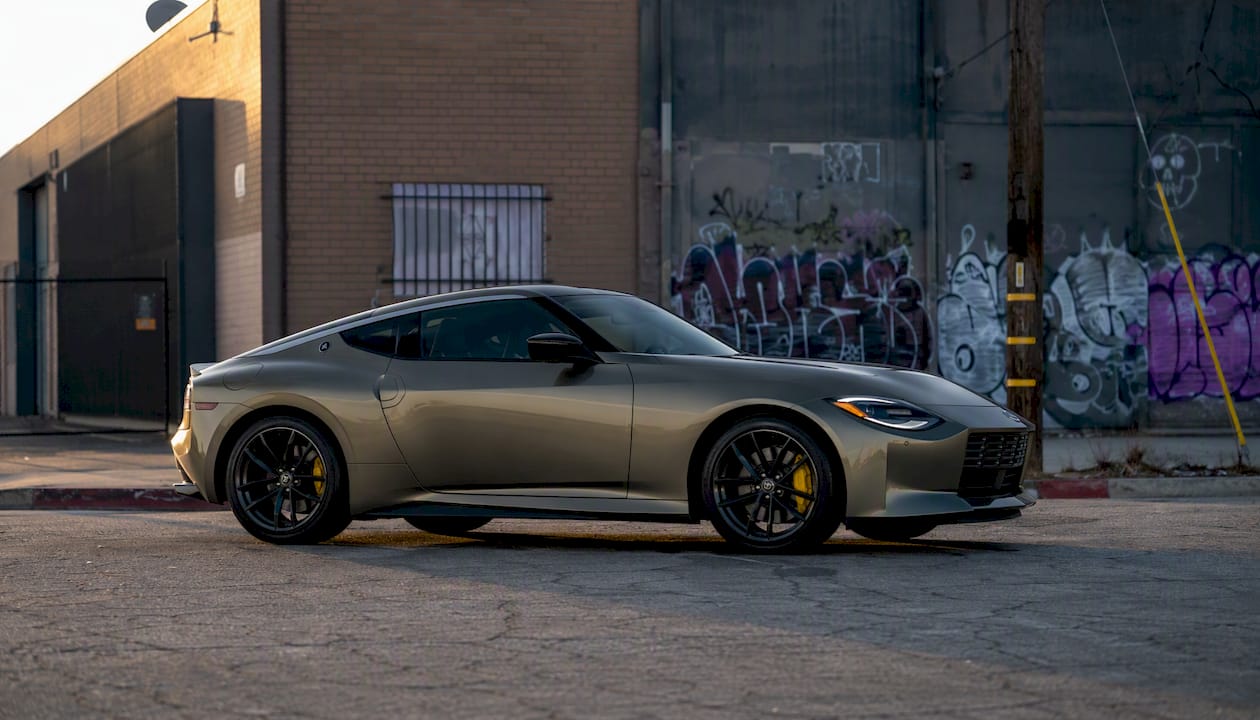
Nissan Z and Nissan Z Sport
MSRP: ~$42,000–$55,000 | Engine: 3.0L twin-turbo V6, 400 hp | 0–60: ~4.5 sec | Drivetrain: RWD
The Z Sport trim adds tuned suspension and sharper chassis calibration over the base car. The 400 hp twin-turbo V6 is strong, the retro styling is a genuine draw, and the price undercuts the M2 by a significant margin. The trade-off is a less polished interior and a transmission that some reviewers find notchy in the manual version.
Pros: 400 hp at an accessible price, heritage styling, manual available Cons: Interior quality lags behind European rivals, automatic-only on some trims, rear visibility is limited
Best for: drivers who want modern power in a classic sports-coupe package without the European price tag.
Genesis G70 and Genesis G70 2.5T
MSRP: ~$38,000–$47,000 | Engine: 2.5L turbocharged four-cylinder, 300 hp | 0–60: ~5.1 sec | Drivetrain: RWD (select trims)
The G70 2.5T is the segment’s best-kept secret. You get a genuinely driver-focused chassis, a well-appointed interior, and a powertrain that punches above its displacement. Genesis backs it with a 10-year/100,000-mile powertrain warranty, which no European rival at this price can match.
Pros: Luxury interior, strong warranty, driver-focused tuning, competitive pricing Cons: Smaller dealer network than BMW or Lexus, resale value still catching up to European brands
Best for: buyers who want near-sports-car dynamics with daily comfort and a warranty that actually means something.
Alfa Romeo Giulia and Alfa Romeo Giulia Sprint
MSRP: ~$45,000–$55,000 | Engine: 2.0L turbocharged four-cylinder, 280 hp (Sprint) | 0–60: ~5.1 sec | Drivetrain: RWD
The Giulia Sprint is the most characterful car on this list below $60K. The steering is direct in a way that German rivals rarely match, and the chassis communicates through every surface. Reliability has improved from early production years, though ownership costs still run higher than Japanese alternatives.
Pros: Best steering feel in the segment, distinctive styling, engaging chassis Cons: Higher-than-average maintenance costs, smaller dealer network, infotainment feels dated
Best for: enthusiasts who prioritize driving character and are willing to accept slightly higher running costs.
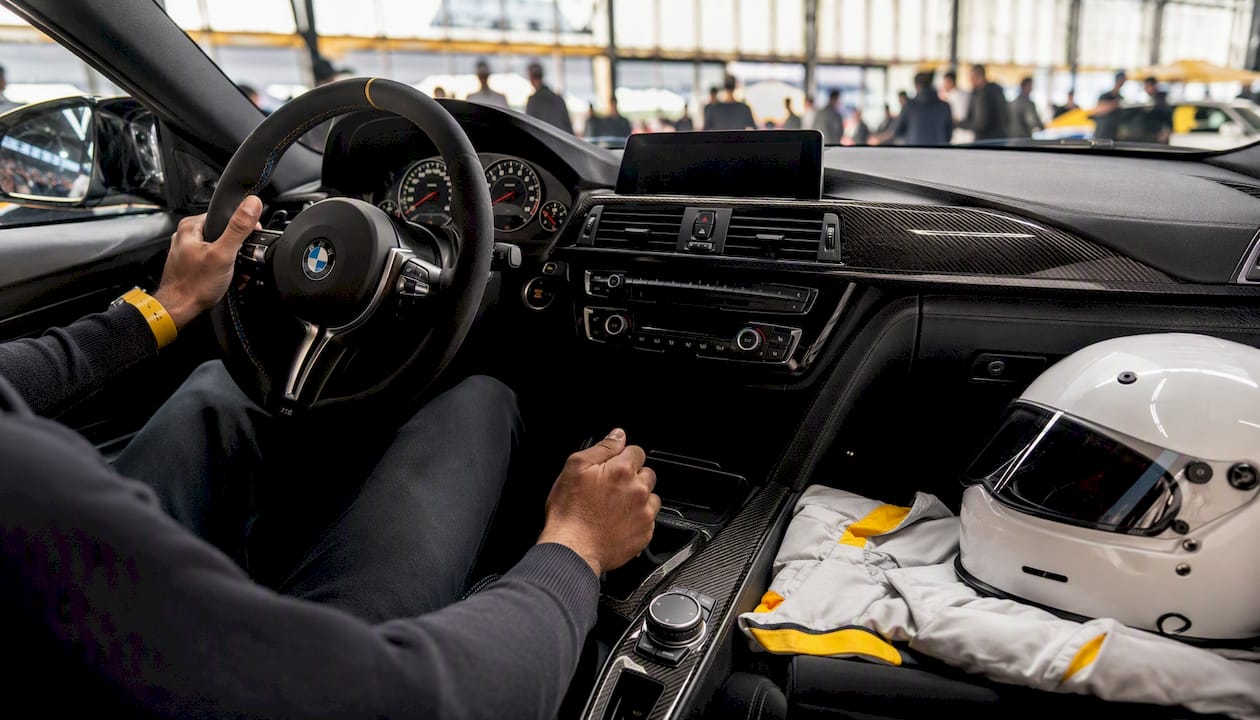
BMW M2 and BMW 230i Coupe
MSRP (M2): ~$65,000–$75,000 | Engine: 3.0L twin-turbo inline-six, 453 hp (523 hp in CS) | 0–60: ~4.1 sec | Drivetrain: RWD
The 2026 BMW M2 CS pushes 523 hp and is described by Motor1 as “an all-time great.” At that power level, owners who disable stability control should expect a genuine learning curve. The standard M2 at 453 hp is more forgiving and still faster than almost anything at its price. The 230i Coupe sits below it in the BMW lineup — less power, more daily-friendly, and a solid entry into RWD coupe ownership.
Pros (M2): Exceptional power-to-weight, track-capable chassis, manual available Cons (M2): Expensive, demanding at the limit, rear seat is tight
Best for (M2): enthusiasts who want a compact track weapon they can drive to work.
Cadillac CT4 and Lexus IS 300
MSRP (CT4): ~$38,000–$48,000 | MSRP (IS 300): ~$43,000–$50,000
These two occupy the “comfortable daily with a hint of sport” slot. The CT4 offers rear-drive dynamics in sport trims with Cadillac’s luxury features at a price that undercuts BMW. The Lexus IS 300 leans further toward refinement — the powertrain is smooth, the ride is comfortable, and reliability is class-leading. Neither will thrill you on a track day, but both are genuinely pleasant to own.
Best for: buyers who want RWD dynamics without sacrificing daily comfort or reliability.
Dodge Challenger
MSRP: ~$35,000–$75,000+ | Engine: Up to 6.2L supercharged V8, 717 hp (Hellcat) | 0–60: ~3.6 sec (Hellcat) | Drivetrain: RWD
The Challenger is the last of the traditional American muscle coupes in production. It is large, heavy, and unashamedly old-school. The base V6 is a reasonable daily driver; the Hellcat variants are genuinely absurd in the best possible way. The platform is aging, but the character is irreplaceable.
Best for: buyers who want maximum torque, retro muscle-car presence, and a roomy coupe.
Chevrolet Corvette Stingray and Chevrolet Corvette
MSRP: ~$68,000–$80,000 | Engine: 6.2L naturally aspirated V8, 495 hp | 0–60: ~2.9 sec | Drivetrain: RWD (mid-engine)
The Corvette Stingray is the most straightforward performance argument on this list. Nearly 500 hp, a mid-engine layout, and a 0–60 time that embarrasses cars costing twice as much. J.D. Power scores it at 89/100 for quality and reliability. The interior has improved dramatically over previous generations, and daily usability is genuinely good.
Pros: Supercar performance at a fraction of European prices, strong reliability, dramatic styling Cons: Cargo space is limited, polarizing exterior, dealer markups persist on popular trims
Best for: performance buyers who want the most car per dollar in the $70K bracket.
Porsche 911 Carrera and Porsche 911
MSRP: ~$115,000+ | Engine: 3.0L twin-turbo flat-six, 379 hp (Carrera) | 0–60: ~3.3 sec | Drivetrain: RWD
The Porsche 911 Carrera S is the benchmark everything else is measured against. Jalopnik’s review calls it a car that “makes every day an event.” The 0–60 time of around 3.3 seconds is Porsche’s own claim; Car and Driver testing shows quicker times in some trims. J.D. Power’s 2026 score of 91/100 is the highest in the sports car segment. Resale value is the best in class.
Pros: Best chassis refinement available, daily usable, exceptional resale value, 91/100 J.D. Power score Cons: $115K+ entry price, options list adds up fast, driveshaft tunnel limits interior space
Best for: buyers who want the definitive RWD sports car and plan to keep it for a decade.
Lexus LC
MSRP: ~$100,000+ | Engine: 5.0L naturally aspirated V8, 471 hp | 0–60: ~4.4 sec | Drivetrain: RWD
The LC is the most beautiful car on this list, and it knows it. The naturally aspirated V8 sounds extraordinary, the interior is the most refined of any car here, and the ride quality is genuinely grand-touring caliber. It is not the fastest or the most engaging, but it is the most pleasurable to spend time in.
Best for: buyers who want GT comfort, a naturally aspirated V8, and a car that draws attention for the right reasons.
Porsche Panamera, Porsche Taycan, and Lucid Air
These three represent the GT and EV end of the RWD spectrum. The Porsche Panamera (from ~$92K) combines four-door practicality with genuine sports-car performance in RWD and AWD variants. The Porsche Taycan (RWD variants from ~$90K) delivers instant EV torque with chassis tuning that preserves driver engagement — Porsche’s engineering ensures it doesn’t feel like a disconnected EV. The Lucid Air (RWD variants from ~$70K) prioritizes range and refinement over outright driving feel, making it the choice for buyers who want EV efficiency in a luxury package.
Pro Tip: If you’re considering the Taycan or Lucid Air as RWD sports alternatives, check the upcoming Porsche 718 electric — Porsche has confirmed an all-electric 718 Boxster for 2027, which may shift the value equation for EV sports-car buyers.
BMW 3 Series (RWD trims)
MSRP: ~$45,000–$55,000 | Engine: 2.0L turbocharged four-cylinder, 255 hp (330i) | Drivetrain: RWD (select trims)
The 330i in RWD configuration is the most practical daily driver on this list. It is not a sports car in the traditional sense, but the chassis is balanced, the powertrain is responsive, and the aftermarket support is enormous. If you need four real seats and a trunk, this is where the RWD sports-car conversation starts.
How do these cars compare at a glance?
The table below lines up the core shortlist across the six decision axes that matter most to buyers. “Best for” categories: Track = lap-time focused; Daily = comfort and practicality; Value = performance per dollar; GT = grand touring comfort and range.
| Model | MSRP (approx.) | Performance | Driver Engagement | Best For | Practicality | Ownership Costs |
|---|---|---|---|---|---|---|
| Mazda MX-5 Miata | ~$30K | 181 hp / 5.7s | ★★★★★ | Value | 2 seats, minimal cargo, ~35 mpg | Very low (~$429/yr maintenance) |
| Toyota GR86 | ~$30–35K | 228 hp / 6.1s | ★★★★★ | Value / Daily | 2+2 seats, limited cargo, — | Low; strong reliability |
| Subaru BRZ | ~$30–35K | 228 hp / 6.1s | ★★★★★ | Value / Daily | 2+2 seats, limited cargo, — | Low; strong reliability |
| Ford Mustang GT | ~$42–55K | 480 hp / 4.2s | ★★★★☆ | Value / Daily | 2+2 seats, usable trunk, — | Moderate; V8 maintenance |
| Nissan Z | ~$42–55K | 400 hp / 4.5s | ★★★★☆ | Value | 2 seats, small cargo, — | Moderate |
| Genesis G70 2.5T | ~$38–47K | 300 hp / 5.1s | ★★★★☆ | Daily | 4 seats, usable trunk, — | Low; 10yr/100K warranty |
| Alfa Romeo Giulia Sprint | ~$45–55K | 280 hp / 5.1s | ★★★★★ | Daily / Track | 4 seats, usable trunk, — | Higher; European servicing |
| BMW M2 | ~$65–75K | 453 hp / 4.1s | ★★★★★ | Track | 2+2 seats, small cargo, — | High; performance maintenance |
| Dodge Challenger | ~$35–75K+ | Up to 717 hp / 3.6s | ★★★☆☆ | Value / Muscle | 4 seats, large trunk, ~14 mpg | Moderate to high |
| Chevrolet Corvette Stingray | ~$68–80K | 495 hp / 2.9s | ★★★★★ | Track / Value | 2 seats, frunk only, — | Moderate; 89/100 J.D. Power |
| Lexus LC | ~$100K+ | 471 hp / 4.4s | ★★★★☆ | GT | 2+2 seats, limited cargo, — | Low; Lexus reliability |
| Porsche 911 Carrera | ~$115K+ | 379 hp / 3.3s | ★★★★★ | GT / Track | 2+2 seats, front trunk, — | Moderate; 91/100 J.D. Power |
| Porsche Panamera | ~$92K+ | Varies / — | ★★★★☆ | GT | 4 seats, large trunk, — | Moderate to high |
| Porsche Taycan (RWD) | ~$90K+ | Varies / ~5.1s | ★★★★☆ | GT / EV | 4 seats, dual trunks, — | Low running; high repair |
| Lucid Air (RWD) | ~$70K+ | Varies / ~4.5s | ★★★☆☆ | GT / EV | 4 seats, large trunk, — | Low running; limited service network |
How do you pick the right RWD sports car for your situation?
Start with use case, not horsepower. The biggest mistake buyers make is shopping by spec sheet and then discovering the car doesn’t fit their actual life.
Priority questions to answer before you visit a dealer
- Daily driver or weekend car? A daily driver needs a comfortable ride, reasonable fuel economy, and a back seat that can handle occasional passengers. The GR86, Genesis G70, and BMW 3 Series work here. A weekend car can sacrifice all of that for engagement.
- Manual or automatic? The MX-5, BRZ, GR86, M2, and Mustang GT all offer manuals. The Corvette and 911 are best in their automatics. Be honest about whether you’ll actually use a manual in traffic.
- How much horsepower can you manage? Under 300 hp on a lightweight platform (MX-5, GR86) is forgiving and teaches good habits. Over 400 hp on a heavier car (M2, Mustang GT) requires more active throttle management, especially in wet conditions.
- What’s your insurance tolerance? High-hp RWD cars attract significantly higher premiums. Get a quote before you fall in love with a Hellcat.
- Garage space and tire costs? Wide-body cars like the Corvette and Challenger need more room. Performance tires on a 911 or M2 can run $1,200–$2,000 per set.
What to push on a test drive
- Throttle response at mid-corner: Apply power gently mid-turn and feel whether the rear steps out progressively or snaps. A progressive car is teachable; a snappy one demands respect.
- Steering weight and feedback: The Giulia and MX-5 set the standard here. If a car feels numb at center, no amount of horsepower compensates.
- Ride quality over rough pavement: Track-focused suspensions (M2, GR86 in sport mode) can be genuinely punishing on broken urban roads.
Red flags on used RWD sports cars
- Excessive electronic intervention that can’t be disabled (suggests the car was set up to mask handling issues)
- Evidence of track use without corresponding maintenance records (worn rear differential, uneven tire wear)
- Unusually poor dealer support for performance trims in your area
Pro Tip: Before buying any used RWD sports car, inspect the rear differential, driveshaft joints, and subframe mounts. These are the wear points unique to RWD layouts that used-car listings rarely disclose. A pre-purchase inspection from a specialist costs $150–$300 and can save thousands.
What does it actually cost to own a top RWD sports car?
Ownership costs split cleanly into two tiers: lightweight entry sports cars and high-performance machines.
Entry-tier RWD sports cars (MX-5, GR86, BRZ, Nissan Z)
The Mazda MX-5’s annual maintenance estimate is among the lowest in the segment. The GR86 and BRZ are similarly inexpensive to maintain, with Toyota and Subaru dealer networks keeping parts costs reasonable. Insurance is moderate because these cars have modest power and attract careful drivers.
High-performance RWD sports cars (M2, Corvette, 911, Mustang GT)
Turbocharged and high-output platforms add long-term repair risk. The M2’s twin-turbo inline-six and the 911’s complex PDK transmission are capable but expensive when something goes wrong. Reliability surveys favor simpler, naturally aspirated platforms — the Corvette’s pushrod V8 and the Lexus LC’s naturally aspirated V8 both benefit from mechanical simplicity relative to their performance output.
Key ownership considerations:
- Insurance: High-hp RWD cars (Hellcat, M2 CS, 911 Turbo) can push annual premiums well above $3,000 in urban markets
- Tires: Performance tire sets on 911 and M2 run $1,200–$2,000 per set; the MX-5 uses inexpensive 195-section tires
- Depreciation: The 911 holds value better than any car on this list; the Dodge Challenger and Nissan Z depreciate faster
- Fuel: A Hellcat Challenger at 14 mpg combined costs roughly twice as much to fuel annually as an MX-5 at 35 mpg
Pro Tip: For used buyers, turbocharged and hybridized powertrains add long-term repair exposure that simple naturally aspirated engines avoid. If budget is a constraint, a used naturally aspirated car (GR86, MX-5, Corvette C7) often delivers better five-year ownership economics than a used turbocharged European rival.
Why do enthusiasts prefer rear-wheel drive?
The mechanical argument is straightforward. RWD separates steering from propulsion, which means the front wheels handle direction and the rear wheels handle power delivery. That separation gives the driver more direct steering feedback and a more controllable rotation at the limit.
In practice, this plays out differently depending on the power level. A lightweight MX-5 at 181 hp is forgiving and communicative — you can feel exactly what the rear tires are doing, and the consequences of a mistake are manageable. A BMW M2 CS at 523 hp is a different conversation entirely. Motor1’s review notes that owners who disable stability control should expect a genuine learning curve; the weight transfer is abrupt and the power delivery demands active management.
AWD systems add grip and reduce the skill floor, but they also filter out the feedback that makes RWD cars feel alive. That trade-off is why the Pirelli tire guide describes RWD as offering “better control of the vehicle for an experienced driver” — the key phrase being “experienced.” RWD rewards investment in skill.
Pro Tip: If you’re moving up from a front-wheel-drive car to a high-horsepower RWD machine, book a track day with an instructor before you disable stability control on public roads. Learning throttle management in a controlled environment is the single fastest way to get comfortable with tail-out transitions.
How Frenzycars selected and ranked these models
Every model on this list was evaluated against six criteria, weighted in this order:
- Driver engagement: Steering feel, chassis balance, throttle response, and the quality of feedback the car delivers to the driver
- Performance metrics: Horsepower, 0–60 times, and track-capable setup (not just straight-line speed)
- Ownership and reliability signals: J.D. Power scores, long-term owner surveys, and maintenance cost data
- Price and value: Performance and engagement relative to MSRP, not absolute power output
- Model-year freshness: 2025/2026 production status, recent updates, and upcoming redesigns
- Practicality: Real-world usability for daily driving, cargo, and passenger accommodation
Primary sources consulted include J.D. Power’s 2026 quality and reliability study, Motor1 long-form road tests, Jalopnik reviews, TopSpeed comparative analysis, and owner-reported maintenance data from multiple outlets.
On AWD and EV inclusions: The Porsche Taycan and Lucid Air appear because RWD variants exist and are relevant to buyers considering the segment’s electric direction. AWD-only models were excluded from the core rankings. The Panamera is included as a GT reference point, not a pure sports car.
What should you expect from the interior of a sports car?
Interior quality varies more dramatically in this segment than performance numbers suggest. The Porsche 911 and Lexus LC set the standard: both offer genuinely premium materials, logical controls, and seats that hold you in place without bruising you on a two-hour drive. The 911’s cabin is driver-focused to the point of austerity; the LC’s is more of a lounge.
Mid-tier cars tell a mixed story. The Genesis G70 punches well above its price with soft-touch materials and a clean layout. The Alfa Romeo Giulia’s interior has improved but still feels less cohesive than German rivals. The Nissan Z’s cabin is functional but dated, with hard plastics that feel out of place next to a $50K price tag.
At the entry level, the GR86 and BRZ are honest about what they are: the focus is the driving experience, not the upholstery. The MX-5’s interior is compact but well-executed, with controls positioned exactly where a driver’s hands naturally fall.
One practical note: RWD driveshaft tunnels can reduce interior floor space and cargo capacity compared with front-wheel-drive or EV layouts. The 911’s front trunk is a clever workaround, but it holds a weekend bag, not a set of golf clubs.
What technology and safety features do these cars offer?
Modern RWD sports cars have closed the gap with mainstream vehicles on technology, though the implementation varies. The Porsche 911 and BMW M2 offer the most sophisticated driver-assistance suites — adaptive cruise, lane-keeping, and automatic emergency braking — without compromising the driving experience. Porsche’s PASM adaptive suspension and BMW’s DSC stability system are both configurable enough to satisfy track drivers and daily commuters.
The Chevrolet Corvette’s Performance Data Recorder is a standout feature: it records video and telemetry data from track sessions, which is genuinely useful for improving lap times and understanding the car’s limits. The Ford Mustang GT’s MagneRide damper system (available on higher trims) adjusts suspension stiffness in real time and meaningfully improves both ride quality and handling.
Entry-level cars like the GR86 and MX-5 offer standard automatic emergency braking and lane-departure warning, though the driver-assistance suites are less comprehensive than in luxury-tier models. The Nissan Z and Dodge Challenger lag slightly on technology content relative to their price points.
One area where all RWD sports cars require attention: stability control calibration. The best systems (Porsche’s PSM, BMW’s DSC) allow progressive intervention reduction through multiple modes. Systems that only offer full-on or full-off are less useful for drivers developing their skills.
What do expert reviews say about driving these cars?
Expert consensus aligns on a few clear points. The MX-5 is universally praised for its handling-to-price ratio — every major outlet names it the benchmark for accessible engagement. The GR86 and BRZ receive similar treatment, with reviewers consistently noting that the chassis rewards smooth, committed driving more than the power output suggests.
The Porsche 911 Carrera S earns the most consistent superlatives. Jalopnik’s road test describes it as a car that “makes every day an event,” and that sentiment appears across Car and Driver, Road & Track, and MotorTrend coverage. The 0–60 time of around 3.3 seconds (Porsche’s claim) understates how the car actually feels in motion — the PDK transmission and chassis work together in a way that makes the numbers feel conservative.
The BMW M2 CS draws the most polarized reviews. Motor1 calls it “an all-time great.” Other reviewers note that 523 hp in a compact coupe demands genuine skill and that the car’s character changes significantly when stability systems are reduced. Both assessments are accurate; they just describe different drivers.
The Corvette Stingray consistently surprises reviewers who expect a traditional American muscle car. The mid-engine layout transformed the handling dynamics, and most road tests describe it as genuinely competitive with European sports cars at twice the price.
For detailed long-form road tests and editorial rankings, Frenzycars publishes ongoing coverage of these models as new trims and updates arrive.
How do RWD sports cars hold their value?
Resale value in this segment is more predictable than buyers expect, once you know the patterns.
The Porsche 911 is the strongest performer. It consistently retains a higher percentage of its original MSRP than any other car on this list, driven by strong demand, limited production of desirable trims, and a collector community that sustains prices on older models. A well-maintained 911 from five years ago is worth more today than most cars depreciated in that window.
The Chevrolet Corvette holds value well for an American car, particularly the C8 generation. The mid-engine redesign created genuine collector interest, and dealer markups on popular trims have kept transaction prices above MSRP on some configurations.
The Mazda MX-5 depreciates modestly and steadily — it never commands a premium, but it never collapses either. The combination of low running costs and a loyal enthusiast community keeps used prices reasonable.
The Dodge Challenger and Nissan Z depreciate faster than the segment average. The Challenger’s aging platform and the Z’s limited production updates mean used prices soften more quickly. That creates buying opportunities: a two-year-old Challenger Hellcat can represent exceptional value per horsepower.
Used classics like the 2005 Nissan 350Z, 2004 Mazda RX-8, 1999 Mazda MX-5 Miata, 2000 Toyota MR2 Spyder, 1997 BMW Z3, 2003 BMW Z4, 1994 Pontiac Firebird, 1996 Ford Mustang GT, 1985 Chevrolet Corvette, and 2008 Pontiac Solstice all have strong enthusiast followings that support used prices. The RX-8’s rotary engine requires specific maintenance knowledge; the MR2 Spyder’s mid-engine layout rewards experienced drivers. Parts availability is generally good for all of these through specialist suppliers.
How do the top RWD sports cars compare to each other in their segments?
Within the entry tier, the GR86 and BRZ are effectively tied. The MX-5 wins on pure engagement and cost; the GR86/BRZ wins on power and practicality. The Nissan Z undercuts the M2 on price while offering comparable straight-line performance, though the chassis refinement gap is real.
In the mid tier, the Genesis G70 2.5T is the value outlier. It competes directly with the BMW 330i and Cadillac CT4 on price, but the 10-year warranty and driver-focused chassis tuning give it a genuine edge for buyers who prioritize long-term ownership economics. The Cadillac CT4 offers luxury features at a lower price point than BMW but lacks the Genesis’s warranty depth.
The Alfa Romeo Giulia Sprint sits in a category of one for steering feel. Nothing at its price delivers the same direct, communicative front end. The trade-off is higher maintenance costs and a smaller dealer network than BMW or Lexus.
At the top, the 911 and Corvette Stingray represent different philosophies. The 911 is the more complete car — better daily usability, stronger resale, more refined. The Corvette is the more dramatic value proposition: supercar acceleration at roughly 60% of the 911’s price. Buyers who prioritize the driving experience over the badge tend to choose the 911; buyers who prioritize performance per dollar tend to choose the Corvette.
What model-year changes should buyers know about for 2026?
The 2026 model year brings a few meaningful updates worth tracking before you sign a purchase agreement.
The BMW M2 CS is the headline addition: 523 hp in the standard M2 platform, confirmed for 2026 production. If the standard M2 is already on your shortlist, the CS warrants a test drive before committing.
The Porsche 911 continues its current generation with no major redesign imminent, which is good news for buyers — the current platform is mature and well-sorted. Porsche has confirmed an all-electric 718 Boxster for 2027, which will affect the entry-level Porsche sports car market but leaves the 911 unchanged for now.
The Dodge Challenger has reached the end of its production run in traditional internal-combustion form. The nameplate is expected to return in an electrified format, but current inventory represents the last of the traditional V8 muscle-car configuration. If that matters to you, now is the time.
The Nissan Z continues without major changes for 2026. The Genesis G70 receives minor interior updates. The GR86 and BRZ are mid-cycle with no significant changes announced.
For buyers considering EV alternatives, the Lucid Air and Porsche Taycan RWD variants are both available now, and the upcoming Porsche 718 electric will expand the RWD EV sports car options in 2027.
Key Takeaways
The Porsche 911 leads on reliability (91/100 J.D. Power, 2026) and resale value, the Mazda MX-5 Miata leads on engagement per dollar, and the Chevrolet Corvette Stingray delivers the most performance per dollar in the $70K bracket.
| Point | Details |
|---|---|
| Best value pick | Mazda MX-5 Miata offers the highest engagement-to-price ratio with ~$429/year maintenance costs. |
| Best performance per dollar | Chevrolet Corvette Stingray delivers 495 hp and a 2.9-second 0–60 for ~$68K, outpacing European rivals at twice the price. |
| Most reliable | Porsche 911 scores 91/100 in J.D. Power’s 2026 reliability study, the highest in the sports car segment. |
| Best GT pick | Lexus LC combines a naturally aspirated V8, refined interior, and grand-touring comfort for buyers who prioritize the journey. |
| Frenzycars coverage | Frenzycars publishes ongoing expert reviews, spec comparisons, and model-year updates for every car on this list. |
The spec sheet doesn’t tell the whole story
There’s a version of this conversation that never happens in car reviews, and it’s the one worth having. The spec sheet tells you the Corvette is faster than the 911 at its price. It doesn’t tell you that the 911 is the car you’ll still want to drive on a Tuesday morning three years from now, when the novelty has worn off and you’re just going to get coffee.
The cars that hold their appeal longest are the ones that communicate. The MX-5 at 181 hp feels faster than a 300 hp crossover because every input is amplified and returned to you. The Giulia’s steering tells you things about the road surface that most cars filter out entirely. That quality — mechanical honesty — is what the RWD layout enables and what the best cars on this list deliver.
What I’d watch for in 2026: the M2 CS is the most exciting new arrival, but it’s also the most demanding. The Challenger’s end of production in traditional V8 form is a genuine moment — if you’ve been considering one, the window is closing. And the electric transition, while still a few years from reshaping this segment, is moving faster than most buyers expect. The Taycan already proves that RWD dynamics survive electrification. The 718 electric will test whether the entry-level sports car buyer agrees.
Frenzycars covers every car on this list
If you’ve narrowed your shortlist to two or three models, the next step is a side-by-side spec comparison. Frenzycars publishes detailed car specs by make and model for every vehicle on this list, including current MSRP ranges, powertrain options, and trim-level breakdowns. You get the same depth as a dealer spec sheet without the sales pressure.
For buyers still exploring the category, the best cars by category section organizes picks by use case — track, daily driver, GT, and value — so you can cross-reference this list against other segments before committing. Check the current model-year specs and start your shortlist there.
Useful sources for further research
These are the primary sources used in this article, each worth bookmarking for deeper research before a purchase decision:
- J.D. Power 2026 Sports Car Reliability Scores — the most authoritative reliability ranking for current sports cars, including the 911’s 91/100 and Corvette’s 89/100 scores
- Motor1: 2026 BMW M2 CS Review — the definitive long-form road test for the M2 CS, covering performance, handling limits, and ownership trade-offs
- Jalopnik: 2025 Porsche 911 Carrera S Review — detailed real-world assessment of the 911’s daily usability and performance balance
- TopSpeed: AWD vs. RWD Sports Cars — clear comparative analysis of why RWD delivers superior driver engagement