
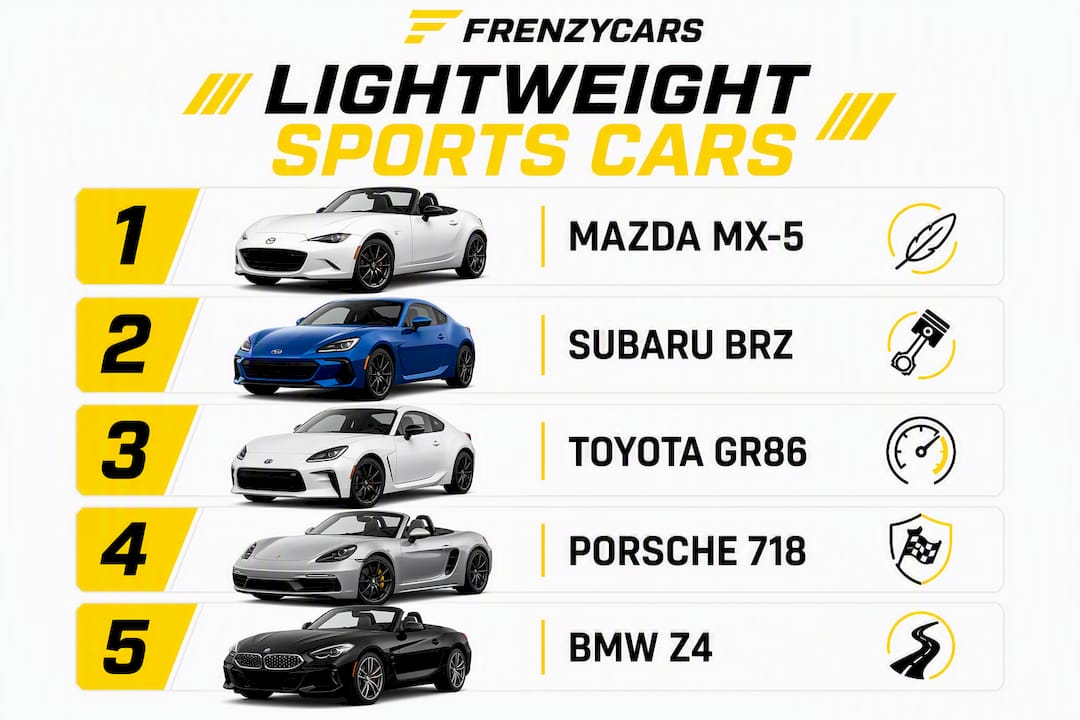
The lightest, most driver-focused sports cars available in the U.S. right now include the Mazda MX-5 Miata, the Subaru BRZ / Toyota GR86, and the Porsche 718 Cayman, each with distinct weight ranges reflecting various trims and specifications. Each earns its spot for a different reason. The Miata is the purest expression of the lightweight sports car philosophy: minimal mass, near 50/50 weight distribution, and a driving feel that no turbocharged sedan twice its price can replicate. The BRZ and GR86 are the most affordable entry points into rear-wheel-drive sports car ownership. The 718 Cayman is the one you buy when you want a mid-engine layout that makes every corner feel effortless.
Here is the quick shortlist:
- Mazda MX-5 Miata — the lightest car on this list and the best daily driver among them. Budget pick and weekend toy in one.
- Subaru BRZ / Toyota GR86 — among the more affordable rear-wheel-drive sports cars with proper trunks. Best for first-time enthusiasts.
- Porsche 718 Cayman / Boxster — offers mid-engine balance that punches well above its weight class. Best for drivers who want precision over raw power.
- Toyota Supra — base model has a turbocharged inline-six with strong performance. Best for buyers who want sports car feel with more daily usability.
- BMW Z4 — shares its platform with the Supra. Softer, more touring-oriented, but still quick.
- Chevrolet Corvette — known for mid-engine layout since 2020, high horsepower, and strong performance-per-dollar value.
- Porsche 911 (entry-level Carrera) — offers rear-engine, rear-wheel drive, and strong daily drivability among Porsches.
- Volkswagen GTI — front-wheel drive, four seats, a real trunk. Not a traditional sports car, but a practical hot hatch.
- MINI John Cooper Works — the lightest front-wheel-drive option here. Punchy, characterful, and quick in the city.
Pro Tip: Curb weight figures on manufacturer spec sheets reflect the lightest possible build. Add roughly 30–50 lbs for automatic transmissions, premium trim packages, or bundled safety options before comparing models.
How do these lightweight sports cars compare side by side?
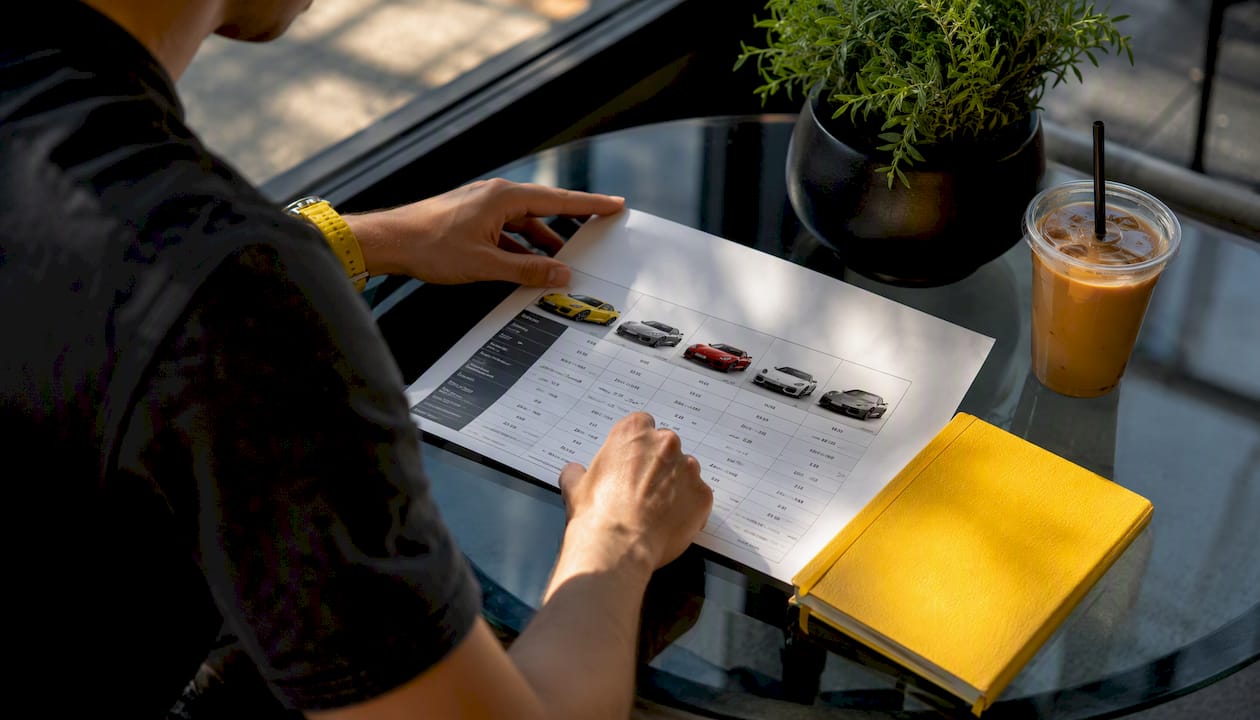
The table below uses manufacturer-sourced curb weights where available, with 0–60 figures drawn from published road tests. MSRP figures reflect current U.S. pricing at time of publication; used-market bands are approximate and vary by region and mileage.
| Model | Horsepower | Drivetrain | New MSRP (approx.) | Seats / Trunk | Best For |
|---|---|---|---|---|---|
| Mazda MX-5 Miata (soft-top, manual) | 181 hp | RWD / front-engine | ~$31,000 | 2 / 4.6 ft³ | Daily driver, budget pick |
| Mazda MX-5 Miata RF (manual) | 181 hp | RWD / front-engine | ~$34,000 | 2 / 4.6 ft³ | Weekend toy, style upgrade |
| Subaru BRZ (manual, base) | 228 hp | RWD / front-engine | ~$33,395 | 2+2 / 6.9 ft³ | First-time enthusiast |
| Toyota GR86 (base) | 228 hp | RWD / front-engine | ~$32,895 | 2+2 / 6.3 ft³ | Track-day starter |
| MINI John Cooper Works | 231 hp | FWD | ~$38,900 | 4 / 8.7 ft³ | Urban performance |
| Porsche 718 Cayman (base) | 300 hp | RWD / mid-engine | ~$72,800 | 2 / 15.0 ft³ | Precision driving |
| Volkswagen GTI | 241 hp | FWD | ~$34,000 | 5 / 22.8 ft³ | Practical daily driver |
| Toyota Supra 3.0 | 382 hp | RWD / front-engine | ~$58,000 | 2 / 10.2 ft³ | Power-to-weight value |
| BMW Z4 sDrive30i | 255 hp | RWD / front-engine | ~$57,700 | 2 / 9.9 ft³ | Touring roadster |
| Porsche 911 Carrera (base) | 379 hp | RWD / rear-engine | ~$114,400 | 2+2 / 4.6 ft³ | Daily-drivable sports car |
| Chevrolet Corvette Stingray | 495 hp | RWD / mid-engine | ~$68,000 | 2 / 12.6 ft³ | Best performance per dollar |

Sources: Mazda USA, Porsche technical data, Subaru trim PDF, Edmunds specs. 0–60 figures from published road tests; treat as approximate.
Per-model specs, pros, and cons you need to know
Mazda MX-5 Miata
The lightest car in this comparison and the one most automotive journalists reach for when they want to explain why weight matters more than horsepower.
- Base curb weight: 2,366 lbs for the soft-top manual; Grand Touring automatic is slightly heavier
- RF variant: 2,467 lbs for the RF manual, heavier than the soft-top equivalent due to the retractable hardtop mechanism
- Engine: SKYACTIV-G 2.0L, 181 hp, 151 lb-ft
- Drivetrain: RWD, front-engine, near 50/50 weight distribution
- New MSRP: ~$31,000–$37,000 depending on trim; used examples commonly found from $18,000–$28,000
- Seats / trunk: 2 seats, 4.6 ft³ trunk
Pros: Lightest on the list, exceptional balance, affordable to insure and maintain, available as soft-top or RF. Cons: 181 hp feels modest on the highway, trunk is genuinely tiny, no back seat at all.
The RF adds a retractable hardtop that looks sharper and reduces wind noise, but that 100-lb penalty shifts the center of gravity slightly higher. For pure driving feel, the soft-top manual is the one.
Subaru BRZ / Toyota GR86
These two share a platform, the same 228 hp flat-four engine, and nearly identical curb weights. The differences are small but real.
- BRZ base curb weight: 2,837 lbs for the manual / 2,881 lbs for the automatic according to the manufacturer
- GR86 base curb weight: 2,835 lbs (manual) / 2,877 lbs (automatic), nearly identical to BRZ, per manufacturer figures
- Engine: 2.4L naturally aspirated flat-four, 228 hp, 184 lb-ft
- Drivetrain: RWD, front-engine
- New MSRP: BRZ from ~$33,395; GR86 from ~$32,895 (U.S. pricing is comparable)
- Seats / trunk: 2+2 rear seats (tight), BRZ trunk 6.9 ft³ vs GR86’s 6.3 ft³
Pros: Balanced chassis, naturally aspirated engine rewards revving, rear seats add occasional practicality, affordable entry price. Cons: 228 hp feels adequate rather than exciting above 70 mph, rear seats are adult-unfriendly, no factory turbocharged option.
The BRZ’s slightly larger trunk is a real-world advantage if you plan to use this as a daily driver. The GR86’s suspension tuning is marginally sportier from the factory.
Pro Tip: If you are choosing between the BRZ and GR86, test-drive both back to back. The suspension calibration difference is subtle in a parking lot and obvious on a winding road.
Porsche 718 Cayman / Boxster
The mid-engine layout is the 718’s defining characteristic. Porsche’s engineering places the engine behind the driver and ahead of the rear axle, which keeps mass centralized and the center of gravity low. The result is a car that feels lighter than its ~2,944–3,010 lb curb weight suggests.
- Curb weight: ~2,944–3,010 lbs depending on configuration
- Base engine: 2.0L turbocharged flat-four, 300 hp; GTS 4.0 uses a 4.0L flat-six, 394 hp
- Drivetrain: RWD, mid-engine
- New MSRP: Base Cayman ~$72,800; GTS 4.0 ~$99,700; GT4 RS ~$164,200
- Seats / trunk: 2 seats, 15.0 ft³ total (front frunk + rear trunk)
Pros: Best chassis balance in this comparison, mid-engine layout, excellent build quality, strong resale value. Cons: Expensive to buy and maintain, base 300 hp engine is good but not thrilling, options pricing adds up fast.
The 718 Cayman has more cargo space than the Miata or the 911 because it uses both a front frunk and a rear trunk. That is a genuine daily-driver advantage.
Toyota Supra
- Base curb weight: ~3,181 lbs (A91 base); 3.0 trim is similar
- Engine: 3.0L turbocharged inline-six (3.0 trim), 382 hp, 368 lb-ft
- Drivetrain: RWD, front-engine
- New MSRP: ~$58,000–$65,000; used A90/A91 examples from ~$38,000–$55,000
- Seats / trunk: 2 seats, 10.2 ft³
Pros: 382 hp is the most power per dollar among the front-engine RWD cars here, strong aftermarket support, quick 0–60 of ~3.9 s. Cons: Shares its platform with the BMW Z4 (some buyers object to the BMW-sourced engine and electronics), stiffer ride than the Z4.
For context on Toyota’s broader performance direction, Frenzycars has covered the Toyota GR GT supercar and what it signals about the brand’s lightweight engineering priorities.
BMW Z4
- Base curb weight: ~3,275 lbs (sDrive30i)
- Engine: 2.0L turbocharged inline-four (sDrive30i), 255 hp; M40i uses a 3.0L inline-six, 382 hp
- Drivetrain: RWD, front-engine, soft-top convertible
- New MSRP: ~$57,700–$72,000; used from ~$38,000–$60,000
- Seats / trunk: 2 seats, 9.9 ft³
Pros: More refined interior than the Supra, softer suspension suits long-distance driving, open-top experience. Cons: Heavier than the Supra despite sharing the same platform, less focused driving feel.
Chevrolet Corvette (base Stingray)
- Base curb weight: ~3,366 lbs
- Engine: 6.2L naturally aspirated V8, 495 hp
- Drivetrain: RWD, mid-engine (since 2020)
- New MSRP: ~$68,000; used C8 examples from ~$55,000–$80,000
- Seats / trunk: 2 seats, 12.6 ft³
Pros: 495 hp for $68,000 is extraordinary value, mid-engine layout, 0–60 in ~2.9 s, strong dealer network. Cons: Heaviest car on this list, interior quality has improved but still trails European competitors, insurance costs are high.
The Corvette is the outlier here: it is the heaviest car in the comparison, but its power-to-weight ratio beats everything except the 911 GT3 variants. If raw acceleration matters most, nothing else at this price comes close.
Porsche 911 (entry-level Carrera)
- Base curb weight: ~3,354 lbs (Carrera)
- Engine: 3.0L twin-turbocharged flat-six, 379 hp
- Drivetrain: RWD, rear-engine
- New MSRP: ~$114,400; used 992-generation from ~$90,000–$120,000
- Seats / trunk: 2+2 rear seats, 4.6 ft³ front trunk
Pros: The most livable daily driver among the Porsches, rear seats are usable for children, exceptional build quality, strong resale. Cons: Rear-engine layout creates unique handling characteristics that take time to learn, expensive to buy and maintain.
Volkswagen GTI
- Base curb weight: ~3,131 lbs
- Engine: 2.0L turbocharged inline-four, 241 hp
- Drivetrain: FWD
- New MSRP: ~$34,000; used from ~$22,000–$30,000
- Seats / trunk: 5 seats, 22.8 ft³
Pros: Five seats, large trunk, affordable, genuinely fun to drive, practical enough for daily use. Cons: Front-wheel drive limits handling ceiling, not a sports car in the traditional rear-wheel-drive sense.
The GTI belongs in this comparison because it delivers more driver engagement per dollar than almost anything else at its price, even if it does not qualify as a lightweight sports car by strict definition.
MINI John Cooper Works
- Base curb weight: 2,888 lbs
- Engine: 2.0L turbocharged inline-four, 231 hp
- Drivetrain: FWD
- New MSRP: ~$38,900; used from ~$22,000–$32,000
- Seats / trunk: 4 seats, 8.7 ft³
Pros: Lightest front-wheel-drive option here, quick steering, distinctive styling, four seats. Cons: Front-wheel drive, small trunk, premium pricing for what is essentially a hot hatch.
What does “lightweight” actually mean for a sports car?
The term gets used loosely. In the automotive world, curb weight is the standard: the mass of the vehicle with all fluids topped off and no passengers or cargo. Dry weight strips out fluids and is used mainly in motorsport. Unladen weight is a regulatory term used in Europe. When you see a spec sheet, you are almost always looking at curb weight, but the exact trim and configuration matter.
A few factors that shift the number more than most buyers realize:
- Roof type: The MX-5 RF adds roughly 100 lbs over the soft-top manual variant, purely from the retractable hardtop mechanism.
- Transmission: Automatic gearboxes typically add 30–50 lbs over a manual equivalent.
- Option packages: Safety tech bundles, premium audio, and larger wheels all add mass. Manufacturer trim PDFs show the weight difference between trim levels clearly.
- Layout: A mid-engine car like the 718 Cayman can feel lighter than its curb weight suggests because the mass sits close to the car’s center. Porsche’s engineering philosophy holds that mid-engine placement lowers the center of gravity and centralizes rotational mass, which translates directly into sharper turn-in and more predictable limit handling.
Pro Tip: When comparing two models, check the manufacturer’s trim-specific PDF rather than a third-party aggregator. Aggregators often list base weight for a trim that is no longer the entry configuration, which can make a car appear lighter than the version you would actually buy.
How to choose the right lightweight sports car for your situation
Start with how you plan to use the car at least 80% of the time.
- Daily driver with weekend fun: Mazda MX-5 Miata or Volkswagen GTI. The Miata’s low running costs and tight handling make it genuinely enjoyable in traffic. The GTI adds back seats and a real trunk.
- First sports car / track-day starter: Subaru BRZ or Toyota GR86. Affordable, balanced, and forgiving enough to learn on. Parts and tires are cheap.
- Performance without compromise: Porsche 718 Cayman. The mid-engine layout and build quality justify the price if you drive it seriously.
- Maximum performance per dollar: Chevrolet Corvette. Nothing at $68,000 touches 495 hp and a mid-engine layout.
- Grand touring / occasional track: BMW Z4 M40i or Toyota Supra 3.0. Both offer turbocharged inline-six power and enough refinement for long trips.
Questions to ask before buying:
- What is the exact curb weight for this specific trim and transmission?
- Is this the soft-top or RF / hardtop variant (for convertibles)?
- Has the car been tracked? Look for worn brake pads, heat-cycled tires, and aftermarket suspension components.
- Is the manufacturer spec sheet available for this exact model year and trim?
- What does insurance cost for this model in your zip code? Sports cars vary widely. The Frenzycars insurance guide is a useful starting point.
Red flags in used listings: mismatched VIN data, missing service records, aftermarket engine management systems without documentation, and curb-weight figures that do not match the manufacturer PDF for the listed trim.
Pro Tip: Before visiting a dealer, pull the manufacturer’s spec PDF for the exact trim you are considering. Dealers sometimes list base curb weight for a model that only comes in a heavier trim in the current model year.
How Frenzycars selected these models and figures
Every model in this comparison is currently available in the U.S. market, either as a new purchase or a well-supported used option. Curb-weight figures come from manufacturer spec sheets and PDFs where available. For the Mazda MX-5 Miata, figures come directly from Mazda USA’s published specs: 2,366 lbs for the soft-top manual and 2,467 lbs for the RF manual. For the Porsche 718, figures reference the Porsche technical data PDF. BRZ figures come from the Subaru trim comparison PDF.
0–60 figures are drawn from published independent road tests rather than manufacturer claims, since manufacturer figures are measured under controlled conditions that rarely reflect real-world performance.
The selection criteria:
- Current-model relevance (2025–2026 model years or actively sold)
- U.S. market availability (new or strong used-market presence)
- Representative trims (base or most common configuration)
- Manufacturer-sourced curb-weight figures as the primary reference
Edmunds’ MX-5 features and specs page was used as a corroborating source for driving impressions and the distinction between the Miata’s balance-first philosophy and heavier sport sedans that compensate with horsepower.
What you give up when you go lightweight
The trade-offs are real and worth naming plainly.
Handling vs comfort: A lighter car with a stiffer chassis transmits road imperfections directly. The BRZ and GR86 ride noticeably firmer than a GTI on the same road. The Miata’s short wheelbase amplifies bumps at highway speed. These are not flaws; they are the cost of the feedback that makes these cars rewarding.
Space: The Miata’s 4.6 ft³ trunk holds a weekend bag and not much else. The 911’s front trunk is similarly small. The BRZ’s 6.9 ft³ is the most practical among the pure sports cars here. Understanding how manufacturers measure these figures matters; Frenzycars covers how cargo space is measured in detail.
Safety tech: Entry-level trims on the BRZ, GR86, and Miata sometimes omit features like blind-spot monitoring and rear cross-traffic alert that come standard on family sedans. Check the trim-specific equipment list before assuming a feature is included.
Fuel economy: Lighter cars are generally more efficient, but high-revving sports engines and spirited driving erase that advantage quickly.
How do these cars compare on fuel economy?
Lighter cars tend to return better fuel economy, but the relationship is not linear. Engine displacement, gearing, and how you drive matter as much as curb weight.
The Mazda MX-5 Miata leads this group in real-world efficiency. Its 2.0L SKYACTIV-G engine and low curb weight combine for EPA estimates around 26 city / 35 highway mpg in manual form. The BRZ and GR86 return roughly 21 city / 30 highway mpg with the manual gearbox. The Volkswagen GTI comes in around 24 city / 32 highway mpg, which is impressive for a five-seat car.
At the other end, the Corvette’s 6.2L V8 returns around 15 city / 27 highway mpg. The Porsche 718 base model manages approximately 21 combined mpg. The 911 Carrera sits around 18 city / 25 highway mpg.
The practical takeaway: if fuel costs factor into your ownership budget, the Miata and GTI are the clear leaders. The Corvette and 911 are daily-driver propositions only if fuel economy is not a concern.
How lightweight sports cars got here
The lightweight sports car as a category traces back to the post-World War II era, when European manufacturers like Lotus, Alfa Romeo, and Porsche built small, nimble roadsters on the premise that less mass meant more fun. Colin Chapman’s famous directive at Lotus, “simplify, then add lightness,” became the philosophical foundation for an entire segment.
The original Mazda MX-5 Miata, launched in 1989, was a direct revival of that British roadster tradition. It became the best-selling two-seat sports car in history and proved that the formula still worked in a market that had largely moved toward heavier, more powerful cars.
The Porsche 911 has been in continuous production since 1963, evolving from an air-cooled lightweight to a turbocharged grand tourer while maintaining its rear-engine layout. The 718 name itself references Porsche’s mid-engine racing cars from the 1950s and 1960s.
The modern BRZ and GR86 are a deliberate callback to the AE86 Toyota Corolla of the 1980s, a car that became a cult object in motorsport and car culture precisely because of its light weight and balanced chassis. Toyota and Subaru co-developed the current platform to deliver that same character at an accessible price.
The Chevrolet Corvette’s shift to a mid-engine layout in 2020 was the most significant change in the model’s 67-year history. It brought the Corvette’s handling philosophy in line with European mid-engine sports cars at a fraction of their price.
Are lightweight sports cars safe?
Lighter cars have less mass to absorb crash energy, which is a genuine engineering challenge. Modern lightweight sports cars address this through high-strength steel structures, aluminum reinforcements, and advanced airbag systems rather than simply adding mass.
The Mazda MX-5 Miata has historically performed well in IIHS testing, earning Good ratings in most categories. The Subaru BRZ received a Top Safety Pick designation from the IIHS in recent model years, aided by Subaru’s EyeSight driver-assist system on higher trims. The Volkswagen GTI consistently earns strong safety scores given its more conventional body structure.
The Porsche 718 and 911 are not regularly submitted to IIHS testing, but both carry a full suite of active safety systems including automatic emergency braking, lane-keeping assist, and adaptive cruise control on higher trims.
One honest note: convertibles like the Miata and Z4 have inherently different rollover dynamics than hardtops. Both use reinforced windshield frames and pop-up roll hoops, but a hardtop provides more consistent overhead protection. If safety ratings are a primary concern, the BRZ, GR86, or GTI are the stronger choices in this group.
Key Takeaways
The lightest and most driver-focused sports car available in the U.S. is the Mazda MX-5 Miata at 2,366 lbs, but the right choice depends on your budget, intended use, and how much practicality you are willing to trade for handling.
| Point | Details |
|---|---|
| Lightest option | Mazda MX-5 Miata soft-top manual at 2,366 lbs. The RF manual variant weighs 2,467 lbs. |
| Best value for performance | Chevrolet Corvette Stingray delivers 495 hp and mid-engine balance from ~$68,000. |
| Real-world weight | Add 30–50 lbs to any base spec figure for automatic transmissions or option packages. |
| Layout matters as much as mass | Mid-engine cars like the 718 Cayman feel lighter than their curb weight because mass is centralized. |
| Frenzycars resources | Use the Frenzycars car specs tool to compare trim-specific figures before visiting a dealer. |
The weight obsession is worth it
There is a version of this conversation where someone argues that modern turbocharged engines have made weight irrelevant. More power compensates for more mass, the argument goes, and the numbers back it up in a straight line.
That argument misses the point entirely. A lightweight sports car is not primarily about lap times. It is about the quality of the information the car sends back to you: the way a 2,366-lb Miata communicates exactly how much grip the front tires have left, or the way a mid-engine 718 Cayman rotates through a corner without drama. A heavier car with more power can be faster, but it rarely feels as alive.
The compromises are real. Small trunks, firm rides, and modest back seats are not bugs in the design. They are the direct result of prioritizing the things that make these cars worth driving. If you can live with those trade-offs, and most enthusiasts find they can, a lightweight sports car will change how you think about driving in a way that a faster but heavier alternative simply will not.
Frenzycars helps you dig deeper into every model
Choosing between a Miata and a BRZ, or deciding whether the 718 Cayman justifies its price over the Corvette, comes down to spec details that vary by trim, model year, and configuration. Frenzycars publishes detailed car specs by make and model so you can pull the exact figures for the trim you are actually considering, not just the base configuration that shows up in most comparisons. The best cars by category section covers top picks across price bands and use-cases, from daily drivers to weekend track toys. Before you book a test drive, check the weight reduction guide if you are weighing a factory-light model against a modified alternative. And if you want to sample a performance car before committing, the Valor Motor Club exotic rental fleet in Charlotte, NC, offers a practical way to drive cars like the 718 Cayman or Corvette back to back.
Useful sources for verifying specs
When a purchase decision is on the line, go to primary sources. Aggregator sites are useful for discovery but frequently list outdated or base-trim figures.
- 2026 Mazda MX-5 Miata specs (Mazda USA) — curb weight, engine output, and trim comparison for the soft-top
- 2025 Porsche 718 Cayman specs (Edmunds) — independent spec verification including cargo volume and curb weight
- Mazda MX-5 Miata features and specs (Edmunds) — corroborating source for driving impressions and balance claims
Always verify the exact model year and trim in the manufacturer PDF before finalizing a purchase decision. Aggregator summaries often reflect the lightest or oldest configuration, not the one currently on dealer lots.