TL;DR:
- Performance cars overheat primarily because combustion-side issues like lean fuel ratios and timing cause excess heat that exceeds cooling capacity.
- Most overheating problems resolve with proper tuning, airflow management, and data logging before costly hardware upgrades.
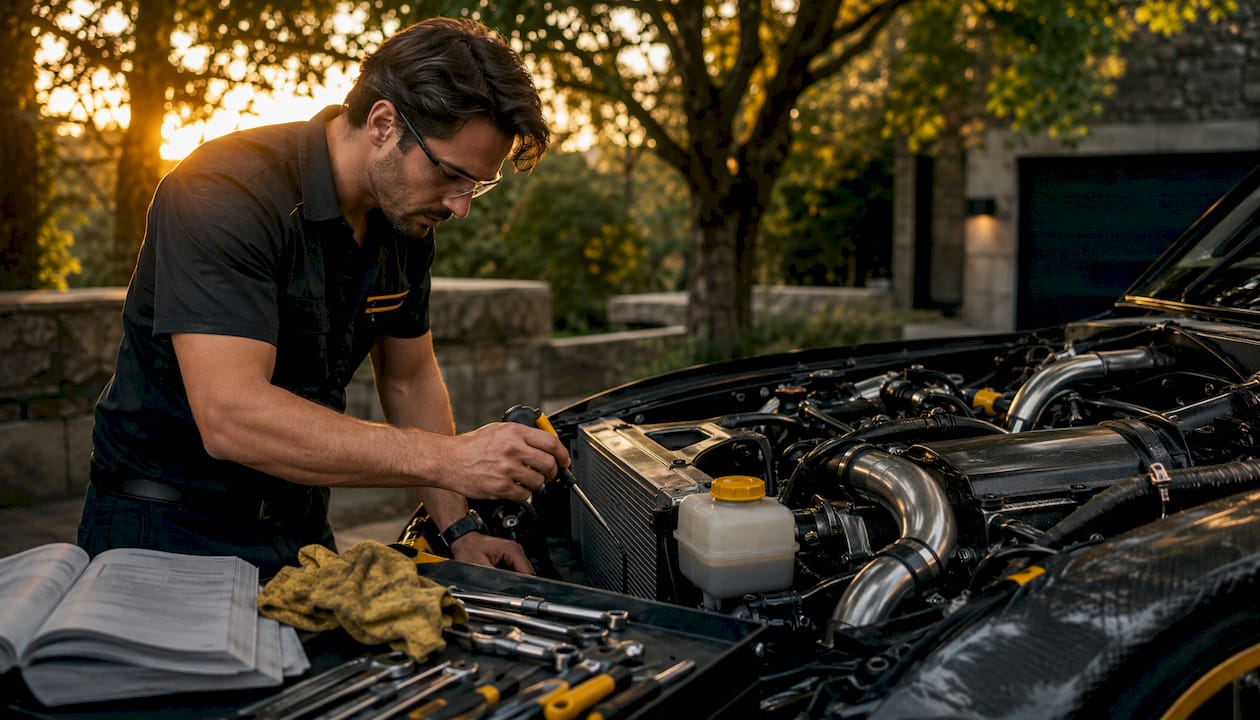
Performance cars overheat when heat generation exceeds the cooling system’s capacity to reject it. That sounds simple, but the root cause is usually combustion-side, not hardware: a lean air/fuel ratio, mistimed ignition, or a fuel switch without a remap will spike thermal load faster than any radiator upgrade can compensate. Before you pull the cooling system apart, log your data.
Quick triage — do these first:
- Pull over safely, shift to neutral or park, and kill accessory loads (A/C, fans on max).
- Watch for steam or smoke. If you see either, shut the engine off immediately.
- Once cool, check the coolant reservoir level and look for visible leaks around hoses and the radiator.
- Do NOT open the radiator cap while the engine is hot.
Pro Tip: Before ordering parts, pull AFR logs, exhaust gas temperature (EGT) traces, and coolant-temp data under load. In many race-engine overheating cases, the fix is a remap, not a new radiator.
Why do performance cars overheat? Heat generation vs. heat rejection
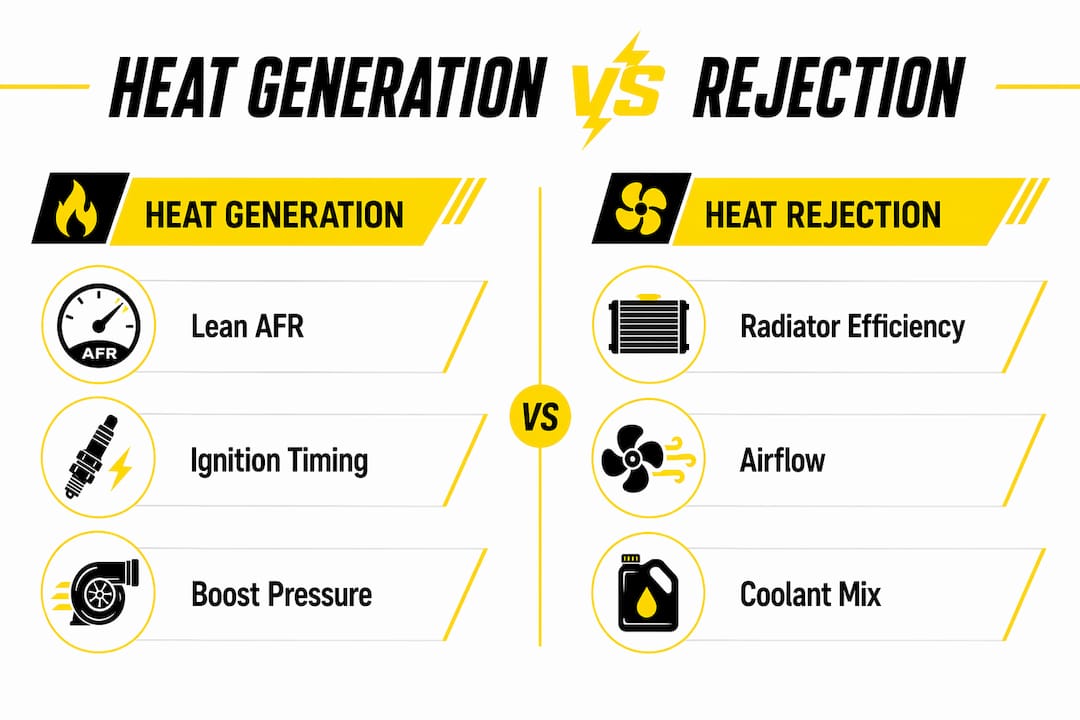
Every overheating problem falls into one of two buckets: the engine is producing more heat than it should, or the cooling system can’t shed the heat it’s receiving. Mixing these up is what sends owners down the wrong diagnostic path.
Heat generation covers everything that raises the thermal load on the engine:
- Combustion efficiency (lean AFR, incorrect ignition timing, detonation)
- Forced induction heat (compressor outlet temps, intercooler efficiency)
- Increased displacement or power output
- Accessory loads and parasitic drag
Heat rejection covers everything that removes heat from the system:
- Radiator core size, condition, and flow rate
- Coolant flow (water pump speed, hose diameter, thermostat operation)
- Airflow across the radiator (ram air at speed, electric fans at idle)
- Oil cooler and intercooler capacity
The interaction between these two sides is what catches people off guard. Heat load can increase significantly as power rises with forced induction or displacement upgrades, and a stock cooling system simply wasn’t designed to handle that delta. A modest tune that adds 80 horsepower can push heat output past what a radiator upgrade alone can absorb.
The core principle: Mechanics caution against reflexively upsizing the radiator. Combustion efficiency, coolant flow, and exhaust heat are often the limiting factors that should be addressed first — and a larger radiator on a poorly tuned engine is just a more expensive way to run hot.
Pro Tip: Sketch out (or ask your tuner to show you) a simple “heat in vs. heat out” diagram for your specific build. Knowing which side of the equation is failing tells you exactly where to spend money.
Engine and tuning causes: AFR, timing, fuel, and boost
This is where most race-engine overheating problems actually live. The cooling system gets blamed because the temperature gauge is the visible symptom, but the combustion chamber is often the crime scene.
How lean AFR raises engine temperatures
Stoichiometric combustion for gasoline sits at 14.7:1 air-to-fuel ratio. At that ratio, combustion is theoretically complete. Run leaner than that under load and you get incomplete combustion — more energy exits as exhaust heat rather than cylinder pressure. Race tuners typically target richer AFRs around 12.5:1–13.0:1 under full load specifically to keep combustion temperatures manageable. A lean spike on a wideband log is one of the clearest indicators that the engine is generating excess heat.
Ignition timing and its thermal consequences
Timing that’s too advanced at the wrong RPM/load point causes detonation — uncontrolled combustion that generates intense, localized heat on piston crowns and ring lands. Timing that’s too retarded pushes the pressure peak late in the piston’s travel, meaning more energy exits as exhaust heat instead of doing useful work. Both scenarios raise operating temperatures. The goal is minimum best torque (MBT) timing at each load point, which keeps combustion efficient and thermal load predictable.
Fuel switches without a remap
Switching fuels without updating the tune is one of the most reliable ways to introduce an overheating problem that wasn’t there before. Stoichiometric ratios differ significantly by fuel: gasoline is ~14.7:1, E85 is ~9.7:1, and methanol is ~6.4:1. An injector map built for gasoline will run lean on E85 without recalibration. The cooling system that handled the previous fuel without issue is typically still capable — the combustion chemistry changed, and the calibration hasn’t caught up.
Forced induction: boost, intercooler efficiency, and detonation
Turbocharged and supercharged engines compress intake air, which raises its temperature before it even enters the combustion chamber. A degraded or undersized intercooler means elevated intake air temperatures (IAT), which increases detonation risk and raises the baseline thermal load on every combustion cycle. High boost without adequate intercooling is a compounding problem: hotter charge air, more susceptibility to knock, and a tune that may be pulling timing to compensate — all of which increase heat output.
Diagnostic checks for combustion-side overheating:
- Pull wideband AFR logs under full load — look for lean spikes above 14.0:1 at high RPM.
- Check EGT traces: elevated exhaust gas temperatures confirm excess heat is leaving through the exhaust, not the cooling system.
- Read spark plugs after a heat cycle — a light, chalky color indicates lean combustion and excess heat.
- Verify fuel pressure under load; a failing fuel pump or clogged filter can lean out the mixture at high demand.
- Log intake air temperatures before and after the intercooler to assess intercooler efficiency.
Pro Tip: On a wideband log, a lean spike that appears as the engine comes onto load (not at idle) is a classic sign of a fuel delivery limitation — injector duty cycle, fuel pump capacity, or a map that wasn’t built for the current power level. EGT probes on each cylinder can pinpoint which cylinder is running hottest.
What cooling hardware failures actually look like
Combustion-side causes aside, the cooling system itself can fail in ways that reduce heat rejection even when the engine is tuned correctly. Each component has a distinct failure signature.
Common failure modes and their symptoms:
- Clogged or collapsed radiator core: Overheating at speed, where ram air should be doing most of the work. The radiator can’t transfer heat fast enough because flow is restricted.
- Thermostat stuck closed: Engine overheats quickly from cold start; the coolant never circulates to the radiator. Upper radiator hose stays cold.
- Water pump bearing or impeller failure: Overheating under load with normal idle temps; the pump moves coolant at low RPM but cavitates or loses flow at high speed.
- Collapsed suction hose: Intermittent overheating that’s hard to reproduce; the hose collapses under pump suction and restricts flow.
- Radiator cap failure: Cap that doesn’t hold pressure lowers the system’s boiling point, causing coolant to boil at lower temperatures than it should.
- Fan motor or relay fault: Overheating only at idle or in traffic — when ram air is absent and the fan is the only source of airflow across the radiator.
Practical component tests:
- Pressure test: Pressurize the cold system to the cap’s rated pressure and hold for 15 minutes. Any drop indicates a leak.
- Upper/lower hose temperature comparison: With the engine at operating temp, the upper hose should be significantly hotter than the lower. A small differential suggests restricted flow through the radiator core.
- Thermostat check: Remove and submerge in hot water with a thermometer. It should open at its rated temperature (typically 180–195°F for performance applications).
- Fan operation: With the engine at operating temp and A/C off, the electric fan should cycle on. Check relay and fuse if it doesn’t.
- Radiator cap test: A cap tester confirms the cap holds its rated pressure; a cap that releases early drops system boiling point.
| Component | Symptom Pattern | Simple Test |
|---|---|---|
| Thermostat (stuck closed) | Overheats quickly from cold; upper hose stays cold | Bench test in hot water |
| Water pump | Overheats under load; normal at idle | Hose temp differential under load |
| Radiator core | Overheats at speed; normal at idle | Upper/lower hose temp split |
| Electric fan | Overheats only at idle/traffic | Manual activation test |
| Radiator cap | Boils at lower than expected temp | Pressure cap tester |
| Collapsed hose | Intermittent, hard to reproduce | Visual inspection under suction |
When a component test passes, that’s useful information — it narrows the problem to the combustion side or airflow management. Don’t replace parts that test fine.
Airflow, heat soak, and why stationary cars overheat fastest
A performance car’s cooling system is designed around moving air. At speed, ram air does most of the work pushing airflow through the radiator core. At idle or in slow traffic, the electric fan is the only source of forced airflow, and it’s rarely as effective as 60 mph of ram air.
Why safety cars and traffic cause overheating in race cars:
- Reduced vehicle speed means dramatically less ram air through the radiator.
- The engine is still generating heat (often at elevated RPM to keep boost up or maintain oil pressure).
- Intake air temperatures climb because hot underhood air recirculates instead of being swept away.
- Heat soak builds in the intake manifold, intercooler, and fuel system.
After a hard stint, heat soak continues even after the engine shuts down. Coolant stops circulating, hot spots develop around the head and exhaust ports, and residual heat can cause vapor lock in the fuel system. This is why a proper cool-down protocol matters as much as the hardware itself.
Heat-soak warning signs:
- Lap times drift slower by 0.5–2.0 seconds without traffic or driver error.
- IAT climbs steadily and doesn’t recover on straights.
- Coolant and oil temperatures plateau high and keep creeping after back-to-back push laps.
Pro Tip: After a hard session, do a cool-down lap at reduced pace with short-shifting to lower exhaust energy and underhood temps while keeping airflow moving. If you must shut down immediately, leave the engine idling for 2–3 minutes with the fan running before killing the ignition. Never shut a hot race engine off cold-turkey in a tight paddock space.

Coolant, oil, and boiling-point basics for performance use
The fluid side of thermal management is often the cheapest fix and the most overlooked.
Getting coolant mixture right
A 50/50 mix of ethylene glycol antifreeze and distilled water raises the boiling point to roughly 265°F at atmospheric pressure. System pressure raises it further — a 16 psi radiator cap pushes the boiling point above 260°F even on a straight-water system. For track use, many builders run a 30/70 antifreeze-to-water mix to improve heat transfer (water conducts heat better than glycol), accepting reduced freeze protection in exchange for better thermal performance. Additives like Water Wetter can further reduce surface tension and improve heat transfer in a water-heavy mix.
Coolant maintenance steps:
- Drain and flush the system every two years or per the manufacturer’s interval, whichever comes first.
- Use distilled water only — tap water introduces minerals that cause scale buildup inside the radiator and passages.
- Verify the coolant concentration with a refractometer, not a float-type tester, for accuracy.
- Check the radiator cap pressure rating and replace it if it’s more than three years old.
Oil as a secondary coolant
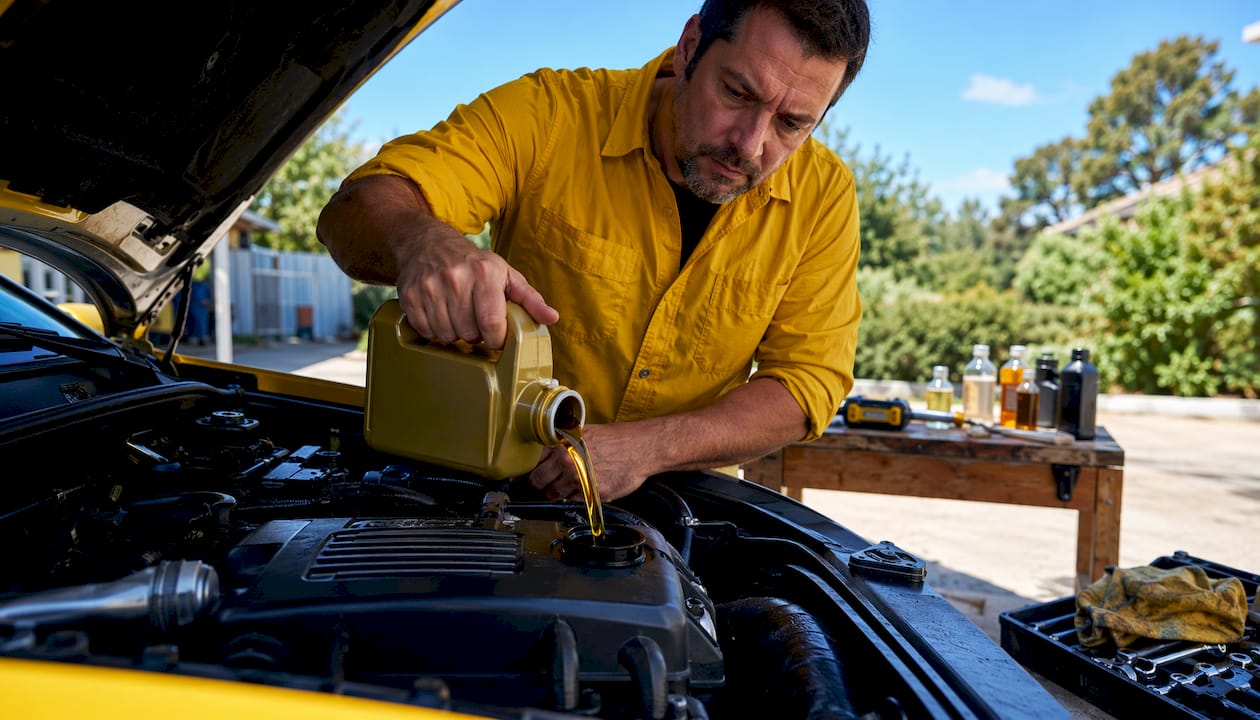
Engine oil absorbs heat from pistons, bearings, and the valvetrain — components the coolant circuit never directly touches. Oil that’s degraded or running at excessive temperature loses viscosity, which reduces its ability to carry heat away from bearings and increases friction. An oil cooler is often the single most cost-effective thermal upgrade for a track car because it protects both lubrication and heat management simultaneously.
Bleeding air pockets out of the system
Trapped air after servicing is a frequent, non-obvious cause of intermittent overheating. Air pockets impede coolant flow and create localized hot spots, especially in complex multi-radiator layouts. To bleed properly: fill the system cold with the heater on full, start the engine with the reservoir cap loose, and squeeze the upper hose repeatedly while the thermostat opens to burp trapped air. On cars with bleed screws at the highest point in the system, open them until coolant flows without bubbles.
Pro Tip: After any cooling system work, run the engine through two full heat cycles and recheck the reservoir level. Air pockets often don’t reveal themselves until the thermostat opens for the first time.
Step-by-step diagnostic checklist to find the root cause
Work through this in order. Start cheap and simple; move to instrumented tests only when the basics check out.
Tools you need:
- Cooling system pressure tester
- Wideband AFR sensor/logger
- EGT sensors (per-cylinder if possible)
- Infrared thermometer
- OBD-II scan tool with live data
- Combustion leak test kit (block tester / chemical test for exhaust gases in coolant)
- Thermometer clamps for hose temperature measurement
Ordered diagnostic steps:
- Cold level check: Inspect the coolant reservoir and radiator (when cold) for level and contamination. Milky or oily coolant suggests a head gasket issue.
- Pressure test: Pressurize the cold system and hold for 15 minutes. Any drop means there’s a leak somewhere in the circuit.
- Coolant flow check: With the engine at operating temp, measure upper and lower hose temperatures with an IR thermometer. A small differential (less than 20°F) across the radiator suggests restricted flow through the core.
- Thermostat verification: If the upper hose stays cold while the engine overheats, the thermostat is stuck closed.
- Fan operation check: Confirm the electric fan activates at the correct coolant temperature. Check relay, fuse, and temperature sensor.
- AFR/EGO logs under load: Log wideband AFR during a full-throttle pull. Lean spikes above 14.0:1 at high load confirm a combustion-side heat source.
- EGT analysis: Elevated EGTs (typically above 1,400°F / 760°C on a gasoline engine under load) confirm excess heat leaving through the exhaust.
- Block/combustion leak test: If coolant is disappearing without visible external leaks, use a block tester to check for combustion gases in the coolant. A color change confirms head gasket failure or a cracked head.
| Measurement | Normal Range | Warning Sign |
|---|---|---|
| Coolant temp (operating) | 195–220°F (90–105°C) | Above 240°F (115°C) |
| Upper/lower hose temp split | 15–30°F across radiator | Less than 10°F |
| AFR at full load (gasoline) | 12.5:1–13.0:1 | Above 14.0:1 (lean) |
| EGT (gasoline, full load) | 1,200–1,400°F | Above 1,450°F |
| System pressure hold | Stable at cap rating | Any pressure drop |
What to do the moment your performance car overheats
Speed matters here. Every minute you keep driving on an overheating engine accelerates damage.
Immediate steps:
- Find a safe place to pull off the track or road — don’t stop on a blind corner or active racing line.
- Shift to neutral or park and turn off the A/C. If you’re on track, signal clearly and exit.
- If you see steam or smell coolant burning, shut the engine off immediately.
- If no steam is visible and temps are climbing but not critical, try idling with the fan running — sometimes this recovers the situation.
- Do NOT open the radiator cap. A pressurized system can spray scalding coolant.
- Let the engine cool for at least 30 minutes before checking the reservoir.
- Once cool, check the reservoir level. If it’s low and you have distilled water, top it up carefully.
What to document while you wait:
- Gauge behavior: did temp climb gradually or spike suddenly?
- Smoke color: white smoke suggests coolant burning; blue smoke suggests oil.
- Any unusual smells (sweet = coolant, acrid = oil burning).
- Whether overheating occurred at speed, at idle, or during a specific RPM range.
Hard warnings:
- Never pour cold water on a hot engine block. Thermal shock can crack the block or head.
- Continuing to drive while overheating accelerates damage rapidly — stop and diagnose rather than pushing on.
- If you suspect detonation or ignition-related overheating, don’t restart repeatedly. Each restart risks additional piston and ring land damage.
Prevention and upgrades that actually work for performance cars
The most common mistake in addressing overheating problems in sports cars is buying hardware before understanding the cause. Here’s the priority order that experienced tuners use.
Upgrade priority framework:
- Data and tune first: Correct AFR tables, ignition timing maps, and fuel delivery before touching hardware. A remap costs less than a radiator and fixes more overheating problems.
- Cooling flow second: Replace a failing water pump, upgrade to a high-flow thermostat, and replace any soft or collapsed hoses.
- Oil cooler third: Protects bearings and reduces the thermal load the coolant circuit has to handle. Often the highest-value hardware upgrade for track cars.
- Heat exchangers fourth: Intercooler upgrade for forced-induction cars, larger radiator if flow tests confirm the core is the restriction.
- Airflow management last: Ducting, shrouds, bonnet vents, and fan upgrades address the delivery of air to heat exchangers — only useful if the exchangers themselves are adequate.
| Symptom | Most Likely Cause | First Upgrade to Try |
|---|---|---|
| High EGTs under load | Lean AFR or timing issue | ECU remap / AFR correction |
| Overheating in traffic only | Fan or oil cooler | Electric fan upgrade / oil cooler |
| Overheating at speed | Radiator restriction or flow | Radiator flush or upgrade |
| Overheating after fuel switch | Lean mixture on new fuel | Remap for new fuel stoichiometry |
| Overheating after power upgrade | Cooling capacity mismatch | Oil cooler + radiator upgrade |
| Intermittent overheating | Air pocket or cap failure | Bleed system, replace cap |
Cost vs. benefit summary:
- ECU remap: High impact, moderate cost. Fixes combustion-side heat at the source.
- Oil cooler: High impact, moderate cost. Reduces coolant circuit load and protects bearings.
- Electric fan upgrade: Moderate impact, low cost. Solves idle/traffic overheating specifically.
- Larger radiator: Moderate impact, higher cost. Only effective when flow tests confirm the core is the bottleneck.
- Intercooler upgrade: High impact for boosted cars, moderate cost. Reduces IAT and detonation risk.
- Bonnet vents / ducting: Low-to-moderate impact, variable cost. Useful only after exchangers are confirmed adequate.
Pro Tip: In many builds, a correct fuel tune plus an oil cooler delivers bigger reliability gains than a large radiator alone. The radiator handles coolant heat; the oil cooler handles the heat the coolant circuit never sees. Running both correctly is what keeps a track car consistent across a full session.
What overheating actually does to a performance engine
Understanding the damage progression is what separates owners who catch problems early from those who rebuild engines.
Temperature thresholds:
| Temperature | Status | Risk Level |
|---|---|---|
| 195–220°F (90–105°C) | Normal operating range | None |
| 220–240°F (105–115°C) | Elevated; monitor closely | Increasing |
| 240°F (115°C)+ | Dangerous; stop and diagnose | High |
| 260°F+ | Engine damage very likely | Severe |
Damage progression:
- Oil breakdown: Happens first, often before visible symptoms. Oil viscosity drops, film strength decreases, and bearing surfaces lose protection.
- Head gasket failure: The most common catastrophic result of sustained overheating. The gasket fails between a coolant passage and a combustion chamber, allowing coolant into the cylinder.
- Warped cylinder head: Aluminum heads warp at lower temperatures than cast iron. A warped head means a machine shop resurface at minimum, replacement at worst.
- Piston damage: Detonation-related overheating attacks piston crowns and ring lands directly. Damage can be rapid and severe.
- Seized bearings: If oil breakdown progresses far enough, bearing surfaces weld to journals. This is typically a full engine rebuild.
Signs damage has already occurred:
- White or sweet-smelling exhaust smoke (coolant burning in the combustion chamber)
- Milky or foamy oil on the dipstick or under the oil cap (coolant mixing with oil)
- Coolant level dropping with no visible external leak
- MIL codes for coolant temperature sensor or misfire on a specific cylinder
- Compression test showing a low cylinder adjacent to a normal one (head gasket between them)
Temperatures above 240°F generally require immediate intervention — at that point, the question isn’t whether damage is occurring, but how fast.
Routine maintenance and pre-event checks that prevent overheating
Most track-day overheating incidents are preventable with consistent maintenance. The cars that run cool all season are the ones with owners who check the boring stuff.
Recommended service intervals for performance use:
- Coolant replacement: Every two years or every 30,000 miles, whichever comes first. High-stress use degrades inhibitors faster than street driving.
- Pressure test: At least once per season, and after any cooling system work.
- Hose and clamp inspection: Before every track event. Squeeze hoses — any that feel soft, spongy, or show surface cracking need replacement.
- Radiator flush: Every two years or when contamination is visible. A clogged core reduces flow before it causes obvious symptoms.
- Water pump inspection: At timing belt/chain service intervals, or if any bearing noise develops. Impeller erosion on aluminum pumps is common in high-mileage performance applications.
- Thermostat replacement: Every 50,000 miles or if any temperature irregularity appears. Thermostats are cheap insurance.
Pre-event checklist:
- Bleed the cooling system if any work was done since the last event.
- Confirm AFR tables are current for the fuel you’re running that day.
- Inspect radiator ducting and shrouds — make sure nothing has shifted or torn.
- Verify electric fan operation before leaving the paddock.
- Check oil condition and level; change if it’s within 1,000 miles of its service interval.
- Confirm thermostat and radiator cap pressure ratings match your system spec.
- Check coolant concentration with a refractometer.
Seasonal notes: In summer heat, consider dropping to a 30/70 antifreeze-to-water mix for better heat transfer. In winter or cold-climate track days, verify freeze protection is adequate for overnight temperatures. Ambient temperature swings of more than 40°F between events can meaningfully affect operating temperatures, especially for cars with fixed thermostat ratings.
Why combustion problems beat upgraded radiators, according to tuners
The diagnostic workflow that experienced race tuners use starts with data, not parts. Overheating is often misdiagnosed as a radiator-only problem; many incidents resolve after correcting fuel mixture, ignition timing, or water-pump drive ratios — without touching the radiator at all.
The Frenzycars diagnostic workflow: Log AFR and EGT under load first. Verify consistent coolant flow with hose-temperature differentials. Inspect airflow and packaging for recirculation. Only then select targeted hardware upgrades based on what the data actually shows.
This approach matters because the symptoms of a lean AFR and a clogged radiator look identical on the temperature gauge. The difference is that a remap costs a fraction of a radiator replacement and addresses the actual heat source. Owners who skip the data step often end up with a new radiator on a poorly tuned engine — and the same overheating problem.
The Frenzycars performance car maintenance checklist walks through the full pre-event and routine service workflow that supports this diagnostic approach. For track cars where braking and thermal management interact, the brake upgrade tier guide covers how brake heat feeds back into underhood temperatures during hard sessions.
What the data-first approach looks like in practice:
- A turbocharged street car running E85 developed repeated overheating after a power upgrade. AFR logs showed lean spikes above 14.5:1 at high RPM. A remap correcting injector duty cycle for E85 stoichiometry resolved the overheating without any cooling hardware changes.
- A naturally aspirated track car overheated consistently in traffic but not at speed. Fan relay inspection found a failing relay that caused the fan to drop out above 85°F ambient. A $30 relay replacement fixed what looked like a major cooling problem.
- A forced-induction build with a new intercooler still overheated. IAT logs showed the intercooler was working correctly, but EGTs were elevated across all cylinders. Timing was advanced beyond MBT for the fuel in use. Pulling 2 degrees of timing at high load dropped EGTs and resolved the overheating.
Heat management is a performance system, not a single part. The biggest gains come from controlling airflow paths, logging the right temperatures, and setting targets for stability rather than chasing the lowest absolute number.
Key Takeaways
Performance cars overheat when combustion-side heat generation — lean AFR, mistimed ignition, or unmatched forced induction — exceeds what the cooling system can reject, and data logging is the fastest way to tell which side is failing.
| Point | Details |
|---|---|
| Log before you buy parts | Pull AFR, EGT, and coolant-temp data under load before ordering any cooling hardware. |
| Lean AFR is the most common race cause | Race tuners target richer AFRs under load to keep combustion temperatures manageable. |
| An intervention threshold temperature exists: sustained coolant temperatures above 240°F (115°C) are dangerous and engine damage becomes very likely beyond that point. | |
| Oil cooler beats a bigger radiator | An oil cooler addresses heat the coolant circuit never sees and protects bearings simultaneously. |
| Bleed after every cooling system service | Trapped air causes intermittent hot spots and is frequently misdiagnosed as a component failure. |
The part most owners skip
The pattern that shows up repeatedly in overheating diagnoses is this: owners spend money on the visible hardware (radiator, hoses, thermostat) and skip the data that would tell them whether any of it was necessary. A wideband sensor and a logging session cost less than a radiator and reveal far more.
There’s also a tendency to treat temperature management as a problem to solve once and forget. In motorsport, heat is a dynamic variable — ambient conditions, stint length, safety car periods, and fuel load all shift the balance between heat generation and rejection during a single session. The teams that run consistently cool aren’t the ones with the biggest radiators; they’re the ones who treat temperature like a setup variable and adjust accordingly.
If you’re chasing an overheating problem, collect the data first: AFR traces, EGT logs, and coolant-temp graphs under the conditions where the problem appears. Share those logs with a tuner who knows your platform before committing to hardware. The answer is almost always in the data, not in the parts catalog.
Authoritative sources and recommended reading
These are the sources and Frenzycars resources worth bookmarking for deeper diagnostics and parts research.
- Speedway Motors: Fix An Overheating Race Engine: The most practical race-engine overheating guide available. Covers AFR, timing, pump drive ratios, and why the cooling system is rarely the first place to look.
- HP Academy: Engine Coolant Temperatures: Authoritative numeric thresholds for normal and dangerous operating temperatures, with tuner context on why stable lower temps protect against detonation.
- VP Racing Fuels: Engine Overheating After Switching Fuels: Detailed technical explanation of how fuel stoichiometry changes cause lean conditions and overheating after a fuel switch.
- CarParts.com: How Hot Does a Radiator Get?: Consumer-accessible explanation of radiator temperature ranges and the damage thresholds that matter.
- Bumper.com: Engine Overheating Causes: Practical driver-focused guide on immediate actions and how to identify the cause after an overheating event.
- Frenzycars Performance Car Maintenance Checklist: The full pre-event and routine service workflow that supports the diagnostic approach in this article.
For readers moving from troubleshooting into shopping decisions: the Frenzycars car specs hub lets you look up OEM cooling specifications by make and model — useful for comparing your stock cooling baseline against what the build actually demands.