
Most modern cars on full synthetic oil can go 5,000–10,000 miles between oil changes. If your car has an oil-life monitoring system (OLM), follow it. If it doesn’t, check your owner’s manual first, then use 5,000–7,500 miles as a practical default for most drivers on synthetic. The old 3,000-mile rule, which originated with older engines and conventional oil, is largely outdated for newer vehicles.
According to Kelley Blue Book, modern vehicles using synthetic or semi-synthetic oils commonly go 7,500–10,000 miles between changes. The average U.S. driver covers about fourteen thousand miles per year, which can translate to roughly one or two oil changes annually on synthetic.
Pro Tip: Keep a simple log in your glove box or a notes app: date, mileage, oil brand, and viscosity. That record protects your warranty and adds real value at resale.
Situations that shorten your interval:
- Frequent short trips under 5 miles (engine never fully warms up)
- Towing, hauling, or driving a turbocharged engine
- Extreme heat, extreme cold, or dusty/off-road conditions
- Heavy stop-and-go city traffic or frequent idling
- Vehicles older than 10 years running conventional oil
Key Takeaways
Most drivers on full synthetic oil should change it every 5,000–7,500 miles, follow the owner’s manual above all else, and never go more than 12 months between changes regardless of mileage.
| Point | Details |
|---|---|
| Default interval for most drivers | 5,000–7,500 miles on full synthetic; check the owner’s manual for your exact spec. |
| Severe service shortens intervals | About 80% of U.S. drivers qualify as severe service; shorten to 5,000 miles or less. |
| Time-based minimum | Change oil at least once per year even if mileage is low; oil degrades with age. |
| Urgent signs override mileage | Dark gritty oil, engine ticking, or warning lights mean change it now, not at the next interval. |
| Log every service | A documented maintenance history protects your warranty and supports resale value. |
What are the typical oil change intervals by oil type?
| Oil Type | Normal Service | Severe Service | Time Minimum |
|---|---|---|---|
| Conventional | 3,000–5,000 miles | 3,000 miles | Every 6 months |
| Semi-synthetic | 5,000–7,500 miles | 4,000–5,000 miles | Every 6 months |
| Full synthetic | 7,500–10,000 miles | 5,000–7,500 miles | Once per year |
| Manufacturer long-life | 10,000–15,000 miles | Per OLM reading | Once per year |
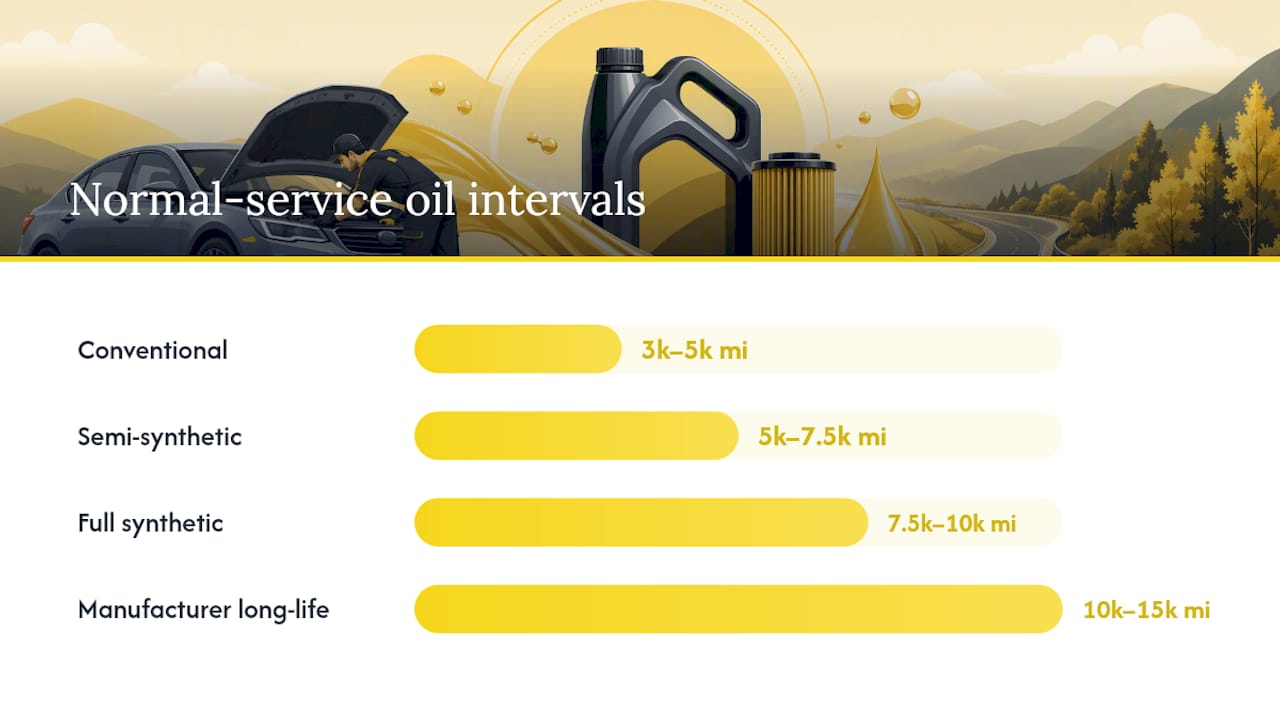
Normal driving means mostly highway miles, trips longer than 10 miles, moderate temperatures, and no towing. Severe driving covers the opposite: lots of short trips, stop-and-go traffic, extreme climates, towing, or dusty roads.
Even if you barely drive, oil degrades over time from moisture and contaminants. A car sitting in a garage still needs fresh oil at least once a year.
On oil-life monitors: trust them, but understand what they are. An OLM uses sensors and algorithms to estimate oil degradation based on driving patterns, temperature, and engine load. It does not physically test the oil.
How do you determine the right interval for your exact vehicle?
Start with the owner’s manual. Every manufacturer publishes a maintenance schedule with the exact mileage interval, oil viscosity (like 5W-30 or 0W-20), and API or ILSAC specification required. That schedule, not a quick-lube shop’s sticker, is the authoritative answer for your car.
Here’s a practical decision flow:
- Check the owner’s manual for the manufacturer’s recommended interval and oil grade.
- Look for an OLM on your dashboard. If your car has one, follow it as your primary trigger.
- Identify your oil type. Synthetic allows longer intervals; conventional does not.
- Assess your driving conditions. If you match any severe-service criteria, shorten the interval.
- Apply the time-based minimum. Even low-mileage drivers should change oil at least once per year.
You can find your owner’s manual in the glove box, on the manufacturer’s website, or by searching your VIN. For quick reference on factory-recommended specs by make and model, Frenzycars’ vehicle database is a useful starting point.
Factors that should push you toward a shorter interval:
- Towing a trailer or hauling heavy loads regularly
- Lots of short trips (under 5 miles each)
- Driving in temperatures consistently below 10°F or above 100°F
- Dusty, unpaved, or off-road conditions
- Frequent idling (delivery routes, rideshare driving)
- Turbocharged or high-performance engine
Pro Tip: After every oil change, photograph the shop receipt and save it to a cloud folder labeled with your car’s year, make, and model. If you ever need to make a warranty claim, that documentation is your first line of defense.
Hybrid owners face a counterintuitive situation: because the combustion engine runs less, oil can accumulate more moisture and fuel dilution. Follow the OLM or a conservative interval rather than assuming fewer engine hours means less frequent service. The benefits and quirks of hybrid ownership are worth understanding before setting any maintenance schedule.
What counts as “severe” driving and how does it change your interval?
Industry data shows that approximately 80% of U.S. drivers experience severe driving conditions, most without realizing it. The biggest culprit is the short daily commute: a 3-mile round trip to the grocery store never brings the engine to full operating temperature, so moisture and fuel vapors stay in the oil instead of burning off.
Severe service is defined by any of the following:
- Trips consistently under 5 miles in normal temperatures or under 10 miles in freezing weather
- Sustained towing, trailer hauling, or carrying maximum payload
- Driving in dusty, muddy, or off-road conditions
- Prolonged idling (taxi, delivery, rideshare)
- Operating in ambient temperatures above 90°F or below 10°F for extended periods
- Stop-and-go urban traffic as your primary driving environment
Interval adjustments for severe service:
Example profiles:
The suburban commuter: Drives 8 miles each way to work, mostly surface streets. That qualifies as severe service. A 5,000-mile interval on synthetic is the right call, not 10,000.

The weekend highway driver: Puts 400 miles on the car every Saturday on the interstate, rarely drives during the week. Normal service applies. 7,500–10,000 miles on synthetic is reasonable.
The pickup truck owner who tows monthly: Towing puts enormous thermal stress on oil. Treat every towing month as severe. Shorten to 5,000 miles regardless of what the OLM says, since towing loads can outpace what the sensor algorithm expects.
Pro Tip: Turbocharged engines run significantly hotter than naturally aspirated ones, which accelerates oil breakdown. Many manufacturers already classify turbocharged engines as severe service. Check your manual specifically for turbo guidance rather than applying the standard interval.
For performance and turbocharged vehicles, the performance car maintenance checklist covers additional considerations beyond oil alone.
Synthetic vs. semi-synthetic vs. conventional: which lasts longer?
Full synthetic oil is engineered for stability. Its uniform molecular structure resists oxidation, maintains viscosity across a wider temperature range, and holds up longer under high heat than conventional oil, which is refined from crude and contains naturally occurring impurities. Semi-synthetic blends the two, offering better performance than conventional at a lower price than full synthetic.
Typical mileage by oil type:
- Conventional: 3,000–5,000 miles. Degrades faster, especially in heat or stop-and-go traffic.
- Semi-synthetic: 5,000–7,500 miles. A solid middle ground for older vehicles or moderate budgets.
- Full synthetic: 7,500–10,000 miles, and up to 15,000 miles when the manufacturer explicitly allows it.
The upfront cost of synthetic is higher, typically $70–$100 for a full synthetic change versus $35–$55 for conventional. But at twice the interval, the per-mile cost often comes out lower. For a driver covering 15,000 miles per year, two synthetic changes beats five conventional changes in both cost and shop visits.
Turbocharged and high-performance engines run hotter and break down oil faster. For those vehicles, full synthetic is not optional; it’s the only oil that holds up reliably between changes.
Pro Tip: Never switch oil types mid-interval. If you’re moving from conventional to synthetic, do it at the next scheduled change and reset your interval expectations accordingly.
One thing most drivers miss: the oil filter has a finite capacity. When it approaches saturation, a bypass valve opens and unfiltered oil circulates through the engine. That sets a hard ceiling on how far you can stretch any interval, even if the oil itself still looks clean.
What are the urgent signs your oil needs changing now?
Mileage is a guide, not a guarantee. Sometimes oil degrades faster than expected, and the car will tell you before the odometer does.
Watch for these urgent indicators:
- Oil warning light: Pull over safely when possible, check the level immediately. Low pressure or critically low level needs same-day attention.
- Dark, gritty oil on the dipstick: Fresh oil is amber and translucent. Black, opaque, or gritty oil is overdue.
- Engine ticking or knocking: Insufficient lubrication causes metal-on-metal contact. Don’t ignore this.
- Burning oil smell inside the cabin: Can indicate a leak dripping on hot engine parts or severely degraded oil.
- Excessive exhaust smoke: Blue-gray smoke often means oil is burning in the combustion chamber.
- Sudden drop in fuel efficiency: Degraded oil creates more friction, which costs you MPGs.
If you notice ticking or knocking, stop driving and check the oil level before continuing. Running an engine low on oil for even a short distance can cause permanent damage.
Pro Tip: Check your oil level once a month, regardless of mileage. It takes 90 seconds and catches slow leaks before they become expensive problems.
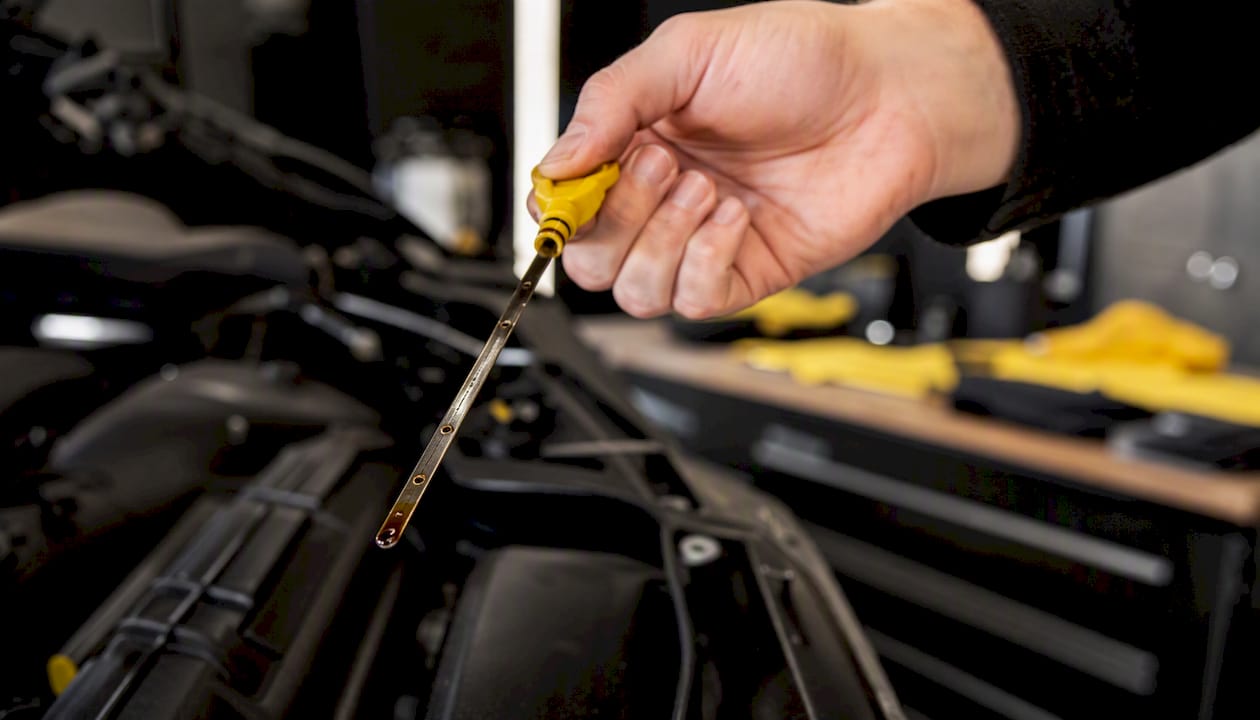
When buying a used car, the dipstick tells you a lot about how the previous owner maintained the vehicle. A used car test drive checklist includes oil condition as one of the first things to verify.
How to check your oil level and condition with the dipstick
Park on level ground. The engine can be warm or cold, but cold gives a cleaner read since hot oil expands slightly and can splash the dipstick.
- Pop the hood and locate the dipstick (usually a brightly colored loop or handle near the engine center).
- Pull it out and wipe it clean with a lint-free rag.
- Reinsert it fully, then pull it out again.
- Read the level. Oil should sit between the MIN and MAX marks. Below MIN means add oil; above MAX means too much was added.
- Check the color and texture. Rub a drop between your fingers. Amber and smooth is fine. Black and gritty means it’s time for a change. Milky or foamy oil can indicate coolant contamination, which needs immediate shop attention.
- Smell it. A sharp, acrid smell suggests the oil has been running hot or is severely degraded.
Pro Tip: Do this check once a month and always before a long road trip. Five minutes of prevention beats a $4,000 engine repair.
What happens if you wait too long between oil changes?
Oil that runs past its service life stops protecting and starts causing damage. The progression is predictable:
- Increased engine wear: Depleted additives mean metal surfaces contact each other directly.
- Sludge formation: Oxidized oil thickens into a tar-like deposit that clogs oil passages.
- Filter bypass: A saturated filter opens its bypass valve, sending unfiltered oil through the engine.
- Turbocharger damage: Turbos spin at up to 200,000 RPM and rely entirely on clean, pressurized oil. Degraded oil causes bearing failure fast.
- Higher repair costs: Sludge removal, bearing replacement, or a full engine rebuild can run $3,000–$8,000 or more.
- Voided warranty: Documented failure to follow the manufacturer’s maintenance schedule can give an automaker grounds to deny a powertrain warranty claim.
Neglecting oil changes doesn’t just shorten engine life gradually. It creates a failure point that can strand you without warning. A $75 oil change is the cheapest insurance your engine has.
Resale value takes a hit too. A car with no maintenance records, or records showing long gaps between services, is worth measurably less at trade-in. Buyers and dealers check service history, and a missing oil change log raises red flags.
Pro Tip: If you’ve gone significantly over your interval, don’t panic. Get the change done immediately and consider a second change 1,000 miles later to flush any remaining degraded oil from the system.
How much does an oil change cost and how long does it take?
Typical price ranges at a shop, including filter and labor:
- Conventional oil change: $35–$55
- Semi-synthetic: $45–$70
- Full synthetic: $70–$100
A standard shop visit takes 30–45 minutes for a basic oil and filter change. Quick-lube chains often run faster; dealerships may take longer if they bundle a multi-point inspection.
DIY runs cheaper on parts ($25–$60 for oil and filter depending on type) but requires tools, a safe way to lift the car, and proper disposal of the used oil. Most auto parts stores, including AutoZone and O’Reilly Auto Parts, accept used oil for recycling at no charge.
Money-saving tips:
- Buy full synthetic oil in 5-quart jugs when it’s on sale; most engines take 4–6 quarts.
- Watch for manufacturer or shop coupons, especially at dealerships during slow seasons.
- Never skip the filter change to save a few dollars. A new filter is non-negotiable at every oil change.
- Always use the viscosity grade specified in your owner’s manual, not whatever the shop has in stock.
Pro Tip: Used motor oil is hazardous waste. Never pour it down a drain or into the trash. Drop it at any AutoZone, O’Reilly, or participating service station for free recycling.
Why does the owner’s manual matter for oil change intervals?
The owner’s manual is the manufacturer’s engineering specification, not a suggestion. It lists the exact oil viscosity, API/ILSAC certification, and mileage interval that the engine was designed and tested around. Deviating from it, especially by using a lower-grade oil or skipping changes, can void your powertrain warranty.
AAA emphasizes that following the manufacturer-specified oil grade and interval is the primary guidance for protecting both engine longevity and warranty coverage. That’s not a conservative opinion; it’s the baseline every other recommendation builds from.
Some manufacturers, particularly those with OLM-equipped vehicles, specify extended intervals of 10,000–15,000 miles for approved synthetic oils. Those intervals are legitimate when the manufacturer explicitly permits them. Following a 15,000-mile interval on a car that only allows 7,500 miles is a different matter entirely.
The owner’s manual is the only document that was written specifically for your engine by the people who built it. Every other source, including this one, is a general guide.
Where to find your interval and oil spec:
- Glove box owner’s manual (maintenance schedule section)
- Manufacturer’s website (search your year, make, model, and “maintenance schedule”)
- Oil filler cap or a sticker inside the hood (often shows viscosity grade)
- Frenzycars’ car specs database for quick reference by make and model
Proper maintenance records also matter for extended warranty claims. If you carry an extended warranty, understanding what documentation it requires is worth reviewing before your next service. The best extended car warranty companies typically require proof of regular oil changes to honor powertrain claims.
Pro Tip: If your car is still under the factory powertrain warranty, use the manufacturer-specified oil grade every time, even if a shop recommends something different. Mismatched oil specs are one of the few things that can give a manufacturer a legitimate reason to deny a claim.
How to verify your oil change was done correctly
Don’t just hand over your keys and trust the receipt. A quick check after any oil change takes two minutes and confirms the job was done right.
Post-service checklist:
- Check the dipstick. Oil should be at or near the MAX mark and amber-colored, not black.
- Confirm the oil type and viscosity on the receipt match your owner’s manual spec (e.g., 5W-30 full synthetic).
- Look under the car for fresh drips or puddles. A loose drain plug or filter can leak immediately.
- Check the oil filler cap is seated and tight.
- Look for a new service sticker on the windshield with the next recommended mileage noted.
- Reset the OLM if your car has one. Some shops forget this step; your manual shows how.
- Start the engine and watch for the oil pressure warning light to go off within a few seconds.
If the oil on the dipstick is already dark after a fresh change, ask the shop what oil they used and verify it matches your spec. Fresh oil should look noticeably lighter than what came out.
The case for following your manual, not the shop’s sticker
Here’s the honest take: the oil change industry spent decades training drivers to come in every 3,000 miles. That was profitable. It was also unnecessary for most modern cars.
The real answer is less dramatic than either extreme. You don’t need to change oil every 3,000 miles, but you also shouldn’t push to 15,000 miles unless your manufacturer explicitly says you can. The sweet spot for most drivers on synthetic is 5,000–7,500 miles, adjusted down for severe service and anchored to a once-per-year minimum regardless of mileage.
The owner’s manual wins every argument. The OLM is your best real-time tool. And a simple maintenance log costs nothing but pays off every time you sell a car or file a warranty claim.
Sources
- Synthetic vs Conventional Oil: Which Is Better for Your Car
- How Often Should I Change My Oil?
- Automotive oil change intervals: severe vs normal driving (industry bulletin)
- Signs your car needs an oil change