TL;DR:
- Getting an alignment check with every tire purchase ensures optimal tire wear, vehicle safety, and fuel efficiency. Proper wheel alignment adjusts suspension angles to reduce uneven wear and support advanced driver-assist systems, saving money long term. Regularly verifying alignment before and after mounting new tires prolongs tire life and maintains vehicle performance.
Get an alignment check every time you buy new tires. That’s the short answer, and NHTSA, Hunter Engineering, and Frenzycars all point to the same conclusion: the role of wheel alignment in tire buying isn’t optional maintenance you schedule later. It’s part of the purchase itself. Before your new tires are mounted, ask the shop for a pre-install alignment readout. If the numbers are out of spec, insist on a four-wheel alignment before you leave. A typical alignment service can easily save you the cost of premature tire replacements.

What is wheel alignment, and why does it affect your tires?
Wheel alignment is a suspension geometry calibration that sets the precise angles at which your tires contact the road. It has nothing to do with the tires or wheels themselves. Technicians adjust the suspension components to bring three key angles back to factory spec:
- Camber: The inward or outward tilt of the tire when viewed from the front. Excessive camber causes one edge of the tread to wear faster than the other.
- Toe: Whether the fronts of the tires point inward (toe-in) or outward (toe-out) relative to each other. Toe error is the most common cause of rapid, feathered tread wear.
- Caster: The angle of the steering axis viewed from the side. Caster affects straight-line stability and steering feel more than tire wear, but severe caster imbalance can cause pulling.
A single degree of error in any of these angles starts degrading your tires from the first mile.
Why alignment matters for safety, fuel economy, and modern driver-assist systems
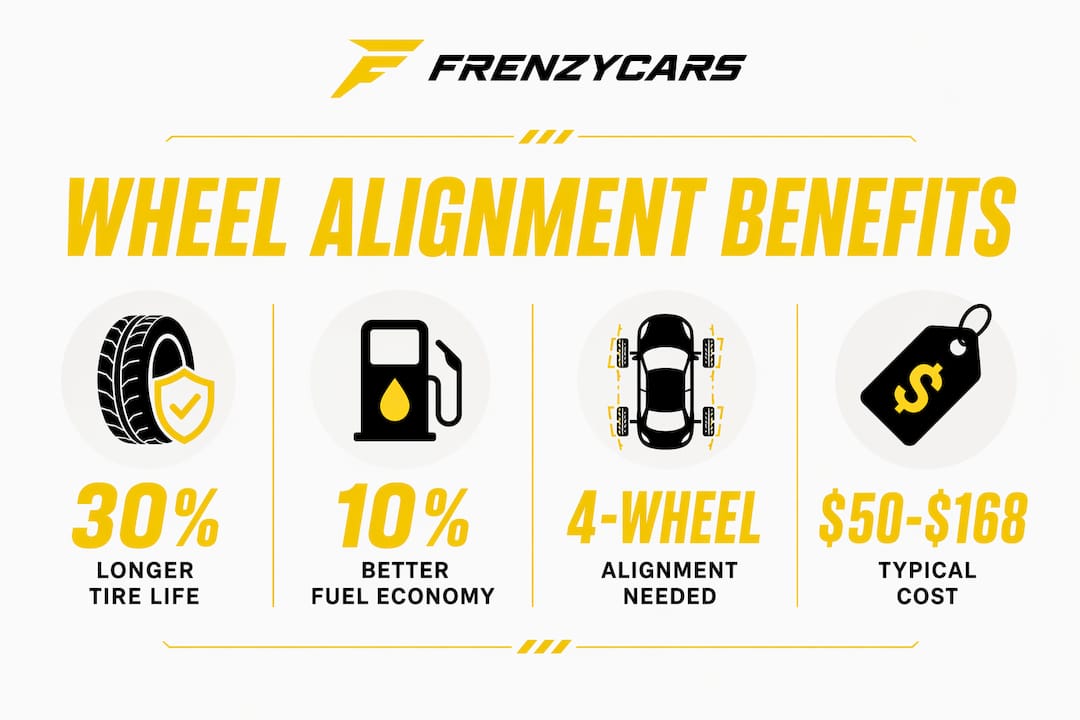
Misalignment costs you in at least four ways simultaneously: uneven tire wear, higher fuel bills, degraded handling, and stressed suspension components. Misaligned wheels can significantly reduce tire life, which on a quality set of tires represents hundreds of dollars lost before the tread is anywhere near worn out.
Stat worth knowing: According to Hunter Engineering, every inch a vehicle is out of alignment is roughly equivalent to dragging the tire sideways for 100 feet in every mile driven. That constant scrubbing translates directly into rolling resistance, which your engine has to overcome on every trip.
Fuel economy takes a measurable hit too. Misalignment can reduce fuel economy noticeably in identified cases. For a driver covering 15,000 miles a year, that’s a real number at the pump.
There’s also a modern wrinkle most drivers don’t consider. Lane-keeping assist, automatic emergency braking, and other ADAS systems assume your vehicle’s geometry is within factory tolerance. When alignment drifts, those systems can behave erratically or lose accuracy. If your car has any driver-assist features, alignment isn’t just a tire issue.
How to tell if your alignment is off before you buy new tires
Some alignment problems announce themselves loudly. Others are nearly invisible until you’re staring at a worn-out tire you weren’t expecting to replace.
The obvious signs: your vehicle pulls consistently to one side on a flat road, the steering wheel sits noticeably off-center when you’re driving straight, or you feel vibration through the wheel at highway speeds. These are urgent. Don’t buy tires until alignment is corrected, because new rubber on a misaligned car starts wearing unevenly from day one.
The quieter signs are trickier. Alignment problems are sometimes “silent” — drivers feel no pull while tread wear and fuel penalties accumulate gradually. Inner-edge feathering or cupping is nearly invisible in a casual walk-around. Before you go to the shop, photograph the inner and outer edges of each tire at ground level. That documentation gives the technician a clear picture and gives you evidence if a warranty claim comes up later.
Any recent pothole strike, curb impact, or minor collision is also reason enough to request a check, even when the car feels fine.
What happens during an alignment service at a reputable shop
A proper alignment visit follows a clear sequence. Here’s what a reputable shop should walk through:
- Pre-alignment inspection. The technician checks tire pressure, inspects suspension components (tie rods, control arm bushings, ball joints), and looks for worn parts that would prevent a successful alignment. A single worn tie rod can make it impossible to hold spec.
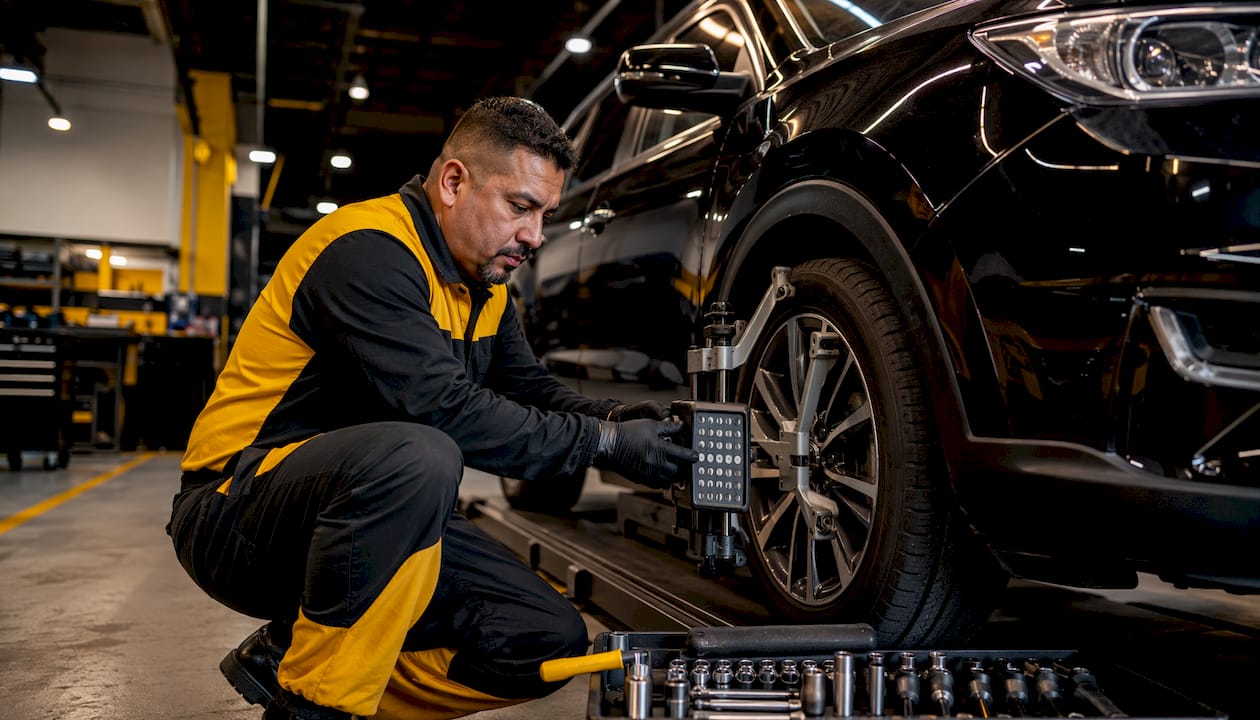
- Measurement on the alignment rack. The vehicle is driven onto a computerized rack with sensors attached to all four wheels. The machine reads current camber, toe, and caster angles against your manufacturer’s specifications.
- Before printout. The machine prints the current readings. Request this before any adjustments are made. It’s your proof that an alignment was actually needed.
- Adjustments. The technician adjusts toe, camber, and caster to bring all angles within spec. On most modern passenger cars, this requires a four-wheel alignment, not just a front-end check.
- After printout. A second printout shows the corrected readings. Without a before-and-after report, you have no verifiable proof the work was done.
- Road test. The technician (or you) drives the vehicle briefly to confirm straight tracking and centered steering.
Four-wheel vs. two-wheel alignment: Most modern vehicles need a four-wheel alignment because the rear suspension is also adjustable. A two-wheel (front-only) alignment is acceptable only on older vehicles with a solid rear axle that has no adjustable angles.
When should you get an alignment?
The baseline recommendation is every 6,000–12,000 miles, or at minimum once a year. But driving conditions and vehicle type change that calculus significantly.
| Driving condition | Recommended alignment frequency |
|---|---|
| Normal highway/suburban driving | Every 12,000 miles or annually |
| Urban driving with frequent potholes | Every 6,000 miles or with each tire rotation |
| After any pothole, curb strike, or minor collision | Immediately, regardless of mileage |
| Modified, lowered, or performance vehicles | Every 6,000 miles; after any suspension work |
| After new tire installation | Always check; correct if out of spec |
The timing question buyers ask most often: should you align before or after mounting new tires? Check alignment before buying if you see existing uneven wear — that wear pattern tells the technician what’s been happening. Then get a full four-wheel alignment after the new tires are mounted and balanced. That sequence protects your investment from mile one.
Pro Tip: Pair your alignment check with every other tire rotation. Most shops offer both services together at a bundled rate, and the combined habit keeps you from missing either interval.
Is wheel alignment worth the cost?
A standard four-wheel alignment typically costs a moderate amount depending on provider and vehicle type. Independent shops often come in at the lower end; dealers typically charge more.
| Service type | Typical price range | Notes |
|---|---|---|
| Front-end (2-wheel) alignment | $50–$100 | Appropriate only for vehicles with non-adjustable rear suspension |
| Four-wheel alignment | $50–$168 | Recommended for most modern passenger cars |
| Dealer alignment | $100–$168+ | Higher labor rates; same computerized equipment |
The math is straightforward. A quality set of tires can be costly. Misalignment can significantly shorten tire life, meaning you could be replacing that set much earlier than necessary. An alignment that extends tire life can save a substantial amount in tire costs, before even accounting for fuel savings. The alignment pays for itself.
How alignment should shape the tires you choose
This is where the role of wheel alignment in buying decisions gets specific. High-mileage tire warranties — 60,000, 70,000, or 80,000 miles — are written assuming your vehicle is in proper alignment. Run those tires on a misaligned car and the warranty becomes meaningless, because the wear pattern will be uneven and the mileage claim will never be reached.
If you’re buying performance tires with a softer compound, alignment precision matters even more. Softer tread wears faster under any scrubbing force, so even minor misalignment accelerates wear disproportionately.
Practical steps when buying tires:
- Request a pre-install alignment readout before the tires are mounted.
- Bundle the alignment with the tire purchase — many shops discount it when combined.
- Ask about road-force balancing if you’re buying performance or run-flat tires; it catches issues a standard spin balance misses.
- Insist on both the before and after printouts and keep them with your vehicle records.
Pro Tip: The “before” printout is your evidence. If a shop later claims the alignment was fine and you’re seeing uneven wear, that document tells the real story.
If you’re also considering aftermarket wheels, know that offset and backspacing changes can affect alignment angles and may require a fresh alignment setup after installation.
What to say at the tire shop: scripts that actually work
Walk in with these questions ready and you won’t get a partial check or a vague answer.
Before purchase: “Can you pull a free alignment readout before you mount the tires? I’d like to see the before printout.” If the shop says no, that’s a red flag. Photograph your current tread wear on all four corners before you arrive.
At installation: “I’d like a four-wheel alignment after the mount and balance, and I need the after printout before I pay.” If the numbers were in spec on the pre-check, ask them to confirm in writing. If they were out, the after printout proves the correction was made.
Post-install test drive: Drive a straight, flat road at 40–50 mph with hands loosely on the wheel. The car should track straight with no pull. The steering wheel should be centered. If either is off, go back before you leave the parking lot.
Your pre-buy checklist before new tires go on
Run through this before any tire purchase:
- Photograph the inner and outer edges of all four tires at ground level.
- Note any pulling, off-center steering, or vibration and tell the tech.
- Request a pre-install alignment readout; keep the before printout.
- Confirm four-wheel alignment will be performed if the readout is out of spec.
- Verify TPMS sensors are reset after mounting.
- Confirm balancing is included (road-force balancing for performance tires).
- Set a calendar reminder for your next alignment check at 6,000–12,000 miles.
For a broader look at scheduled maintenance intervals, Frenzycars has a full guide on building a maintenance schedule that keeps alignment, rotation, and other services from slipping.
Key Takeaways
Wheel alignment belongs in every tire purchase: skipping it risks uneven wear from mile one and voids the mileage warranty on premium tires.
| Point | Details |
|---|---|
| Alignment is part of the tire purchase | Always request a pre-install readout and correct alignment before new tires are mounted. |
| Demand before/after printouts | These documents prove the alignment was needed and completed — keep them with your records. |
| Cost math favors alignment | At $50–$168, a four-wheel alignment costs far less than replacing a $400–$800 tire set prematurely. |
| Misalignment is often silent | Fuel penalties and inner-edge wear accumulate before you feel any pull — proactive checks matter. |
| Check every 6,000–12,000 miles | Adjust frequency for urban driving, pothole impacts, or any suspension work. |
The part most tire buyers get wrong
Most drivers treat alignment as something to consider after a problem shows up. A pull, a crooked steering wheel, a worn-out tire they weren’t expecting. By then, the damage is already done and the money is already spent.
The smarter frame is this: alignment is a condition your new tires inherit the moment they’re mounted. If the geometry is off, those tires start their life at a disadvantage. Every mile compounds the problem quietly. The drivers who benefit most from treating alignment as a tire-buying line item are high-mileage commuters, anyone buying premium or high-warranty tires, and drivers of modified or lowered vehicles where alignment drift is faster and more consequential.
The checklist and shop scripts in this article aren’t about being difficult with a technician. They’re about getting what you’re paying for. A before-and-after printout takes the shop two minutes to produce. If they resist, that resistance tells you something worth knowing before you hand over $600 in new rubber.
Authoritative sources and further reading
For readers who want to verify claims or go deeper on the technical side:
- NHTSA Tire Safety: The federal consumer-safety baseline on tire maintenance, inflation, and alignment. Best for regulatory context and safety statistics.
- Hunter Engineering — Benefits of Wheel Alignment: Industry-level data on rolling resistance and fuel economy impacts. Best for the engineering case behind alignment’s fuel and wear effects.
- Firestone Complete Auto Care — Alignment Guidance: Consumer-facing explanation of alignment intervals and what to expect at a shop visit.
- Bridgestone — Tire Alignment and ADAS: Covers the interaction between alignment and modern driver-assist systems. Useful for owners of newer vehicles with lane-keeping or automatic braking features.
- Frenzycars — Performance Car Maintenance Checklist: Covers alignment and other maintenance tasks for performance and modified vehicles that need more frequent service intervals.
This article is general information for educational purposes. For advice specific to your vehicle, consult a qualified ASE-certified technician or your manufacturer’s service documentation.