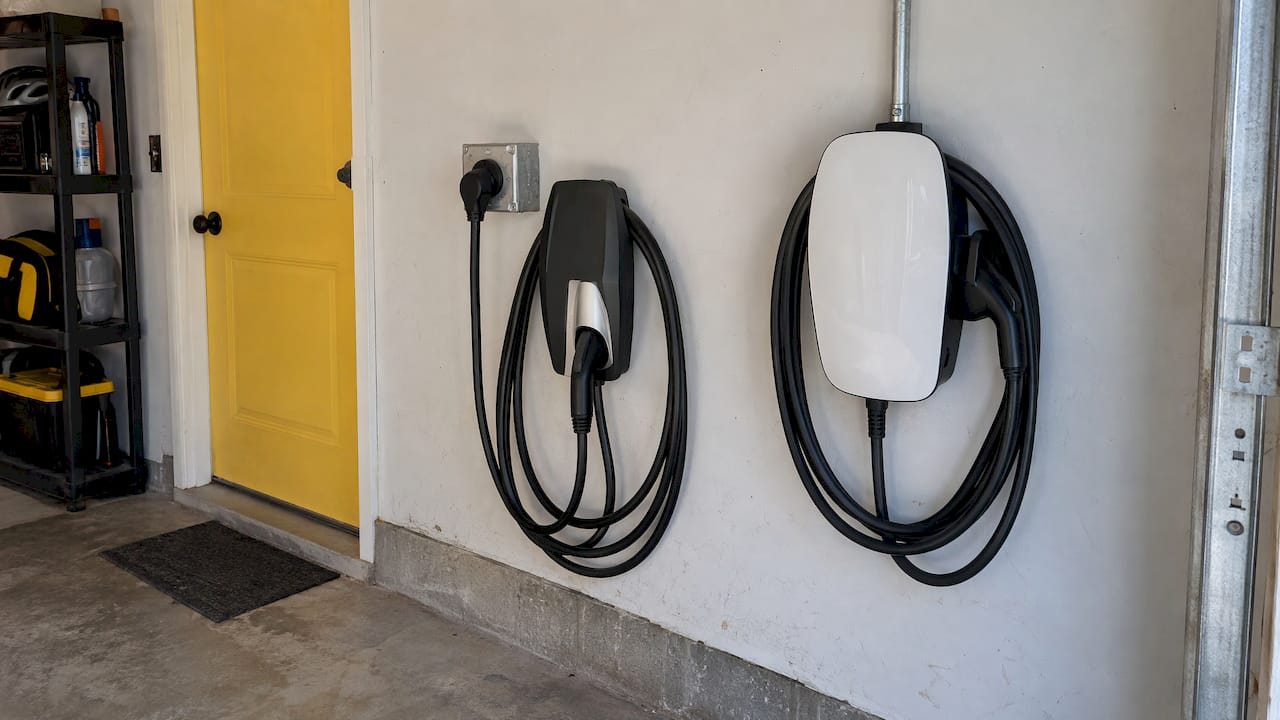
For most drivers who charge at home every night, a hardwired Level 2 charger is the better long-term setup. It can run at 48 amps, it has no plug to wear out, and it handles outdoor installs cleanly. A NEMA 14-50 outlet wins when you want a lower upfront cost, a charger you can unplug and take with you, or you already have a healthy outlet in the garage. Both are 240-volt Level 2 charging. The real difference is how the charger connects to your electrical panel, and that choice sets your top speed, your code requirements and your flexibility.
TL;DR
- Hardwired connects the charger directly to the circuit. It supports up to 48 amps (11.5 kW), avoids a plug-and-receptacle wear point and suits outdoor walls.
- NEMA 14-50 plug-in is capped at 40 amps (9.6 kW) continuous, costs less to set up if the panel is close and lets you take the charger along.
- Your car’s onboard charger sets the real ceiling. Check its kW rating before paying for a faster circuit.
- Either way you need a dedicated circuit, a properly sized breaker and a licensed electrician. Existing outlets are a starting point, not proof of readiness.
What the two terms actually mean
A NEMA 14-50 is a common 240-volt, 50-amp receptacle with four slots. You see it for RV hookups and electric ranges, and it is a popular spot to plug in a Level 2 charger. The US EPA’s home charging guide lists it as a common choice for Level 2 chargers.
Hardwired does not mean plugged in. It means the charger’s cable is wired straight into the circuit’s conductors inside a junction box or the charger’s own enclosure. There is no outlet and no plug. If you search “hardwire Level 2 charger,” this is what you are looking at: a wall-mounted unit permanently connected by an electrician.
Both setups are Level 2, which the EPA says adds roughly 25 to 40 miles of range per hour. The difference shows up in the ceiling. The EPA also notes that chargers rated 48 amps or higher are usually required to be hardwired rather than plugged into an outlet.
Speed: 40 amps versus 48 amps
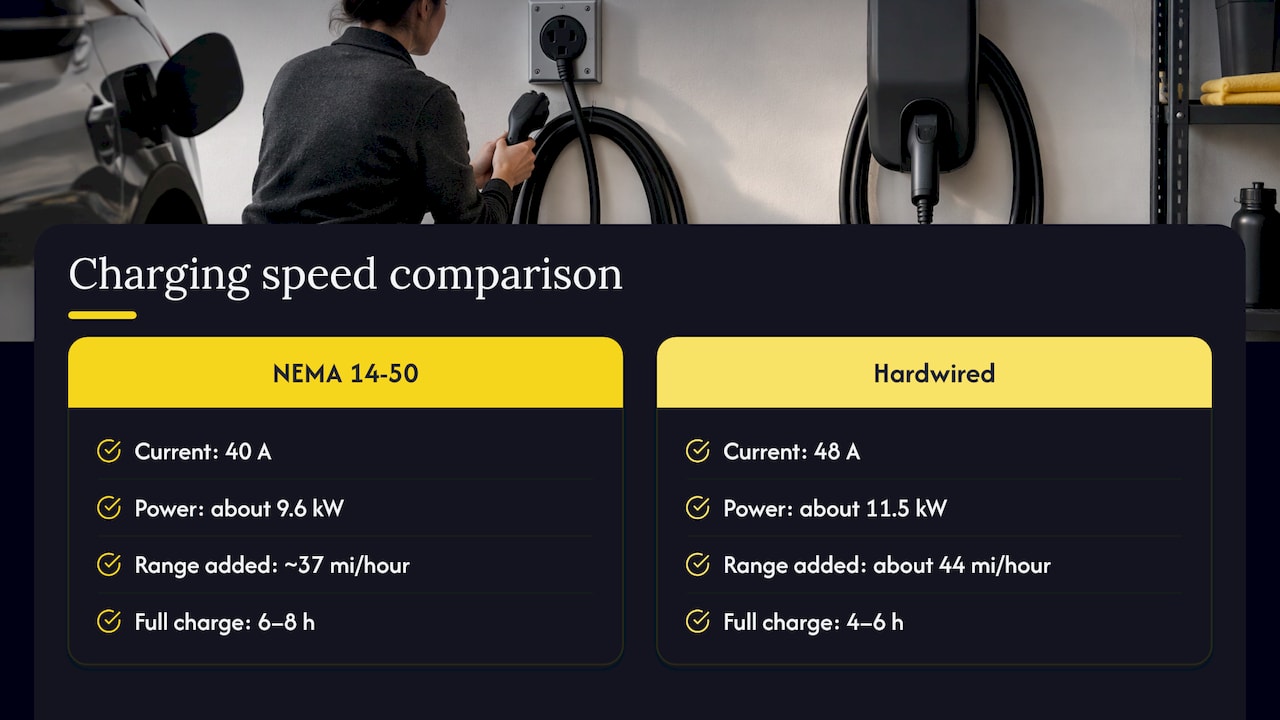
The 14-50 setup is limited by a rule of thumb that matters a lot: a continuous load, like charging, should not exceed 80% of the circuit rating. On a 50-amp circuit that means 40 amps, or about 9.6 kW. A hardwired charger on a 60-amp circuit can run 48 amps, or about 11.5 kW. The EPA says to size the breaker at least 125% of the charger’s rating, so a 40-amp charger needs a dedicated 50-amp circuit.
EnergySage puts this in practical terms. It estimates a hardwired charger adds about 44 miles of range per hour to a Tesla Model Y, against about 37 miles per hour from a plug-in. It also cites roughly 4 to 6 hours to a full charge hardwired and 6 to 8 hours plugged in.
Your car decides whether 48 amps matters
Here is the catch for enthusiasts who shop on horsepower and range. EnergySage says most EVs accept between 7.7 and 11.5 kW on AC, and a more powerful charger is wasted if the car cannot use it. If your onboard charger tops out at 7.7 kW, a 40-amp plug-in already delivers everything the car can take.
The same source says that for most owners who charge overnight, the gap between 40 and 48 amps may not matter much. It matters more for high-mileage daily drivers and large-battery vehicles. Look up the onboard charger rating before you decide. Our electric car comparison tool lets you view EVs side by side when you are still choosing the car.
| Factor | NEMA 14-50 plug-in | Hardwired |
|---|---|---|
| Max continuous current | 40 A on a 50 A circuit | Up to 48 A on a 60 A circuit |
| Max power | About 9.6 kW | About 11.5 kW |
| Typical full charge | 6 to 8 hours | 4 to 6 hours |
| Portable | Yes, unplug and take it | No, stays with the house |
| Wear point | Plug and receptacle | None |
| Outdoor suitability | Needs outdoor-rated outlet | Generally preferred |
Code requirements in plain English
This is where installs go wrong, so it is worth slowing down. Electrical rules come from the National Electrical Code (NEC), a model code that states and cities adopt, sometimes with changes. Your local authority having jurisdiction, usually the building department, decides which edition and amendments apply to you.
Per a guide to NEC Article 625, both setups need a dedicated branch circuit. The two differ in these ways:
- Plug-in 14-50: 50-amp circuit, #6 copper wire, a 40-amp continuous limit and GFCI protection. GFCI (ground-fault circuit interrupter) is a safety device that cuts power fast when current leaks to ground.
- Hardwired 48 amps: 60-amp circuit, #6 copper on 75°C-rated terminations (#4 if you use NM-B cable) and no GFCI breaker required under the EV-specific section.
The GFCI gap has an exception. The 2023 NEC’s section 210.8(F) requires GFCI protection on circuits of 50 amps or less in outdoor locations and in garages at or below grade at dwellings, according to that same guide. So a hardwired charger on a 50-amp or smaller circuit in those places can still need it, while a 60-amp hardwired circuit does not fall under that rule.
What changed in the 2026 NEC
The same publisher’s summary of the 2026 NEC changes says the 2026 edition took effect on September 9, 2025. It adds section 625.4, requiring permanently installed EV equipment to be installed by qualified persons. It also says nonlocking 30-, 50- and 60-amp receptacles used for EV charging, including the 14-50, must be listed for that use, and that a 50-amp receptacle is not allowed on a 40-amp branch circuit. The GFCI requirement for EV-charging receptacles is unchanged. Not every jurisdiction has adopted this edition yet, so ask your electrician which one your city enforces.
Can you use the 14-50 outlet you already have?
Sometimes, but treat it as a starting point. An outlet that has powered a dryer or RV for years may have been installed to a different standard or may carry heat damage. Before you plug a charger into it for hours every night, have a licensed electrician confirm:
- The circuit is dedicated, with no other loads sharing it.
- The breaker size, wire gauge and grounding match the charger and local code.
- The receptacle is listed for the job and is tight, with no discoloration or melted plastic.
- Your panel has capacity for the added load. The EPA says electricians perform load calculations for this.
- Permits and inspections are handled.
Charging draws a steady current for hours, which is harder on a receptacle than a short appliance cycle. If the outlet looks worn, feels warm after use, or has an unknown history, replacing it or switching to hardwired is usually the cleaner fix.
What it costs
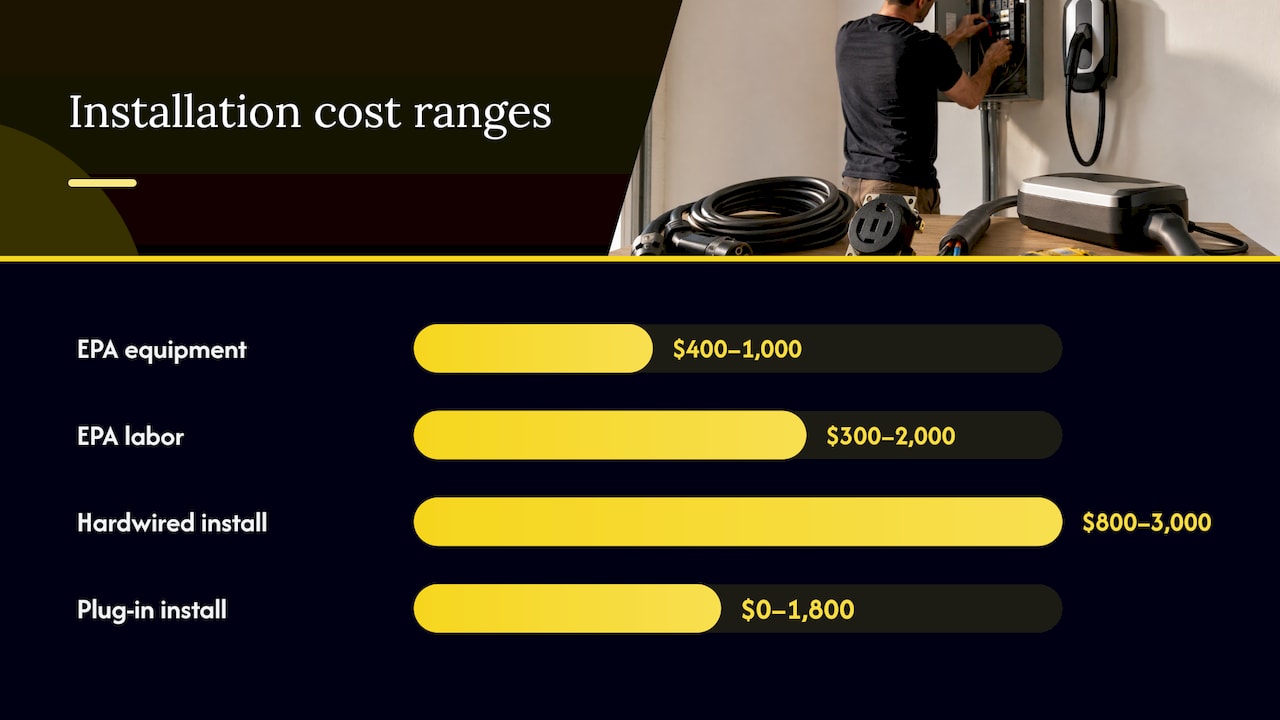
The EPA says Level 2 installations run $400 to $1,000 for equipment and $300 to $2,000 for labor. EnergySage gives installation ranges of $800 to $3,000 for hardwired and $0 to $1,800 for plug-in. The low end for plug-in assumes you already have a compatible 14-50 outlet, in which case mounting the charger may be all you need.
What moves your price:
- Distance from the panel. Long conduit runs add labor and material.
- Panel capacity. A full or old panel may need a service upgrade, which is a separate and larger expense.
- Indoor or outdoor. Weatherproofing and GFCI choices change the parts list.
- Permits. Fees and inspection rules vary by city.
For the bigger picture on running costs per mile, see our guide to 2026 U.S. EV charging costs. For federal incentives and what homeowners should check, read EV home charging in 2026.
Safety, reliability and the outdoor question
Hardwiring removes the plug and receptacle, which are the parts that loosen, overheat and wear with repeated plugging. That is why many electricians lean toward hardwiring for daily charging, and why it is the cleaner choice for a permanent setup.
Outdoors, the case gets stronger. Enphase’s guidance on hardwired versus plug-in stations recommends hardwiring for most outdoor installs because the connection is more weather-resistant and generally avoids nuisance tripping of a GFCI. Plug-in chargers outdoors need a suitable outdoor-rated outlet and charger.
Whichever you choose, never use a household extension cord or a worn adapter for EV charging, and keep the charger’s own settings matched to the breaker the electrician installed.
Portability: the real strength of the plug
A plug-in charger on a 14-50 outlet goes where you go. Unplug it for a road trip, a vacation rental with an RV outlet, or your next house. If you rent or expect to move within a few years, that flexibility is worth real money, since a hardwired unit stays with the property and needs an electrician to remove.
If you live in an apartment, your options look different again. Our guide for renters covers charging in apartments with a Level 1 outlet or shared Level 2.
Which setup fits you
| Your situation | Better fit |
|---|---|
| Daily charging, owner-occupied home, long-term | Hardwired |
| Outdoor wall or carport install | Hardwired |
| Large battery or high daily mileage, car accepts 11.5 kW | Hardwired at 48 A |
| Car’s onboard charger is 7.7 kW or lower | Either, 14-50 is enough |
| Healthy existing 14-50 near the panel | Plug-in, after an electrician checks it |
| You move often or want to take the charger on trips | Plug-in |
| Tight budget, short run from the panel | Plug-in |
A simple order of operations works well:
- Find your car’s onboard charger rating in the owner’s manual or spec sheet.
- Decide where the charger will live and how far that is from the panel.
- Ask a licensed electrician for a load calculation and quotes for both a 14-50 and a hardwired install.
- Confirm which NEC edition and local amendments apply, and get the permit.
Our take
We test cars with instruments and we write about what happens after the purchase, because the charging setup shapes how an EV feels to live with every single day. The performance numbers on a spec sheet mean little if the car sits on a slow or flaky home connection.
Our advice is to start with the car, not the hardware. Find the onboard charger rating, then match the circuit to it. If you charge nightly at a home you plan to keep, hardwiring at 48 amps gives you the headroom, the clean installation and the outdoor durability. If your car tops out lower, or you want a charger that travels, a properly verified 14-50 does the job.
Whichever you pick, bring an electrician into it early. A good quote covers the panel load calculation, the permit and the right breaker, and it is cheaper than fixing a hot outlet later.
Ramón
Keep researching your next EV
If you are still deciding which car to charge, our electric car comparison puts models side by side, and our look at how home charging affects the cost of owning an EV shows why the setup at home matters so much over five years. You can find more at FrenzyCars.
Sources
- Getting Started with Home EV Charging, US EPA
- Hardwire vs. Plug-In EV Charger: Which is Right For You?
- Hardwired vs Plug-In EV Charger: Which and What Wiring?
- NEC 2026 Changes: What Changed From NEC 2023
- Hardwired or Plug-In? Discover the Best Solution for You