
Ending a car lease early is possible, but the cheapest route is rarely the obvious one. Returning the car early usually triggers a charge based on what the lessor still expects to collect minus what the car will fetch. Buying the car out, trading it in or transferring the lease can each beat that charge, depending on what your car is worth today versus what your contract says it costs. Below is how each path works, what you can be billed, and the steps to lock in the final number before you sign anything.
TL;DR
- Early termination means the lease ends before its scheduled date. At a voluntary exit, the Federal Reserve Board says you typically choose among returning the car and paying the charge, trading it to a third party, or buying it early and reselling it.
- The charge is generally the remaining lease balance minus what the car is credited at. It can run to several thousand dollars and can exceed what finishing the lease would have cost.
- Your contract sets your price. Compare your buyout price with the car’s market value before you decide anything.
- Get every figure in writing, including fees and taxes, and compare the total of ending early against simply riding out the remaining payments.
- Military service members have special protection in some situations under the Servicemembers Civil Relief Act.
What ending a lease early actually means
The Federal Reserve Board defines early termination as the lease ending before its scheduled termination date, either voluntarily or involuntarily. Voluntary is the case this article covers: you decided you no longer want the car, maybe because your commute changed, a baby is on the way, the payment stopped fitting your budget, or a new model caught your eye.
Two facts shape everything that follows. First, your right to end early is defined in your own lease agreement, so the contract comes before any advice, including ours. Second, the Fed’s leasing FAQ says the earlier you end the lease, the greater the charge is likely to be. Early in a lease, you owe the most and the car has lost the most value relative to the balance.
The lessor is the company that owns the car and holds your lease, usually a captive finance arm of the manufacturer or a bank. The federal Consumer Leasing Act requires that your lease state the conditions for early termination and the amount, or the method for working out the amount, of any penalty. That means the formula is already in your paperwork. Find the section titled something like “early termination” or “default” and read it first.
Your four main options side by side
There are more than four ways to describe an exit, but they boil down to these. The first three come straight from the Federal Reserve Board’s list of voluntary options; the transfer is another path some lessors allow.
| Option | How it works | Where the money goes | Watch for |
|---|---|---|---|
| Return the car and pay the charge | Lessor sells the car and bills you the shortfall | Early termination charge plus any fees | Can exceed the cost of finishing the lease |
| Buy the car out, keep it | You pay the contract buyout price | Buyout price, taxes, registration, loan costs | Fees and sales tax on top of the price |
| Buy out and resell or trade in | You sell to a third party and settle the lessor | Sale proceeds offset your payoff | Whether the lessor allows third-party buyouts |
| Transfer the lease | Another person takes over your payments | Transfer fee, if any | Confirming you are fully released from liability |
AutoFinder, a car-cost site, adds early upgrade programs and simply keeping the lease to the list of paths. Keeping the lease is a real option and often the cheapest, which is why the math below matters.
How the early termination charge is calculated
Most lessors use the same logic. Take the remaining lease balance (what you would still owe on a payoff basis), then subtract the amount credited to you for the car. That credit is its realized value, usually the actual wholesale price the lessor gets at sale or an independently appraised wholesale value, according to the Fed.
A simple worked example: your payoff is $18,000 and the car’s value is $15,000. You owe about $3,000, plus fees. This is the same example Experian uses to show how the charge is built.
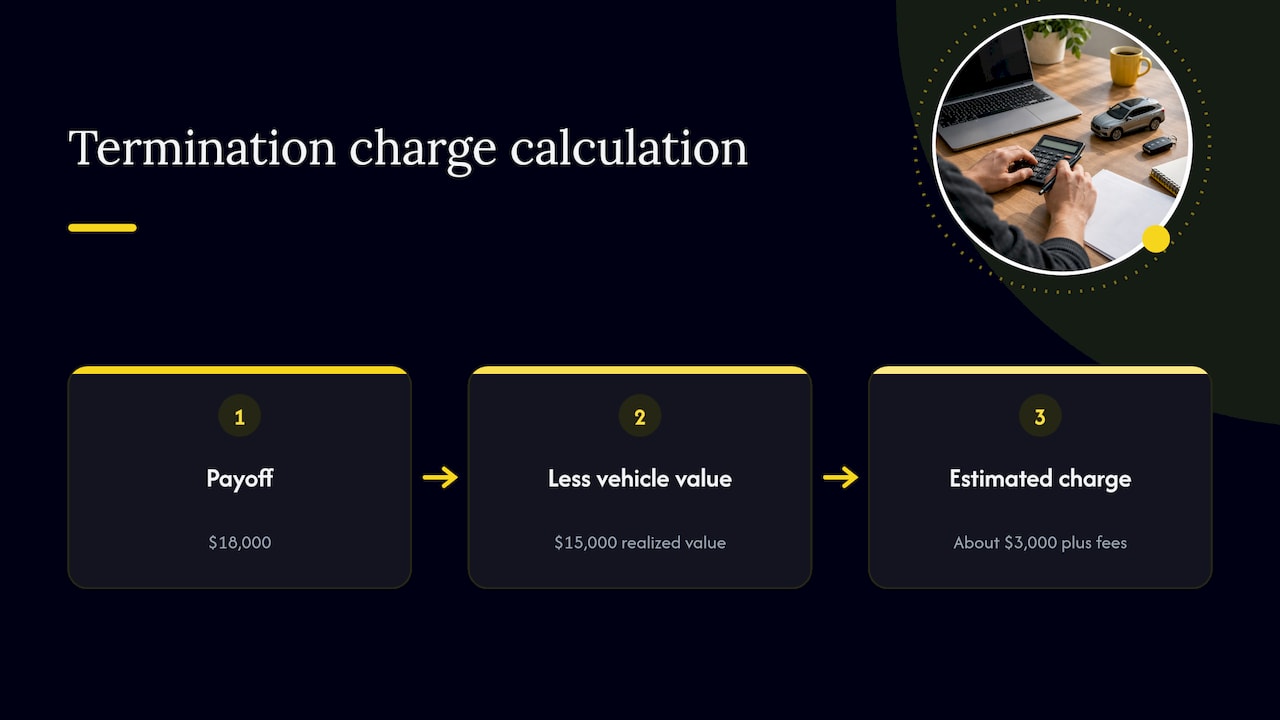
The lesson is that you control one variable better than you might think: the realized value. Wholesale values move with the used-car market, with your mileage and with condition. If wholesale prices are strong, the gap shrinks. If a bidder will pay far above what the lessor’s formula expects, the picture can flip entirely. AARP’s guide describes a couple with 17 payments left who could return the car for $19,512, about $1,300 less than the sum of their remaining payments, yet a much higher outside bid on the car meant they would have to cover the difference if they went another route. The AARP walkthrough shows how heavily the realized value drives the answer.
If the residual value in your contract is a term you have never looked at, our explainer on how residual value changes your lease payment shows why that number sets both your payment and your buyout price.
Fees that can stack on top
The Federal Reserve Board says the charge may also include disposal fees, transfer fees, taxes, late charges, past-due payments and parking tickets. Add them up before you compare options.
- Disposition fee. Consumer Reports describes this as typically a few hundred dollars that the dealer charges to clean, condition and ready the car for sale, and notes you avoid it if you buy out the car. See our guide to avoiding lease disposition fees by buying through the lender.
- Past-due amounts. Missed payments, late fees and unpaid tickets get rolled into what you owe.
- Taxes and government fees. These depend on your state and on the route you choose.
- Extra termination charge. Some contracts disclose an additional charge. Under the New York Attorney General’s guidance, it must be reasonably related to the lessor’s harm.
Mileage and wear charges deserve a note. In New York, the attorney general states that a lessor may not charge excess mileage if you return the vehicle before the full lease term ends. Rules differ by state, so read your lease and your state’s consumer guidance rather than assuming. Under the Consumer Leasing Act, the early termination penalty must be reasonable in light of the anticipated or actual harm, as the statute at 15 U.S.C. 1667b is summarized.
Your right to an independent appraisal
In New York, a lessee is entitled to a binding independent appraisal of the car’s value on early termination. That matters because the credit applied to your balance is a major piece of the bill. If your state offers something similar, it is worth using, and your lease may describe how to request one. Ask the lessor in writing how the realized value will be determined and who will appraise the car.
Can you return a leased car three months early?
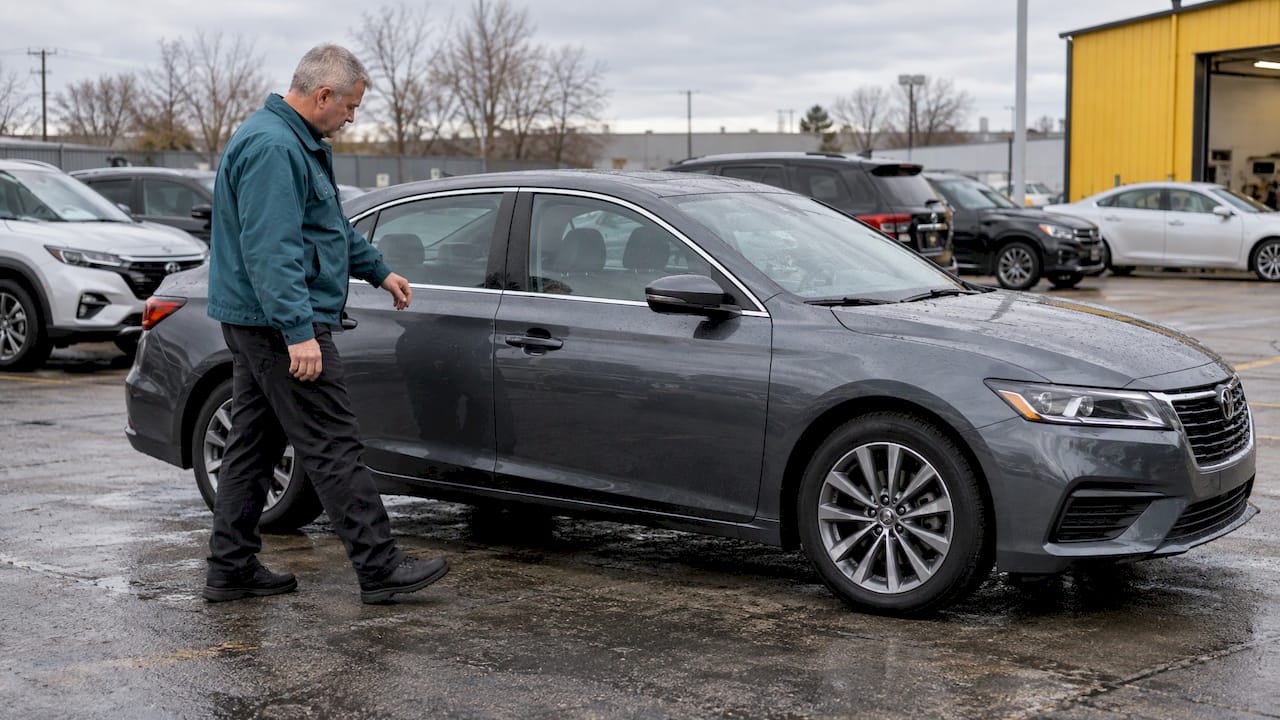
Often, yes. LegalClarity reports that most leasing companies will let you return a car a few months before the contract ends, with an early termination charge computed the way described above: adjusted lease balance minus realized wholesale value. With only three months left, the balance is small, so the charge is often smaller than it would be at month 12. It can still be larger than three monthly payments, though, so compare the two figures directly.
The rule of thumb: the closer to the scheduled end, the less likely early termination beats simply finishing the lease. If your lease is nearly over, ask the lessor whether the regular lease-end return can be moved up with no penalty. Some will accommodate you if you are turning in the car and leasing or buying another model from the same brand, but that is a lessor decision, so get it confirmed in writing.
Buying out your lease: is it worth it?
Most leases let you buy the car at a buyout price set at the start. Consumer Reports explains that the depreciation rate is baked into the contract, so the lessor cannot change the price when market conditions shift. That is the whole reason a buyout can be a bargain: if used-car prices rose, the car may be worth more than your payoff. During early pandemic shortages, Consumer Reports notes, payoff amounts were often thousands of dollars below actual value.
Run the numbers
- Find the buyout price in your lease and ask the lessor to confirm it, including any purchase option fee.
- Research the car’s current market value for your exact trim, mileage and condition.
- Add the costs of buying: loan interest, sales tax, registration, insurance changes and title transfer fees, the items Consumer Reports tells you to total up.
- Compare the all-in cost with what ending the lease another way would cost.
If the car is worth more than the all-in buyout cost, you have equity. You can keep the car or, where the lessor permits, sell it and keep the difference. Experian says an early buyout may require making all remaining lease payments, paying the difference between that amount and the buyout price, and paying an early termination fee. Ask the lessor to spell out which of those apply to your contract, because it changes the math considerably.
Financing a lease buyout
Unless you pay cash, you need a loan for the buyout. Experian says buyout loans are available from banks, credit unions, online lenders and leasing companies, typically at higher rates than new-car loans. Before you borrow:
- Get the written buyout quote first, with fees and taxes, so the loan amount is accurate.
- Compare the loan’s annual percentage rate and term against the real value of the car, so you do not end up owing more than it is worth.
- Check for prepayment penalties and payoff errors on the loan itself. Our guide to auto loan prepayment penalties and payoff errors lists what to look for.
- Understand the interest rate you are being quoted. Lease paperwork uses a money factor, and our money factor to APR conversion shows how to compare it with a loan rate.
If you are weighing a buyout against a different car altogether, our lease versus buy comparison puts the long-run costs side by side.
Trading in or selling a leased car
When you trade a leased car to a dealer, the dealer pays off the lessor and applies any value above the payoff to your next purchase. If the car is worth less than the payoff, that shortfall is negative equity and it follows you into the new deal, usually rolled into the new loan or lease. That is how people end up paying for the old car inside a new payment for years.
The Fed describes this route as trading the vehicle in to a third party, applying excess proceeds or covering a shortfall. Before you accept an offer, get two numbers: the lessor’s payoff and the car’s real market offer. Our guide on negative equity before you trade walks through it, and our trade-in value guide covers how to get the strongest offer. When the next car is part of the plan, calculate the real out-the-door price so a rolled-in balance does not hide in the monthly payment.
Not every lessor allows third-party buyouts, or dealers who are not of the same brand to buy the car out. Ask before shopping offers around.
Transferring the lease to someone else
A lease transfer, sometimes called an assumption, hands your remaining payments to another driver. Your lessor must approve it, and it may charge a transfer fee. The point AutoFinder stresses is the one that matters most: verify that you are fully released from future liability. If the paperwork leaves you on the hook and the new driver stops paying, the lessor can come back to you. Get the release in writing before you hand over the keys.
Special case: active-duty military
Experian notes that under the Servicemembers Civil Relief Act, active-duty service members can terminate a car lease early without early termination charges or fees in some situations. If you have received deployment or relocation orders, check your eligibility with your installation’s legal assistance office before you pay any charge.
Steps to end a lease early and confirm the final amount
- Read your lease. Find the early termination clause, the buyout price and the disposition fee. The Consumer Leasing Act requires the method for figuring any penalty to be stated.
- Request a written early termination payoff quote from the lessor, and a separate purchase quote if you are considering a buyout. Ask what is included: fees, taxes, past-due items.
- Find the car’s real value. Collect offers from sellers, and ask about an independent appraisal if your state or contract provides one.
- Compare every route against the cost of finishing the lease. Experian’s finance team points out that continuing to pay can cost less overall, and that a lump sum may fit your budget differently than monthly payments.
- Fix any past-due balances such as tickets or missed payments, since they are added to what you owe.
- Get everything in writing, whether it is a termination, transfer or buyout agreement, and keep the confirmation that the lease account is closed.
- Insurance and registration. Update coverage and plates after the car changes hands. If your next car is your first on a policy of your own, see our guide on car insurance for new drivers.
Avoiding the problem next time
The Federal Reserve Board’s advice is blunt: because early termination can be expensive, pick a lease term that matches how long you expect to drive the car, rather than a longer term for a lower payment with the idea of ending it early. If you are not sure you will keep a car for three years, plan for the flexibility before you sign, not after.
Early termination is mostly a math problem disguised as a stress problem. The contract already tells you how the charge is figured, and the market tells you what the car is worth. Once you put those two numbers next to each other, the decision usually makes itself.
At FrenzyCars, our job is to help readers make smarter decisions about the cars they buy, own and love, and that means doing the arithmetic out loud: payoff, market value, taxes, fees. Our lease guides on residual value, money factors, disposition fees and negative equity are written so you can check a dealer’s or lessor’s quote line by line rather than guess.
Our advice: get the written quote first, price the car second, and decide third. In that order, an early exit stops being a gamble.
Ramón
Plan your next car with better numbers
If an early exit is part of getting into a different vehicle, start with the specs and rankings. Browse car specs by make and model to compare trims and performance, or see our best cars by category to shortlist a replacement before you commit to ending your current lease.
Sources
- Federal Reserve Board: Leasing vs. Buying, Early Termination
- Federal Reserve Board: Vehicle Leasing FAQ
- New York Attorney General: Leases and Rentals
- Consumer Reports: Should You Buy the Car You’re Leasing?
- Experian: How to Get Out of a Car Lease
- AARP: 4 Best Options to Get Out of an Auto Lease
- LegalClarity: Can I Return My Leased Car 3 Months Early?
- AutoFinder: How Much Does It Cost to End a Car Lease Early?