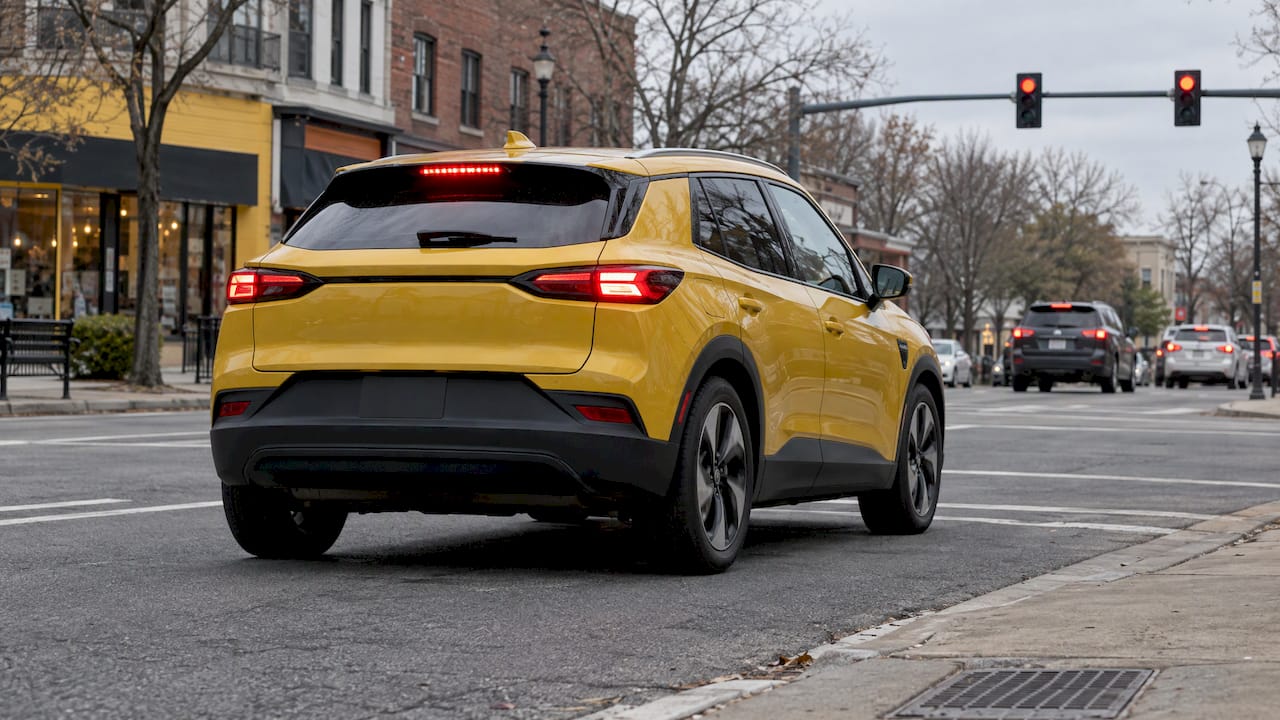
Regenerative braking, or regen, turns your electric motor into a generator whenever you slow down. Instead of burning off momentum as heat in the brake pads, the car sends it back to the battery as electricity. If you are shopping for an EV or hybrid, or you just bought one, regen is the feature that most changes how the car feels to drive and how far it goes. This guide covers how it works, what it recovers, when it backs off and how to use it well.
TL;DR
- Regen uses the wheels to spin the electric motor backward in role, so it makes electricity and slows the car at the same time.
- It recovers real energy, and it helps most in stop-and-go driving, less on the highway.
- Friction brakes still do the work in emergency stops, at very low speeds and when the battery is full or cold.
- Smooth, early lifting off the accelerator gives regen more time to work than late, hard braking.
- Many cars let you pick the strength of regen, including one-pedal driving.
What regenerative braking actually is
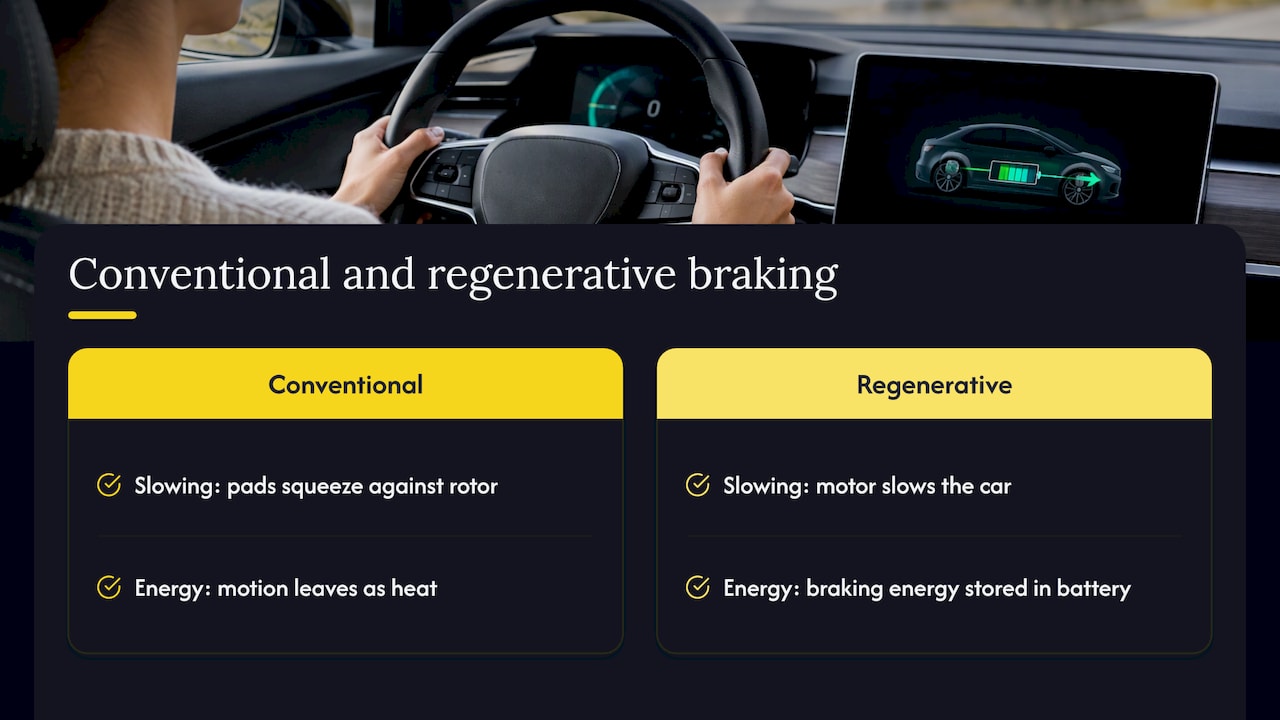
A conventional brake squeezes pads against a rotor. Friction slows the car, and the car’s kinetic energy (the energy of its motion) leaves as heat. NHTSA, the federal vehicle safety agency, explains that an electrified vehicle’s motor can slow the car and capture energy that conventional brakes would otherwise dissipate as heat. The U.S. Department of Energy describes the same idea: otherwise wasted braking energy is converted to electricity and stored in the battery.
Not every hybrid does this. NHTSA notes that micro hybrids, the lightest type, cannot regenerate, while mild, medium and full hybrids can. Every battery-electric car does.
How regen works, step by step
- You lift off the accelerator or press the brake. In most cars, regen starts the moment you ease off the pedal.
- The wheels turn the motor. The Department of Energy explains that during braking the rotating wheels turn the electric motor, reversing its usual job.
- The motor acts as a generator. Turning the motor creates electricity and also resists the wheels’ rotation, which is what slows the car.
- The battery stores the energy. The current is routed to the traction battery, the large pack that powers the car.
- Friction brakes step in as needed. A control unit blends the two systems. Clemson University’s vehicular electronics lab describes a torque coordinator that adds friction braking when the motor cannot slow the car enough by itself.
That blending is why the pedal in an EV can feel different from a gas car. You are pressing one pedal, but the car decides how much of the stop comes from the motor and how much from the pads.
If you want the bigger picture of how the motor, engine and battery share the work in a hybrid, see our explainer on how a hybrid powertrain works.
How much energy does regen recover?
The honest answer depends on how you drive. The Department of Energy’s 2024 analysis reports that net regenerative braking recovers about 22% of energy on the EPA combined city and highway cycle. The same analysis puts a typical EV’s overall efficiency at 87% to 91% once regen is counted, versus roughly 30% for a conventional gasoline car, with results depending on the drive cycle.
A few things follow from that:
- City driving gains the most. FuelEconomy.gov says regen contributes to hybrids’ advantage over comparable conventional cars especially in stop-and-go driving, where there is more braking to harvest.
- Highway driving gains little. Clemson’s lab notes regen has minimal impact during highway driving, because you rarely brake at a steady cruise.
- It is not free energy. Regen returns part of what you spent accelerating. It cannot return more than the car used overall, though FuelEconomy.gov notes that on cycles with substantial regenerative braking, measured drive-cycle efficiency can exceed 100% because the figure counts energy returned against energy drawn from the battery on that cycle.
The same logic explains why drive cycle matters for any vehicle’s efficiency, a point also made in this guide on drive cycles and fuel economy.
A quick worked example
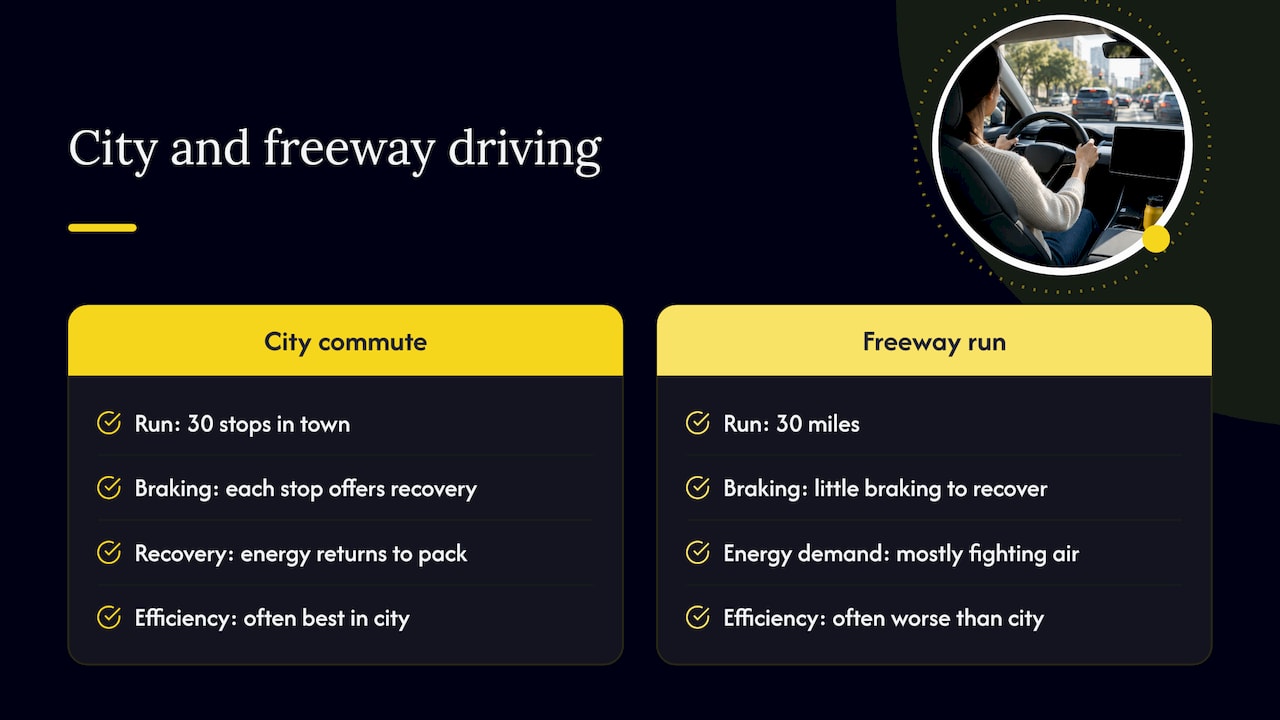
Picture a commute of 30 stops in town versus a 30-mile freeway run. In town, each stop is a chance to return energy to the pack, so the car’s displayed consumption often looks better than its highway figure. On the freeway you spend almost all of your energy fighting air, and there is little braking to recover. That is why EVs frequently post their best efficiency numbers in city driving, the reverse of most gas cars.
When regen is limited
Regen is strong but not unlimited. Know these situations so the car never surprises you.
| Situation | What happens |
|---|---|
| Emergency or hard braking | Friction brakes take over. NHTSA says conventional brakes remain in use in emergency braking. |
| Full battery | With nowhere to send electricity, regen is reduced. NHTSA lists a fully charged battery among the events where conventional brakes are used. |
| Cold battery | Rivian’s 2026 explainer says a cold battery may accept less recovered energy. |
| Very low speed | The motor produces little braking force near a stop, so the pads finish the job. |
This is normal design, not a fault. Think of regen as the first layer of braking, with the friction brakes always ready behind it. A fully charged car on a cold morning, for example, may feel like it has weaker regen on the first downhill. It returns as the pack warms and the charge level drops. Our guide to battery preconditioning covers how warming the pack ahead of a winter drive helps.
Benefits you will notice
More range. Every bit of energy returned is energy you do not need to buy again at a charger. Mazda’s guide notes regen can help maximize range.
Less brake wear. Because the motor does much of the slowing, the pads and rotors work less. Many EV owners find their pads last longer than on a comparable gas car. For typical lifespans and when to budget, see our brake pad lifespan guide.
Smoother, more controlled driving. Strong regen lets you modulate speed with your right foot alone, which many enthusiasts enjoy on twisty roads.
Hybrid efficiency. In a non-plug-in hybrid, the battery is charged by regen and the engine, so regen is what keeps the small battery topped up without plugging in.
How to turn on and adjust regen
Most of the time you do not have to switch it on. It works when you lift off the accelerator or press the brake. What you can change is how strong it is. Mazda’s guide says drivers can adjust regeneration on some vehicles through drive modes, shifter positions or steering-wheel paddles, and that some battery-electric models offer one-pedal driving.
- Low or standard regen: The car coasts when you lift, much like a gas car. Good for open highways.
- High regen: Lifting off slows the car noticeably. Best for town and hill descents.
- One-pedal driving: The car slows firmly when you lift and can come close to a stop without touching the brake. Check your owner’s manual, because behavior at a full stop varies by model.
Try each setting on a familiar route. Most drivers settle into the strongest setting in the city and a lighter one on the highway.
Driving tips to get more out of regen
- Look ahead. Rivian’s explanation says gradual deceleration and anticipating stops give the system more opportunity to return energy than last-second hard braking.
- Lift early, not late. A long, gentle slowdown into a red light beats a late stab at the brake pedal.
- Use high regen downhill. Descents are free energy, as long as the battery is not already full.
- Mind the battery state. Leaving a little room in the pack when you start at the top of a hill helps regen work. Long trips benefit from planning too, as in our EV road trip guide.
- Keep the brakes healthy. Because pads get less use, they can corrode or glaze from sitting. Press the brake firmly and regularly so the friction system stays ready, and have it inspected on schedule.
What to look for when you shop
If regen matters to you, compare these points on a test drive:
- Does the car offer adjustable regen levels, paddles or one-pedal mode?
- Does the pedal feel consistent as the car blends motor and friction braking?
- Is it an EV, a full hybrid or a mild hybrid? Regen strength and the energy it can store differ by type.
Use our electric car comparison tool to line up EVs side by side, or browse the hybrid SUV comparison if you want regen without plugging in. Still deciding between the two? Our guide on how to choose between a hybrid and an electric car walks through it.
Perspective
Regen is the clearest example of why an EV is more than a gas car with a different fuel tank. It changes your driving habits, your brake bills and your efficiency in the same stroke, and the best way to understand it is to read about it, then feel it.
That is how we approach every car at FrenzyCars: instrument-tested reviews and practical guides that tell you how a feature behaves on real roads, so you can choose the car and the regen setting that fit the way you drive. If you love performance, look at how hybrid motors add punch as well as efficiency in our technical guide to hybrid motors.
Ramón
Find your next regen-equipped car
Ready to compare? Browse car specs by make and model or see our best cars by category to shortlist EVs and hybrids that suit your driving.
Sources
- NHTSA: Electric and Hybrid Vehicles
- AFDC: Full Hybrid Braking
- AFDC: Hybrid Braking
- AFDC: How Do Hybrid Electric Cars Work
- Clemson Vehicular Electronics Laboratory: Regenerative Braking
- DOE Fact of the Week #1360
- FuelEconomy.gov: Where the Energy Goes, Hybrids
- FuelEconomy.gov: Regenerative Braking for Electrified Powertrain Vehicles
- Rivian: How Regenerative Braking Works