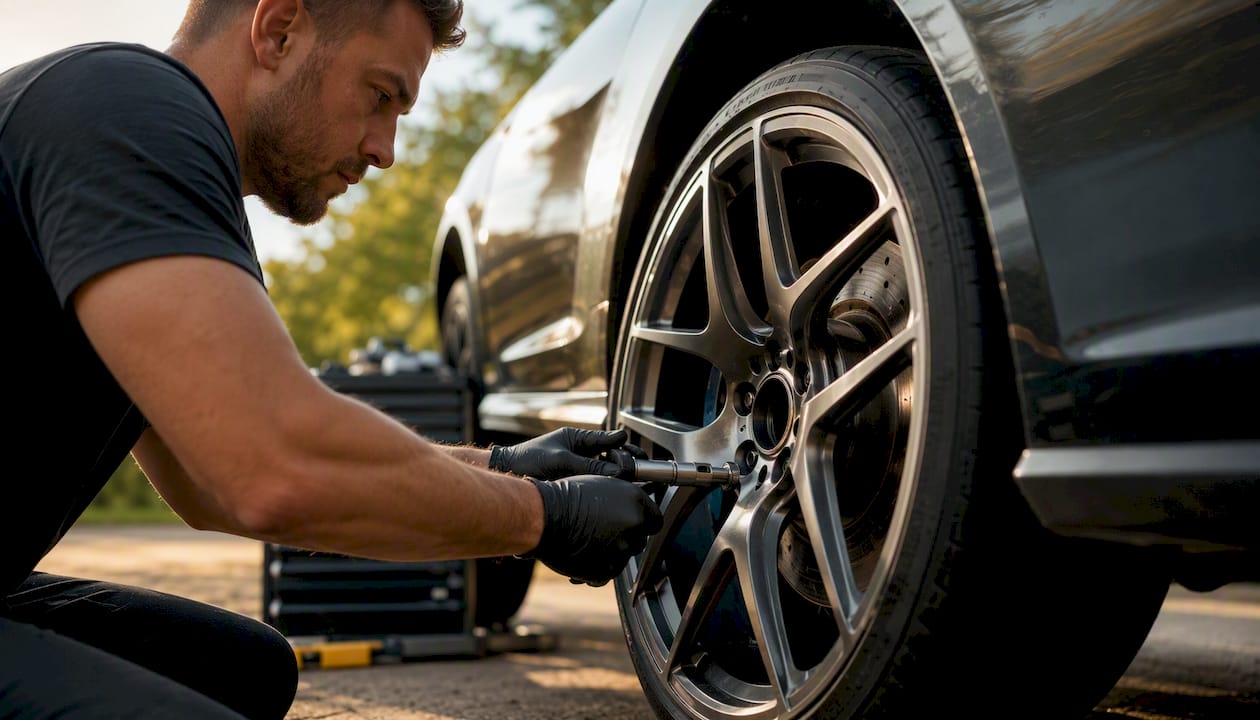
Yes, lightweight wheel upgrades improve acceleration, braking, and steering feedback by cutting rotational inertia and unsprung mass, but the size of the gain depends heavily on where you drive. In a controlled test on a BMW M3, swapping from a 20 lb wheel to a 52 lb wheel added 0.31 seconds to a 31 to 87 mph run and cost 1.61 seconds per lap on a road course. That gap shows up in lap times and stopwatch runs far more clearly than it does in daily commuting, where the differences are real but subtler.
Every pound removed from a wheel does double duty. It reduces unsprung mass, the weight your suspension has to control below the springs, and it cuts rotational inertia, the resistance a spinning wheel has to speeding up or slowing down. FrenzyCars has covered this trade-off across weight-reduction projects long enough to know the pattern: the benefit compounds fastest on cars that already ask a lot of their tires and brakes.
Three situations tend to produce the most noticeable gains:
- Track and lap-time chasing: Every rotational pound saved reduces the energy your engine and brakes spend accelerating and decelerating the wheel itself, lap after lap.
- Lightweight or high-revving engines: Cars with less torque to spare feel the reduced rotational load more directly than heavy, torque-rich engines do.
- Drivers who prioritize steering feel: Reduced unsprung mass lets the suspension react faster to bumps and inputs, which sharpens feedback through the wheel.
If none of those three describe your driving, the upgrade still helps. It just won’t transform your commute the way it transforms a lap sheet.
Key Takeaways
Lightweight wheel upgrades reduce rotational inertia and unsprung mass, producing measurable gains in acceleration, braking, and steering feedback that scale with track use and driving intensity.
| Point | Details |
|---|---|
| Rotational weight matters most | A pound saved at the wheel rim has a bigger effect than a pound saved elsewhere on the car. |
| Track gains are clearest | A controlled test showed a 1.61 second lap-time penalty from 32 lb of added wheel weight. |
| Fuel economy isn’t guaranteed | The lightest wheel tested was not the most fuel-efficient; aerodynamic design also matters. |
| Fitment determines the outcome | Bolt pattern, offset, and tire sidewall height change the real-world result as much as raw weight. |
| Material choice should match use | Flow-formed suits daily drivers, forged suits serious track use, magnesium and carbon suit dedicated race cars. |
Benefits of Lightweight Wheel Upgrades: The Physics Behind the Feel
Two concepts explain almost everything lighter wheels do to a car: unsprung mass and rotational inertia. Understanding both is the difference between buying wheels that actually solve your problem and buying wheels because they look good in photos.
Unsprung mass is any component your suspension has to control without the benefit of spring and damper isolation. That includes the wheel, tire, brake rotor, caliper, and part of the suspension arms themselves. Every time a tire hits a bump, the suspension has to accelerate that unsprung mass upward and then control its return. Heavier wheels mean more mass to fling around, so your dampers work harder to keep the tire in contact with the road. Less unsprung mass means the suspension can react faster and keep the contact patch planted through rough pavement and hard cornering.
Rotational inertia is a different animal entirely, and it’s the one drivers underestimate. A spinning wheel doesn’t just have mass; it has mass distributed around a radius, and that distribution matters more than the total weight. A pound of aluminum sitting at the rim’s outer edge takes far more energy to spin up than a pound sitting near the hub, because rotational energy scales with the square of the radius at which the mass sits. This is why rim weight matters more than hub weight when engineers evaluate a wheel design, and why two wheels of identical total weight can feel completely different depending on how that weight is distributed.
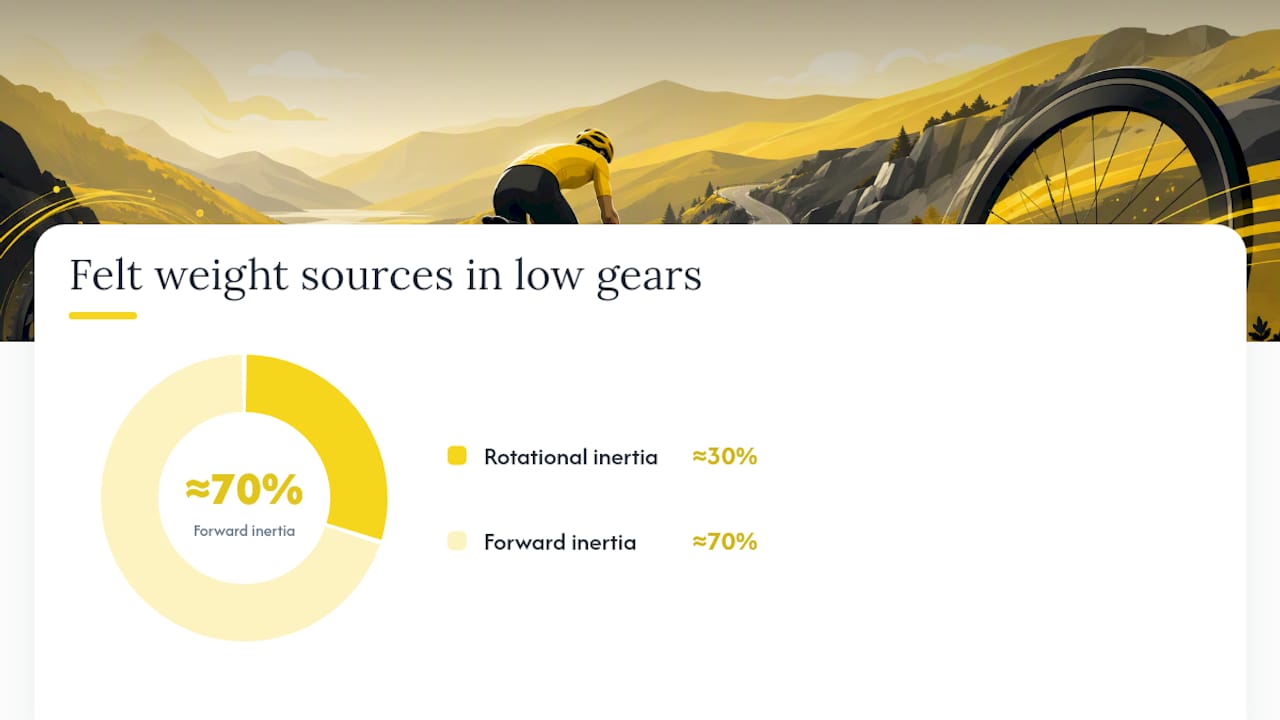
A technical primer on the subject frames it well: shedding rotational mass can feel like shedding more than the same amount of static vehicle weight, because the engine has to overcome both the car’s forward inertia and the wheel’s rotational inertia simultaneously. The effective mass multiplier from rotational inertia can add roughly 30 percent or more to the felt weight in lower gears, which is why lightweight wheels feel most dramatic when you’re accelerating hard from a stop or exiting a slow corner in second gear.
Pro Tip: If you want to feel the difference rotational inertia makes, spin a bicycle wheel by the axle versus spinning it by flicking the rim. The rim flick takes far less effort to get the same speed, which is the same principle at work in your car’s wheels, just scaled up.
Reduced unsprung and rotational mass shows up in a handful of concrete ways once you’re behind the wheel:
- Faster spool-up in lower gears, where the engine’s torque advantage over rotational resistance is smallest.
- Reduced brake load, since the brakes aren’t just stopping the car, they’re also decelerating the wheel’s rotational energy on every stop.
- Improved mid-corner recovery, because a lighter suspension assembly reacts to mid-corner bumps and weight transfer more quickly.
- More precise steering feel, since the front wheels respond to steering input with less rotational lag.
None of this means unsprung mass is universally bad in every scenario. One SAE paper on the topic notes that in specific racing contexts, some unsprung mass can help control roll initiation, acting almost like a damping element during transient weight transfer. It’s a narrow exception, and it doesn’t overturn the general rule for street and most track applications, but it’s worth knowing that “lighter is always better” isn’t a law of physics. It’s a strong pattern with edge cases.
The practical takeaway is that where the weight sits matters as much as how much weight you remove. A wheel that’s lighter overall but concentrates its remaining mass near the hub will outperform a wheel of the same total weight with heavy spokes reaching toward the rim. That’s a detail most buyers never think to ask about, and it’s exactly why two wheels with identical spec-sheet weights can feel noticeably different on the same car.
Real-World Numbers: Acceleration, Lap Times, and Fuel Economy
The clearest data point available comes from a controlled test on an F80-generation BMW M3, where researchers swapped a 20 lb wheel for a 52 lb wheel and measured both acceleration and lap time on the same car, same tires, same track. The 31 to 87 mph acceleration run went from 5.76 seconds to 6.07 seconds, a 0.31 second difference from 32 lb of added rotational weight spread across four wheels. Lap time went from 99.13 seconds to 100.74 seconds, a 1.61 second swing on a single lap.

Those numbers tell you two things. First, the effect is real and measurable under controlled conditions. Second, it’s not enormous on a street car with a stock suspension and reasonable power. A 1.61 second lap-time swing matters enormously to a club racer chasing a personal best, and it’s nearly invisible to someone driving to the grocery store.
| Test Condition | 20 lb Wheel | 52 lb Wheel | Difference |
|---|---|---|---|
| 31 to 87 mph acceleration | 5.76 seconds | 6.07 seconds | 0.31 seconds |
| Lap time (single lap) | 99.13 seconds | 100.74 seconds | 1.61 seconds |
Motorsport applications show a starker picture. A Formula Student team studied in Racecar Engineering cut 10.75 kg from their car’s unsprung mass assembly and measured a 67% increase in rotational acceleration, which translated into sharper traction and steering response. That’s an extreme example, a purpose-built race car with far less total mass than a street car, so the percentage gain doesn’t transfer directly to your daily driver. It does confirm the direction and mechanism the BMW test demonstrated at a smaller scale.
A few sensitivity patterns are worth knowing before you shop:
- Rotational weight counts more than static weight. A pound saved at the wheel has an outsized effect compared to a pound saved from, say, the trunk, because of the rotational inertia multiplier discussed earlier.
- Lower gears amplify the effect. First and second gear acceleration benefits more than fifth or sixth gear cruising, since the engine’s torque multiplication is highest there.
- Tire choice interacts with wheel weight. A heavier, stickier tire can partially offset a lighter wheel’s rotational benefit, so the two choices should be considered together, not separately.
- Braking benefits scale with repeated stops. Track sessions with hard braking zones show the clearest reduction in rotational energy the brakes have to absorb; a single stop sign barely registers.
Fuel economy is where expectations need the most adjustment. Stop-and-go driving benefits more than highway cruising, because accelerating from a stop repeatedly engages the rotational inertia penalty, while steady highway speed mostly just fights aerodynamic drag and rolling resistance. But an SAE study on wheel design found something counterintuitive: the lightest wheel tested was not the most fuel-efficient one. Wheels that combined permanently bonded aerodynamic covers with a mass-optimized structural backbone beat purely weight-focused designs on fuel economy, because aerodynamic drag around a wheel well matters more to highway MPG than a few pounds of rotational mass.
Statistic to remember: a 32 lb weight difference across four wheels cost 1.61 seconds per lap and 0.31 seconds in a mid-range acceleration run on a controlled test. Scale that ratio to whatever weight difference your prospective wheel swap represents, and you’ll have a realistic, not aspirational, sense of what to expect.
Realistic MPG guidance follows the same logic: expect a small, mostly city-driving improvement from weight alone, and don’t expect a highway mileage transformation unless the wheel’s aerodynamic design was engineered for it specifically.
What Lightweight Wheels Cost You in Money, Durability, and Ride Quality
Every gain in this category comes with a corresponding trade-off, and pretending otherwise does readers a disservice. Price scales roughly with manufacturing precision: cast wheels sit at the bottom of the price range, flow-formed wheels cost more but shed meaningful weight, and forged wheels command the highest prices for the best strength-to-weight ratio. Durability tends to follow the same order, with forged wheels generally tolerating curb strikes and potholes better than cast wheels of comparable weight, since the forging process aligns the metal’s grain structure for greater impact resistance.
Ride quality is where enthusiasts sometimes get surprised. A lighter wheel doesn’t automatically mean a smoother ride, especially if the weight savings comes paired with a larger diameter or a lower-profile tire. Larger, lighter wheels can actually increase noise, vibration, and harshness (NVH) transmitted into the cabin, because the shorter, stiffer tire sidewall that typically accompanies a bigger wheel absorbs less impact before passing it to the suspension. If ride comfort matters to you as much as performance, the wheel diameter and tire sidewall height deserve as much attention as the wheel’s weight spec.
Safety and maintenance deserve a specific checklist after any wheel swap:
- Re-torque the lug nuts after the first 50 to 100 miles, since new wheels can settle slightly against the hub.
- Inspect for hairline cracks around bolt holes and spokes periodically, especially after curb strikes or pothole impacts.
- Watch for corrosion if you’ve chosen magnesium wheels, since magnesium reacts more aggressively to road salt and moisture than aluminum.
- Confirm brake clearance any time you change wheel diameter, width, or offset, since aftermarket brake kits and lightweight wheels don’t always clear each other without spacers.
Magnesium wheels deserve a specific caution. They offer the best weight-to-strength ratio of any common wheel material, but they’re also more brittle than aluminum under repeated impact stress, and that brittleness becomes a real safety concern on a street car that has to deal with potholes and curbs rather than a smooth, debris-free racetrack.
Pro Tip: If your budget can’t stretch to forged wheels, flow-formed wheels usually get you 70 to 80 percent of the weight savings at a meaningfully lower price. Reserve magnesium or full forged carbon setups for dedicated track cars where the ride is smoother and the impact risk is lower. Always confirm fitment with a test-fit before committing, since offset and clearance problems are far cheaper to catch before the wheels are mounted.
Cast, Flow-Formed, Forged, or Carbon: Matching Material to Purpose
Wheel construction methods map fairly predictably onto a weight, strength, and cost triangle, and understanding where each one sits saves you from overpaying for capability you don’t need or underbuying for capability you do.
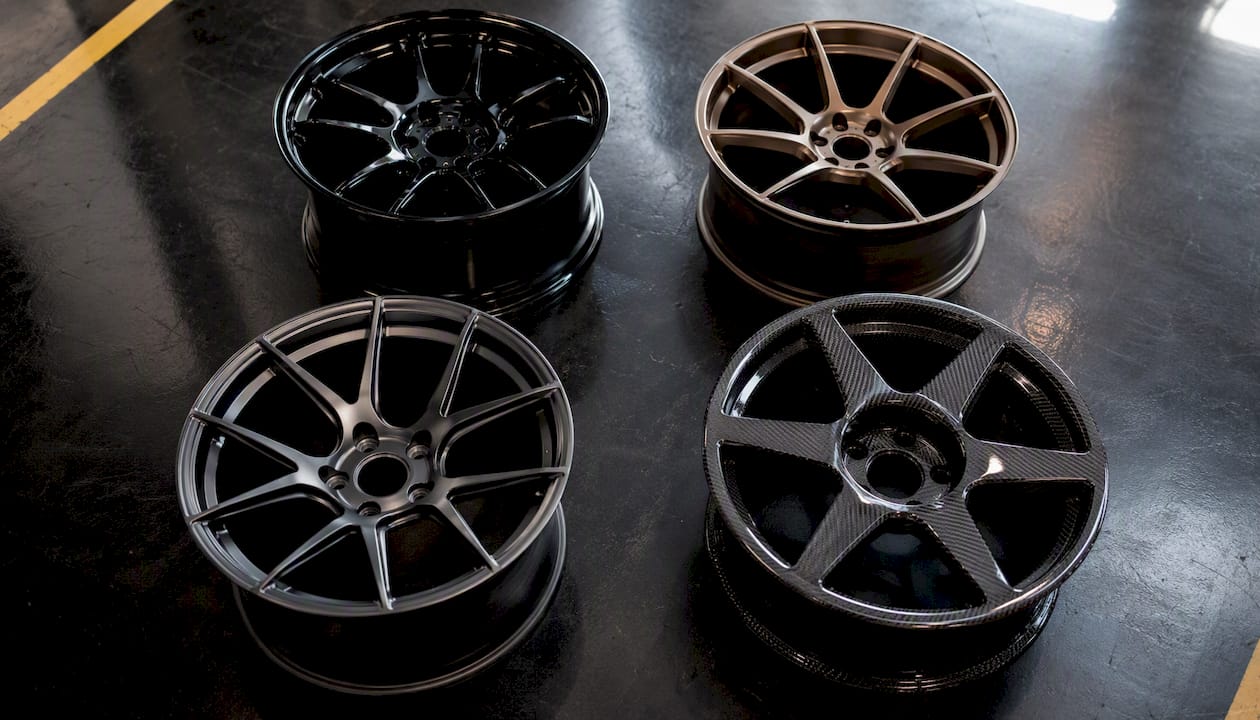
Cast wheels are the most common and least expensive, made by pouring molten aluminum into a mold. They’re heavier for a given strength than other methods because the casting process leaves a less uniform grain structure, requiring extra material to hit safety margins.
Flow-formed wheels start as a cast blank, then get spun and stretched under heat and pressure to compress and align the metal’s grain structure in the rim area. That process trims meaningful weight without forged-wheel pricing, which is why flow-forming has become the sweet spot for enthusiasts upgrading a daily driver or mild track car.
Forged wheels are machined from a solid billet of aluminum compressed under enormous pressure, giving them the highest strength-to-weight ratio of any mainstream aluminum construction. They cost more because the process wastes more material and requires more machining time, but the resulting wheel tolerates impact far better than a cast or flow-formed wheel of equal weight.
Two-piece and three-piece wheels bolt or weld a separate barrel to a center section, which lets manufacturers mix materials and offer more precise width and offset customization, often at a weight penalty compared to a one-piece forged design.
Magnesium wheels deliver the lowest weight of any metal option and show up almost exclusively on dedicated race cars, since their brittleness under repeated street impacts makes them a poor daily-driving choice.
Carbon fiber wheels currently sit at the top of both the weight-savings chart and the price chart, common on exotic and hypercar applications where cost is a secondary concern to outright mass reduction.
Aerodynamics complicates the simple “lighter is better” story. A wheel engineered with smooth aero surfaces and an optimized structural backbone can beat a lighter, purely mass-focused design on fuel economy and even high-speed stability, since drag reduction around the wheel well often outweighs the rotational-inertia benefit of a few saved pounds at highway speeds. Design engineers increasingly use multi-objective optimization to balance mass, stiffness, and manufacturability rather than chasing the single lightest spoke pattern possible.
For a daily driver, flow-formed aluminum is usually the right call. For a track-day car that still sees street use, forged aluminum earns its price premium. Save magnesium and carbon for cars that live on a trailer between events.
Getting Fitment Right: Size, Offset, and Tire Pairing
None of the performance gains above matter if the wheel doesn’t fit the car correctly. Fitment mistakes are the single most common way enthusiasts turn a promising upgrade into an expensive mistake.
Run through this checklist before you order anything:
- Confirm bolt pattern and hub-centric fit. The wheel’s bolt pattern must match your hub exactly, and hub-centric rings should be used if the wheel’s center bore is larger than your hub’s diameter.
- Check offset and its effect on scrub radius. A different offset than stock changes how the tire’s contact patch sits relative to the steering axis, which alters steering effort and can introduce unwanted camber-like effects.
- Verify brake and suspension clearance. Larger brake calipers or lowered suspension setups can rub against a wheel’s inner barrel if the offset or diameter isn’t matched carefully; a wheel alignment and tire fitment check before final installation catches most of these issues.
- Match tire sidewall height to your priorities. A shorter sidewall on a larger-diameter wheel sharpens steering response but transmits more impact harshness; a taller sidewall on a smaller wheel rides softer but adds rotational mass and reduces steering precision.
- Mock up before you buy. Many wheel shops offer test-fit services or loaner sets specifically so you can catch clearance problems before committing, similar in spirit to why a test drive matters before buying a car in the first place.
Watch for these warning signs after installation:
- Scrubbing or rubbing at full steering lock or over bumps, which usually points to incorrect offset or width.
- Sudden oversteer or unpredictable handling under load, which can signal a mismatched tire sidewall or incorrect torque on the lug nuts.
- Uneven tire wear after a short break-in period, often a sign the alignment wasn’t reset after the wheel swap.
Wheel diameter, width, and tire sidewall height together determine the effective rotational inertia of your new setup far more than the wheel’s raw weight number alone. A shop that understands this will steer you toward the combination that actually delivers the benefits you’re paying for.
The Evidence Behind Lighter Wheel Claims
Most of the strong claims about lightweight wheels trace back to a small number of controlled tests, and knowing how those tests were built matters if you want to judge whether the results apply to your car.
The most cited controlled comparison remains the BMW M3 test discussed earlier, which held tires, driver, and track constant while swapping only wheel weight between a 20 lb and 52 lb set. That controlled design is exactly why the 0.31 second acceleration difference and 1.61 second lap-time difference carry weight as data rather than anecdote. Same car, same driver, same track, same tires. Only the wheel weight changed.
| Study | Vehicle/Platform | Key Metric | Result |
|---|---|---|---|
| Jalopnik controlled wheel test | BMW M3 (F80) | Acceleration, 31 to 87 mph | 0.31 second penalty at +32 lb total |
| Jalopnik controlled wheel test | BMW M3 (F80) | Lap time, single lap | 1.61 second penalty at +32 lb total |
| Racecar Engineering UGR20 study | Formula Student race car | Rotational acceleration | 67% increase after 10.75 kg unsprung mass cut |
| — | Passenger vehicle wheels | Fuel efficiency ranking | Aero-optimized wheel beat lightest wheel |
When you read consumer-facing wheel comparisons that aren’t structured this carefully, apply some skepticism. A few things separate a trustworthy test from a marketing exercise:
- Same tires across every test run. Swapping tire compound or size alongside wheel weight muddies which variable caused the change.
- Same driver, ideally the same lap or run repeated multiple times. Driver variability alone can swing lap times by more than a lighter wheel does.
- Controlled ballast, not just swapped parts. The best studies isolate wheel weight specifically rather than changing multiple suspension components at once.
- Disclosed vehicle power and drivetrain. A result from a 600 horsepower car doesn’t necessarily transfer to a 150 horsepower commuter, since the torque-to-rotational-inertia ratio differs enormously.
It confirms the mechanism convincingly, but the magnitude belongs to a very different vehicle category.
The number worth remembering: roughly 32 lb of total added wheel weight cost a well-tuned street performance car 1.61 seconds over a single lap. That’s your benchmark for whether a prospective wheel swap’s weight savings is likely to matter on a track day versus mostly on paper.
Installing and Maintaining Lightweight Wheels Safely
Getting the performance benefit without the downside risk comes down to a short list of habits, most of which take fifteen minutes and save you from a much worse afternoon later.
- Torque lugs to manufacturer spec at installation, then re-torque after 50 to 100 miles once the wheel has settled fully against the hub face.
- Use hub-centric rings if your new wheels have a larger center bore than your hub, so the wheel is centered by the hub rather than relying on lug tension alone.
- Inspect for hairline cracks every few thousand miles or after any hard curb strike, focusing on the area around bolt holes and spoke junctions where stress concentrates.
- Check for corrosion on magnesium wheels more frequently than aluminum, particularly if you drive in areas that salt roads in winter.
- Confirm tire seating visually and by feel after any wheel change, since an improperly seated bead can cause a slow leak or sudden failure at speed.
Beyond that first-installation checklist, fold wheel inspection into your regular performance car maintenance routine, particularly if you track the car regularly.
If you notice a crack, persistent vibration, or corrosion that goes beyond surface discoloration, take the wheel to a shop capable of non-destructive testing rather than continuing to drive on it. Exotic materials like magnesium or carbon fiber may also carry different warranty and insurance implications than standard aluminum, so it’s worth confirming coverage details with your insurer before a major material upgrade rather than after a claim.
Where Lightweight Wheels Actually Earn Their Keep
Hands-on impressions of lightweight wheel swaps tend to split cleanly along the street versus track line this article keeps returning to. On the street, the most honest thing to say is that the steering feels noticeably more alive, and that’s often worth more to a driver than a stopwatch number nobody’s timing anyway. On track, the calculus changes, and every rotational pound saved shows up in braking points and exit speeds that compound over a full session.
For most enthusiasts running a daily driver with occasional track days, flow-formed wheels hit the right balance of price and durability. Forged wheels justify their premium once lap times and repeated hard use enter the picture, since the durability gain matters as much as the weight loss at that point. Magnesium and carbon belong to a narrower audience: cars that rarely see a pothole and drivers who’ve already optimized nearly everything else.
The BMW test’s 1.61 second lap-time swing is worth keeping in perspective. It’s a real, measurable number, but it came from over 30 lb of difference across four wheels. A more modest, realistic upgrade will produce a more modest, realistic gain, and that’s fine. The steering feel improvement often shows up before the stopwatch does anyway.
Ready to Upgrade? Start With Your Car’s Specs
Before buying any wheel set, confirm the exact bolt pattern, offset range, and factory wheel weight for your specific model. FrenzyCars’ car specs database lets you look up factory wheel and tire specifications by make and model, so you know precisely what you’re upgrading from before you spend money upgrading to something else. Pairing that baseline with the fitment checklist above is the fastest way to avoid an expensive clearance mistake.
Sources
- A multi-objective optimization approach for lightweight wheel structural design
- The Effects of Rotational Inertia on Automotive Acceleration
- Does Wheel Weight Matter for Performance? The Truth About Unsprung Mass
Review the test methodology notes on driver consistency, tire control, and ballast before drawing firm conclusions from any single test’s numbers.