
If you’re shopping for a new car, buy the lightest model that fits your needs. If you already own one, start with unsprung weight: wheels, tires, and brakes. That single shift in priority delivers more noticeable handling gains than clearing your trunk ever will.
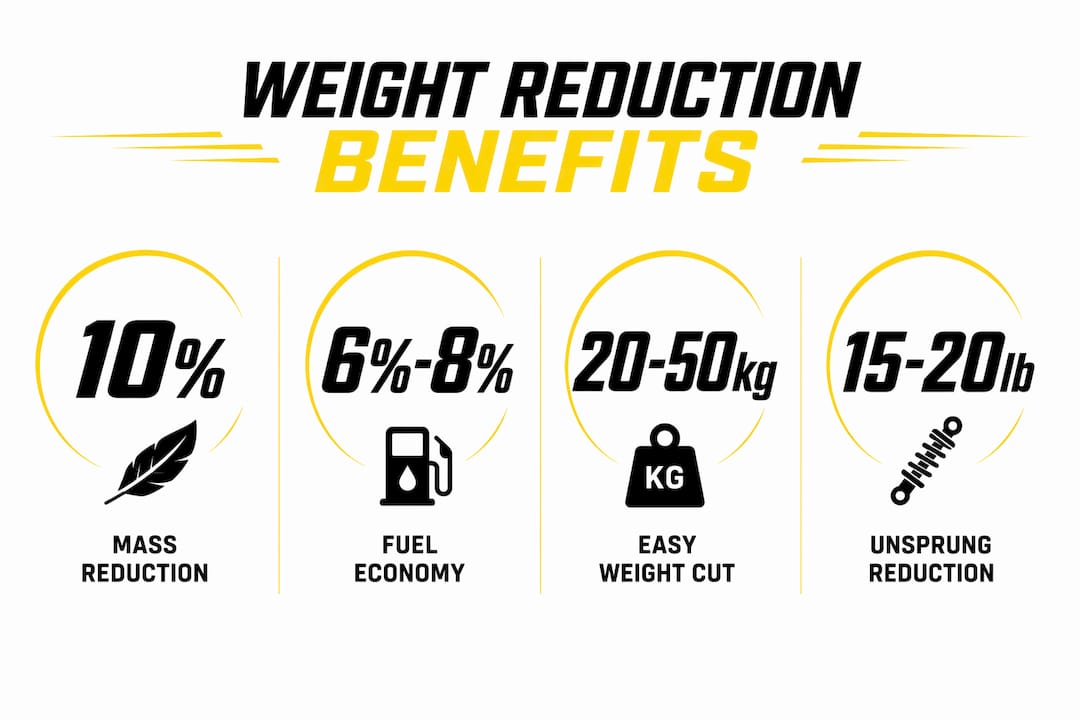
Here’s why it matters. A 10% mass reduction typically yields a 6%–8% improvement in fuel economy. Lighter cars also accelerate faster, brake shorter, and corner with more agility because lower inertia means every pound of engine output works harder. Think of it as a force multiplier: you get more from the power you already have without touching the engine.

Unsprung vs. sprung weight. Unsprung mass is everything not supported by the suspension: wheels, tires, brake rotors, and calipers. According to Intrax, reducing 15–20 lb per corner of unsprung or rotational mass often delivers more perceptible changes than removing 50 lb of static cabin mass. Sprung weight reductions still help fuel economy, but you feel unsprung reductions in every corner.
Safe, street-legal reductions to consider:
- Clear the trunk and remove unused cargo (free, immediate)
- Pull the spare tire and jack if you carry a plug kit instead
- Remove rear seats or sound deadening for a basic strip of 20–50 kg
- Swap to lighter alloy or forged wheels and lower-profile tires
- Upgrade to lightweight brake rotors and aluminum components (see brake upgrade options for tier-by-tier guidance)
- Consider a lightweight exhaust or aluminum driveshaft as second-tier moves
Never remove: airbags, structural bracing, or factory safety glass. Doing so can violate NHTSA road-safety rules and gut your crashworthiness. Lexan window replacements may also be illegal on public roads in many states. Always plan changes around maintaining front-to-rear weight distribution; stripping only one end of the car upsets balance and can make handling worse.
Long-term note: aluminum and carbon-fiber components can carry higher repair costs and embodied emissions than steel. Factor that into ownership math before committing to advanced lightweight modifications.
| Dimension | What to look for | Why it matters |
|---|---|---|
| Curb weight | Under 3,000 lb for sports cars; — for compact SUVs | Lower baseline = better power-to-weight from the factory |
| Power-to-weight | Higher hp/lb ratio | Predicts real-world acceleration more accurately than hp alone |
| EPA fuel economy | Best-in-class MPG or MPGe | Reflects efficiency gains from mass reduction |
| MSRP / used price | Compare total cost of ownership | Lightweight materials raise sticker price; used market softens that |
| Practicality | Seats, cargo volume | Aggressive weight cuts often sacrifice rear-seat space |
| Safety ratings | NHTSA / IIHS scores | Lightweight ≠ unsafe when OEM-engineered; verify before buying |
| Weight-saving potential | Easy (20–50 kg) vs. advanced (100 kg+) | Sets realistic expectations for DIY vs. professional builds |
Use Frenzycars’s car specs database to compare curb weights side by side, or browse best cars by category for editorially vetted lightweight picks across commuter, sports, and compact SUV classes. EV buyers should check the best electric cars guide — curb weight directly affects range and battery sizing on electric platforms, so the lightweighting math changes meaningfully there.
For truck owners weighing weight reduction against power upgrades, the diesel performance checklist from Standard Diesel Direct offers a useful parallel framework.
Frenzycars helps you find the lightest car for your needs
Researching curb weights across dozens of models is slow work. Frenzycars cuts that time by aggregating factory specs, EPA fuel-economy figures, and safety ratings in one place, organized by category so you can compare lightweight candidates without bouncing between manufacturer sites. Whether you want a sub-3,000 lb sports car, a fuel-efficient compact, or an EV where every kilogram saved extends range, the car specs database gives you the numbers to make a confident call. Start there, filter by curb weight, and you’ll have a shortlist in minutes.
Key Takeaways
A 10% mass reduction yields a 6%–8% fuel-economy gain, making the choice of a lighter car the highest-leverage move available to most buyers.
| Point | Details |
|---|---|
| Buy lighter first | Choosing a factory-lightweight model delivers mass savings without safety or comfort trade-offs. |
| Prioritize unsprung weight | Reducing 15–20 lb per corner (wheels, tires, brakes) beats 50 lb of cabin removal for handling gains. |
| Easy strip: 20–50 kg | Clearing the trunk, spare, and sound deadening gets you there with minimal cost or risk. |
| Never touch safety items | Airbags, structural bracing, and compliant glass are off-limits on any street-driven car. |
| Frenzycars specs database | Compare curb weights, EPA mpg, and safety ratings across models at frenzycars.com/cars/. |