TL;DR:
- Hybrid motors boost vehicle performance by providing instant torque, enabling faster acceleration and smoother driving. They also improve efficiency through regenerative braking and electric-only operation at low speeds, reducing emissions during city driving.
Hybrid motors improve vehicle performance because electric motors deliver full torque from zero RPM, something a gasoline engine physically cannot do. While an internal combustion engine (ICE) must climb through its RPM range before reaching peak torque, an electric motor hits its maximum output almost immediately. Pair that instant thrust with a gasoline engine, and you get a powertrain that is quicker off the line, smoother through the rev range, and more efficient across everyday driving conditions.
Key performance advantages hybrid systems deliver:
- Instant torque from the electric motor fills the gap while the ICE builds RPM
- Higher combined output than the gasoline engine alone
- Regenerative braking recaptures energy that conventional brakes waste as heat
- Electric-only operation at low speeds where ICE efficiency is worst
- Smoother acceleration through coordinated motor and engine control
Why hybrid motors aid performance: the powertrain explained
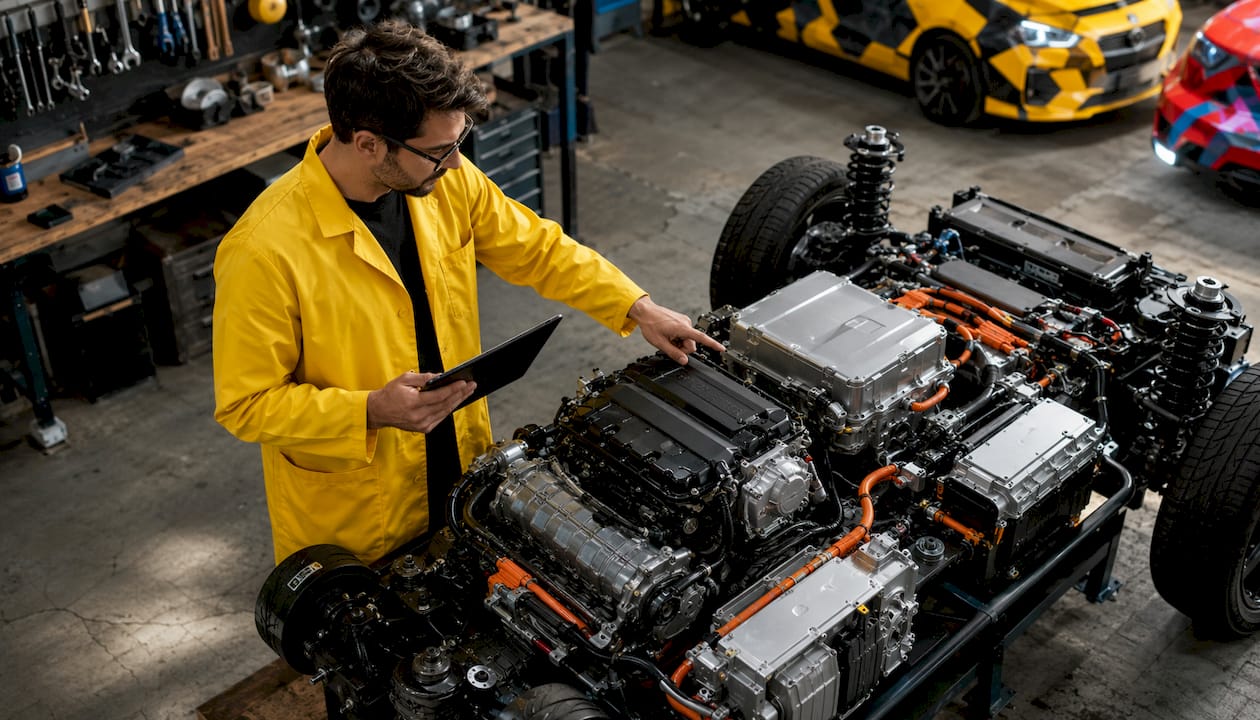
A hybrid powertrain has four core components: the ICE, one or more electric motors, a battery pack, and a power control unit. Each plays a distinct role, and the way they interact determines the vehicle’s performance character.
Hybrid architectures and their trade-offs:
| Architecture | How it works | Performance trade-off |
|---|---|---|
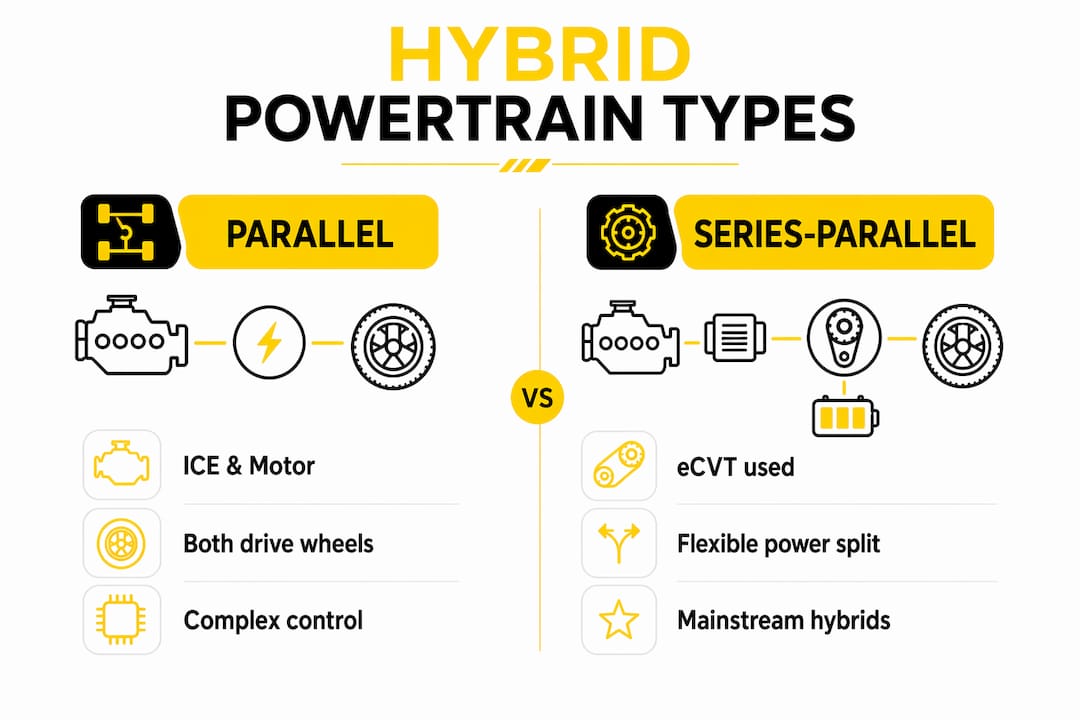
| Parallel | ICE and motor both drive the wheels directly | Strong high-speed output; less electric-only range |
| Series | ICE generates electricity; motor drives wheels | Smooth, EV-like feel; ICE efficiency varies |
| Series-parallel | System switches between both modes | Best overall flexibility and efficiency |
The series-parallel layout, used in many mainstream hybrids, pairs an electronic continuously variable transmission (eCVT) with the powertrain. The eCVT eliminates fixed gear steps, allowing the control unit to keep both the engine and motor operating in their most efficient ranges at all times. Regenerative braking feeds captured kinetic energy back into the battery during every deceleration event, reducing the load on the ICE and cutting fuel use.
Electric assistance also lets engineers downsize the ICE without sacrificing total output. A smaller engine runs closer to its efficiency sweet spot more often, and the motor covers the power deficit whenever demand spikes.
How hybrid motors sharpen acceleration and driving dynamics
The acceleration advantage of a hybrid comes down to torque timing with valve control exhaust. A gasoline engine produces its peak torque somewhere in the middle of its RPM band, which means there is a noticeable lag between pressing the accelerator and feeling full thrust. An electric motor has no such lag. It delivers its rated torque almost immediately, covering exactly the window where the ICE is weakest.

The 2022 Honda CR-V Hybrid illustrates this concretely. Its hybrid powertrain produces 212 hp and 232 lb-ft of torque, compared to 190 hp and 179 lb-ft for the non-hybrid variant. That 53 lb-ft torque gain is not a paper number; you feel it in how the vehicle responds from a standing start.
Beyond straight-line acceleration, advanced hybrids use independent electric motors on separate wheels to perform torque vectoring. By sending more torque to the outside wheel during a corner, the system actively rotates the vehicle through the turn rather than relying purely on mechanical grip. Hyundai’s e-VMC system takes this further, adjusting torque dynamically to influence the vehicle’s center of gravity and improve cornering agility beyond what a traditional mechanical differential can achieve.
Pro Tip: If you want to feel the torque vectoring effect, find a tight on-ramp and pay attention to how the car rotates into the apex. A well-tuned hybrid system feels planted and eager, not pushed.
Modern hybrid control units have also nearly eliminated powertrain jolts during mode transitions. Early hybrids could shudder when the gasoline engine kicked in; today’s systems use torque compensation algorithms to make the handoff imperceptible.
How hybrid motors enhance efficiency compared to ICE alone
Efficiency and performance are usually presented as opposites. Hybrid systems dissolve that trade-off by assigning each power source to the conditions where it excels.
The electric motor handles low-speed, stop-and-go driving where the ICE burns fuel inefficiently just to keep itself running. The gasoline engine takes over at highway speeds where it operates near its efficiency peak. Regenerative braking means every time you slow down, the system is banking energy rather than discarding it as heat through the brake pads.
Thermal management is the less-discussed piece of this puzzle. Hybrid powertrains use active cooling circuits to keep battery cells, power electronics, and motor windings within their optimal temperature ranges. Operating outside those ranges degrades both performance and longevity, so the thermal system is not a comfort feature; it is a performance requirement. You can explore the full hybrid powertrain efficiency breakdown in Frenzycars’s dedicated guide.
Where internal combustion engines fall short
A gasoline engine is a thermodynamic machine, and thermodynamics sets hard limits on it. Peak efficiency for most production ICEs tops out around 40%, meaning the majority of the energy in the fuel becomes heat rather than motion. At idle and low loads, efficiency drops further because the engine is running but producing almost no useful work.
Torque delivery is also RPM-dependent. The engine must rev up before it reaches its power band, which creates the lag that drivers feel as hesitation off the line. At very low speeds, the ICE is essentially a liability: it consumes fuel, generates heat, and contributes little to forward motion. Hybrid systems exist, in large part, to cover exactly this weakness.
At what speed does the electric motor take over?
Electric motors in hybrids typically operate alone at speeds up to around 30 mph, depending on battery state of charge and power demand. Below that threshold, the ICE is inefficient and the electric motor handles propulsion cleanly. Above it, the gasoline engine becomes the more efficient choice for sustained cruising, though the motor continues to assist during hard acceleration.
This threshold is not a fixed wall. Demand a burst of acceleration at 25 mph and the ICE will join immediately. Coast gently at 28 mph with a charged battery and the motor may carry the car alone. The control unit makes this decision continuously, in real time, based on speed, load, and battery level.
How battery technology shapes hybrid motor output
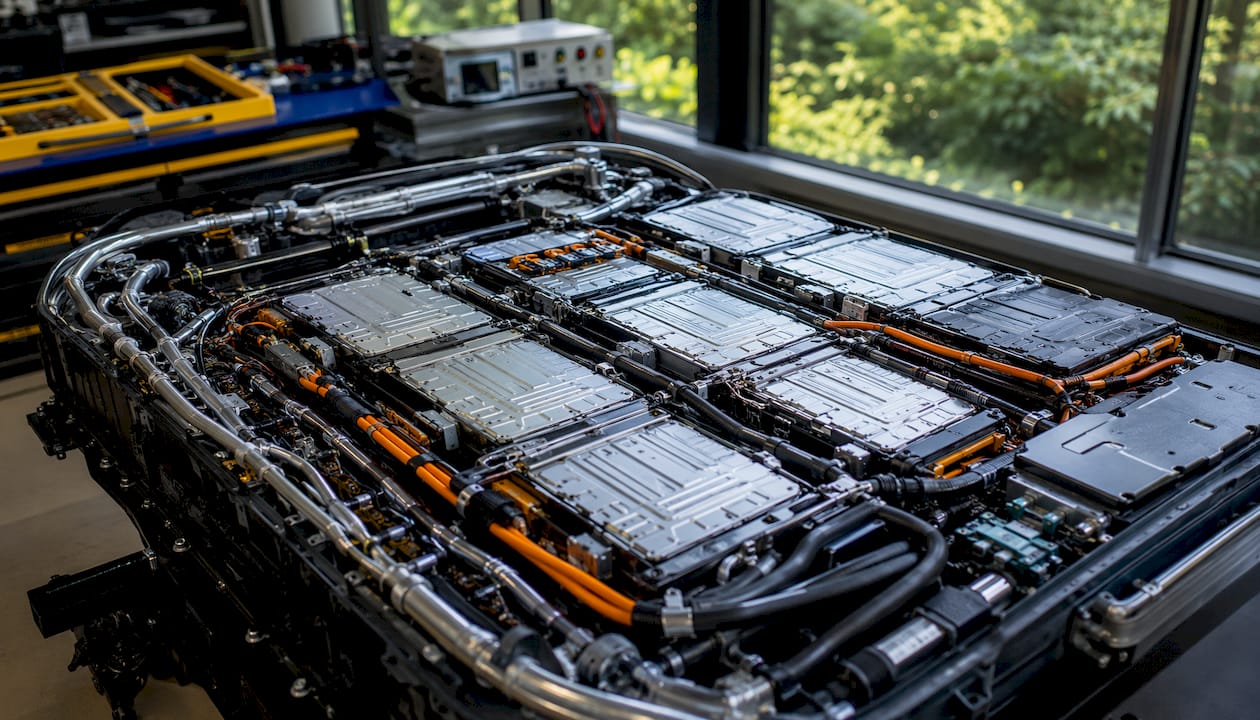
The battery pack is the energy reservoir that makes the electric motor’s instant torque possible. A pack with higher energy density stores more charge, which extends the range of electric-only operation and gives the motor more headroom to assist during aggressive driving. Nickel-metal hydride (NiMH) chemistry dominated early hybrids; lithium-ion has largely replaced it in newer models because of its superior energy density and faster charge acceptance from regenerative braking.
Charge acceptance rate matters as much as total capacity. A battery that can absorb regenerative energy quickly recovers more usable power from each braking event, which feeds back into the next acceleration cycle. For a deeper look at how these systems compare across current models, Frenzycars covers hybrid vs. electric vehicle technology in detail.
Emissions benefits tied to hybrid performance gains
The same electric-motor operation that improves low-speed acceleration also cuts tailpipe emissions during the driving conditions that produce the most pollution: urban stop-and-go traffic. When the motor drives the car alone, the ICE is off and emitting nothing. When both run together, the ICE operates under lighter load, which reduces combustion byproducts.
Regenerative braking contributes here too. Fewer hard braking events mean less particulate matter from brake dust, a source of urban air pollution that often goes unmentioned alongside exhaust emissions. High-performance hybrid models, like those covered in Frenzycars’s Mercedes-AMG GT 63 S E Performance feature, demonstrate that emissions reduction and serious performance output are not mutually exclusive.
Fuel economy and real-world driving range
Hybrids deliver their biggest fuel economy gains in city driving, which is the inverse of conventional vehicles. Consumer Reports testing confirms that hybrids drive more smoothly and powerfully than their non-hybrid counterparts, while also returning better fuel economy where it counts most for the average American commuter. On the highway, the efficiency advantage narrows because the electric motor contributes less at sustained high speeds. The practical result is a vehicle that handles urban driving on electricity, highway driving on gasoline, and transitions between the two without any input from the driver.
For model-specific hybrid performance specs, the Frenzycars car specs database covers powertrain output figures across makes and models.
Key Takeaways
Hybrid motors improve performance because electric torque fills the ICE’s low-RPM gap, producing faster acceleration, higher combined output, and better efficiency across real-world driving conditions.
| Point | Details |
|---|---|
| Instant torque advantage | Electric motors deliver peak torque almost immediately, eliminating the lag ICE engines produce at low RPM. |
| Higher combined output | The 2022 Honda CR-V Hybrid produces 212 hp and 232 lb-ft of torque, compared to 190 hp and 179 lb-ft for the non-hybrid version, enhancing performance. |
| Regenerative braking | Kinetic energy captured during deceleration recharges the battery instead of being lost as heat. |
| Electric-only threshold | Hybrids typically run on electric power alone up to around 30 mph, covering the range where ICE efficiency is worst. |
| Torque vectoring capability | Independent electric motors distribute torque per wheel, improving cornering stability beyond mechanical differentials. |