
A partial zero emissions vehicle (PZEV) is a gasoline-powered car certified to meet the Super Ultra-Low-Emission Vehicle (SULEV) tailpipe standard, produce zero evaporative fuel-system emissions, and carry an extended emissions warranty of 15 years or 150,000 miles, as defined by the California Air Resources Board (CARB). The name is a regulatory term from CARB’s Zero-Emission Vehicle (ZEV) program, not a drivetrain category. For used-car buyers, the extended warranty is the most tangible benefit: emissions components covered for 15 years or 150,000 miles can translate into real savings on repairs that would otherwise come out of pocket.
Why did CARB create the partial zero emissions vehicle category?
The PZEV label grew out of a policy problem CARB faced in the late 1990s. The ZEV program, launched in 1990, required automakers to sell a percentage of true zero-emission vehicles in California. Battery technology at the time could not support mass-market electric vehicles at scale, so automakers lobbied for a transitional credit category that would reward meaningful air-quality improvements without requiring a fully electric drivetrain.
CARB’s answer was a tiered credit structure. Here is how the category evolved:
- Late 1990s: CARB introduced partial-credit vehicle categories to give automakers compliance flexibility while battery and fuel-cell technology matured.
- Early 2000s: The PZEV designation was formalized in CARB rulemaking, tying partial ZEV credit to a specific certification bundle: SULEV exhaust, zero evaporative emissions, and extended warranty durability.
- Mid-2000s onward: Advanced Technology PZEV (AT-PZEV) and Transitional ZEV (TZEV) subcategories were added for vehicles with electric drive components (like plug-in hybrids), earning higher credit values while still using the PZEV certification bundle as a baseline.
- LEV II / LEV III integration: CARB’s rulemaking exhibits through 2022 continued referencing PZEV definitions within broader LEV and ZEV compliance frameworks, confirming the category’s role across multiple regulatory generations.
The core policy rationale: PZEV let automakers earn compliance credit while investing in pure ZEV production. It was a bridge, not a destination. CARB’s ZEV program overview describes this portfolio approach explicitly, treating partial-credit vehicles as one piece of a longer electrification strategy.
What technical criteria must a vehicle meet to earn PZEV certification?
CARB’s certification documents specify four core requirements. Miss any one of them and the vehicle does not qualify.
- SULEV tailpipe exhaust standard: The vehicle must meet SULEV emission limits over a 150,000-mile useful life, not just at initial certification. SULEV is roughly 90% cleaner than the average new car sold at the time the standard was introduced.
- Zero evaporative emissions: The fuel system must produce no measurable hydrocarbon vapor during standardized evaporative-emission test procedures. This covers fuel-tank breathing, hot-soak losses, and running-loss emissions.
- On-board diagnostics (OBD) durability: The OBD system must remain functional and accurate across the full 150,000-mile useful life, catching any emissions-related malfunction before it causes real-world pollution.
- Extended emissions warranty: Manufacturers must warrant emissions-related components for 15 years or 150,000 miles, whichever comes first. This is significantly longer than the federal minimum of 8 years or 80,000 miles.
The baseline PZEV credit allowance is a fractional value under CARB’s ZEV program rules. Vehicles with additional zero-emission capabilities (such as electric-only driving range) can earn higher allowances through AT-PZEV or TZEV designations, but those additions are capped to prevent partial-credit vehicles from displacing pure ZEV credit value.
Quick-reference glossary
| Abbreviation | Full term | What it means in plain language |
|---|---|---|
| PZEV | Partial Zero-Emission Vehicle | Meets SULEV + zero evap + 15-yr/150k warranty |
| SULEV | Super Ultra-Low-Emission Vehicle | Very low tailpipe NOx, HC, CO over 150,000 miles |
| ULEV | Ultra-Low-Emission Vehicle | Cleaner than LEV, less strict than SULEV |
| LEV | Low-Emission Vehicle | Baseline California clean-car standard |
| ZEV | Zero-Emission Vehicle | No tailpipe emissions (BEV, FCEV) |
| AT-PZEV | Advanced Technology PZEV | PZEV bundle plus electric drive component |
| TZEV | Transitional ZEV | Updated term for AT-PZEV in later CARB rules |
| OBD | On-Board Diagnostics | Emissions monitoring system built into the vehicle |
Which vehicles can carry PZEV certification, and how do you find them?
PZEV is a certification, not a drivetrain. A conventional gasoline sedan, a gasoline-electric hybrid, and certain advanced-drivetrain variants can all earn PZEV status if they satisfy the four criteria above. Owning a hybrid does not automatically mean PZEV, and a PZEV is not an EV. The benefits of hybrid vehicles overlap with PZEV in some areas, but the certifications are independent.
To find out whether a specific model and trim year carries PZEV certification:
- Visit the CARB Executive Orders (EO) database and search by manufacturer, model, and model year. Each certified vehicle receives a unique EO number.
- Cross-reference with CARB’s model-year certification tables, which list emission categories by make, model, and engine configuration.
- Check the U.S. EPA’s certification database as a secondary confirmation, since the EPA tracks state-certified vehicles alongside federal-standard ones.
Geographic availability matters. California and the states that adopted California’s standards under Section 177 of the Clean Air Act were the primary markets where automakers offered PZEV-certified variants. A vehicle sold in a non-adopting state may carry a different certification tier even if the model name is identical. Not every trim level within a model line receives PZEV certification either; the EO number is the only reliable confirmation.
How to verify PZEV status on a new or used vehicle
Dealer advertising uses “low emissions” loosely. The only verification that counts is documentation tied to the vehicle’s actual certification.
- Check the under-hood label. The Vehicle Emission Control Information (VECI) label, usually affixed to the underside of the hood or the radiator support, states the emission standard the vehicle was certified to. Look for “SULEV” and a reference to California or CARB standards to verify certification.
- Review the owner’s manual and warranty booklet. The extended emissions warranty section will specify 15 years or 150,000 miles if the vehicle is PZEV-certified.
- Search CARB’s executive-order listings. Using the vehicle’s make, model, model year, and engine, confirm the EO number and its associated emission category.
- Request the EO number from the seller. When buying used, ask the seller or dealer for the CARB Executive Order number directly. A seller who cannot produce it or does not know what it is warrants extra scrutiny.
- Contact BAR if the label is missing. The California Bureau of Automotive Repair (BAR) instructs consumers and technicians to use the under-hood VECI label to confirm extended warranty coverage. If the label is absent, BAR can facilitate ordering a replacement by VIN, typically within a few days.
For used-car buyers, the warranty transfer question is critical. The extended emissions warranty runs from the original sale date and typically transfers with the vehicle, not the owner. Confirm the original in-service date before assuming full coverage remains.
Pro Tip: Ask the seller specifically for the “CARB Executive Order number” rather than accepting a generic “low emissions” claim. That EO number is the only document that ties a specific vehicle configuration to a certified emission standard. If a dealer cannot provide it, look it up yourself on CARB’s website before signing anything.

Understanding certified used car documentation more broadly can also help you spot gaps in warranty coverage before purchase.
How does PZEV compare to hybrids, plug-in hybrids, and battery-electric vehicles?
The comparison depends on what you are trying to reduce. PZEV addresses local air pollutants: smog-forming hydrocarbons, nitrogen oxides, and evaporative fuel vapors. It does not directly target carbon dioxide or greenhouse gas emissions in the way a battery-electric vehicle (BEV) does.
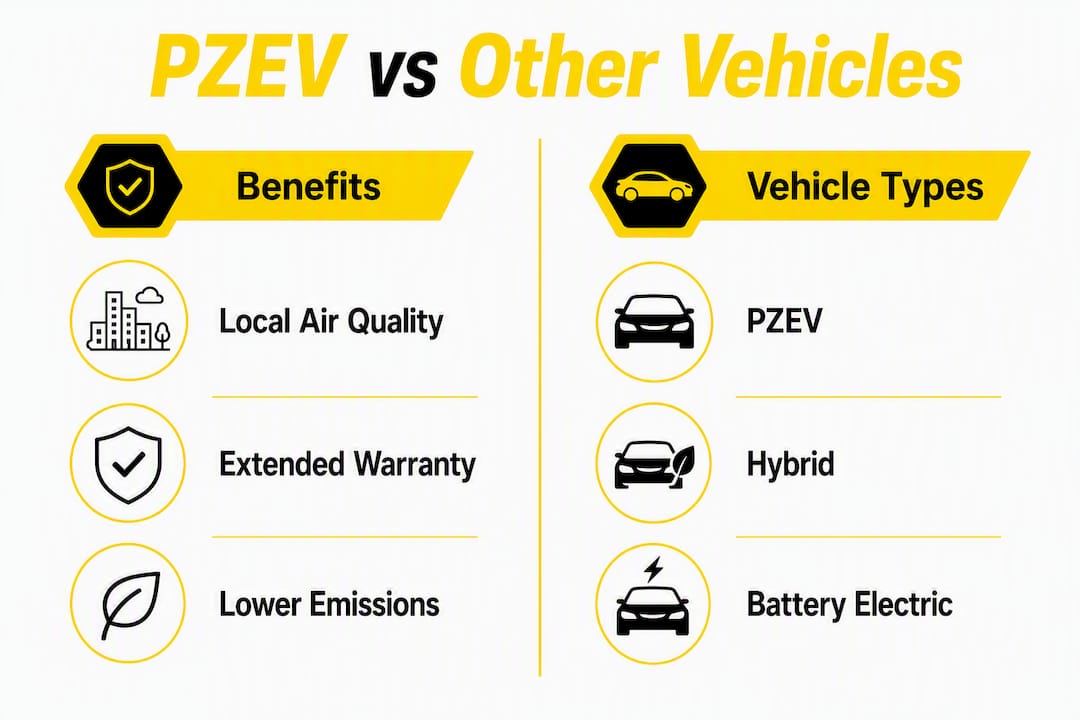
| Vehicle type | Primary emissions benefit | GHG reduction | Qualifies for EV tax credit | Extended emissions warranty |
|---|---|---|---|---|
| PZEV (gasoline) | Very low NOx/HC tailpipe; zero evap | Minimal vs. standard gas | No | 15 yr / 150,000 mi |
| Hybrid (non-PZEV) | Moderate tailpipe reduction | Moderate (fuel savings) | No | Standard federal minimums |
| Hybrid with PZEV cert | Very low NOx/HC; zero evap | Moderate | No | 15 yr / 150,000 mi |
| Plug-in hybrid (TZEV) | Low tailpipe; some electric miles | Moderate to significant | Sometimes (partial) | Varies by certification |
| Battery-electric (BEV) | Zero tailpipe | Significant (grid-dependent) | Yes (income/price limits apply) | Federal EV battery warranty |
A PZEV can be the right call when local air quality is the priority, the budget does not support a BEV, or the extended emissions warranty is genuinely valuable for a used-car purchase, especially when considering EV charger installation for future electrification options. For lifetime CO2 reduction and access to federal EV tax credits, a BEV or qualifying plug-in hybrid is the stronger choice. The hybrid vs. electric decision involves more variables than emissions alone, including charging infrastructure and total cost of ownership.
How PZEV functions inside CARB’s ZEV credit strategy
CARB designed the ZEV program as a portfolio compliance mechanism. Automakers selling above a threshold volume in California must meet a percentage ZEV requirement each model year. Pure ZEVs (battery-electric and fuel-cell vehicles) generate the highest credit values. PZEV vehicles generate a baseline allowance of 0.2 per vehicle, a fraction of what a BEV earns.
The CARB ZEV program ISOR documents specify that additional allowances above the 0.2 baseline are available for zero-emission vehicle miles traveled (VMT) and advanced componentry, but those additions are capped. The cap exists specifically to prevent AT-PZEV and TZEV credits from substituting for pure ZEV credits beyond a defined ceiling, protecting the program’s long-term electrification goals.
| Credit category | Baseline allowance | Can earn additional allowance? | Counts toward pure ZEV requirement? |
|---|---|---|---|
| PZEV | 0.2 | No (baseline only) | Partial, with caps |
| AT-PZEV / TZEV | 0.2 + ZEV VMT formula | Yes, capped | Partial, with caps |
| BEV / FCEV (ZEV) | — | Yes | Fully |
CARB’s ZEV program was structured so that partial-credit vehicles like PZEVs could generate compliance value for automakers during the years when pure ZEV volumes were too low to meet mandates alone. The program explicitly treats PZEV as a transitional mechanism, not a long-term substitute for battery-electric or fuel-cell vehicles.
This structure explains why PZEV availability peaked during the mid-2000s through mid-2010s, when BEV production was scaling but not yet sufficient to meet all ZEV obligations. As BEV volumes grew, the relative importance of PZEV credits declined.
Is a PZEV worth buying? A checklist for used-car shoppers
The extended warranty is the clearest financial argument for a PZEV used car. Emissions-related repairs, including catalytic converters, oxygen sensors, and evaporative-emission system components, can run into hundreds or thousands of dollars. A vehicle still within its 15-year/150,000-mile coverage window shifts that risk to the manufacturer.
- Confirm the VECI label is present and legible. A missing or damaged label is a red flag; order a replacement through BAR before completing the purchase.
- Calculate remaining warranty coverage. Subtract the original in-service date from today. If the vehicle is past 15 years or 150,000 miles, the extended warranty has expired.
- Inspect evaporative-emission components. Ask a mechanic to check fuel-system seals, purge valves, and the charcoal canister. These are the components most likely to degrade and the ones PZEV certification specifically covers.
- Verify the EO number against CARB’s database. Confirm the vehicle’s configuration (engine, model year, trim) matches the certified EO.
- Confirm warranty transferability. Ask the seller for documentation showing the original in-service date and confirm the warranty follows the vehicle.
- Compare against non-PZEV alternatives. If the warranty has expired or the label is missing, a non-PZEV used car with a strong aftermarket extended warranty may offer comparable protection. See Frenzycars’ guide to extended car warranty options for context.
A PZEV is not automatically better than a non-PZEV used car. The certification matters most when the warranty is still active and the emissions components are intact. Outside that window, the label is historical, not protective.
What states recognize PZEV, and what does that mean for buyers?
PZEV availability has always been tied to where California’s emission standards apply. Under Section 177 of the federal Clean Air Act, other states may adopt California’s LEV and ZEV regulations in place of federal standards. States that did so are commonly called “Section 177 states” or “clean-car states.”
CARB’s Section 177 state table lists the states that adopted California’s LEV criteria, GHG regulations, and ZEV program, along with the model year each adoption took effect. States including New York, Massachusetts, and others have adopted California standards, meaning automakers were required to offer California-compliant vehicles in those markets. New York’s LEV/ZEV program mirrors California’s structure directly.
For buyers, this means:
- A vehicle purchased in a Section 177 state during the years that state had adopted California standards is more likely to carry PZEV certification than one sold in a non-adopting state.
- Certification is model-year and trim specific. Do not assume a vehicle sold in a Section 177 state is PZEV; verify with the EO number.
- No state law requires individual consumers to buy a PZEV. The mandate falls on automakers, not buyers. PZEV is a manufacturer compliance tool that shapes which vehicles are available, not a consumer obligation.
C2ES’s summary of state clean vehicle policies provides a useful overview of how state-level adoption affects vehicle availability across the country.
Key Takeaways
A PZEV is a regulatory certification bundle, not a drivetrain type, and the 15-year/150,000-mile emissions warranty is its most buyer-relevant feature.
| Point | Details |
|---|---|
| PZEV certification bundle | Requires SULEV tailpipe standard, zero evaporative emissions, and a 15-year/150,000-mile extended warranty. |
| How to verify it | Check the under-hood VECI label, confirm the CARB Executive Order number, and review the warranty booklet. |
| Warranty is the key benefit | The extended emissions warranty covers catalytic converters, O2 sensors, and evap components well beyond federal minimums. |
| Not equivalent to a BEV | PZEV reduces local air pollutants but does not deliver the greenhouse gas reductions or EV tax credits of a battery-electric vehicle. |
| Section 177 states expand availability | States that adopted California standards are more likely to have PZEV-certified variants available, but trim-level verification is still required. |
PZEV is more useful than most buyers realize
The PZEV label gets dismissed as a technicality, a footnote in a regulatory document that most car shoppers never encounter. That dismissal misses something real. The extended emissions warranty is one of the longest manufacturer coverage periods attached to any non-luxury vehicle category, and it covers components that fail with frustrating regularity on high-mileage used cars.
Where the label falls short is on climate. A PZEV gasoline vehicle is genuinely cleaner at street level, producing far less smog-forming pollution than a standard car. But it still burns gasoline, and its lifecycle carbon footprint is not meaningfully different from a comparable non-PZEV model. Buyers who are primarily motivated by CO2 reduction should be looking at BEVs, and Frenzycars’ coverage of top electric vehicle options is a good starting point for that research.
The most underappreciated use case for PZEV is the used-car buyer in a Section 177 state who finds a vehicle still within its warranty window. That buyer gets meaningful emissions-component protection at no extra cost, assuming the label is intact and the EO number checks out. That is not a minor thing. It is a concrete financial benefit that most used-car listings do not highlight and most buyers do not know to ask for.
Frenzycars’ position: PZEV is worth understanding and worth verifying. It is not a reason to choose a gasoline car over an EV in 2026, but it is a reason to prefer one used gasoline car over another when the warranty math works in your favor.
Useful sources for further research
These are the primary regulatory and practical sources worth bookmarking if you are verifying a vehicle’s PZEV status or researching the program in depth.
- CARB ZEV Program Overview: The authoritative starting point for understanding how PZEV fits into California’s broader electrification mandate and credit structure.
- California Code of Regulations, Title 13, Section 1962.2: The regulatory text that formally defines PZEV, AT-PZEV, and TZEV, including credit allowance values.
- CARB Exhaust Emission Standards and Test Procedures: The technical document specifying SULEV standards, evaporative-emission requirements, OBD durability, and the 15-year/150,000-mile warranty requirement.
- BAR Newsletter: Vehicles with Extended Emissions Warranties: Practical consumer and technician guidance on confirming warranty coverage and ordering replacement VECI labels by VIN.
- CARB Section 177 State Adoption Table: Lists every state that adopted California’s LEV and ZEV standards, with the model year each adoption took effect.
“Consumers are sometimes not informed about extended emissions warranties” — BAR guidance on PZEV-era vehicles, recommending that buyers check the under-hood VECI label and contact BAR if it is missing or illegible.