Yes, you can buy a car out of state — it’s completely legal, and millions of Americans do it every year. The core rule is straightforward: you pay sales or use tax where you register the vehicle, not where you buy it. Before you book a flight or start negotiating, confirm your home state’s emissions requirements, pull up your DMV’s out-of-state registration page, and budget for use tax at your home rate.
Documents to secure at the point of purchase:
- Signed title (or Manufacturer’s Certificate of Origin for new vehicles)
- Bill of sale showing the actual purchase price
- Proof of insurance meeting your home state’s minimums
- Temporary transit tag or dealer-issued temporary plate
Pro Tip: Search “[your state] DMV out-of-state vehicle registration” before you travel. Most state DMV websites list the exact forms, fees, and inspection requirements. Bookmarking that page saves you a wasted trip later.
Key Takeaways
Buying a car out of state is legal and manageable, but tax is always owed where you register the vehicle, and the inspection must come before the paperwork.
| Point | Details |
|---|---|
| Tax follows registration | You owe use tax in your home state; a credit applies if the dealer collected tax at sale. |
| 30-day registration window | Many states require titling and registration within 30 days of purchase — start immediately. |
| Inspection before payment | Arrange a pre-purchase inspection by a local mechanic or mobile inspector before finalizing any deal. |
| Private sales add burden | Private buyers handle transit permits, VIN verification, and full use tax at home DMV — budget accordingly. |
| Run the full cost calculation | Add travel, transport, inspection, compliance repairs, and tax to the sticker price before deciding. |
Is buying a car in another state actually worth it?
The honest answer: sometimes yes, often no — and the math decides it.
Where it makes sense:
- You’re hunting a specific trim, color, or low-mileage example that doesn’t exist locally
- The price difference is large enough to absorb travel, transport, and compliance costs
- You’re buying a rare or classic vehicle with a thin local market
Where it usually doesn’t:
- The sticker price is only marginally lower than what’s available nearby
- Your home state has strict emissions rules the vehicle may not meet
- You’re buying privately and haven’t budgeted for full use tax at registration
The decision framework is simple: add up every dollar the out-of-state route costs beyond a local purchase (travel, transport, inspection, possible repairs, transit permit, and any tax shortfall). If the savings clear that number with room to spare, it’s worth it. If the gap is thin, a local deal is almost always less friction. NerdWallet’s guidance on out-of-state purchases frames this as three discrete phases — research and inspection, financial finalization, and administrative registration — and notes that skipping any phase is where buyers get burned.
How to calculate the true out-the-door cost
The sticker price is just the starting point. Here’s how to build the real number.
Step 1: Start with the purchase price. This is the taxable base in most states — the figure on the bill of sale. Trade-in credits and dealer discounts may reduce it, but verify your home state’s rules; some states tax the pre-discount price.
Step 2: Add dealer fees. Documentation fees, title fees, and any dealer-added accessories are real costs. Out-of-state dealers may also charge a fee to prepare paperwork for your home state.
Step 3: Add travel or transport costs. Flights, hotels, rental cars, or professional vehicle shipping all count. Auto transport quotes vary by distance and carrier type; factor pickup and delivery fees separately.
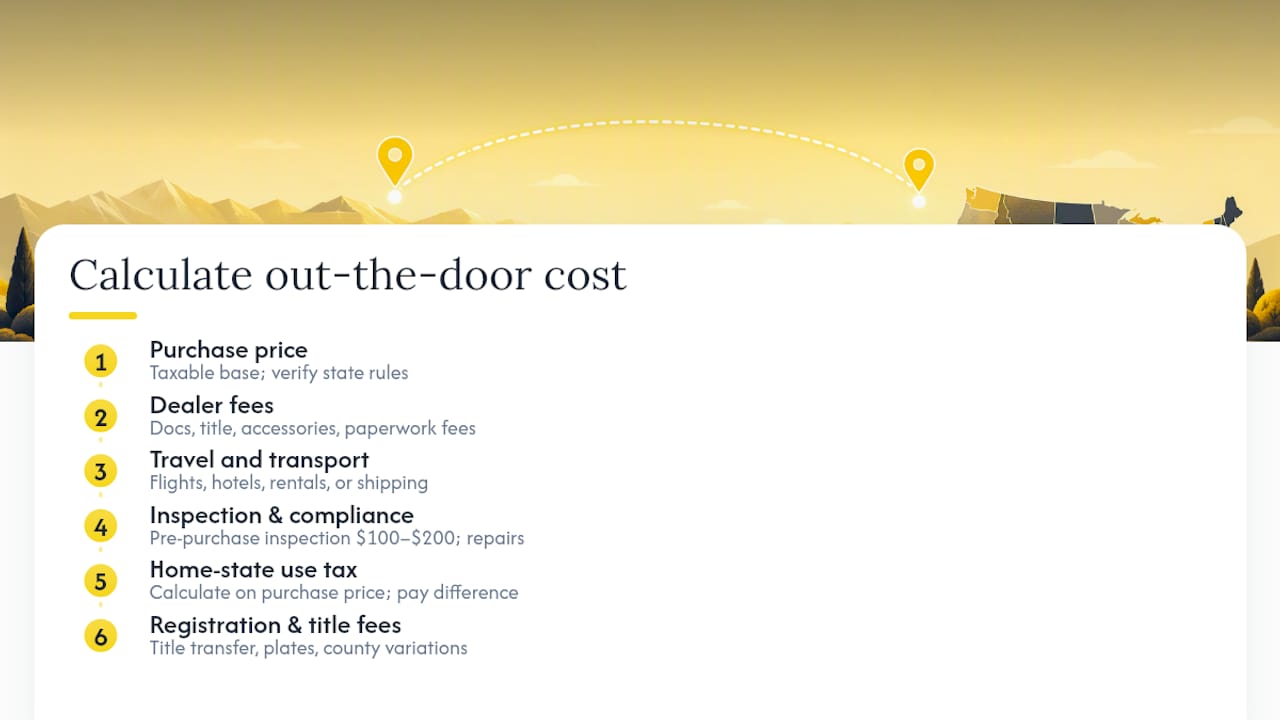
Step 4: Add inspection and compliance costs. Budget for a pre-purchase inspection by a local mechanic near the seller (typically $100–$200), plus any repairs needed to pass your home state’s emissions or safety test.
Step 5: Add home-state use tax. Calculate this on the purchase price at your home state’s rate. If the dealer collected tax, you’ll owe the difference if your home rate is higher.
Step 6: Add registration and title fees. Title transfer, plates, and registration vary by state and sometimes by county.
In this example, the $1,500 sticker savings shrinks to $705 after real costs. Use a car comparison shopping checklist to build your own version in a spreadsheet with columns for each cost item, a local total, and an out-of-state total side by side.
Who collects sales tax, and how do credits work?
This is the part most buyers get wrong, and it’s worth getting exactly right.
Vehicle sales tax is owed to the state where the car will be titled and registered — your home state — not the state where you bought it. If a dealer in the selling state collected sales tax at the point of sale, your home state will typically give you a dollar-for-dollar credit. You’ll owe the difference if your home rate is higher. If your home rate is lower, don’t expect a refund.
The Illinois Department of Revenue states this plainly: use tax is due where the vehicle will be registered and used. That principle holds across virtually every state that charges sales tax.
Documents to bring to your home DMV:
- Bill of sale showing the purchase price (required to calculate tax owed)
- Proof of any tax collected by the selling-state dealer
- Signed title or MCO
- Proof of insurance
- Odometer disclosure statement (required for vehicles under 10 years old in most states)
Private seller purchases: Expect to pay the full use tax rate when you register at home. There’s no dealer to collect it on your behalf, so bring the signed bill of sale and be prepared to write a check at the DMV window.
Tax evasion warning: Registering a vehicle in a no-sales-tax state while you actually live and drive in a tax state is illegal — not a loophole. States actively enforce this, and penalties can include back taxes, fines, and vehicle impoundment. Buying in a no-tax state does not eliminate your home-state use tax obligation. Your home state will collect what it’s owed when you register. Attempting to work around this by claiming a false residency is a separate legal problem entirely.
As Carqly’s state-by-state sales tax guide confirms, residents of tax states owe use tax at registration regardless of where the purchase happened.
Step-by-step: titling and registering a car you bought in another state
Treat this as a checklist you complete in order. Missing a step typically means a return trip to the DMV.
- Obtain a transit permit or temporary tag before driving the car home. Dealers usually issue these; private sellers do not. If buying privately, contact your home state’s DMV or the selling state’s DMV to get a transit permit before you leave.
- Confirm your home state’s registration window. Many states require titling and registration within 30 days of purchase. Texas, for example, requires titling and registration within 30 days and specifies the exact documents needed: proof of inspection, proof of insurance, the original out-of-state title, and Form 130-U.
- Schedule any required inspections. Some states require a safety or emissions inspection before they’ll issue plates. Book this immediately after arrival so you’re not racing the registration deadline.
- Gather your documents. You’ll typically need: the original signed title (not a photocopy), bill of sale, proof of insurance, odometer statement, and any inspection certificates.
- Visit your county tax office or DMV. Bring all documents. The clerk will calculate your use tax, collect registration and title fees, and issue plates or a temporary registration. If there’s a lienholder, the title may be mailed to them directly.
- Handle lienholder logistics. If you financed the purchase, your lender may need to be listed on the title. Confirm this with your lender before the DMV visit.
New York’s DMV allows registration and title by mail for out-of-state buyers and issues a 10-day inspection-extension sticker for applicants coming from another state — a useful model for understanding how states accommodate the process.
| Step | Typical Timing |
|---|---|
| Obtain transit permit | Day of purchase |
| Drive or ship vehicle home | Day 1–7 |
| Schedule and complete home-state inspection | Day 3–10 |
| Visit DMV with all documents | Day 7–25 |
| Plates and registration issued | Day 10–30 |
How emissions and safety inspection rules affect your purchase
This is where out-of-state purchases most often go sideways. A car that passed every inspection in the selling state may still fail yours.
Why it matters: Emissions standards vary significantly by state. California has its own standards, stricter than federal EPA rules, and several states follow California’s program. A vehicle sold and inspected in a state with looser standards may not be equipped to pass a California or Northeast-state emissions test.
How to check before you buy:
- Look up your home state’s DMV or emissions program website and search by model year and VIN
- Ask the seller for any recent inspection reports or emissions certificates
- Verify whether your home state accepts a selling-state inspection certificate or requires its own post-purchase test
If the car fails your home state’s test:
- Request a price reduction to cover estimated repair costs
- Negotiate that repairs be completed before you finalize payment
- Walk away — a car you can’t register isn’t a deal at any price
Emissions and safety standards can differ significantly between states, and buyers who skip this check often face repair bills that wipe out any price advantage. A vehicle that meets the selling state’s inspection requirements may still fail your home state’s emissions or safety checks.
Pro Tip: For California residents specifically, check whether the vehicle has a California Air Resources Board (CARB) compliant sticker before purchasing. Non-CARB vehicles cannot be registered in California regardless of their condition.
Dealer vs. private seller: what changes and what doesn’t
The vehicle itself is the same either way. The paperwork burden is not.
Buying from a dealer is generally smoother for cross-border purchases. Dealers are set up for it: they can issue temporary tags, collect your home-state sales tax (many do, though not all), and prepare the title transfer paperwork. Some will even handle registration filing on your behalf. Dealers may also offer certified pre-owned inspections or limited warranties, which private sellers cannot. The tradeoff is that dealer fees add to the purchase price, and you have less room to negotiate on documentation costs.
Buying from a private seller puts every administrative task on you. That means arranging your own transit permit, paying full use tax when you register at home, scheduling VIN verification if your state requires it, and handling any required safety or emissions inspection. There are no consumer protections equivalent to dealer regulations, so due diligence on the title is entirely your responsibility.
Out-of-state dealers are generally equipped to handle cross-border sales; private-party purchases place the administrative burden squarely on the buyer, including transit permits and VIN verification.
Private sale checklist:
- Verify the title is signed by the seller and matches the VIN on the vehicle
- Confirm any lien is released (get a lien release letter if applicable)
- Get a bill of sale showing the actual purchase price, date, and both parties’ names
- Arrange a transit permit before driving home
- Consider using an escrow service for large transactions to protect both parties
Payment method matters more in private sales. Wire transfers and cashier’s checks are standard; personal checks are a risk. Never hand over cash without a signed bill of sale in hand.
Getting the car home: drive, tow, or ship?
Three options, each with different costs and paperwork implications.
Drive it home — the simplest option if the car is in good mechanical shape and the distance is reasonable. You need a valid transit permit or dealer temporary tag before you leave the seller’s lot. Confirm your insurance covers the vehicle the moment you take ownership; call your insurer before the purchase date to add the car to your policy.
Tow it — useful if the car isn’t drivable or you don’t want to put miles on it. You’ll still need a transit permit in most states. Factor in the cost of a tow truck or flatbed trailer rental.
Ship it professionally — the right call for long distances, high-value vehicles, or situations where you can’t travel to pick it up. Auto transport costs vary by distance, vehicle size, and whether you choose open or enclosed transport. Get at least two quotes and confirm the shipper’s insurance covers the vehicle’s full value during transit.
Insurance reminder: Your home state’s minimum liability coverage must be active before the car touches a public road. Most insurers can add a new vehicle to your policy with a phone call, effective immediately. Don’t assume your existing policy automatically covers a newly purchased vehicle for more than a brief grace period — confirm the exact terms with your insurer.
VIN verification: Some states require a physical VIN inspection by law enforcement or a DMV agent when you bring in an out-of-state vehicle. Check your home state’s rules before arrival so you can schedule this immediately and avoid delaying registration.
- Open transport: lower cost, vehicle exposed to weather and road debris
- Enclosed transport: higher cost, better protection for classic or luxury vehicles
- Door-to-door vs. terminal-to-terminal: door-to-door is more convenient; terminal-to-terminal is cheaper but requires you to drop off and pick up at a carrier’s facility
What the timeline and fees actually look like
Most buyers underestimate how long the administrative tail runs after the purchase.
The registration window in many states is 30 days from the date of sale. Miss it and you may face late fees or penalties. Processing times vary: an in-person DMV visit can complete registration the same day, while mailed applications often take two to four weeks.
Common fees to budget for:
- Title transfer fee: varies by state, typically $15–$100
- Registration fee: varies widely by state and vehicle weight
- License plate fee: often bundled with registration
- Emissions or safety inspection fee: typically $20–$75 depending on the state
- Lien filing fee: if you financed the purchase
- County-level surcharges: some counties add their own fees on top of state fees
| Timeline Step | Typical Window |
|---|---|
| Day of purchase: obtain transit permit | Day of sale |
| Transit to home state | Days 1–7 |
| Home-state inspection | Days 3–14 |
| DMV visit (in-person) | Days 7–25 |
| Registration completed | Days 10–30 |
| Plates received (if mailed) | Days 14–45 |
Plan for the longer end of these windows if you’re mailing documents or if your state’s DMV has a backlog. Some states issue a temporary registration that lets you drive legally while the permanent plates are processed.
Frenzycars’ expert used-car inspection and test-drive checklist
An out-of-state purchase means you often have one shot at seeing the car in person. Make it count.
- Exterior walk-around. Check all body panels for mismatched paint, rippling, or overspray — signs of prior collision repair. Inspect tires for uneven wear (indicates alignment or suspension issues). Verify all lights work. Look for rust along the rocker panels, wheel wells, and undercarriage.
- Under the hood. Check engine oil (color and level), coolant, brake fluid, and power steering fluid. Look for oil leaks on the engine block or around gaskets. Inspect belts for cracking or fraying. Check the battery terminals for corrosion.
- Undercarriage and structural check. Get the car on a lift if possible. Look for frame welds, bent subframe components, or signs of flood damage (mud deposits in hard-to-clean areas, rust on the floor pan).
- Interior and electronics. Test every window, lock, and seat adjustment. Check the HVAC system on both heat and AC. Verify the infotainment system, backup camera, and any driver-assist features function correctly.
- Test drive. Accelerate firmly from a stop — hesitation or rough shifting points to transmission or engine issues. Brake hard in a safe area; the car should stop straight with no pulling. Listen for clunks over bumps (worn suspension), whining at speed (wheel bearings), or grinding during braking (worn pads or rotors). Check that the steering wheel centers naturally after a turn.
- Paperwork verification. Match the VIN on the dashboard, door jamb, and title. Confirm the title is clean (not salvage, rebuilt, or flood-branded — see Frenzycars’ guide on rebuilt title risks). Review service records for consistent maintenance. Run a vehicle history report using the VIN.
Pro Tip: If you can’t be there in person, hire a mobile pre-purchase inspection service near the seller’s location. Services like these send a mechanic to the car and deliver a written report with photos — typically for $100–$200 — and can save you from a costly mistake on a vehicle you’ve only seen in listing photos. Frenzycars’ used car test-drive checklist covers every step in detail.
Common mistakes buyers make in out-of-state transactions
Most of these are avoidable with a single phone call or 20 minutes of research before you commit.
Assuming the selling state’s inspection transfers. It usually doesn’t. A passing emissions certificate from Nevada means nothing if you’re registering in Massachusetts. Verify your home-state requirements before purchase, not after.
Underestimating use tax on private purchases. Buyers sometimes assume a private sale means no tax. It doesn’t. Your home state will calculate use tax on the bill-of-sale price when you register. Budget for it.
Red flags in listings and paperwork:
- VIN on the title doesn’t match the VIN on the dash or door jamb — walk away immediately
- Seller can’t produce the original title or claims it’s “being processed”
- Odometer reading on the title is higher than the current dash reading
- Seller is evasive about a vehicle history report or refuses to allow an independent inspection
- Title shows a salvage, rebuilt, or flood brand
Missing the registration deadline. Thirty days passes faster than you’d expect when you’re scheduling inspections and gathering documents. Start the DMV process the week you get home, not the week before the deadline.
Paying without a lien release. If the seller still owes money on the car, the lender holds the title. You need a lien release letter before the title is legally clear. Never pay in full until you’ve confirmed the title is free and clear.
If a red flag appears, the right move is to pause. Request an independent inspection, demand corrected paperwork, or walk away. A deal that falls apart over a title discrepancy is a deal that saved you from a much larger problem.
A straight take on what actually matters
Most articles about buying a car out of state spend too much time on the mechanics and not enough on the order of operations. Here’s the part that actually trips people up.
Buyers tend to fall in love with a listing, then work backward to justify the trip. That’s the wrong sequence. The inspection comes first — before you negotiate price, before you arrange transport, before you wire a deposit. A car that looks perfect in photos can have a bent frame, a rebuilt title, or emissions equipment that won’t survive your home state’s test. None of that shows up in the listing.
The second thing people underestimate is the administrative tail. The purchase takes a day. The registration process can take a month, and it requires documents you need to secure at the point of sale. If you leave the seller’s driveway without a signed title and a bill of sale showing the actual price, you’ve created a problem that’s hard to fix from 800 miles away.
My recommendation: treat the inspection as non-negotiable, even if it costs you $150 and a day’s delay. And before you commit to any out-of-state deal, check your home DMV’s out-of-state registration page and confirm exactly what you’ll need to bring. The Frenzycars test-drive and inspection checklist is a good place to start. If the seller won’t accommodate an independent inspection, that’s your answer.
Sources
Start with your home state’s DMV before you do anything else. Every state publishes an out-of-state registration guide with the exact forms, fees, and inspection requirements.
- If You Buy a Car in Another State, What Tax Do You Pay? - LegalClarity
- Buying a Car Out of State - NerdWallet
- Buying a Car Out-of-State - Illinois Department of Revenue
- Out-of-state and foreign vehicles - Texas DMV
- Register an Out-of-State Vehicle | NY DMV
Bookmark your home state’s DMV registration page now. When you’re standing in a seller’s driveway 600 miles from home, you’ll want that page pulled up on your phone.
This article is general information, not a substitute for advice from a qualified financial advisor. Consult a qualified financial professional about your own circumstances before acting on anything here.