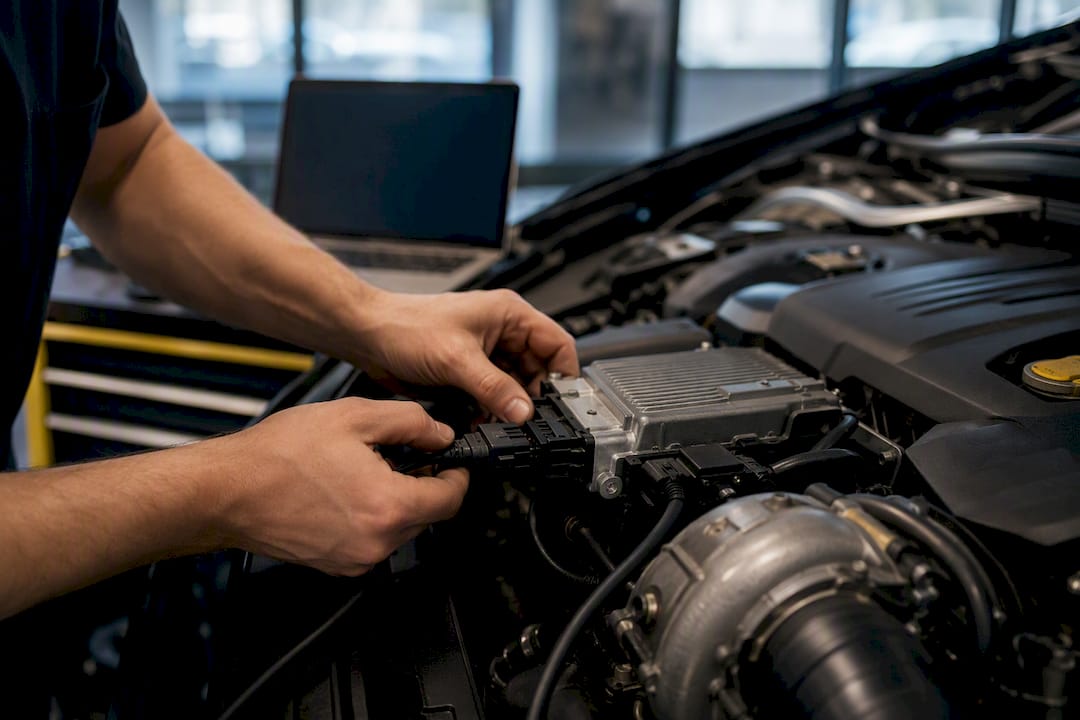
Yes, ECU tuning makes sense for most street cars, but the smart move is starting conservative. For a mechanically sound daily driver, a Stage 1 tune from a reputable source is the right entry point. If you’re chasing bigger gains on a heavily modified engine, skip the shortcuts and book a professional dyno session instead.
Here’s what a tune typically buys you and what it can cost you:
- Benefits: More horsepower and torque, sharper throttle response, and in some cases better fuel economy from optimized fueling and timing curves.
- Risks: Voided warranty coverage, potential emissions noncompliance under the Clean Air Act, and added mechanical stress if you skip supporting upgrades.
A 2025 academic review of remapping outcomes found that turbocharged engines commonly see gains in the 20 to 40 percent range from a Stage 1 remap, while naturally aspirated engines land in a more modest 5 to 15 percent band. That gap alone should shape your expectations before you spend a dollar. Your next move: confirm your engine’s mechanical health, pick a tune method that matches your goals, and read the legal section below before anyone touches your ECU.
Key Takeaways
A conservative, verified ECU tune delivers real horsepower and drivability gains for most street cars, but only when paired with mechanical health checks and emissions compliance.
| Point | Details |
|---|---|
| Start conservative | Stage 1 tuning suits most healthy street cars; save dyno-custom tuning for heavily modified builds. |
| Match gains to engine type | Expect roughly 5 to 15 percent gains on naturally aspirated engines and 20 to 40 percent on turbocharged engines. |
| Stay within the law | Confirm CARB Executive Orders and avoid emissions-delete tunes to stay compliant with the Clean Air Act. |
| Verify before you trust it | Datalog air-fuel ratio, knock, and timing after any tune, ideally backed by a dyno session. |
| Use real specs to plan | FrenzyCars’ car specs by make and model help you confirm baseline numbers before choosing a tune method. |
ECU Tune Street Car Guide: What the Computer Actually Controls
The engine control unit is the small computer that decides how your engine runs, moment to moment, thousands of times per second. It reads inputs from sensors, oxygen levels, intake air temperature, throttle position, crank angle, and uses that data to decide how much fuel to inject, when to fire the spark plugs, and how much boost to allow. Tuning means rewriting the instructions that computer follows.
Every ECU relies on lookup tables, often called maps, that tell the computer what to do at a given combination of RPM and load. A fueling map might say “at 3,000 RPM and 50 percent throttle, inject this much fuel.” A timing map does the same for ignition advance. A boost map governs how hard a turbo pushes air into the engine. Tuners adjust these tables to extract more performance, richen or lean the fuel mixture, advance or retard timing, and raise boost ceilings.
Manufacturers build in headroom on purpose. A factory tune has to work reliably across a huge range of conditions: bad gas, high altitude, a 20 year old car with worn injectors, a driver who never changes their oil. That means the factory map is conservative by design, leaving performance on the table in exchange for durability and consistency across every unit that rolls off the line. Tuning removes some of that safety margin to unlock power the hardware is already capable of producing.
Beyond fueling and timing, most ECUs also manage:
- Rev limits that cap engine speed to protect components.
- Torque management, which can quietly pull power in certain gears to protect the drivetrain.
- Boost control on turbocharged and supercharged engines.
- Emissions-related systems, including catalytic converter monitoring, exhaust gas recirculation, and evaporative emissions checks.
That last category matters more than most beginners realize. Emissions monitoring isn’t a side feature bolted onto the ECU. It’s deeply woven into the same code that controls fueling and timing, which is exactly why aggressive tunes that disable or “trick” emissions sensors carry legal weight, not just a warranty risk. A skilled tuner adjusts performance parameters while leaving emissions monitoring intact. A shortcut tune disables the monitoring instead, which is a different animal entirely and one that regulators pay close attention to.
Tuning also directly affects drivability. Richer fuel maps and more aggressive timing change how the car feels at idle, in traffic, and under hard acceleration. A well-executed tune smooths out flat spots in the factory throttle map and firms up shift points on automatics. A sloppy one introduces hesitation, rough idle, or a check-engine light within a week. Longevity follows the same logic: a tune that respects the engine’s mechanical limits, detailed further in our technical breakdown of engine mapping, adds power without shortening the engine’s life. One that ignores those limits borrows performance today at the cost of a rebuilt engine tomorrow.
Best ECU Tuning Methods for Street Cars
Not every tuning method fits every car, and picking the wrong one wastes money or, worse, damages your engine. Here’s how the main approaches stack up for someone actually driving their car on public roads.
-
Off-the-shelf tune files. These are pre-written maps designed for a specific make, model, and mod combination, often loaded through a handheld flasher or an app. They’re cheap, fast to install, and reversible in minutes. The tradeoff is that they’re generic. A file built for “stock engine, cold air intake, and cat-back exhaust” assumes your car matches that exact spec. If your fuel quality, climate, or supporting mods differ even slightly, you’re running a map that wasn’t built for your actual car.
-
OBD-II flashing and handheld tuners. These devices plug into your diagnostic port and let you load a tune, switch between multiple tune slots, and sometimes datalog basic parameters. Convenience is the main selling point. Precision is the tradeoff. You’re still typically working from a pre-built file rather than a custom calibration, so the ceiling on safe, optimized gains is lower than a dyno-tuned setup.
-
Piggyback modules. These sit between the factory ECU and the engine, intercepting and modifying sensor signals before they reach the stock computer. They’re popular because they don’t touch the factory calibration directly, which some owners see as a lower-risk way to add power while keeping the OEM ECU’s other functions untouched. The downside is compatibility. Piggybacks work well on some platforms and poorly on others, and they add another point of failure to the wiring harness.
-
Standalone ECUs. A full standalone system replaces the factory computer entirely, giving a tuner complete control over every parameter. This is the right call for heavily modified engines, swaps, or race-only builds, but it’s overkill and expensive for a street car that just needs more punch out of the corner. Standalone systems also typically sacrifice OEM comfort features and emissions integration, which pushes a car further from street-legal territory unless it’s done carefully.
-
Dyno-custom tuning. A tuner puts your specific car on a dynamometer, logs real-time data, and adjusts the map based on how your engine actually responds, not a generic template. This costs more and takes longer than loading a file, but it accounts for your exact combination of mods, fuel, and climate. For anything beyond a mild Stage 1 setup, this is the method that actually extracts safe power instead of guessing at it.
Pro Tip: If you’re running anything other than a stock engine with minor bolt-ons, an off-the-shelf file is a gamble. The moment your mod list gets specific, custom dyno tuning stops being a luxury and starts being the only method that accounts for your actual hardware.
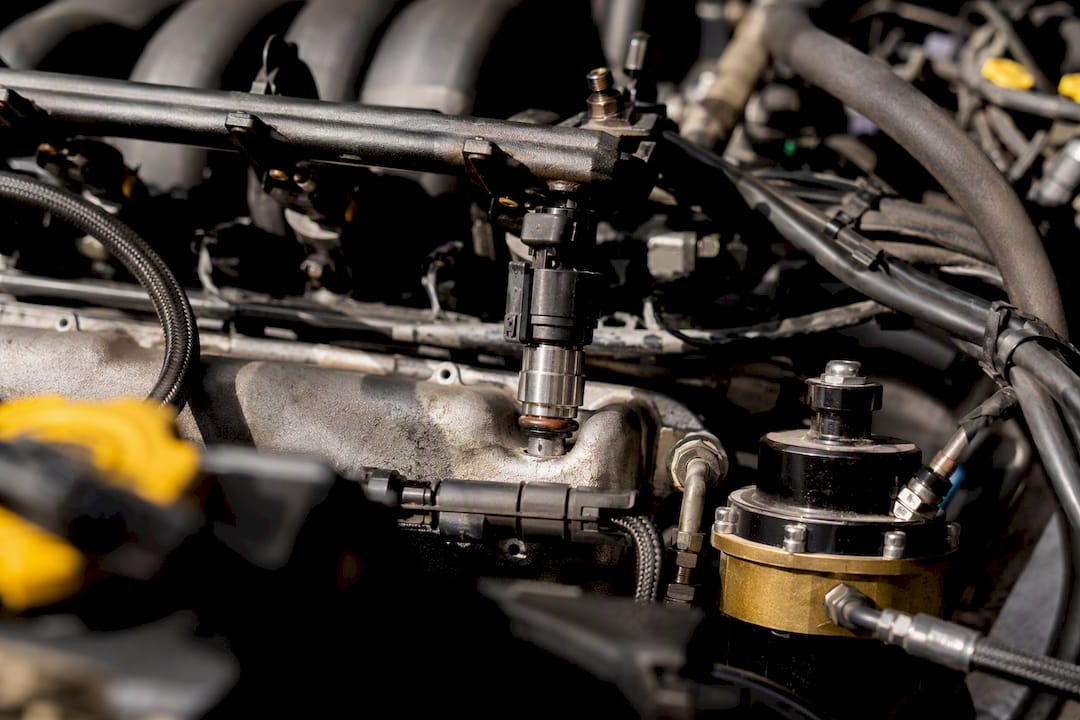
Supporting hardware sometimes makes the method decision for you. If your fuel injectors are already maxed out at stock flow rates, no tune, off-the-shelf or custom, can safely add meaningful power until you upgrade the fuel injectors to handle the additional demand. The same logic applies to fuel pumps, intercoolers, and clutches on manual cars. A tune amplifies whatever your hardware can already support; it doesn’t create headroom that isn’t there.
ECU Tuning Stages and Realistic Horsepower Gains
Tuning stages aren’t a formal industry standard, but they’ve become shorthand everyone in the performance community understands. Here’s what each one actually delivers, and what it costs.
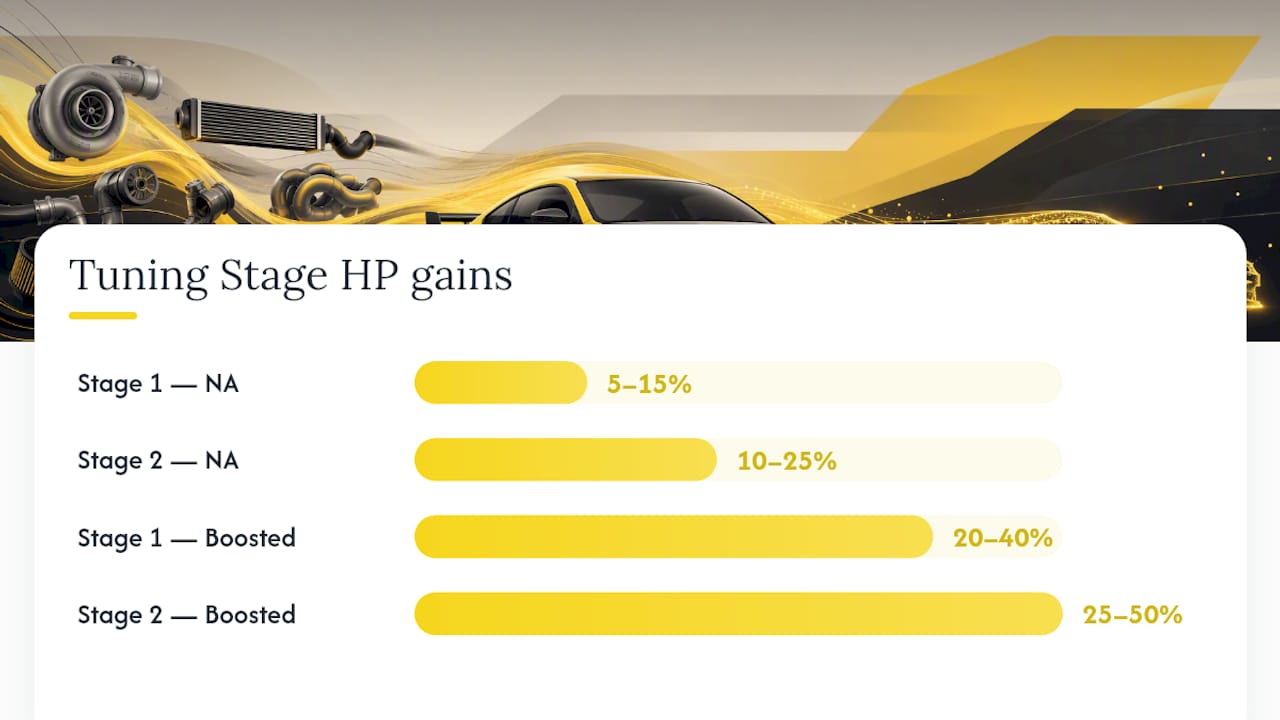
Stage 1 means a tune with no supporting hardware changes beyond basic bolt-ons like an intake or exhaust. This is the safest, cheapest entry point. Naturally aspirated engines typically see gains in the 5 to 15 percent range, while turbocharged and supercharged engines often land between 20 and 40 percent because boosted engines have more untapped headroom in their factory maps. A recent academic review of remapping outcomes backs up that turbo advantage, noting that boosted platforms consistently deliver the best return per dollar spent on tuning alone, without touching hardware.
Stage 2 adds supporting modifications, usually a larger intercooler, upgraded fuel injectors, a bigger turbo inlet, or a stronger clutch, paired with a revised tune that takes advantage of the new parts. Gains here are incremental rather than dramatic, often another 5 to 10 percent on top of Stage 1 numbers, because you’re removing the bottlenecks that capped the first tune’s safe ceiling.
Stage 3 typically means a bigger turbo, upgraded internals, standalone engine management, and a build oriented toward track use rather than daily driving. Gains can be substantial, sometimes doubling factory output on the right platform, but cost and risk both climb steeply. This is where warranty concerns, emissions compliance, and long-term reliability all become serious considerations rather than footnotes.
Here’s what to budget for at each level:
- Off-the-shelf tune files: roughly $200 to $700, depending on the platform and file complexity.
- Dyno-custom tuning: roughly $400 to $1,500 or more, scaling with how many sessions and revisions the build requires.
- Supporting hardware: varies enormously by platform, from a few hundred dollars for an intake and exhaust to several thousand for injectors, an intercooler, and a clutch upgrade.
The jump from Stage 1 to Stage 2 usually costs more in hardware than in tuning fees. The tune itself is often the cheapest line item in the whole build, which is exactly why skipping proper verification to save a couple hundred dollars is a bad trade against an engine that costs thousands to rebuild.
ECU Tuning Risks, Warranty Rules, and Emissions Law
The single most important legal fact in this entire guide: under the Clean Air Act, tampering with emissions controls or installing a defeat device is illegal, and enforcement focuses specifically on parts and software that increase a vehicle’s emissions output. This isn’t a gray area the way some forum threads suggest. It’s federal law, and it applies to street-driven vehicles regardless of whether you personally care about emissions testing in your state.
The EPA’s own enforcement policy lays out what counts as a legitimate defense for selling or installing an aftermarket tune. A manufacturer or tuner needs a “reasonable basis” showing the product doesn’t increase emissions, which typically means one of three things: the part is functionally identical to the stock component, emissions testing demonstrates no adverse effect, or the product carries a CARB Executive Order. Notably, the same policy warns that software tuners themselves, not just physical parts, can be treated as defeat devices if they disable or bypass emissions monitoring.
This isn’t theoretical. In 2024, COBB Tuning settled with the EPA and DOJ over alleged Clean Air Act violations tied to its tuning products.
The settlement required COBB Tuning to stop selling and supporting certain products found to increase emissions, and it barred the company from developing similar unauthorized calibrations going forward unless it could demonstrate compliance, including obtaining a CARB Executive Order for future products.
That’s a well-known, established performance brand facing real civil penalties and operational restrictions, not a fly-by-night shop. If a company that size can get caught in enforcement action, an individual owner running an uncertified tune isn’t invisible either, particularly in states with mandatory emissions testing.
Beyond the legal exposure, tampering has direct consequences on ownership. EPA materials and case law consistently note that tampering can void manufacturer warranty coverage, and insurers can deny claims tied to modified components if a tune contributed to a mechanical failure or accident. Dealerships and service centers increasingly check for tune signatures during warranty claims, and a denied claim on a failed transmission or blown engine can cost far more than any tune’s performance benefit.
Here’s how to keep your build legal without giving up meaningful gains:
- Ask for a CARB Executive Order on any tuning product marketed for street use, especially in states with strict emissions programs.
- Keep a reversible stock backup of your original ECU file so you can restore factory settings before inspections or dealership visits.
- Get periodic emissions testing if your tune touches fueling or catalytic converter monitoring, even where it isn’t legally required, just to confirm you haven’t drifted out of compliance.
- Avoid “delete” tunes that disable EGR, catalytic converters, or evaporative emissions systems. These are the exact features enforcement actions target most aggressively.
DIY ECU Tuning vs Hiring a Professional Tuner
DIY tuning is reasonable when you’re running a modest Stage 1 setup on a mechanically healthy engine with well-documented, widely-supported hardware. Beyond that, the math tilts toward paying a professional.
Here’s the gear you actually need if you’re going the DIY route:
- A reliable OBD-II flasher or handheld tuner compatible with your specific make and model, not a generic universal device.
- A full backup of your factory ECU file before you flash anything, saved somewhere you won’t lose it.
- A wideband oxygen sensor if you’re working with a boosted engine, since factory narrowband sensors don’t give you the resolution needed to catch a dangerously lean condition.
- Datalogging software that records air-fuel ratio, knock activity, timing, and boost pressure in real time during test drives.
- Basic workshop tools for checking fluid levels, inspecting hoses and connections, and accessing the OBD port safely.
Before you flash anything, run through a short mechanical health check. Confirm compression across all cylinders is within spec, verify fuel pressure holds steady under load, inspect the cooling system for leaks or a failing thermostat, and check that ignition components, plugs, coils, wires, aren’t already showing signs of wear. A tune amplifies existing problems as readily as it amplifies power. Feeding more fuel and boost through a marginal ignition system is how you turn a minor issue into a cracked piston.
Certain situations are red flags that should send you straight to a professional dyno tuner instead of attempting DIY:
- Active check-engine codes you haven’t diagnosed and resolved.
- Known mechanical issues, worn timing components, oil consumption, coolant loss, that haven’t been addressed.
- Heavily modified engines running standalone management, forced induction swaps, or aftermarket internals.
Pro Tip: If your car has thrown even one unexplained check-engine light in the last month, fix that before you touch the tune. A tune built on top of an existing fault just makes diagnosing the real problem harder later.
A shop like the ones referenced through Alternative Car Care can handle both the diagnostic work and the tuning session, which matters more than it sounds. Diagnosing a problem and tuning around it are two different skill sets, and a good professional tuner does both.
Preparing for and Verifying an ECU Tune
Before anyone flashes your ECU, back up the original file and resolve any outstanding trouble codes. Skipping this step is the single most common mistake owners make, and it’s the reason so many forum threads end with “I can’t get my stock tune back.”
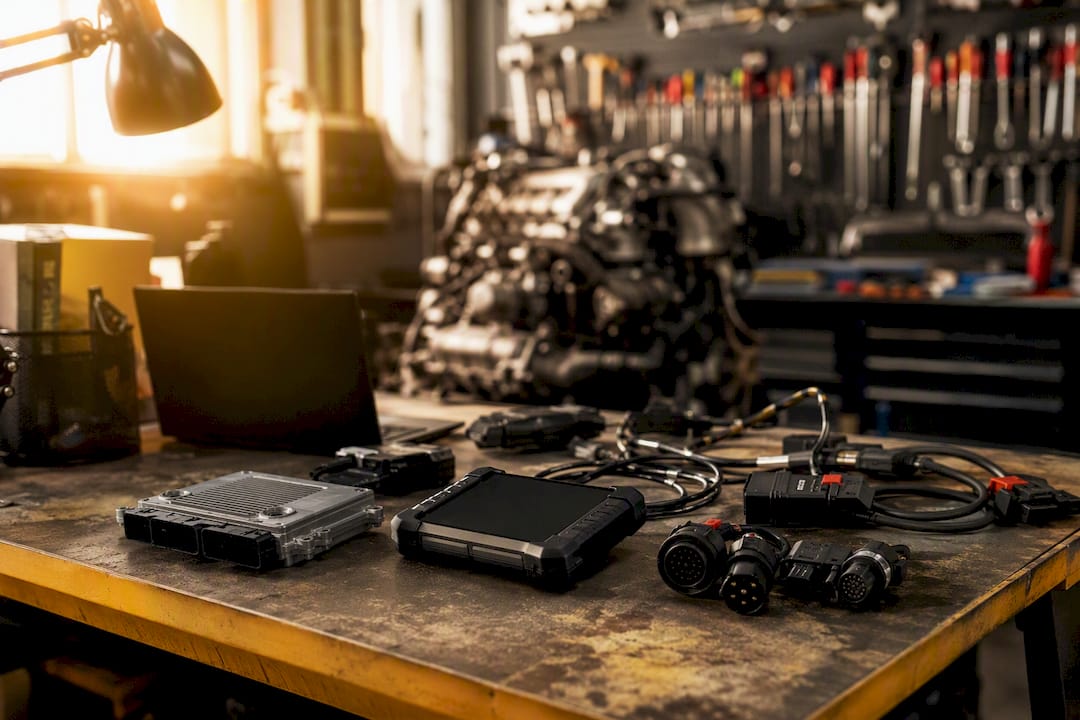
Verification separates a tune that works from one that just feels like it works. A dyno session or a controlled road-load test gives you objective before-and-after numbers instead of butt-dyno guesses. Pair that with datalogs tracking air-fuel ratio, knock activity, and timing advance across the RPM range, and you’ll know within one drive whether the tune is running safely or quietly cooking your pistons.
Here’s a practical breakdown of what to check and how often:
| Check | Frequency |
|---|---|
| Datalog review (AFR, knock, timing) | First 200 miles, then monthly |
| Coolant and oil temperature monitoring | Every drive during break-in period |
| Spark plug inspection | After initial break-in period post-tune |
| Fuel trim and injector duty cycle check | Every 3,000 miles |
Watch coolant temperatures closely during the first few tanks of fuel after a tune, especially if you’ve added boost or leaned out the fuel map. A cooling system that was marginal before a tune can become a real problem afterward, which is worth reviewing against the mechanics of why performance cars overheat before you push the car hard.
Routine maintenance matters more after a tune, not less. Oil changes, spark plug intervals, and fluid checks that were fine on a factory calibration may need to happen more often once the engine is working harder. A performance maintenance checklist built for modified cars accounts for that shift.
Finally, document everything. Keep a record of the tune file version, install date, dyno numbers, and any parts changed alongside it. If you ever need to demonstrate compliance for an inspection or explain a modification during a warranty dispute, that paper trail is the difference between a quick conversation and a denied claim.
FrenzyCars’ Recommended Tuning Workflow
The sequence matters more than any single decision inside it. Skipping a step to save time is how a simple Stage 1 build turns into an expensive lesson.
- Diagnose first. Clear and resolve any existing trouble codes, check compression, and confirm the engine is mechanically sound before touching the ECU.
- Start at Stage 1 if the car is healthy. A conservative remap on bolt-on mods is the highest return-per-dollar move for most street cars, particularly turbocharged platforms.
- Verify with data, not feel. Datalog the first several hundred miles and confirm air-fuel ratios and timing stay in a safe range.
- Upgrade hardware before chasing bigger numbers. Injectors, intercoolers, and fuel pumps need to match your power target before a bigger tune makes sense.
- Move to dyno-custom tuning once your mod list gets specific. Generic files stop being safe or effective past a certain point of modification.
Choosing between an off-the-shelf map and a dyno-custom tune comes down to how far your car has strayed from stock. A bone-stock engine with an intake and exhaust is a reasonable candidate for a proven off-the-shelf file. Anything with a bigger turbo, standalone management, or a unique combination of supporting mods needs a tuner who can build a map around your specific car, not a template built for someone else’s.
For readers who want the mechanical detail behind why maps work the way they do, our full breakdown of engine mapping goes deeper into lookup tables and sensor feedback loops than this guide has room for.
An Enthusiast’s Take on Responsible Tuning
Chasing the biggest number on a dyno sheet is the easiest way to build a car you regret owning. The tuning community that lasts, the people still driving the same car ten years later, treats power as one input among several: reliability, drivability, and the ability to pass an emissions test without sweating it.
Compliance isn’t the boring part of tuning. It’s the part that keeps your car legal, keeps your warranty conversations honest, and keeps you from being the cautionary story in someone else’s forum post. A Stage 1 tune done right, verified with real data, respecting the engine’s actual limits, beats a Stage 3 build that spends more time in the shop than on the road.
Build for the car you’ll still want to drive next year, not just the number you want to post this weekend.
Plan Your Tune With FrenzyCars’ Car Data and Guides
Every tuning decision above depends on knowing your platform’s actual baseline, and that’s where most owners waste time guessing instead of checking. FrenzyCars keeps detailed specs by make and model so you can confirm factory horsepower, torque, and known weak points before you spend a dollar on a tune file. That single step prevents the most common Stage 1 mistake: tuning around a number that was never accurate to begin with.
If you’re still deciding which platform rewards tuning the most, our best cars by category breakdown is a useful starting point for comparing turbocharged options against naturally aspirated ones before you commit to a build direction. Pair that research with our maintenance checklists, and you’ll walk into a tuning shop, or your own garage, with real numbers instead of forum guesses. Start by pulling up your car’s specs and mapping out what Stage 1 should realistically deliver on your specific engine.
Sources
- EPA: Vehicle Aftermarket Defeat Devices and Tampering (Fact Sheet)
- Academic review: ECU remapping techniques, benefits, risks and trends (2025)