
Electric vehicles cost more to insure than gas cars, but the gap has narrowed considerably. Model-year 2024 and newer EVs now carry roughly an 18% premium compared to similar gas vehicles, down from the wider gaps seen just a couple of years ago. The average full-coverage EV policy runs about $3,281 a year, but your actual quote depends heavily on the model you pick and the state you live in.
TL;DR:
- Electric vehicle insurance premiums for model-year 2024 and newer are around 18% higher than gas cars, with full coverage averaging about $3,281 annually.
- Costs vary widely depending on the vehicle’s make and model, with luxury EVs insuring for over $10,000 per year and mainstream models costing under $2,000.
- Battery costs can account for up to 50% of an EV’s total value, significantly increasing repair expenses and claim severity for insurers.
- Shopping for insurance before purchasing an EV, and asking about certified repair networks and coverage details, can significantly lower ownership costs.
- The insurance gap for EVs is closing faster than most realize, so buyers should compare real quotes carefully and consider total ownership expenses beyond just purchase price.
How Much Does EV Insurance Cost? Averages and Ranges to Expect
Full-coverage EV insurance averages around $3,281 per year, or roughly $273 a month, according to MoneyGeek’s 2026 analysis. That’s the number most shoppers should anchor to, but it hides a wide spread. Some EVs insure for under $2,000 a year; others, mostly high-end imports, top $10,000.
State-minimum coverage tells a different story. Because it only covers liability and skips collision or comprehensive, minimum policies run far cheaper, sometimes a third of the full-coverage figure. The catch: state-minimum limits usually won’t cover repair or replacement of a damaged battery pack, which can leave EV owners badly exposed after even a moderate accident.
Where you live moves the number just as much as what you drive. Insurify’s data and other industry roundups show the EV premium gap swings widely by state, with places like Massachusetts and New York showing bigger EV surcharges while some other states show the gap nearly closed.
| Coverage Type | Typical Annual Cost | Typical Monthly Cost |
|---|---|---|
| Full coverage (average EV) | ~$3,281 | ~$273 |
| State-minimum liability only | Roughly $1,000–$1,400 | Roughly $85–$115 |
| Luxury/import EV, full coverage | $6,000–$10,000+ | $500–$850+ |
Your driving record, age, credit-based insurance score (where allowed), and even your ZIP code will shift these numbers up or down before you ever see a real quote.
Why EV Insurance Can Be Higher: Underwriting and Repair Cost Drivers
Insurers price EVs higher mainly because of one part: the battery. The NAIC notes that battery packs can represent up to about 50% of a vehicle’s total value, and replacing one after a collision is nowhere near as simple as swapping an alternator.
A few specific factors compound the cost:
- Battery repair or replacement expense — a damaged pack often can’t be spot-repaired; the whole unit gets swapped, at a cost that can rival a used car’s price tag.
- Proprietary parts and thin repair networks — fewer certified shops know how to safely service high-voltage EV systems, which drives up labor costs and repair wait times.
- ADAS and sensor-heavy repairs — cameras, radar, and lidar packages common on EVs add calibration costs after even minor bumper damage.
- Total-loss tendencies — Reuters has reported cases where insurers wrote off EVs with fairly minor battery scrapes because inspecting a pack for hidden damage is expensive and risky.
Battery packs can account for up to 50% of an EV’s total value — a single factor that shapes nearly every underwriting decision insurers make on these vehicles, according to the NAIC.
NAMIC’s whitepaper adds that insurers also weigh vehicle weight, high-voltage safety risk during roadside response, and longer repair timelines when setting EV rates. All of that feeds into claim severity, and claim severity is what actually moves your premium, more than claim frequency does.
Which EVs Cost the Most and Least to Insure
Model choice swings your premium more than almost anything else you control. MoneyGeek’s 2026 data shows mainstream, mass-market EVs insuring for a fraction of what luxury imports cost.
| Model | Approximate Annual Premium (Full Coverage) |
|---|---|
| Chevrolet Silverado EV | ~$1,947 |
| Tesla Model Y | ~$3,343 |
| Audi SQ8 e-tron | ~$10,402 |
A few patterns explain that spread:
- Mainstream automakers with large, established dealer and repair networks (think Hyundai, Chevrolet, Ford) tend to insure cheaper because parts and certified labor are easier to source.
- Luxury and low-volume import EVs often carry higher premiums due to scarce parts, specialized service requirements, and higher replacement values.
- Trucks and larger EVs sometimes insure surprisingly well if they share parts and repair infrastructure with gas-powered siblings.
These are national averages, not personal quotes. Your actual number depends on your state, driving history, credit-based score where applicable, and the specific trim and safety package on your VIN. Two people in the same Model Y can get quotes hundreds of dollars apart. If you’re still comparing options, our breakdown of company car EV picks is a useful starting point for models that tend to insure reasonably.
How to Lower EV Insurance Costs
You have more control over this number than most people assume. Here’s where to focus, in order of impact:
- Get quotes before you buy, not after. Insurance costs vary so much by model that a quick round of quotes on two or three EVs you’re considering can save you real money before you sign a purchase agreement.
- Ask about EV-specific discounts. Some insurers offer garage-parking discounts, anti-theft device credits, and multi-policy bundling that stack meaningfully.
- Enroll in a telematics program. Progressive notes that usage-based programs can offset some of the higher baseline cost of insuring an EV, especially for lower-mileage drivers.
- Choose your deductible and add-ons deliberately. A higher collision deductible lowers your premium, but make sure you can actually cover a battery-related repair bill out of pocket if you raise it.
- Check the insurer’s certified repair network before you buy the policy, not after a claim.
Pro Tip: Ask your insurer directly whether they have certified EV repair shops in your area before you commit to a policy. An insurer with no local high-voltage-certified shop can mean weeks of delay and a rental car bill that outlasts your patience.
How to Shop and Compare EV Insurance Quotes
Comparing EV insurance quotes only works if you’re comparing apples to apples. Two policies with similar-looking premiums can offer very different protection once you dig into the fine print.
Before you request quotes, check that each one includes:
- The same liability limits and collision/comprehensive deductibles across every quote you pull.
- Whether the policy includes an EV-specific battery endorsement or treats the pack like any other mechanical part.
- The insurer’s access to a certified EV repair network in your area, not just a national claim.
- Whether OEM parts are covered or the policy defaults to aftermarket equivalents after a claim.
Have your VIN, trim level, and annual mileage estimate ready before you call. It speeds up the quote and avoids the classic problem of getting a quote for the wrong battery size or drivetrain configuration. And when quotes come back close in price, weight claims-handling reputation over the cheapest number. A $30-a-month savings isn’t worth much if the insurer takes six weeks to process a battery claim.
Impact of Driving Behavior and Mileage on EV Insurance Rates
How you drive matters just as much for an EV as it does for a gas car, arguably more, given how much insurers now lean on telematics data to price EV policies. Hard braking, rapid acceleration, and high nightly mileage all push your risk profile up, and EVs make that data easier to collect since so many models come with built-in connectivity.
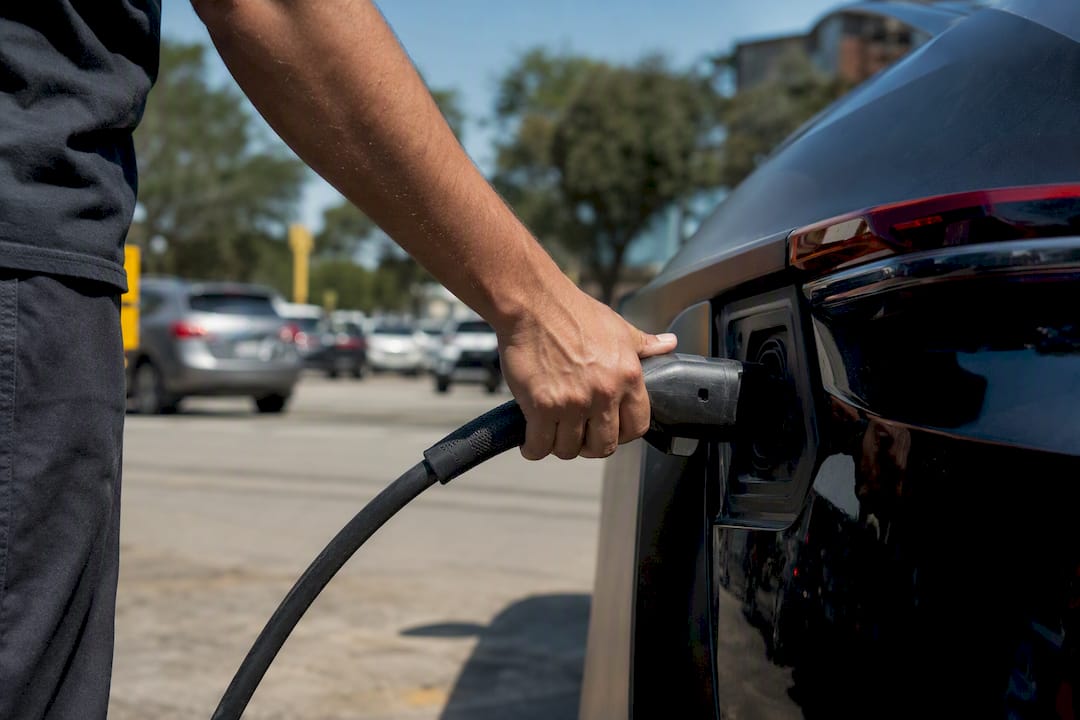
Annual mileage plays a bigger role than most drivers expect. A commuter racking up 20,000 miles a year statistically faces more exposure to collisions than someone driving 6,000. Since EVs are popular for daily commuting and rideshare work, insurers increasingly ask about mileage upfront or price policies with usage-based tiers.
Telematics programs cut both ways here. Because Progressive and other carriers report that some EV models actually generate fewer claims per mile, a driver who can prove smooth, lower-mileage habits through a telematics app often qualifies for meaningful discounts that partially offset the EV repair-cost premium. If you’re a low-mileage driver or work from home most days, this is one of the easiest wins available. Skipping the telematics enrollment because you’re worried about being tracked usually costs you money if your habits are already reasonably safe.
Comparison of EV Insurance Rates Versus Hybrid Vehicles
Hybrids generally insure closer to gas vehicles than EVs do, and the reason comes back to the same battery-and-repair logic. Hybrid battery packs are smaller, cheaper to replace, and the rest of the drivetrain shares far more parts with conventional gas models, so repair networks are already built out.
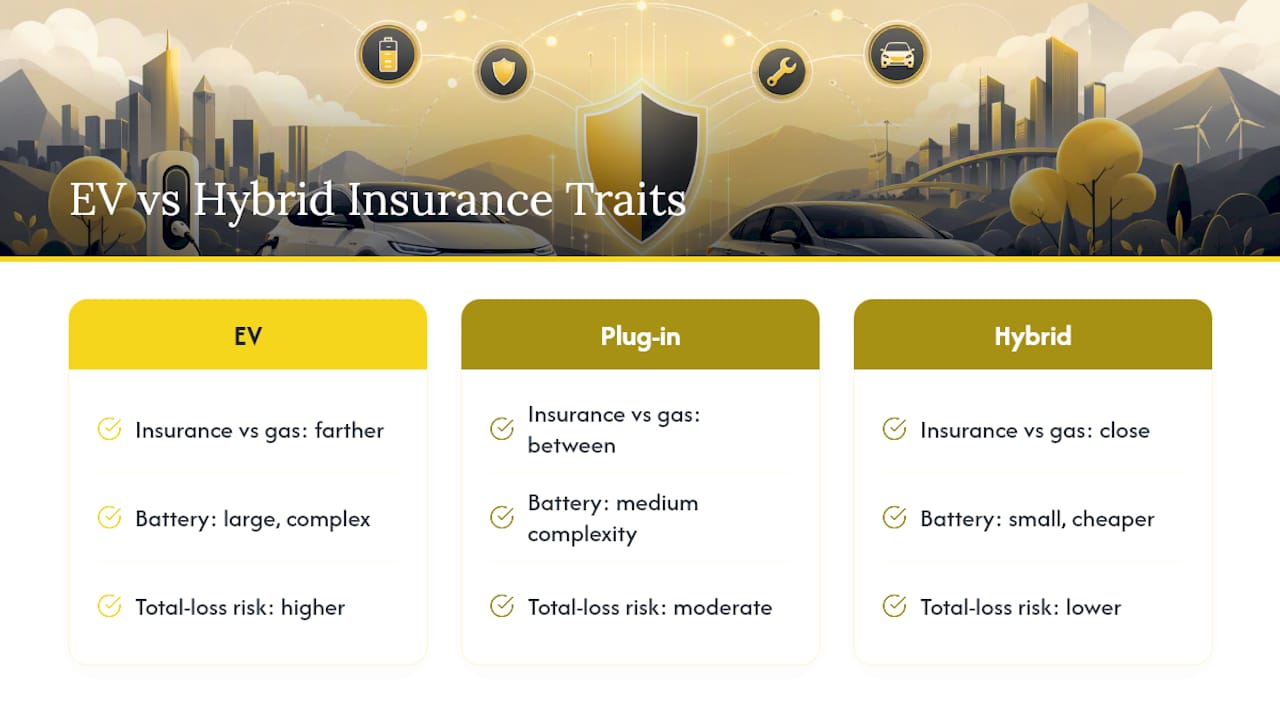
That said, the gap between hybrid and EV insurance costs is shrinking for the same reason the EV-to-gas gap is shrinking: newer EV models are seeing better claims data and wider repair-network coverage than the early EVs that set the industry’s original risk assumptions. A 2026 Tesla Model Y insures much closer to a comparable hybrid crossover than a 2020 EV would have a few years ago.
Plug-in hybrids sit in between. They carry a battery large enough to add some repair complexity but usually not large enough to trigger the total-loss risk that pure EVs face after battery damage. If you’re deciding between a hybrid and a full EV and insurance cost is a deciding factor, our hybrid vs. electric comparison guide walks through the total ownership math, not just the sticker price, which is where the real cost difference usually shows up.
Influence of Insurance Company Policies on EV Coverage and Rates
Not every insurer treats EVs the same way, and that inconsistency is one of the biggest reasons shopping around actually pays off. Some carriers have invested heavily in EV-specific underwriting models, certified repair partnerships, and battery-specific endorsements. Others still price EVs using adjusted versions of their standard gas-vehicle formulas, which can work for or against you depending on the model.
NAMIC’s analysis points out that carriers are actively rethinking claims processes for EVs, factoring in things like high-voltage safety protocols for first responders and tow operators, and longer parts-fulfillment windows. Insurers further along that learning curve tend to price more accurately, which sometimes means lower premiums for well-understood models and sharper increases for newer or less common ones.
This is also where discount structures differ most. One insurer might offer a meaningful bundling discount for EV owners who also insure their home; another might not have an EV-specific discount at all. Reading the policy fine print on battery coverage, rental car allowances during long EV repairs, and OEM-parts guarantees matters more here than with a standard gas vehicle policy, since the gaps between carriers are wider.
How EV Safety Ratings and Repair Costs Influence Premiums
Safety ratings cut premiums, but repair costs can cancel that benefit out entirely for some EVs. A model that performs well in crash testing but requires expensive sensor recalibration or battery inspection after even a minor fender bender can still price out higher than a slightly less safe vehicle that’s cheap to fix.
This is the tension that makes EV pricing harder to predict than gas-vehicle pricing. Insurers weigh both sides: a strong safety rating lowers the odds of a severe injury claim, but the ADAS hardware behind that safety rating (cameras, radar units, sensor arrays) adds real dollars to every repair bill. A busted bumper on a heavily sensor-equipped EV can cost multiples of what the same damage costs on a base-trim gas sedan, because a body shop can’t just pop the bumper back on. It has to recalibrate the whole sensor suite.
That’s part of why the NAIC flags repair cost, not just crash safety, as a primary underwriting input for EVs. If you’re weighing two similarly safe EV models, ask a dealer or the manufacturer how sensor recalibration is typically billed after a minor collision. It’s a detail that rarely comes up in sales conversations but shows up fast on your insurance bill.
How Frenzycars Analyzes EV Insurance Rates
Frenzycars covers EV ownership costs the same way we cover performance and reliability: by pulling from primary sources like the NAIC, NAMIC, MoneyGeek, and Insurify rather than repeating secondhand claims. Our model-level insurance context sits alongside our electric vehicle reviews and car specs database, so readers can check a model’s insurance profile in the same place they’re already researching range, price, and reliability.
Ramón, who covers insurance and ownership costs for Frenzycars, built this piece around the same core question every EV shopper eventually asks: is the sticker price the real price? Insurance is one of the ownership costs buyers underestimate most often, and it deserves the same scrutiny as financing terms or charging costs.
Our Take: The EV Insurance Gap Is Closing Faster Than Most Buyers Realize
Most of what gets repeated about EV insurance is outdated by a year or two, and that lag matters. The 18% gap for 2024 and newer models is a very different number than the 30%-plus penalties quoted in older articles still ranking on Google, and treating those old figures as current is doing readers a disservice.
The bigger miss, though, is buyers who shop for an EV on range and price alone and treat insurance as an afterthought to sort out after the purchase. That’s backward. A $10,000-a-year premium on a luxury import EV isn’t a rounding error. It’s a bigger annual cost than many people’s car payment, and it’s entirely knowable before you sign anything.
What actually works isn’t some clever hack. It’s boring diligence: pull real quotes on the specific trim you want, ask pointed questions about battery endorsements and certified repair access, and weigh mainstream models with strong repair networks against flashier options with thinner support. The buyers who do this before purchase consistently end up with lower total ownership costs than the ones who discover their insurance bill after driving off the lot.
Sources
- Insurify — Electric Vehicle insurance costs report (2026)
- NAIC — Electric Vehicle Insurance Rates
- MoneyGeek — Insuring an Electric Vehicle: Costs and Coverage in 2026
- NAMIC — Insuring the future: electric vehicles (whitepaper)