
TL;DR:
- The best used cars under $20,000 include the Honda Civic and Toyota RAV4 for their proven reliability and safety. Buyers should prioritize vehicle history reports and independent inspections to ensure quality, while keeping reserves for first-year repairs. Realistic median prices and careful assessment help find models with low ownership costs and dependable performance.
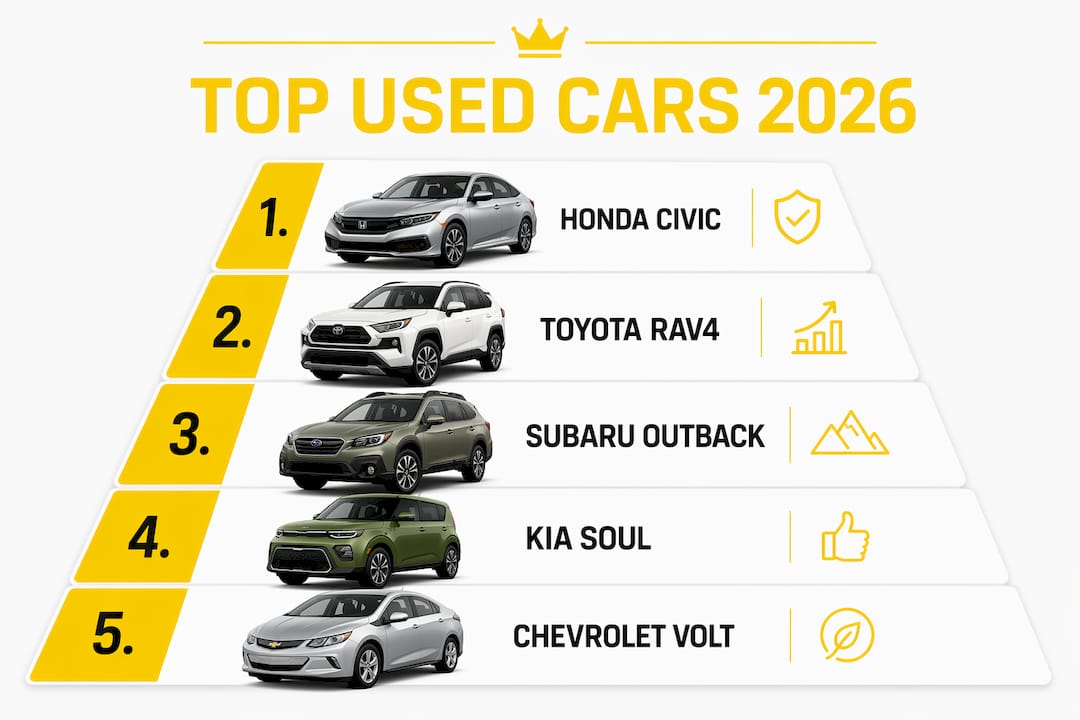
The best used cars right now are the Honda Civic, Toyota RAV4, Mazda3, Hyundai Elantra, Subaru Outback, Ford F-150, Chevrolet Volt, and Lexus ES 350. Each one earns its spot through a combination of multi-year reliability data, IIHS/NHTSA safety performance, and realistic median listed prices that typically stay within a reasonable budget. This shortlist is built by Frenzycars using the same criteria the top consumer sources use: owner-survey reliability, safety ratings, and median market prices from active listings.
TL;DR — top picks at a glance:
- Honda Civic (2020–2022): Best for commuting and long-term reliability
- Toyota RAV4 (2018/2019): Best for small families and compact SUV buyers
- Mazda3 (used): Best for drivers who want handling and a quality interior
- Hyundai Elantra (used): Best budget buy with the most feature content per dollar
- Subaru Outback (used): Best for all-weather driving and cargo utility
- Ford F-150 (used): Best for towing, hauling, and truck buyers
- Chevrolet Volt (used/PHEV): Best for short-commute drivers who want near-EV fuel costs
- Lexus ES 350 (2016–2017): Best near-luxury pick for low-stress long-term ownership
- Kia Soul (2018): Best urban compact for cargo versatility
- Subaru Impreza (used): Best affordable AWD in a compact footprint
How the best used cars under $20k compare side by side
| Model | Best For | Target Years | Price Expectation | Reliability Notes | Safety | Powertrain / MPG | Ownership Cost Notes |
|---|---|---|---|---|---|---|---|
| Honda Civic | Commute / reliability | 2020–2022 | $18,500–$20,000 | Excellent; avoid CVT issues in pre-2019 | IIHS Top Safety Pick | 1.5T / ~32 mpg | Low maintenance; affordable parts |
| Toyota RAV4 | Small family / SUV | 2018–2019 | $18,000–$20,000 | Strong; check for oil dilution on 2019 | IIHS Top Safety Pick+ | 2.5L engine / good fuel economy | Higher insurance; dealer parts widely available |
| Mazda3 | Handling / style | 2016–2019 | $14,000–$18,000 | Very good; minor infotainment quirks | IIHS Top Safety Pick | 2.0L–2.5L / ~30 mpg | Low cost; premium feel without premium bills |
| Hyundai Elantra | Budget / feature value | 2019–2021 | $13,000–$17,000 | Good; watch for DCT hesitation | IIHS Top Safety Pick | 2.0L / ~32 mpg | Very low purchase price; reasonable insurance |
| Subaru Outback | AWD / cargo | 2015–2018 | $10,000–$14,000 | Good; head gaskets on 2015–2016 | IIHS Top Safety Pick | 2.5L AWD / ~26 mpg | Higher maintenance than Japanese rivals |
| Ford F-150 | Towing / hauling | 2015–2017 | $16,000–$20,000 | Good; EcoBoost spark plugs, cam phasers | NHTSA 4–5 stars | 2.7–5.0L / 17–23 mpg | Higher fuel and insurance costs |
| Chevrolet Volt | Short commute / PHEV | 2016–2018 | $12,000–$17,000 | Very good; battery health is key | NHTSA 5 stars | PHEV / ~42 mpg combined | Low fuel cost; battery check required |
| Lexus ES 350 | Near-luxury / comfort | 2016–2017 | $17,000–$20,000 | Excellent; minimal known issues | IIHS Top Safety Pick | 3.5L V6 / ~24 mpg | Higher insurance; low repair frequency |
| Kia Soul | Urban / cargo | 2018 | $12,000–$16,000 | Good; watch for engine recalls | IIHS Top Safety Pick | 2.0L engine / good fuel economy | Low cost; parts widely available |
| Subaru Impreza | AWD compact | 2017–2020 | $13,000–$17,000 | Good; same head-gasket caution pre-2017 | IIHS Top Safety Pick+ | 2.0L AWD / ~28 mpg | Affordable entry to AWD |
Price reality check: Median listed prices shift by region, mileage, and trim. A 2019 RAV4 with 60,000 miles in the Southeast may list at $18,500; the same car in California often runs $1,500–$2,000 higher. Median market prices from active listings are the only honest anchor. Always filter by your ZIP code before assuming a model fits your budget.
Quick pros/cons:
- Honda Civic: Pros: fuel economy, reliability, resale. Cons: tight rear seat, base trims feel plain.
- Toyota RAV4: Pros: cargo room, reliability, dealer network. Cons: pricier to insure, 2019 oil dilution concern.
- Mazda3: Pros: driving dynamics, interior quality. Cons: smaller trunk, older infotainment in pre-2019 models.
- Hyundai Elantra: Pros: price, features, warranty coverage on newer examples. Cons: DCT hesitation on some trims.
- Subaru Outback: Pros: AWD standard, cargo versatility. Cons: head-gasket risk on 2015–2016, lower fuel economy.
- Ford F-150: Pros: capability, parts availability. Cons: fuel costs, cam-phaser issues on EcoBoost engines.
- Chevrolet Volt: Pros: near-zero fuel cost for short commutes, reliable powertrain. Cons: battery health uncertainty, limited rear headroom.
- Lexus ES 350: Pros: refinement, reliability, comfort. Cons: older safety tech on 2016 base trims, higher insurance.
Detailed profiles: what to look for in each model
Honda Civic (2020–2022)
The 2020–2022 Civic is the safest bet on this list for buyers who want modern safety tech, low running costs, and a car that will still feel current in five years. Honda Sensing (automatic emergency braking, lane keeping, adaptive cruise) is standard across all trims from 2020 onward. Target the Sport or EX trim for the 1.5-liter turbocharged engine; the base LX’s naturally aspirated 2.0-liter is adequate but noticeably slower on the highway. Watch for oil dilution reports on the 1.5T in colder climates, a known issue Honda addressed in later production runs. Mileage sweet spot: 30,000–55,000 miles.
- Pros: Standard Honda Sensing, strong resale, low maintenance costs
- Cons: Tight rear legroom, 1.5T oil dilution in cold climates
- Red flag: Any Civic with a salvage or rebuilt title; check the risks of rebuilt-title cars before you consider one
Toyota RAV4 (2018/2019)
The 2018–2019 RAV4 sits right at the $20k ceiling and delivers the most cargo room and dealer-network support of any pick on this list. Toyota Safety Sense P (pre-collision system, lane departure alert, automatic high beams) is standard on 2018 XLE and above. The 2019 model brought a refreshed interior and updated powertrain, but also introduced an oil dilution issue on the 2.5-liter four-cylinder in cold weather. Ask the seller for oil-change records; frequent short-trip driving in winter climates amplifies the risk. Mileage sweet spot: 35,000–65,000 miles.
- Pros: Proven reliability, strong resale, wide dealer support
- Cons: Oil dilution on 2019 in cold climates, higher insurance than sedans
- Red flag: Missing service records on a 2019 in a northern state
Mazda3 (2016–2019)
Few cars at this price point feel as well-built inside as the Mazda3. The 2016–2019 generation uses Mazda’s SkyActiv platform, which combines a light chassis with a naturally aspirated 2.0- or 2.5-liter engine for genuinely engaging handling. Consumer Reports consistently rates this generation above average for reliability. The infotainment system in pre-2019 models lacks Apple CarPlay, which matters to some buyers. Mileage sweet spot: 30,000–60,000 miles.
- Pros: Driving dynamics, interior quality, reliability
- Cons: No CarPlay on pre-2019, smaller trunk than Civic
- Red flag: Rust on underbody in rust-belt states; inspect carefully
Hyundai Elantra (2019–2021) and Hyundai Sonata (2015)
The 2019–2021 Elantra is the best pure value pick on this list. You get forward collision avoidance, lane keeping, and a 6-speed automatic (avoid the optional DCT, which has a hesitation issue at low speeds) for well under $17,000 in most markets. The 2015 Hyundai Sonata is a different proposition: a mid-size sedan with a comfortable ride and more rear-seat space, typically available for $10,000–$13,000. The Sonata’s 2.4-liter four-cylinder is reliable, though the 2015 model predates standard automatic emergency braking.
- Elantra pros: Low price, standard safety tech, good fuel economy
- Elantra cons: DCT hesitation on some trims, less refined than Mazda3
- Sonata pros: Mid-size space, smooth ride, very low price
- Sonata cons: Older safety tech, higher mileage at this price point
Subaru Outback (2015–2018) and Subaru Impreza (used)
The Outback’s standard AWD and wagon-like cargo floor make it the most practical all-weather pick under $20k. The 2015–2016 models have a documented head-gasket concern on the 2.5-liter four-cylinder; 2017 and later resolved this. The Impreza shares the same AWD system in a smaller, more affordable package, typically $3,000–$5,000 less than a comparable Outback. Both earn IIHS Top Safety Pick ratings across most model years in this range.
- Outback pros: AWD standard, cargo versatility, good safety ratings
- Outback cons: Head-gasket risk on 2015–2016, lower MPG than FWD rivals
- Impreza pros: Affordable AWD entry, compact footprint
- Impreza cons: Less cargo room, base interior
Ford F-150 (2015–2017)
A used F-150 under $20k is almost always a higher-mileage example (70,000–100,000 miles), but the F-150’s parts availability and repair ecosystem make that less scary than it sounds. The 2.7-liter EcoBoost is the sweet spot for fuel economy and towing balance, but cam-phaser wear and spark-plug replacement costs are real considerations. The 5.0-liter V8 is simpler mechanically and worth the fuel penalty for buyers who tow regularly. Always pull a vehicle history report before buying any used truck; fleet and rental use are common.
- Pros: Towing capacity, parts availability, strong used-market supply
- Cons: Fuel costs, cam-phaser issues on EcoBoost, higher insurance
- Red flag: Any F-150 with frame rust or a commercial-fleet history
Chevrolet Volt (2016–2018) and Chevrolet Impala (2015)
The Volt’s PHEV powertrain delivers roughly 53 miles of electric range on a full charge (2016–2018 second-generation), making it a near-zero-fuel-cost commuter for anyone who drives less than 50 miles daily. The gas engine kicks in seamlessly for longer trips. AAA recommends a specialist inspection for used EVs and PHEVs, treating battery state-of-health as a decision-level input. Request a battery health report before committing. The 2015 Impala is a completely different animal: a large, comfortable sedan with a roomy rear seat and smooth highway ride, typically available for $10,000–$14,000.
Pro Tip: For any used PHEV or EV, ask the seller to provide a battery health report from a GM dealer or qualified EV shop. A degraded Volt battery pack can reduce electric range significantly, changing the ownership-cost math entirely.
- Volt pros: Near-zero fuel cost for short commutes, reliable powertrain
- Volt cons: Limited rear headroom, battery health uncertainty
- Impala pros: Big-sedan comfort, low price, smooth ride
- Impala cons: Older safety tech, lower fuel economy
Honda Odyssey (2015) and Honda Fit (2015)
The 2015 Odyssey is the only minivan on this list, and it earns its spot purely on practicality. Eight-passenger seating, Honda’s Magic Slide second-row seats, and a proven 3.5-liter V6 make it the best family hauler under $20k by a wide margin. Expect 80,000–110,000 miles at this price point; the Odyssey handles high mileage well. The 2015 Honda Fit is the opposite end of the spectrum: a subcompact with a Magic Seat rear configuration that folds flat, creating cargo flexibility that embarrasses many larger cars. Both are reliable, low-cost platforms.
- Odyssey pros: Eight-passenger capacity, proven V6, family features
- Odyssey cons: Higher mileage at this price, older safety tech
- Fit pros: Exceptional cargo flexibility, low running costs, easy to park
- Fit cons: Small engine, highway noise
Kia Soul (2018)
The 2018 Soul is the most distinctive-looking car on this list, and its boxy shape actually works in its favor: the flat roofline and upright seating create more headroom and cargo volume than the exterior dimensions suggest. The 2.0-liter four-cylinder is reliable, though Kia issued engine-related recalls on some 2018 Soul units. Check the NHTSA recall database by VIN before purchase. Typically available for $12,000–$16,000 with reasonable mileage.
- Pros: Practical interior volume, distinctive styling, low price
- Cons: Engine recall history on some units, less refined than Honda/Mazda
- Red flag: Any Soul without a clean recall-completion record
BMW i3 (2015)
The 2015 BMW i3 is the most unconventional pick here, and it suits a specific buyer: someone who drives primarily in the city, wants a premium feel, and understands that the i3’s original EPA-rated range of roughly 81 miles (base battery) means it is not a road-trip car. At $10,000–$14,000, the i3 offers a genuinely premium interior and a unique carbon-fiber-reinforced body. Battery degradation is the central concern. AAA’s EV guidance is explicit: have a qualified EV professional assess battery state-of-health before you buy any used EV, and treat that assessment as a go/no-go input, not a negotiation footnote.
- Pros: Premium interior, unique architecture, low city running costs
- Cons: Limited range, battery degradation risk, quirky rear-hinged doors
- Red flag: Any i3 with no documented battery health check
Mazda6 (2016) and Scion FR-S (2015)
The 2016 Mazda6 is the best mid-size sedan value on this list. It depreciates faster than a Camry or Accord, which means you get a newer, better-equipped car for less money. The 2.5-liter four-cylinder is smooth and returns around 32 mpg combined on the highway. The Scion FR-S (2015) is for a completely different buyer: a lightweight, rear-wheel-drive sports coupe with a 2.0-liter boxer engine and a chassis tuned for driver engagement. It is not practical, not spacious, and not particularly fast. It is, however, one of the most honest driving experiences available under $20k.
- Mazda6 pros: Mid-size space, upscale dynamics, strong value
- Mazda6 cons: Faster depreciation means more mileage at this price
- FR-S pros: Pure driving feel, simple mechanics, low weight
- FR-S cons: Cramped rear seat, not practical for daily cargo needs
Infiniti QX50 (2015) and Lexus ES 350 (2016–2017)
The 2015 Infiniti QX50 brings near-luxury features (leather, Bose audio, around-view monitor) at a price point that would buy a base compact SUV new. The QX50 uses a longitudinally mounted 3.7-liter V6, which is smooth but thirsty. The 2016–2017 Lexus ES 350 is the most refined car on this entire list. Toyota’s reliability record combined with Lexus’s interior quality makes this the lowest-stress ownership proposition here. Both earn their spots for buyers who want comfort and refinement without a luxury-brand repair bill.
- QX50 pros: Luxury features, V6 power, distinctive styling
- QX50 cons: Fuel economy, older safety tech
- ES 350 pros: Exceptional reliability, refined ride, low repair frequency
- ES 350 cons: Higher insurance, older safety features on base 2016 trim
How we chose these cars
The shortlist reflects five criteria applied in order: realistic price (median listed price under $20,000 in current U.S. market listings), multi-year reliability (owner-survey data from Consumer Reports and J.D. Power), safety performance (IIHS Top Safety Pick or NHTSA 4–5 stars), total ownership cost (fuel, insurance, and maintenance estimates), and nationwide availability.
- Price check: Every model was verified against current median listed prices. A model that looks good on paper but consistently lists above $20,000 in real listings was excluded or flagged.
- Reliability: Consumer Reports’ selection draws on years of test data and hundreds of thousands of owner-survey responses. Single-year reliability blips were discounted; multi-year trends drove the picks.
- Safety: IIHS Top Safety Pick status and NHTSA overall ratings were checked for the specific model years recommended. How to evaluate car safety ratings is covered in depth separately.
- Ownership cost: Fuel economy, typical insurance tiers, and common repair costs were factored in. A cheap purchase price that leads to expensive ownership was penalized.
- Availability: Models with thin used-market supply in most U.S. regions were deprioritized regardless of other scores.
“A vehicle history report is not a substitute for an independent vehicle inspection. A mechanical inspection is a good idea even if the car has been ‘certified’ and inspected by the dealer.” — Federal Trade Commission, consumer guidance on buying used vehicles
U.S. News structures its under-$20k shortlist around a synthesized overall score that lets buyers compare across body styles without manually weighting every metric. This shortlist uses the same logic: reliability, safety, and price are weighted together, not ranked separately.
Pre-purchase checklist: what to do before you sign
Start with two non-negotiables: pull a vehicle history report (Carfax or AutoCheck) and schedule an independent mechanical inspection before you hand over any money. The FTC is explicit that a history report does not replace a mechanic’s inspection, and that the mechanic’s written cost estimates are your best negotiation tool.
Pro Tip: Consumer Reports recommends scheduling your inspection so the seller has NOT driven the car immediately beforehand. Cold fluid and temperature symptoms that reveal leaks or overheating tendencies get masked when the engine is already warm.
- Pull the VIN history report. Check for odometer rollbacks, title brands (salvage, rebuilt, flood), and accident history. A clean report is necessary but not sufficient.
- Book an independent mechanic. Budget $100–$150 for a pre-purchase inspection. Ask for a written report with itemized repair cost estimates. Use those figures to negotiate.
- Exterior check. Look for mismatched paint, uneven panel gaps, and fresh undercoating that could hide rust. Edmunds flags cracked glass and uneven tire wear as immediate red flags.
- Interior check. Musty smells, damp carpets, rust on seat-rail bolts, and condensation inside headlights are AAA’s primary flood-damage indicators. Walk away from any car showing two or more of these signs.
- Under the hood. Check fluid colors and levels. Milky oil suggests coolant contamination (head-gasket concern, especially on Subarus). Brown coolant suggests deferred maintenance.
- Warning lights. Every warning light should be off. Check-engine, ABS, and SRS lights that are on or that illuminate and then go dark during startup are red flags per AAA.
- Test drive. Use the used car test drive checklist for a structured evaluation. Listen for brake noise, transmission hesitation, and any pull under braking.
- EV/PHEV battery check. For the Volt, BMW i3, or any used EV, request a battery state-of-health report from a qualified EV shop. AAA advises treating battery health as a go/no-go decision input, not an afterthought.
Title red flags to know:
- Salvage title: The car was declared a total loss. Repair quality varies enormously; financing is often unavailable.
- Rebuilt/reconstructed title: A salvage car that was repaired and re-inspected. Resale value is permanently reduced.
- Flood/water damage brand: Electrical systems in flood-damaged cars fail unpredictably, often years later.
What $20,000 buys today: prices, ownership costs, and the $3,000 rule
| Model | Typical Price Range | Est. Annual Fuel Cost | Est. Annual Insurance | First-Year Maintenance Budget |
|---|---|---|---|---|
| Honda Civic (2020–2022) | $18,500–$20,000 | — | — | — |
| Toyota RAV4 (2018/2019) | $18,000–$20,000 | — | — | — |
| Mazda3 (2016–2019) | $14,000–$18,000 | — | — | — |
| Hyundai Elantra (2019–2021) | $13,000–$17,000 | — | — | — |
| Subaru Outback (2015–2018) | $10,000–$14,000 | — | — | — |
| Ford F-150 (2015–2017) | $16,000–$20,000 | — | $1,400–$2,000 | $600–$1,200 |
| Chevrolet Volt (2016–2018) | $12,000–$17,000 | $600–$900 | — | — |
| Lexus ES 350 (2016–2017) | $17,000–$20,000 | $2,000 | $1,500–$2,100 | — |

Fuel cost estimates assume 12,000 miles annually at $3.40/gallon. Insurance estimates are national averages and vary significantly by driver profile and state.
The $3,000 rule, explained honestly: The “$3,000 rule” circulates in personal finance communities with multiple meanings. It is not a single standardized rule and should not be treated as a universal readiness threshold. The most practical interpretation for a sub-$20k used-car purchase: keep $3,000 in reserve after your purchase for first-year repairs, not as a down payment target or a budget ceiling. A car that costs $18,000 and leaves you with zero cash reserve is a worse financial position than a $15,000 car with $3,000 sitting in savings.
Timeline to expect:
- Search phase: 2–4 weeks to find a well-priced unit with clean history
- Inspection and negotiation: 3–7 days from first contact to signed paperwork
- First 60 days: Budget for registration, first oil change, and any deferred maintenance the mechanic flagged
- First year: The most common repair surprises surface in months 2–6, not at purchase
Where to shop and how to negotiate
Where to look:
- Private party (Facebook Marketplace, Craigslist): Lowest prices, no dealer fees, but zero consumer protection. Always inspect independently and never skip the history report.
- Franchised dealers: Higher prices, but CPO programs add value for buyers who want warranty coverage. Understand what certified used cars actually cost before deciding if the premium is worth it.
- Independent used-car dealers: Mid-range pricing, variable quality. Check Google reviews and BBB ratings before visiting.
- Online marketplaces (CarMax, Carvana, AutoTrader): Convenient, transparent pricing, but typically above private-party prices. CarMax’s no-haggle model suits buyers who dislike negotiation.
Negotiation checklist:
- Start with the mechanic’s written repair estimate. Present it as a factual cost, not a complaint.
- Reference median listed prices for the same model, year, and mileage in your region.
- Ask for dealer fees to be itemized. Destination, documentation, and “market adjustment” fees are negotiable or removable.
- Decline add-ons at signing (gap insurance, VIN etching, paint protection). Buy gap insurance from your own insurer at a fraction of the dealer price.
Financing tips:
- Get pre-approved by your bank or credit union before visiting any dealer. Credit unions typically offer lower rates on used-car loans than dealer financing.
- For buyers with credit scores below 650, a secured loan or a co-signer often beats dealer subprime financing on total interest paid.
- Avoid extending the loan term beyond 48 months on a used car under $20k. A 72-month loan on a $16,000 car means you may owe more than the car is worth within 18 months.
- Compare the total cost of the loan, not just the monthly payment. A $50/month difference over 60 months is $3,000.
Key Takeaways
The Honda Civic (2020–2022) and Toyota RAV4 (2018/2019) are the strongest all-around picks under $20,000 for most U.S. buyers, combining proven multi-year reliability, modern safety tech, and realistic median listed prices.
| Point | Details |
|---|---|
| Top reliability picks | Honda Civic (2020–2022) and Toyota RAV4 (2018/2019) lead on multi-year owner-survey reliability and safety ratings. |
| Budget the full picture | Keep $3,000 in reserve after purchase for first-year repairs; purchase price alone does not equal affordability. |
| Inspect before you buy | Get a written mechanic report with repair cost estimates and use those figures to negotiate the price down. |
| EV/PHEV battery check | For the Chevrolet Volt or BMW i3, request a battery state-of-health report; degradation directly affects ownership cost. |
| Frenzycars resources | Use Frenzycars for model specs, safety rating guides, and test-drive checklists to research your shortlist before you shop. |
Why reliability and price together matter more than either alone
The conventional wisdom in used-car buying is to chase the lowest price. That instinct makes sense until you factor in what happens after you drive off the lot. A $12,000 car that needs $4,000 in repairs in year one is not a bargain; it is a $16,000 car with worse reliability than the $16,000 car you passed on.
The picks on this list are weighted toward models where the ownership cost curve is predictable. The Honda Civic and Mazda3 are not here because they are cheap to buy; they are here because they are cheap to own. The Lexus ES 350 earns its spot despite a higher purchase price because its repair frequency is genuinely low, and the Toyota reliability record behind it is not marketing copy.
One thing buyers consistently underestimate: the difference between a model’s reputation and a specific car’s history. A Honda Civic is a reliable platform. A specific 2020 Civic with three prior owners, a salvage title, and 95,000 miles is not automatically reliable just because the nameplate is. The inspection and history-report steps in this guide exist precisely because platform reputation and individual car condition are two different things. The best used-car purchase is the one where you verified both.
Frenzycars helps you research smarter before you buy
Shopping for a used car under $20,000 means comparing dozens of model-year combinations across reliability, safety, and price simultaneously. Frenzycars cuts that research time significantly. The car specs by make and model database lets you pull trim-level details, powertrain specs, and feature breakdowns for every model on this shortlist, so you know exactly what you are looking at before you visit a seller. The safety rating guides and test-drive checklists give you the framework to evaluate any car you find, not just the ones on this list. Whether you are narrowing between a 2019 RAV4 and a 2020 Civic or trying to decide if a used Volt’s battery health justifies the price, Frenzycars has the reference material to make that call with confidence.

Sources and data used in this guide
The shortlist and buying guidance in this article draw on the following authoritative sources:
- Federal Trade Commission (FTC): Consumer guidance on buying used vehicles, including Buyer’s Guide requirements, vehicle history reports, and independent inspection recommendations. consumer.ftc.gov
- Consumer Reports: Multi-year owner-survey reliability data and used-car picks under $20,000. consumerreports.org
- Edmunds: Pre-purchase inspection checklist, exterior/interior red flags, and test-drive guidance. edmunds.com
- AAA: Flood-damage identification, warning-light checks, and used EV battery inspection guidance. magazine.northeast.aaa.com and ev.aaa.com
- U.S. News & World Report: Multi-metric scoring approach for comparing used cars across body styles under $20,000. cars.usnews.com
- Cars.com: Median listed-price methodology and safety/reliability scoring for practical affordability checks. cars.com
- IIHS (Insurance Institute for Highway Safety): Top Safety Pick and Top Safety Pick+ ratings referenced for model-year safety verification.
- NHTSA (National Highway Traffic Safety Administration): Overall vehicle safety star ratings referenced for models without IIHS data.
A note on IIHS and NHTSA ratings: IIHS ratings (Top Safety Pick, Top Safety Pick+) are awarded based on crash-test performance and headlight quality. NHTSA ratings use a 1–5 star scale across frontal, side, and rollover tests. Neither system rates every model year; always verify the specific year you are considering at iihs.org or nhtsa.gov before purchase.
This article is general information for educational purposes. Prices, availability, and vehicle conditions vary. Consult a qualified mechanic, a licensed dealer, and your state’s DMV for guidance specific to your situation.