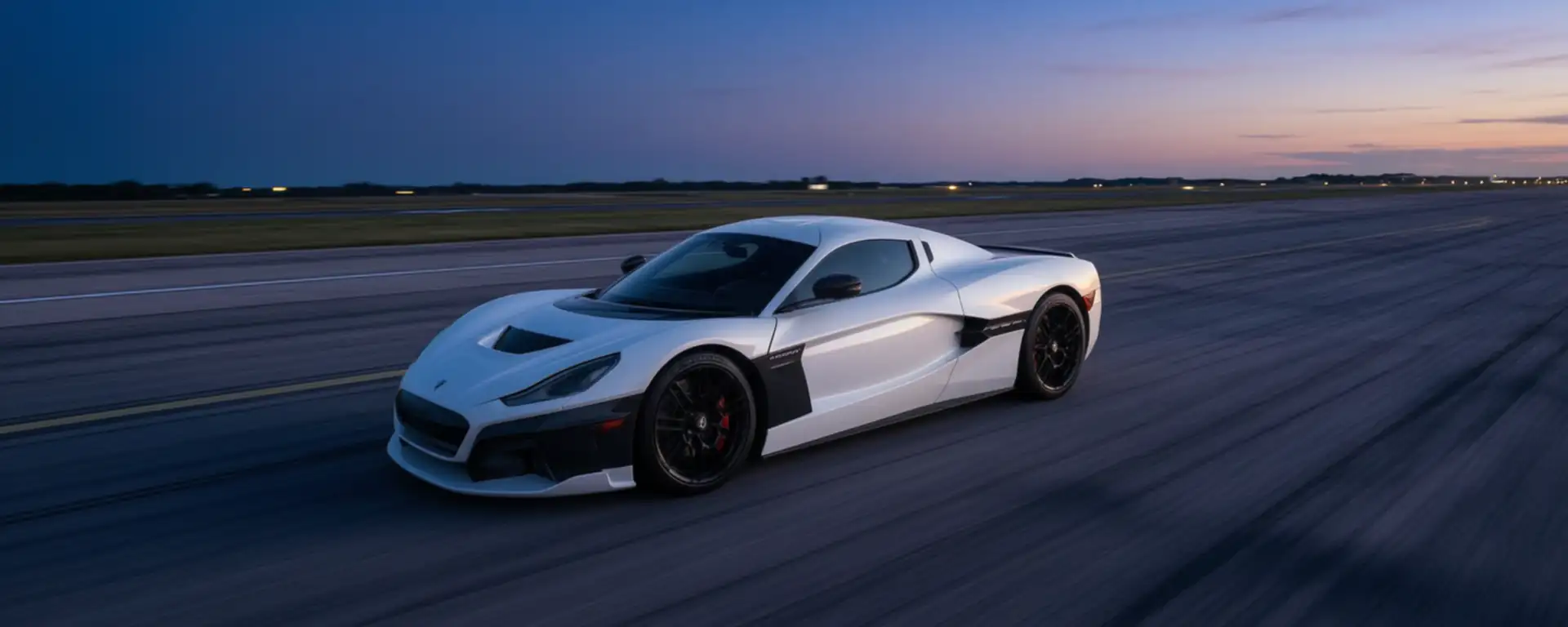
No production car has treated the record book quite like the Rimac Nevera. The Croatian hypercar holds the Guinness World Record for the fastest speed driven in reverse — 275.74 km/h, set in October 2023 — and in July 2025 its evolution, the Nevera R, set 24 new performance records in a single campaign, including the fastest top speed ever recorded by a production EV: 431.45 km/h.
The reverse record: 275.74 km/h backwards
Most cars are gearing-limited in reverse, with a single low ratio meant for parking manoeuvres. The Nevera’s four-motor drivetrain has no mechanical reverse gear at all — the motors simply spin the other way, leaving only software and cooling limits to validate. Test driver Goran Drndak hit 275.74 km/h (171.34 mph) at the ATP proving ground in Papenburg, Germany, in October 2023, breaking a record that had stood for 22 years. The run was stranger than it sounds: the rear wing and diffuser are shaped to generate downforce driving forwards, so at speed in reverse the aerodynamics actively work against the car.
Nevera R: 24 records in one day
In July 2025, Rimac returned with the Nevera R — 2,107 horsepower, limited to 40 units at €2.3 million each — and reset 24 performance benchmarks in a single session. Headlines: a 431.45 km/h (268.2 mph) top speed, the fastest of any production EV; 0-60 mph in 1.66 seconds; and the 0-400-0 km/h sprint-and-stop benchmark reclaimed at 25.79 seconds, more than four seconds quicker than the original Nevera’s mark.
Why Rimac keeps chasing records
With no engine, gearbox, or clutch to protect, Rimac has treated the Nevera as a rolling testbed for whatever record the drivetrain can physically support — from drag-strip numbers that embarrass dedicated race cars to the deliberately absurd reverse run. The pattern is the point: each record is a demonstration that four independently controlled motors can do things no combustion drivetrain can contest, and the Nevera R’s 24-title haul suggests Rimac isn’t done adding pages.