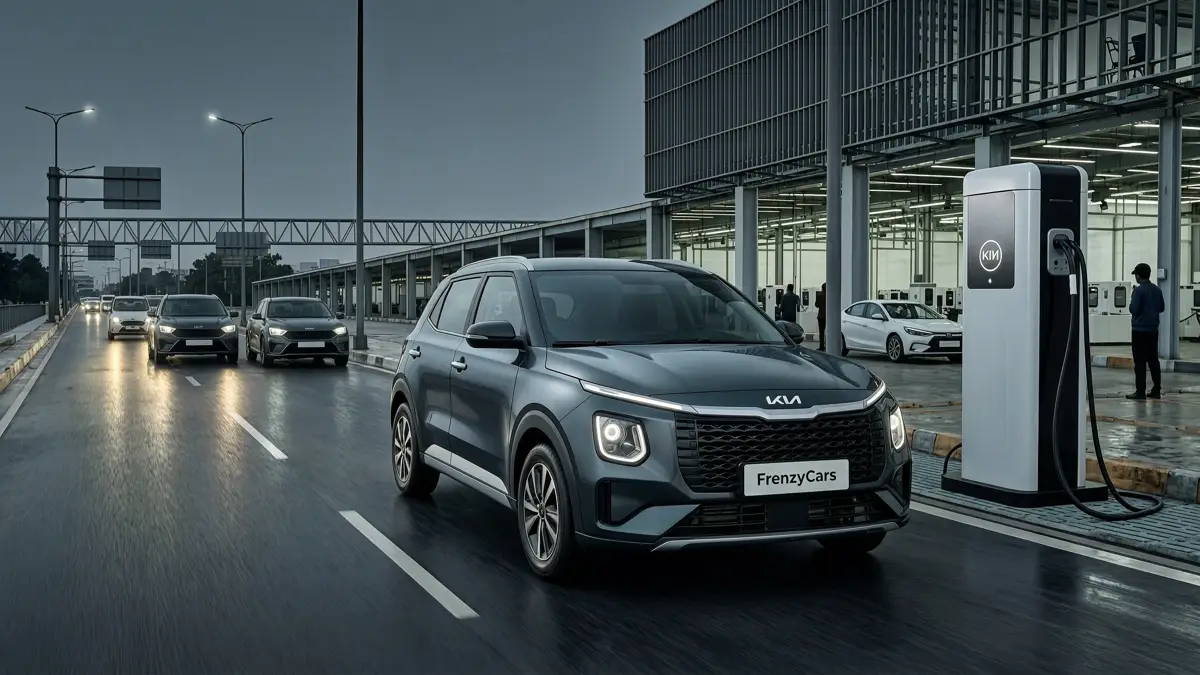
Kia has officially taken the wraps off its most affordable electric vehicle in India – the Syros EV SUV – opening pre-bookings at a nominal ₹25,000. With a best-in-class charging speed and a maximum range of 526 kilometers, the Syros is Kia’s latest gambit to capture the rapidly expanding entry-level EV segment in one of the world’s most price-sensitive car markets.
The Syros EV arrives with two distinct battery packs: a 42 kWh unit for budget-conscious buyers and a larger 51.4 kWh pack for those wanting maximum range. According to Kia India, the larger battery achieves an ARAI-certified range of 526 km (about 327 miles) on a full charge, comfortably covering a week’s worth of daily commuting for most Indian drivers. The smaller battery’s range figure was not detailed in the announcement, but it is expected to be proportionally lower.
Two Battery Choices Deliver Up to 526 km of Range
The 51.4 kWh variant is the headline act. Not only does it offer the longest range in its class, but it also produces 171 PS (126 kW) – enough to propel the Syros from 0-100 km/h in a claimed 8.1 seconds. That’s respectable for an affordable crossover and puts it on par with many entry-level performance hatchbacks. The 42 kWh variant likely produces less power, though Kia did not specify its output or acceleration figures.
Kia India emphasized that the Syros EV’s range is certified under the ARAI (Automotive Research Association of India) cycle, which tends to be more generous than real-world driving. Still, a 526 km ARAI rating suggests the Syros should easily deliver 350-400 km of practical range, which is more than adequate for urban and suburban use.
Fast Charging That Sets a New Benchmark for the Segment
One of the Syros EV’s standout features is its DC fast-charging capability. Kia claims the 51.4 kWh pack can charge from 10 to 80 percent in just 39 minutes – a best-in-class figure for an affordable EV in India. This means a quick coffee break could add enough range for several days of city driving. The 42 kWh pack likely charges at a similar speed, though Kia did not provide specific timing.
This charging speed is made possible by the vehicle’s 400V architecture and advanced battery management. While Kia didn’t specify the maximum charging power, the 39-minute 10-80% time typically corresponds to a peak rate of around 100-120 kW on a compatible charger. The Syros also supports standard AC charging for overnight top-ups at home.
Why the Syros EV Matters for Indian Buyers
India’s electric vehicle market is still in its early stages, but volumes are growing fast. The biggest barrier remains upfront cost. By positioning the Syros as its most affordable EV, Kia is directly targeting first-time EV buyers who might otherwise consider petrol-powered subcompact SUVs like the Hyundai Venue or Maruti Suzuki Brezza. With the Syros, Kia hopes to match those ICE rivals on price while offering dramatically lower running costs and zero tailpipe emissions.
The Syros also arrives as Kia’s lineup in India expands beyond the EV6 and the recently facelifted Niro. Unlike those models, the Syros is designed and engineered specifically for the Indian market, which allows Kia to optimize the car for local conditions – including rough roads, extreme heat, and sparse charging infrastructure outside major cities.
The Syros Nails the Practical Details
As an SUV, the Syros offers a commanding driving position and generous ground clearance – both key selling points in India, where flooded roads and uneven surfaces are common. Kia has not yet released interior photos or detailed dimensions, but the Syros is expected to share its platform with the recently updated Kia Sonet or a dedicated EV architecture. Given the competitive pricing, it’s likely the cabin will feature a large touchscreen, digital instrument cluster, and connected car tech, though those details have not been confirmed.
Pre-bookings are now open across India for a token amount of ₹25,000 (approximately $300 USD). Kia has not announced exact pricing or delivery timelines, but the official launch is expected in the coming months. Given the aggressive positioning, the Syros could start at under ₹12 lakh (roughly $14,500) for the base 42 kWh variant, with the 51.4 kWh version topping out at around ₹16 lakh. Those would make it one of the most affordable long-range EVs in the country.
What This Means for Enthusiasts
While the Syros is primarily a commuter car, its 171 PS motor and 8.1-second 0-100 km/h time give it a hint of sparkle. That powertrain is effectively the same as what Kia uses in its larger EVs, just tuned for efficiency. Enthusiasts who dismiss affordable EVs as appliances should note that instant torque and low weight (expected under 1,500 kg) could make the Syros genuinely fun to drive in urban settings.
Additionally, the 39-minute fast charging means road trips are feasible, as long as rapid chargers are available along the route. As India’s charging network expands – with companies like Tata Power and ChargeZone building out corridors – the Syros could serve as a do-everything daily driver for a new generation of Indian EV owners.
Forward Outlook
Kia has not yet confirmed whether the Syros EV will be exported to other markets. Given that the car is built on a platform tailored for India, and that Kia already sells the EV6 globally, a European or US launch seems unlikely in the near term. Nonetheless, the Syros demonstrates Kia’s ability to deliver an affordable, high-range EV without sacrificing essential features. Deliveries are expected to begin before the end of the year, with final pricing revealed at the official launch event.