Usage-based car insurance pays off for drivers who log low miles, stick to daytime driving, and brake smoothly, but the median savings are modest and roughly a quarter of participants end up paying more once the monitoring period ends. The real decision isn’t just about the discount. It’s whether you’re comfortable handing an insurer, and possibly its data partners, a rolling log of where your car goes and how you drive it.
TL;DR:
- Low-mileage drivers under 8,000 miles a year benefit most from pay-per-mile plans, while careful, moderate commuters may prefer behavior-based programs.
- Insurers retrieve detailed location, trip timing, driving behavior, and phone data, which can be shared with third parties without clear consent.
- Privacy risks have led regulators to scrutinize data sharing practices, making it essential to verify data retention and resale policies before signing up.
- The actual financial benefit is uncertain, as nearly half of participants see no discount or an increase, so consumers should thoroughly review terms and privacy conditions beforehand.
How Usage-Based Insurance Works: Telematics Basics
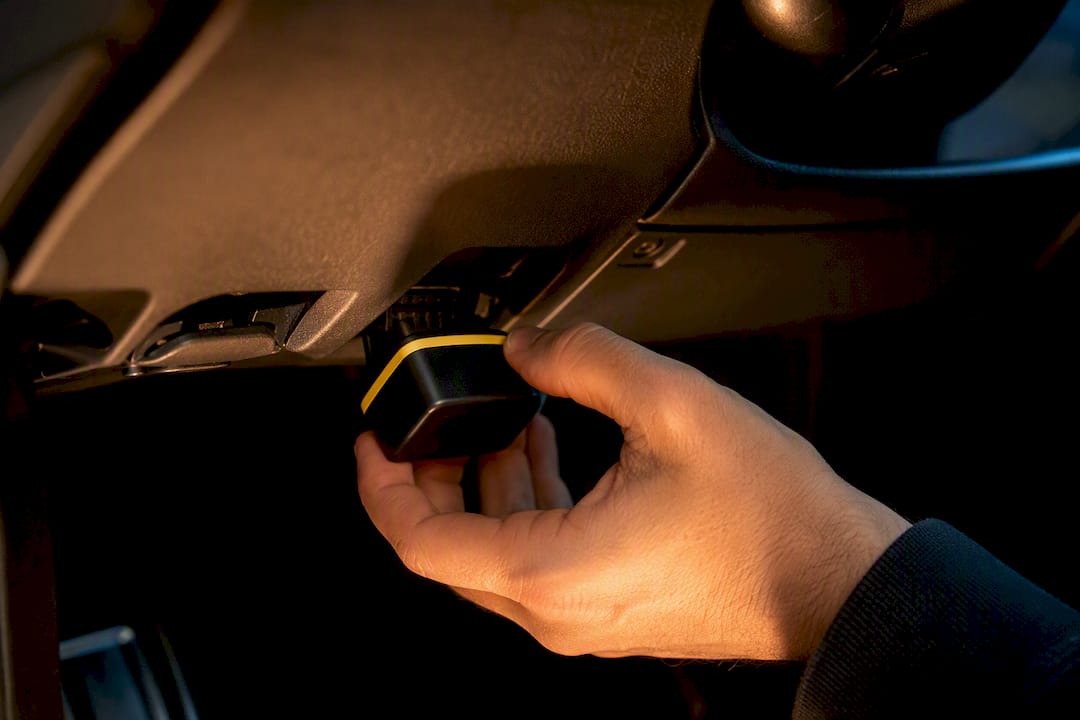
Usage-based insurance, often shortened to UBI, relies on telematics, the technology that captures how, when, and how far you drive and turns that behavior into pricing data. Insurers pull this information through three main channels: a smartphone app that runs in the background during trips, an OBD-II plug-in device that connects to your car’s diagnostic port, or a telematics system already embedded by the automaker.
Each channel measures a similar cluster of signals. Telematics programs typically track speed, hard braking, rapid acceleration, cornering, phone handling, total miles, and time of day, then run those inputs through an algorithm that spits out a driving score. Forbes Advisor notes that insurers vary widely in which signals they weight most and how they convert raw data into a rate adjustment, so the same trip can score differently at two different companies.
Most programs follow a predictable rhythm:
- An initial enrollment discount applies just for signing up, before any data comes in.
- A monitoring window, usually 30 to 90 days, collects your actual driving patterns.
- The insurer recalculates your score and applies the real discount, surcharge, or no change at renewal.
- Ongoing tracking can continue to influence future renewals, not just the first one.
That last point catches people off guard. A bad week of driving eight months from now can still show up on your next bill.
Pay-Per-Mile vs. Driving-Behavior Programs
Not all telematics insurance policies work the same way, and the two dominant models pull in opposite directions.
- Pay-per-mile insurance charges a low base rate plus a per-mile rate for every mile you drive, tracked through a plug-in device or app. Costs scale directly with mileage, which makes this the strongest fit for low-mileage insurance shoppers, retirees, remote workers, or anyone with a second car that mostly sits in the garage.
- Driving-behavior programs keep a traditional base premium but layer a discount or surcharge on top based on your driving score. Braking habits, speed, and phone use matter more here than mileage. Someone who commutes 40 miles a day but drives smoothly can still come out ahead.
- Hybrid models blend both, weighting mileage and behavior together into a single score. These tend to reward the driver who checks every box: low miles, daytime hours, and a light foot.
If you drive under 8,000 miles a year, pay-per-mile insurance usually beats a behavior-only program. If you drive a normal commute but consider yourself a careful driver, a behavior-based telematics insurance policy is the better test.
What Data Insurers Collect and Why Privacy Is the Real Cost
Here’s the part most marketing pages skip. Enrolling in a telematics insurance policy means sharing a detailed behavioral record, not just your location, but your habits and patterns.
The data typically includes:
- Precise location and route history — where you go, not just how far.
- Trip timestamps — when you’re on the road, which can reveal work schedules or routines.
- Hard-braking and acceleration events — tied to specific dates and street-level locations.
- Phone motion and handling data — some apps infer distracted driving from how the phone moves in the cabin.
That data doesn’t always stay locked inside your insurer’s internal systems. It can flow to analytics vendors, affiliated companies, third-party data brokers, or consumer reporting agencies that compile driving histories the way credit bureaus compile financial ones.
Statistic Callout: In January 2025, the FTC took formal action against an automaker for sharing drivers’ precise location and driving-behavior data with third parties without adequate consent, a case that put the entire telematics industry on notice about consent and resale practices.
That enforcement action matters because it confirms what privacy advocates had been warning about for years: driving data doesn’t necessarily stay where you think it does. Before enrolling in any car insurance tracking program, ask directly whether your data can be sold, how long it’s retained after you cancel, and whether you can demand deletion. A verbal assurance isn’t a contract term. Get it in writing.
Who Gains, Who Loses: Savings by the Numbers
The honest answer on savings is less exciting than the ads suggest. Consumer Reports found median annual savings around $120 for telematics users, and plenty of policyholders don’t even realize their insurer runs a monitoring program in the first place.
Statistic Callout: A market review found that roughly 31% of telematics participants saw premium reductions, while 24% ended up paying more and 45% saw no change at all.
That distribution tells you something the discount ads never will: for every driver who saves meaningfully, roughly two see no change or an increase. The drivers most likely to land in the winning third share a profile:
- Low annual mileage, especially under 8,000 to 10,000 miles.
- Daytime driving with little late-night or rush-hour exposure.
- Smooth acceleration and braking habits sustained over the full monitoring window.
Mileage tends to dominate the math more than driving style does, which is why a careful driver who commutes 60 miles round trip can still underperform a mediocre driver who barely leaves the driveway.
What to Ask Before You Enroll in a UBI Program
Before you plug in a device or download an app, run through this checklist. It takes fifteen minutes and can save you from a surprise renewal.
- Confirm the guaranteed discount. Some programs guarantee an enrollment discount regardless of driving data; others only apply a discount after the monitoring period, with no floor.
- Ask what data gets collected and who sees it. Get specifics on location tracking, retention length, and whether data is shared with affiliates or brokers.
- Clarify whether the program can raise your rate. Some insurers only offer discounts; others explicitly reserve the right to surcharge poor scores. That distinction should be in the policy language, not just the sales pitch.
- Check for trip-correction tools. Ask how you dispute a passenger trip logged as your own, and how long you have to fix it.
- Get a baseline quote first. Compare the UBI offer against a standard policy quote for the same coverage before you commit to anything.
Pro Tip: Ask your agent point blank: “Is this program discount only, or can my rate go up?” Experts who track these programs recommend enrolling only when there’s a clear guaranteed discount, explicit privacy terms, and a no-penalty opt-out. If the agent hedges on that answer, that’s information too.
Signing Up, Getting Scored, and Backing Out
Enrollment usually takes minutes. App-based programs need a download and permission to run in the background; OBD-II programs need you to plug a small device into the port under your dashboard, typically near the steering column; embedded systems activate through the automaker’s existing connected-car platform with a few settings toggled on.
Once active, your monitoring window opens. Most run 30 to 90 days before the first real score gets calculated, and that score then feeds into your renewal premium rather than your current one.
- If a passenger drove your car, or someone else drove it while you rode along, most apps give a limited window, often just days, to flag and correct that trip.
- Missed corrections get baked into your score permanently.
- If you leave the program or switch insurers, ask specifically what happens to your stored telematics history. Some insurers purge it; others retain it indefinitely for underwriting reference.
State Rules and Regulatory Guidance on Telematics Insurance
Usage-based insurance isn’t regulated the same way in every state, and that inconsistency is exactly why you need to check local rules before assuming your experience will match a friend’s in another state.
- The National Association of Insurance Commissioners explains that UBI adds individual driving behavior as a rating factor, and that program structures, and whether they can raise or only lower your rate, vary by state and by insurer.
- Your state department of insurance is the authoritative source for whether your state permits surcharge-capable programs or restricts UBI to discount-only status.
- The FTC’s 2025 enforcement action against an automaker for improper data sharing signals that regulators are actively watching how telematics data moves between companies, not just how it’s collected.
Check your state insurance department’s website before enrolling, especially if you’re comparing offers across state lines or recently moved.
FrenzyCars’ Perspective: A Practical Decision Flow
Skip the guesswork. Run this five-step check before enrolling: get a baseline quote on standard coverage, request the program’s written terms on data sharing and surcharge risk, run a short trial with trip-correction turned on, pull a fresh quote once monitoring ends, then decide whether to stay, opt out, or shop elsewhere entirely. If your baseline quote is already competitive, comparing liability versus full coverage may matter more than any telematics discount. FrenzyCars covers insurance mechanics the way we cover new-driver coverage: plainly, and with the tradeoffs left in.
How Claims Work Differently Under a UBI Policy
Filing a claim under a telematics policy follows the same basic process as a standard claim: you report the incident, an adjuster investigates, and the insurer determines fault and payout. The difference is what evidence sits in the file. If your car was enrolled in a driving-behavior program, the insurer already has a timestamped record of your speed, braking, and location leading up to the crash.
That record can work for you or against you. Smooth, within-limit driving in the moments before a collision can support your account of events and speed up approval. But hard braking or a speed spike logged seconds before impact can also be used to dispute liability or challenge your version of the incident, even if the telematics data doesn’t tell the full story of road conditions or another driver’s actions.
Ask your insurer directly whether telematics data factors into claims decisions, not just pricing. Some insurers keep the two processes separate; others explicitly reserve the right to pull driving data during a claims investigation. That’s a meaningful distinction, and one worth getting in writing before you assume your smooth driving score will only ever help you.
Common Pitfalls of Usage-Based Insurance Programs
The gap between what UBI promises and what it delivers usually comes down to a handful of recurring problems.
Passenger misattribution tops the list. If someone else drives your car, or you ride as a passenger in someone else’s trip logged through your phone, the app can attribute that driving to you. Correction windows are often narrow, sometimes just a few days, and a missed correction becomes permanent data.
Score volatility is another issue. A single bad commute during a monitoring window, a sudden highway merge, a slammed brake to avoid a deer, can drag down months of otherwise clean driving. Unlike a credit score, which averages behavior over years, a 30 to 90 day telematics window has far less room to smooth out one rough week.
Then there’s the app itself. Battery drain, GPS glitches in parking garages or tunnels, and background permission issues can all corrupt trip data in ways that hurt your score through no fault of your driving. And because median realized savings tend to run in the $100 to $150 per year range, with mileage often doing most of the work, many drivers discover the discount barely covers the hassle of troubleshooting a buggy app.
How Usage-Based Insurance Affects Different Age Groups
Age changes the telematics equation more than most people expect. Consumer Reports found larger median savings for younger drivers enrolled in monitoring programs, likely because young drivers start from a higher base premium tied to actuarial risk, so even a modest behavioral discount produces a bigger dollar swing. For a driver in their early twenties paying a steep baseline rate, proving smooth, low-risk habits through a telematics insurance policy can meaningfully undercut the age penalty built into traditional pricing.
Senior drivers face a different dynamic. Many retirees already qualify for low-mileage insurance simply by driving less, which makes pay-per-mile programs attractive on paper. But some behavior-based scoring models can penalize slower reaction times or more cautious, hesitant braking patterns that read as erratic to an algorithm even when they reflect careful driving. That’s worth testing cautiously and comparing against a standard low-mileage discount, which may achieve a similar result without the behavioral scrutiny.
Middle-aged commuters with steady routines tend to land in the middle: fewer dramatic swings, but also less dramatic upside, since their baseline rates already reflect a lower-risk actuarial bracket.
UBI Pricing vs. Traditional Insurance Pricing
Traditional car insurance pricing leans on static rating factors: your age, ZIP code, credit-based insurance score, vehicle type, claims history, and years licensed. None of that changes week to week, and none of it reflects how you actually drove yesterday.
Usage-based insurance keeps most of those same baseline factors but layers real-time or recent behavioral data on top. The NAIC frames this as adding individual driving behavior as an additional rating factor rather than replacing the traditional model outright. In practice, that means your ZIP code and credit-based score still matter under a UBI policy. Telematics adjusts the number up or down from that baseline; it doesn’t erase the underlying methodology.
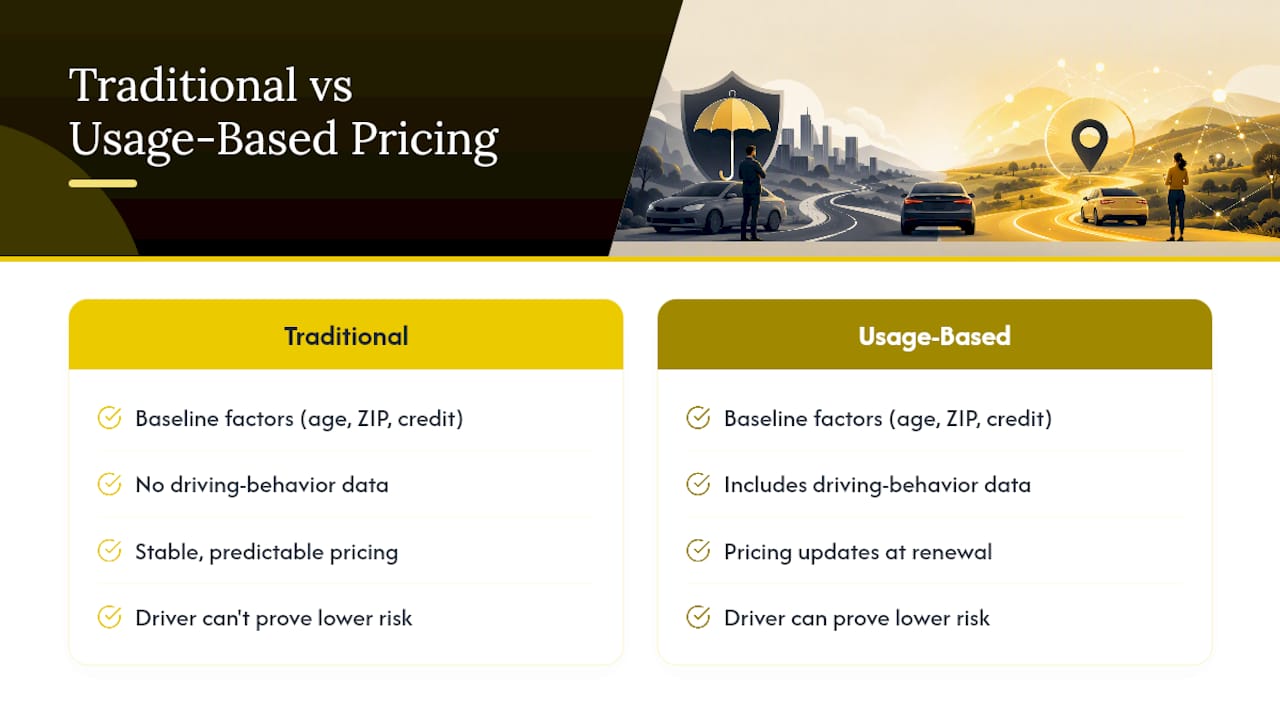
The tradeoff cuts both ways. Traditional pricing can penalize a great driver stuck with a lower credit score or an unlucky ZIP code, with no mechanism to prove otherwise. UBI gives that driver a path to demonstrate lower risk directly. But traditional pricing is also predictable and stable, while UBI pricing can shift at renewal based on a monitoring window that might not represent your normal driving at all.
Telematics Devices and Cybersecurity Risk
A telematics device, whether it’s an OBD-II plug-in or an embedded system, is a piece of connected hardware with a data connection, and that creates exposure most drivers never think about.
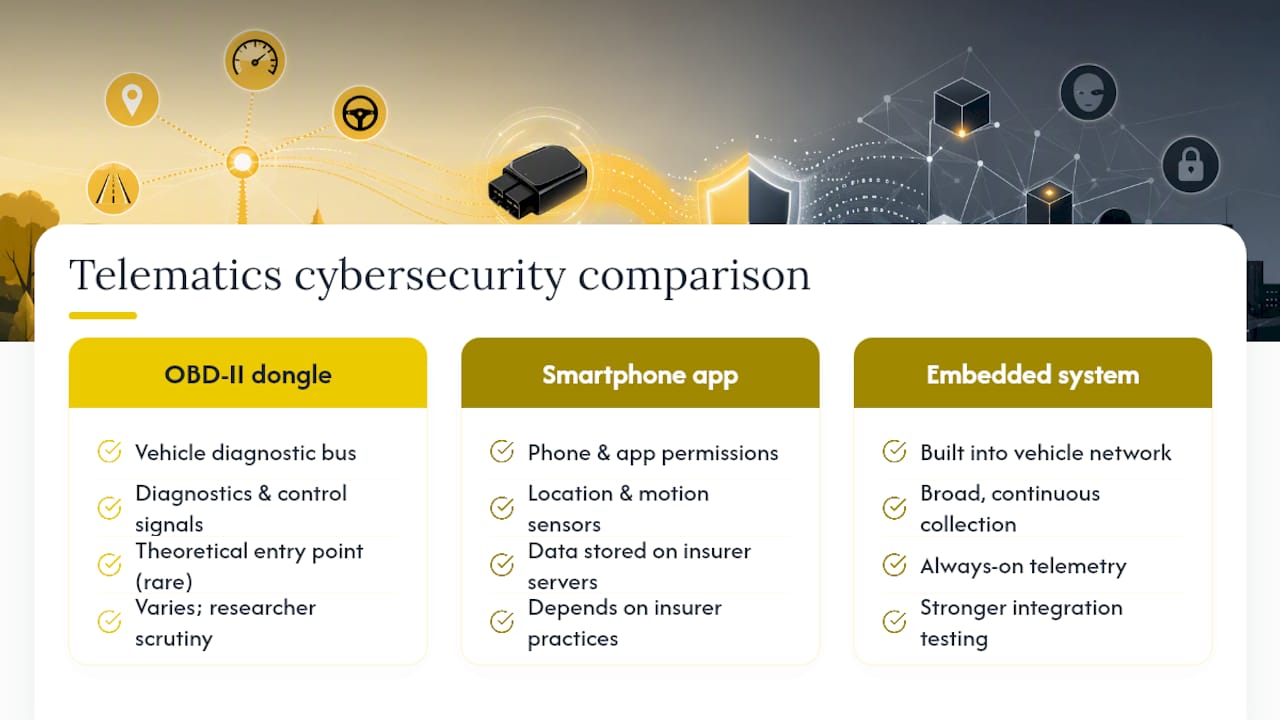
OBD-II plug-ins have drawn security researcher scrutiny because they connect directly to a vehicle’s internal diagnostic network, the same network that controls functions like braking and steering feedback in some vehicle architectures. A poorly secured plug-in theoretically creates an entry point, though real-world exploitation of consumer telematics dongles remains rare. Smartphone apps carry a more everyday risk: they request background location access and sometimes motion-sensor permissions, and that data sits on servers governed by the insurer’s own security practices, not yours.
Embedded systems, built in by the automaker, tend to have stronger integration testing but also collect the broadest data set by default, often running continuously rather than only during insured trips.
The practical takeaway isn’t paranoia, it’s diligence. Ask whether the telematics data transmission is encrypted, whether the app or device has had any reported breaches, and whether the manufacturer or insurer has a public security disclosure policy. A company that can’t answer those questions plainly probably hasn’t thought hard enough about the answer either.
Editorial Take: The Discount Isn’t the Real Question
The industry sells UBI as a savings story. The evidence says it’s a data story with a savings side effect. When roughly a quarter of participants end up paying more and nearly half see no change at all, “sign up and save” stops being an honest pitch. It’s a probability, not a promise.
What gets underweighted in most coverage is how much the FTC’s 2025 enforcement action changes the calculus. This isn’t hypothetical privacy paranoia anymore. It’s a regulator confirming that driving data has moved through channels drivers never agreed to. That should shift the conversation from “will I save $120 a year” to “do I trust this company’s data practices enough to hand over months of location history for that amount.”
My advice: treat UBI enrollment like any other financial decision with an information asymmetry. Get the terms in writing, run the baseline comparison, and don’t let a sign-up bonus rush you past the fine print on data retention.
Sources
- Bumps in the telematics road: privacy and transparency
- Want Your Auto Insurer to Track Your Driving? Understanding Usage-Based Insurance
- FTC takes action against General Motors for sharing driver data
- Car insurance telematics pros and cons - Consumer Reports
- Consumer Reports telematics program findings (summary)