
A car insurance deductible is the amount you pay out of pocket on a covered claim before your insurer covers the rest. It applies mainly to collision and comprehensive coverage, not liability. The practical verdict for most drivers: pick the highest deductible you could pay in cash today without borrowing or draining your emergency fund.
Here’s the quick math that makes the decision concrete:
- On a $2,000 repair with a $500 deductible, you pay $500 and your insurer covers $1,500.
- On that same repair with a $1,000 deductible, you pay $1,000 and your insurer covers $1,000.
- Your premium is usually lower with the $1,000 deductible, but only helps if you’d actually have that cash ready when you need it.
The rest of this guide breaks down exactly how deductibles work, what they cost you in real dollars, and how state law affects what you might get back.
Key Takeaways
Choosing the right car insurance deductible comes down to matching your out-of-pocket risk to cash you can actually access, not to the premium savings alone.
| Point | Details |
|---|---|
| Deductibles apply selectively | Collision and comprehensive typically carry deductibles; liability does not. |
| Affordability beats savings | Pick a deductible you could pay in cash today without borrowing. |
| $500 vs. $1,000 is the common choice | Compare actual quotes since break-even time often runs — or more. |
| State rules affect subrogation | States like California, Texas, New York, and Wyoming have specific deductible reimbursement rules. |
| Recheck after life changes | A new car, a move, or a change in savings should trigger a policy review. |
What a Car Insurance Deductible Actually Covers
Deductibles come in two forms, but for auto insurance you’ll almost always see a flat dollar amount rather than a percentage. Homeowners policies sometimes use percentage-based deductibles tied to a home’s insured value, but car insurance sticks to fixed figures like $250, $500, or $1,000 stated directly on your policy.
Not every coverage on your policy carries one. According to the Insurance Information Institute, deductibles typically apply to collision and comprehensive coverage, while liability coverage, which pays for damage or injury you cause to others, doesn’t have a deductible at all. Personal injury protection (PIP), medical payments (MedPay), and uninsured/underinsured motorist coverage are murkier: some states require deductibles on these, others don’t, and the amount varies by policy and jurisdiction.
Your declarations page (the summary sheet you get when you buy or renew a policy) spells this out line by line. A typical entry looks something like: “Collision: $500 deductible” and “Comprehensive: $250 deductible” listed as separate rows, often with different amounts. Insurers let you set collision and comprehensive deductibles independently, which is a detail a lot of drivers miss.
Pro Tip: Pull out your declarations page right now and check whether your collision and comprehensive deductibles match. Many drivers assume they’re the same and are surprised to find a $500 gap between them.
Coverages with deductibles, generally:
- Collision (hits another vehicle or object)
- Comprehensive (theft, hail, fire, animal strikes, vandalism)
- Sometimes PIP, MedPay, or UM/UIM property damage, depending on your state
Coverages without a deductible:
- Bodily injury liability
- Property damage liability
For a fuller breakdown of what full coverage actually includes versus liability-only policies, see FrenzyCars’ guide on liability vs. full coverage.
How Deductibles Work When You File a Claim
The process is more mechanical than most drivers expect, and understanding the sequence removes a lot of the anxiety around filing.
- You report the accident or damage to your insurer.
- An adjuster or the repair shop estimates the cost of repairs.
- Your deductible is subtracted from that estimate.
- The insurer pays the remaining balance, either to you or directly to the repair shop.
You typically don’t hand your insurer a check for the deductible. Instead, the shop bills the insurer for the full repair cost, and you pay the shop your deductible portion directly while the insurer covers the rest, according to guidance from Progressive. The exception is a total loss, where the insurer cuts you a check for the vehicle’s value minus your deductible.
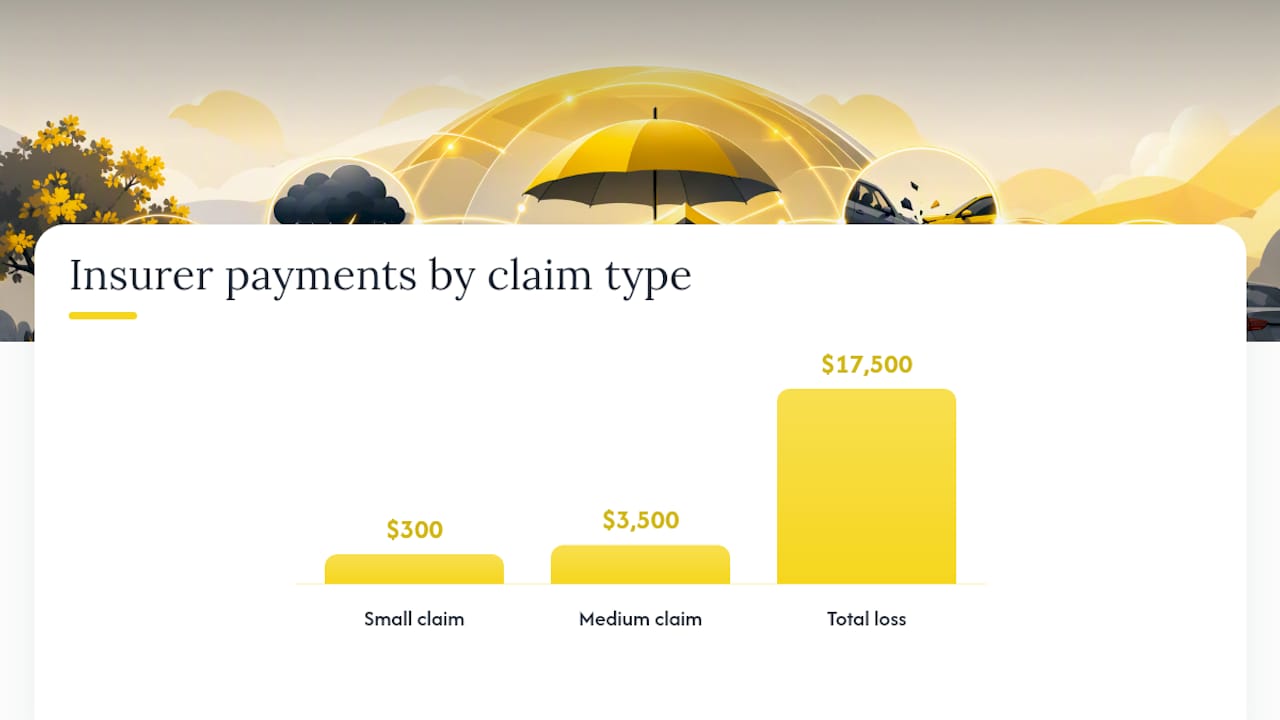
A few examples make this concrete:
- Small claim: A cracked bumper costs $800 to fix. With a $500 deductible, you pay $500 and the insurer pays $300. Many drivers in this situation just pay out of pocket and skip filing, since the payout barely covers the deductible.
- Medium claim: A collision causes $4,500 in damage. With a $1,000 deductible, you pay $1,000 and the insurer pays $3,500, per the payout structure Forbes Advisor outlines for comprehensive, collision, PIP, and UM/UIM property damage claims.
- Total loss: Your car is valued at $18,000 and gets totaled. With a $500 deductible, you receive a check for $17,500.
If the other driver caused the accident, your insurer may pursue that driver’s insurer for reimbursement, a process called subrogation. Depending on your state, you may be entitled to get your deductible back once your insurer recovers money from the at-fault party. That’s covered in more detail below, and it’s worth understanding before you assume a deductible loss is permanent.
Pro Tip: Ask your insurer directly whether they pay the repair shop or reimburse you. Some shops require you to pay your deductible upfront before work begins, while others bill you after the insurer settles.
For the full mechanics of filing, timing, and documentation, check FrenzyCars’ step-by-step claim guide.
Should You Pick a High or Low Deductible?
This is where most of the real decision-making happens, and it comes down to a tradeoff between monthly savings and claim-time risk.
Low deductibles ($250 to $500):
- Lower risk if you’re in an accident, since you owe less at claim time.
- Higher monthly premiums.
- Better fit for drivers with limited emergency savings or a history of frequent claims.
High deductibles ($1,000 to $2,000):
- Lower monthly premiums, often by a meaningful margin.
- Higher exposure if you do file a claim.
- Better fit for drivers with solid emergency savings and a clean driving record.
Drivers file collision or comprehensive claims relatively rarely, on average about once every 17.9 years, according to claims frequency data from ConsumerAffairs. That infrequency is exactly why a higher deductible tends to pay off over time for drivers who can comfortably absorb the occasional hit.
The $500 versus $1,000 comparison is the one most drivers actually face when shopping quotes. If dropping from a $500 to a $1,000 deductible saves you $15 a month, that’s $180 a year. If you’d have to file a claim more than once every six years to make the $500 deductible worthwhile, the math tilts toward the $1,000 option for most people.

A simple affordability check settles most of the indecision: could you write a check for your deductible today without touching a credit card? Kiplinger’s one-month rule suggests setting your deductible around one month’s worth of regular savings, a rule of thumb that works well for drivers with steady income but less well for retirees or anyone on a fixed budget.
How Much Does Raising Your Deductible Actually Save?
Insurers price deductibles on a simple principle: the more risk you absorb, the less risk they carry, and the less they charge you for it. That’s why every quote you get shows a lower premium as the deductible climbs.
MoneyGeek’s analysis found that moving from a $0 deductible to $1,000 can cut your annual full-coverage premium by several hundred dollars, with further reductions at $2,000, though that tier demands a larger cash cushion if you ever need to use it.
Here’s how the break-even math works. Divide the extra deductible amount by your monthly premium savings to find how many months of savings it takes to cover the gap:
These figures are illustrative, since actual savings vary by insurer, driving record, and state, but the pattern holds: the break-even period is almost always measured in years, not months. If you go multiple years without a claim, which is statistically likely given how infrequently the average driver files one, a higher deductible usually wins on pure math.
Pro Tip: Call your agent and ask for quotes at $500, $1,000, and $2,000 deductibles side by side. The percentage difference in premium varies enough by insurer and state that guessing isn’t worth it.
State Rules and Subrogation: The Part Most Drivers Miss
Here’s something most explainers skip entirely: whether you get your deductible back after an accident that wasn’t your fault can depend heavily on which state you live in.
When your insurer pays your claim and then goes after the at-fault driver’s insurer to recover the money, that’s subrogation. As of 2018, 23 states have administrative codes or regulations specifically governing when your paid deductible must be reimbursed as part of that recovery.
A few examples show how differently states handle this:
- California generally requires insurers to include the policyholder’s deductible in subrogation demands and to reimburse it proportionally once money is recovered.
- Texas has specific rules requiring insurers to pursue and share recovered deductible amounts with insureds.
- New York imposes similar proportional-recovery requirements on insurers pursuing subrogation.
- Wyoming is among the states with defined regulatory language addressing deductible reimbursement timing.
The practical effect: if you’re not at fault, you may eventually get some or all of your deductible back, but the timeline can stretch for weeks or months while the insurers negotiate. Some states require prompt, proportional reimbursement; others leave more discretion to the insurer.
This is general information, not legal advice, since these rules can change and interpretation varies by case. Check your state’s Department of Insurance website or ask your agent directly about subrogation timing before assuming you’ll never see that deductible again.
A Practical Checklist for Choosing Your Deductible
Run through these steps before your next renewal or when shopping a new policy:
- Check your emergency savings. Could you cover the deductible in cash within a week? If not, lower it.
- Get quotes at multiple deductible levels. Compare $500, $1,000, and $2,000 side by side, not just one option.
- Confirm lender or lease requirements. Many auto loans and leases cap your maximum allowable deductible, often at $500.
- Factor in vehicle value and repair costs. Newer vehicles, especially EVs with battery packs and advanced sensors, often carry higher repair costs, which changes the math on what a high deductible actually exposes you to.
- Consider your driving patterns. Long commutes, urban parking, or a teen driver on your policy all raise claim likelihood and argue for a lower deductible.
A few red flags mean you should lower your deductible rather than chase premium savings: you’d need to borrow to cover it, you have no emergency fund at all, or you’ve filed more than one claim in the past three years.
When you talk to your agent, ask these three questions directly:
- Does the state I live in require deductible reimbursement through subrogation, and how long does that typically take?
- Do you offer a disappearing or vanishing deductible program for claim-free years, similar to what MoneyGeek describes?
- Can I set different deductibles for collision versus comprehensive coverage?
New drivers building a policy from scratch should also weigh premium cost against deductible risk carefully. FrenzyCars’ guide on insurance for new drivers walks through that balance in more detail.
What FrenzyCars Recommends on Deductibles
Choose the highest deductible you could pay in cash without hesitation, and revisit that number every time your financial situation or your car changes. That’s the whole strategy stripped down to one sentence, and everything else in this guide is really just supporting math.
Where we’d push back on generic advice: don’t set your collision and comprehensive deductibles to match automatically. Comprehensive claims like hail damage, theft, or a cracked windshield tend to cost less than collision repairs, so a lower comprehensive deductible paired with a higher collision deductible often gets you better overall value than a flat number across both.
One trend worth watching if you drive anything newer: repair costs on EVs and tech-heavy vehicles, think sensor-packed bumpers, battery housings, and camera-based safety systems, run noticeably higher than on older, simpler cars. That shifts the math on what a $1,000 or $2,000 deductible actually exposes you to. A fender repair that used to cost $1,200 can now run well past $3,000 once cameras and radar units are involved. If you’re shopping an EV or a newer model with advanced driver-assist features, price out repair costs before locking in a high deductible.
Run new quotes at least once a year, especially after a move, a new car purchase, or a change in your savings. Life events change the right answer faster than most drivers update their policies.
Sources
- Deductible reimbursement and subrogation (state chart)
- Understanding your insurance deductibles — Insurance Information Institute (III)
- What Car Insurance Deductible Should You Choose? — MoneyGeek
- Car Insurance Deductible: What Is It? How Does It Work? — Forbes Advisor
- The 1-Month Rule for Setting Your Car Insurance Deductible — Kiplinger
This article is general information, not a substitute for advice from a qualified financial advisor. Consult a qualified financial professional about your own circumstances before acting on anything here.
Recommended
- Car Insurance for New Drivers (2026): How to Get Covered Without Overpaying | FrenzyCars
- Liability Car Insurance vs. Full Coverage: Which Do You Need in 2026? | FrenzyCars
- How to File a Car Insurance Claim (2026): Step-by-Step Guide | FrenzyCars
- Best Cars for New Drivers: Safe, Affordable Picks | FrenzyCars