
An SR-22 is a certificate your insurer files with the state to prove you carry the liability coverage that state requires. It’s not a policy, so don’t shop for “SR-22 insurance” as a product. Instead, read your court or DMV notice, then call a licensed insurer or agent in your state today. Keep that policy active for the full required period; a lapse can trigger a new suspension.
TL;DR:
- SR-22 is a certificate filed by your insurer to prove you meet state liability requirements, not insurance coverage itself, and must stay active for the full mandated period to avoid suspension reactivation.
- Requirements usually stem from DUIs, driving without insurance, license suspensions, unpaid judgments, or repeated violations, with exact limits and durations specified in your court or DMV notice.
- Filing an SR-22 is quick once you provide your driver details and select a licensed insurer, but costs vary based on state, violation, driver profile, and chosen coverage limits, making comparison essential.
- Lapses in coverage or cancellations during the required period can trigger resuspension and fees; always confirm your filing end date in writing before canceling or switching policies.
- Non-owner SR-22 options exist for drivers without owned vehicles, and meeting ongoing filing requirements is crucial to prevent further legal and financial penalties.
What Is SR-22 Insurance and How Is It Different From a Policy?
An SR-22 is a certificate of financial responsibility, sometimes just called an “SR-22 form.” A state DMV or a court orders it, not your insurance company, and the point is to monitor drivers who’ve shown they’re a higher risk on the road.
The Oregon DMV explains that courts or motor vehicle agencies decide who needs to file, based on specific violations. The certificate itself doesn’t protect you in a crash. Your underlying auto policy does that work; the SR-22 just tells the state that policy exists and meets the minimum limits.

That distinction trips people up constantly. Officially, per Wikipedia’s summary of state DMV language, an SR-22 is proof of insurance, not the insurance itself. Confirm your exact requirement on your state DMV’s page, since the notice you received should list the agency and form number directly.
Do You Need an SR-22? Common Triggers and How to Check
Most SR-22 requirements trace back to a handful of situations. If any of these apply to you, assume you’ll need to file unless your notice says otherwise:
- A DUI or DWI conviction
- Driving without insurance, whether pulled over or in an accident
- A suspended or revoked license from points, unpaid tickets, or unpaid child support in some states
- An at fault accident judgment you haven’t paid
- Repeat traffic violations within a short window
Your reinstatement or court notice is the real source of truth here. It will list the required certificate type, minimum liability limits, and the exact date your obligation ends. Read it carefully before calling anyone, because the form number and required limits vary by state and by offense.
If the notice is unclear or you lost it, call the number printed on it or check your state DMV’s website directly. Don’t guess, and don’t rely on what a friend’s insurer told them about their own SR-22, since state rules differ enough that assumptions get expensive.
How to Get an SR-22: Steps and What to Have Ready
Filing moves fast once you know what to gather. Here’s the order that works:
- Confirm the exact certificate required. Some states want an SR-22; others, for certain alcohol-related offenses, require the higher-limit FR-44 instead. Check the minimum limits and the end date on your notice.
- Contact a licensed insurer or agent. Not every insurer files SR-22s, and the company must be licensed to file in your specific state. Ask directly: “Do you file SR-22s in [your state], and can you handle owner or non-owner filings?”
- Gather your documents. Have your driver’s license number, the court or DMV notice, your VIN if you’re insuring a vehicle you own, and your current policy number if you have one.
- Request electronic filing and an itemized invoice. Ask your insurer to break out the processing fee, the premium, and any state fees separately, so you know exactly what you’re paying for.
If you don’t own a car, ask specifically about a non-owner SR-22. States including Texas document this option for drivers who need to satisfy a filing requirement without insuring a vehicle they own.
Pro Tip: Call two or three insurers before picking one. Filing authority and non-owner options aren’t universal, and pricing swings more than most drivers expect for what looks like a routine form.
How Much Does SR-22 Insurance Cost?
The SR-22 filing itself is usually a small processing fee, often somewhere in the range of a routine service charge rather than a major expense. The bigger cost is what happens to your premium, and that part isn’t small or predictable.
There’s no reliable nationwide price for SR-22 coverage. Your premium depends on your state, the violation that triggered the filing, your driving history, your age, the vehicle you’re insuring, and which insurer you choose. Texas DPS notes a reinstatement fee example tied to lapses, but that’s a state fee, not a premium figure, and it won’t tell you what your own rate will look like.
Shop smart instead of guessing:
- Get quotes from at least three insurers that file in your state
- Ask each one to itemize the premium, filing charge, and any DMV fees separately
- Compare coverage limits, not just the bottom-line price
- Ask about payment plans, since some insurers offer monthly options that reduce the upfront hit
If your vehicle is part of the cost driver, comparing liability minimums against full coverage can help you see where your premium dollars are actually going.
How Long Does an SR-22 Last, and What Happens If It Lapses?
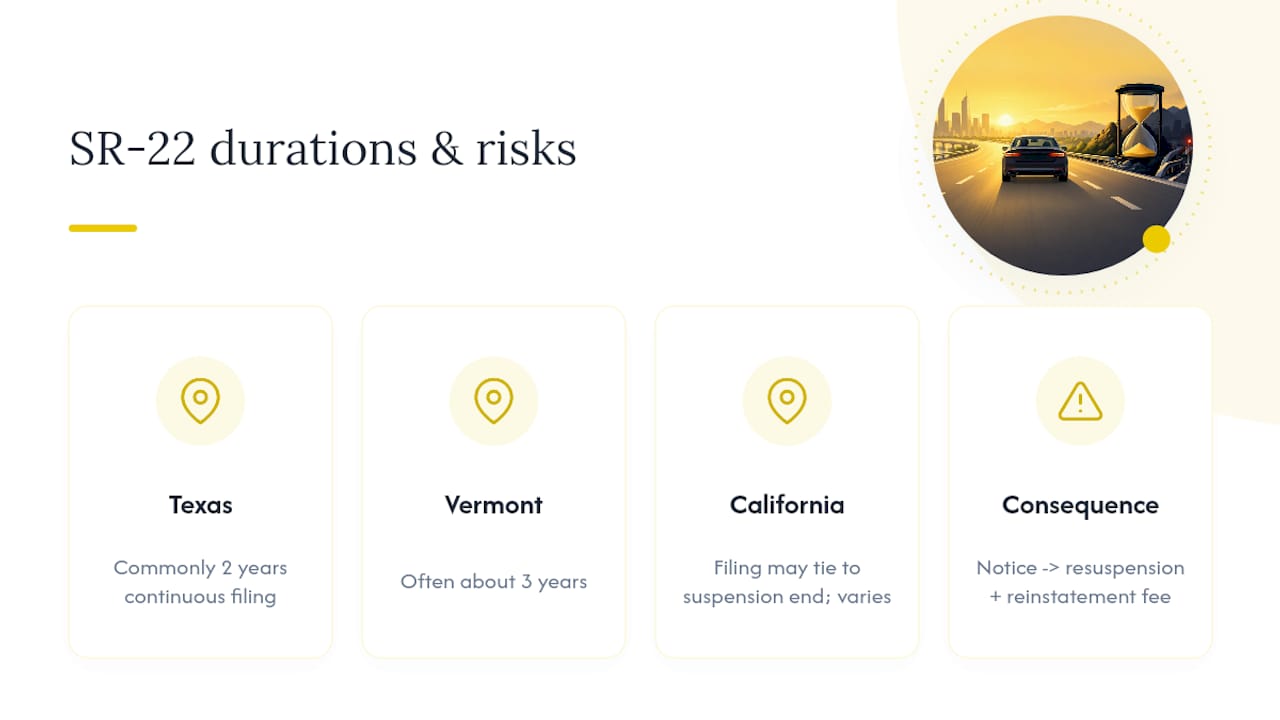
Duration depends entirely on your state and your offense. Texas commonly requires two years of continuous filing. Vermont often runs closer to three years. California sometimes ties the filing period to when your suspension actually ends, not to a fixed calendar date, which means two drivers with similar violations can finish at different times.
Lapses are the real danger here. Texas DPS confirms that insurers notify the state when an SR-22 policy is cancelled or lapses, and that notification can trigger resuspension, plus a reinstatement fee. The Oregon DMV treats a missed payment the same way: as a compliance failure, not a minor billing hiccup.
Before you cancel or switch anything, get written confirmation from your state DMV that your filing period has ended. Only then should you ask your insurer to remove the SR-22 from your policy.
SR-22 vs. FR-44, and Owner vs. Non-Owner Filings
FR-44 isn’t just a stricter version of SR-22. It’s a separate certificate requiring higher liability limits, and states like Virginia apply it to specific offenses rather than using it interchangeably with SR-22. Filing the wrong one delays your reinstatement and can mean redoing the paperwork.
The owner versus non-owner distinction matters just as much. An owner’s filing covers a vehicle you own; a non-owner filing covers you as a driver without an owned vehicle attached. Insurers need to know which one applies before they file anything.
Always confirm the exact form and limits on your notice, or call your state DMV directly, before requesting either filing type.
Checklist for Staying Compliant
A few habits separate drivers who clear their SR-22 cleanly from those who end up back at square one:
- Get written DMV confirmation of your exact end date before canceling anything
- Set up autopay with a buffer in your account, since a bounced payment reads as a lapse
- Request an itemized SR-22 quote every time you shop, separating premium, processing fee, and state fees
- Verify your insurer is licensed to file in the state issuing the requirement, especially if you’ve moved recently
The most common mistakes are letting a policy lapse near the end date, assuming the requirement, filing the wrong certificate type, and skipping a recheck after a move. If you’re also weighing what kind of coverage or vehicle makes sense once you’re past this requirement, our guide on insurance for new drivers covers similar cost mechanics worth understanding early.
Why Speed and Continuity Matter More Than the Paperwork
Most drivers treat the SR-22 like a one-time errand. It’s not. The filing itself takes an afternoon; staying compliant for two or three years is the part that actually determines whether this costs you a few hundred dollars or spirals into another suspension.
The processing fee is almost never the expensive part; understanding title loan rates and costs can help if you need short-term funds to cover fees or reinstatement costs. The premium increase and the risk of a lapse triggering resuspension are what actually cost drivers money and time. If you’re moving states or switching insurers mid term, don’t assume continuity carries over automatically. Get it in writing.
Where to Verify Your State’s SR-22 Rules
Start with the notice you received, then confirm details directly with your state DMV, including Oregon’s SR-22 page and Virginia’s certification guidance.
Sources
- Oregon DMV — SR-22 information
- Texas DPS — SR-22 / proof of financial responsibility FAQ
- Virginia DMV — insurance certifications (FR-44/SR-22 guidance)