
Dropping collision coverage usually makes financial sense only when your car is paid off, worth less than what you’d pay in premiums over a few years, and you have enough savings to cover a repair or replacement without going into debt. If you’re still making loan or lease payments, your lienholder almost certainly requires it. The two checks that matter most: run the 10% rule against your car’s market value, and make sure losing the car tomorrow wouldn’t wreck your budget.
TL;DR:
- Dropping collision coverage makes sense only if your car is paid off, worth less than your premiums over a few years, and you can cover repairs with savings.
- The 10% rule suggests you should consider dropping coverage if your annual premiums exceed 10% of your car’s current market value, adjusted by your personal financial situation.
- Lenders or leasing companies almost always require collision and comprehensive coverage until the car loan or lease is fully paid off.
- Rising repair costs, especially for advanced driver-assist systems and windshields, have shifted the threshold where dropping coverage becomes financially sound.
- Raising your deductible from $500 to $1,000 can cut premiums by about 20% to 25%, but only if you can afford the higher out-of-pocket expenses.
Collision Coverage vs. Comprehensive: What You’d Actually Lose
“Full coverage” isn’t a real insurance product. It’s shorthand for three things bundled together: liability, collision, and comprehensive. Understanding what each piece does is the only way to know what you’re actually giving up if you drop one and keep the other.
Collision pays for damage to your own car when you hit something, or something hits you, regardless of fault. Comprehensive covers everything else that isn’t a collision with another vehicle or object: hail, floods, theft, vandalism, a tree branch through your windshield, or a deer in the road.
- Collision: you back into a pole, sideswipe a guardrail, or rear-end someone in traffic.
- Comprehensive: hail dents your hood, someone breaks a window to steal your stereo, or your car floods in a storm.
- Ancillary coverage: rental reimbursement and some roadside assistance bundles are often tied to carrying physical-damage coverage, meaning if you drop collision and comprehensive, you may lose those add-ons too.
That last point trips people up. You call to drop collision, and three weeks later you’re stranded without a rental car after a fender bender because the reimbursement rider went with it. Ask your agent specifically which add-ons ride on your physical-damage coverage before you make any changes.
Does Any State Require Collision or Comprehensive Insurance?
No state in the U.S. requires collision or comprehensive coverage on a vehicle you own outright. Every state that mandates auto insurance requires liability coverage, which pays for damage and injuries you cause to others. Collision and comprehensive protect your own vehicle, and the decision to carry them is entirely yours once the car is paid off.
Lenders and leasing companies are a different story. If you have an auto loan or a lease, the lender or lessor is listed as a loss payee on your policy, and nearly all of them require both collision and comprehensive until the balance hits zero or the lease ends. Skip it, and you risk a default notice or force-placed insurance, which is almost always more expensive than what you’re already paying.
- Check your loan or lease agreement for the exact coverage minimums required.
- Call your lender once the loan is paid off and request written confirmation that the lien has been released.
- Don’t assume your insurer automatically knows the loan is gone. Update your policy yourself.
The 10% Rule and Other Thresholds Worth Knowing
The most widely used heuristic in the industry is the 10% rule: if your annual collision and comprehensive premiums add up to more than 10% of your car’s current market value, dropping the coverage is often the more rational move. A $500-a-year premium on a car worth $4,000 crosses that line. The same premium on a $20,000 car doesn’t come close.
Value thresholds get cited a lot too, though they’ve shifted. Older guidance pointed to $5,000 as the line where dropping starts to make sense. More recent advice pushes that closer to $7,500, mostly because repair costs have climbed. A cracked windshield on a car with driver-assist sensors isn’t a $200 fix anymore. It can run into thousands once cameras and calibration are involved.
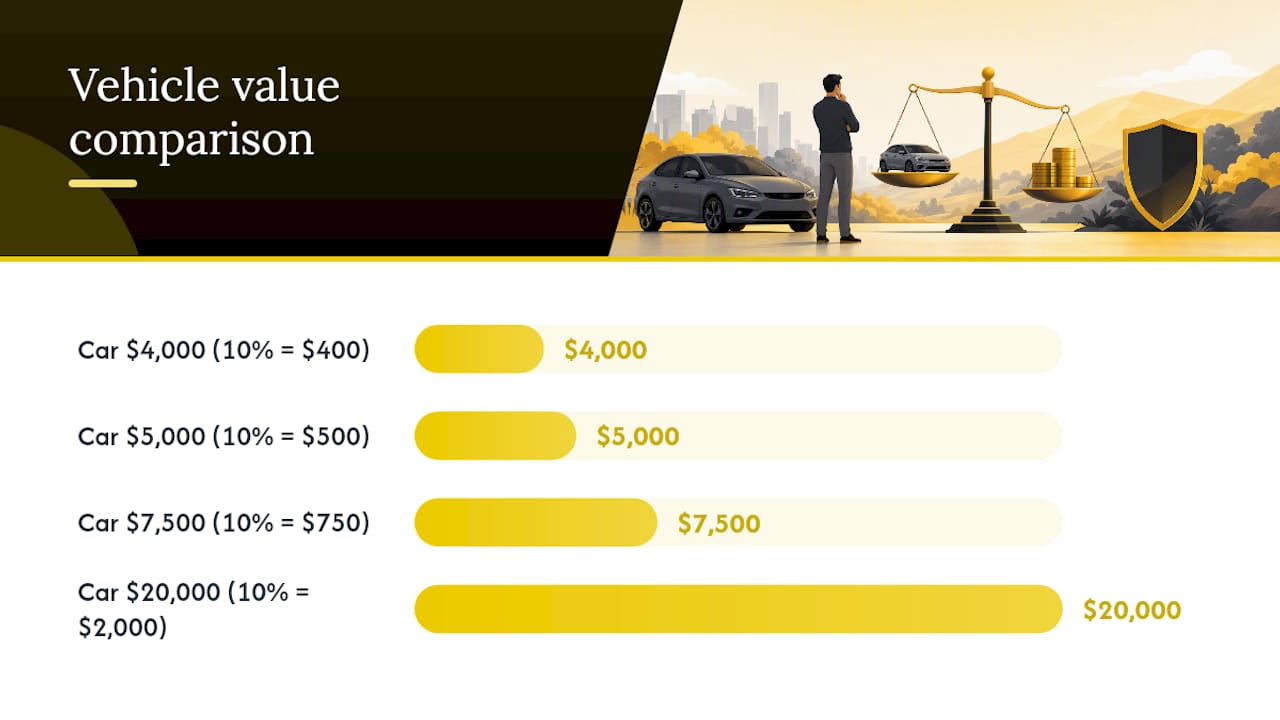
Before you lean on either rule, apply a savings check: do you have enough set aside to cover your deductible plus a meaningful chunk of a replacement vehicle? If the answer is no, the premium savings aren’t worth the exposure.
Your driving profile matters too. Long commutes, high annual mileage, a recent at-fault accident, or living somewhere prone to hail and flooding all push toward keeping coverage longer, even on an older car.
Pro Tip: Pull your last three years of claims history before deciding. A clean record for that stretch is a decent signal your actual risk is lower than the premium suggests.
A 5-Step Calculation to Run on Your Own Car
You don’t need a spreadsheet degree to figure this out. Run these five steps in order and you’ll land on a clear answer.
- Get your car’s real market value. Use Kelley Blue Book or Edmunds to pull a private-party or trade-in value based on your car’s actual mileage and condition, not a guess.
- Total your current premium. Add up what you’re paying annually for collision and comprehensive combined. Call your insurer if your bill doesn’t break it out by coverage type.
- Subtract your deductible. If your car is worth $6,000 and your deductible is $500, your likely payout in a total-loss claim is roughly $5,500, not the full value.
- Test it against the 10% rule. If that $600 annual premium is more than 10% of the car’s value, that’s a strong signal toward dropping. Under $6,000 in value with $600 in yearly premiums lands right at that 10% line.
- Weigh household reliance on the car. If losing it tomorrow would mean you can’t get to work, this changes the math even when the numbers say drop.
Those five steps sort into one of four outcomes: keep both coverages, keep comprehensive only, raise your deductible and keep both at a lower cost, or drop both and self-insure.
Dropping collision and comprehensive can save owners hundreds of dollars a year, but that only pays off if the car is paid off and you’ve got a real cushion to absorb a bad month. Run the math on your specific premium and value. Don’t borrow someone else’s rule of thumb without checking it against your own numbers.
Middle-Ground Options Besides Dropping Everything
You don’t have to choose between full coverage and none. A few middle paths keep some protection while trimming the bill.
Raising your deductible from $500 to $1,000 typically cuts collision and comprehensive premiums by a meaningful percentage, often in the 20% to 25% range, while keeping you protected against a total loss. The catch: you need that $1,000 sitting in an account, not tied up somewhere you can’t touch it fast.
- Keep comprehensive only if you’re in a hail-prone, flood-prone, or high-theft area but rarely drive, since collision risk is what you’re mostly paying to avoid.
- Open a separate savings account and route your premium savings straight into it, turning the decision into a real self-insurance plan rather than a hope.
- If a car sits in storage for months (a classic, a seasonal vehicle), ask your insurer about a comprehensive-only or reduced-usage policy instead of a full cancellation, since some states restrict how long a registered vehicle can go without any coverage at all.
Pro Tip: Ask your insurer directly whether they offer a “storage” or “layup” policy for seasonal vehicles. It’s often cheaper than full coverage and still protects against theft or fire while the car sits.
How to Actually Cancel or Change Your Coverage
Before you pick up the phone, confirm your loan or lease is fully paid off. Calling to drop collision while a lender still has a lien on the car is a fast way to trigger a compliance letter.
- Call your agent directly rather than making changes online, and ask which add-ons ride on your physical-damage coverage.
- Request rental reimbursement, towing, and glass coverage quotes as standalone options if you want to keep any of them.
- Get a written policy declaration showing the exact change and effective date, and save it along with your new ID card.
- Ask what happens if you want to reinstate collision later: some insurers apply a waiting period or reprice based on your driving record since the gap.
Keep a copy of everything. If a dispute ever comes up about what was covered on a given day, the declarations page is your proof.
What a Total Loss Actually Costs You
Numbers make this decision less abstract. A minor fender-bender repair often runs $1,000 to $3,000. A totaled vehicle means you eat the full market value minus your deductible, in cash, right now. Theft with no recovery is functionally the same as a total loss, except there’s no wreck to point to.
Modern repair costs are the wrinkle most people miss. Windshield replacement on a car with driver-assist cameras can run $1,000 to $2,000 once sensor recalibration is included, a bill that would’ve been a few hundred dollars a decade ago.
- Minor collision repair: roughly $1,000 to $3,000 depending on parts and labor.
- Total loss or theft with no recovery: full market value minus your deductible, paid out of pocket if you’ve dropped coverage.
- ADAS sensor and windshield replacement: $1,000 to $2,000, a cost that didn’t exist on older vehicles.
If saving $50 a month means it takes you two years to rebuild a $1,200 cushion, and your car could get totaled next week, the math isn’t as favorable as it looks on paper. If losing the car would mean missed work or a scramble for a loan, that’s your answer regardless of what the 10% rule says.
Changed Your Mind? Here’s How to Add Coverage Back
Re-adding collision or comprehensive is straightforward. Call your insurer, provide your current mileage and vehicle condition, and they’ll requote based on your driving record since the gap. Rates can shift if you’ve had a claim or a violation in the meantime, even a minor one.
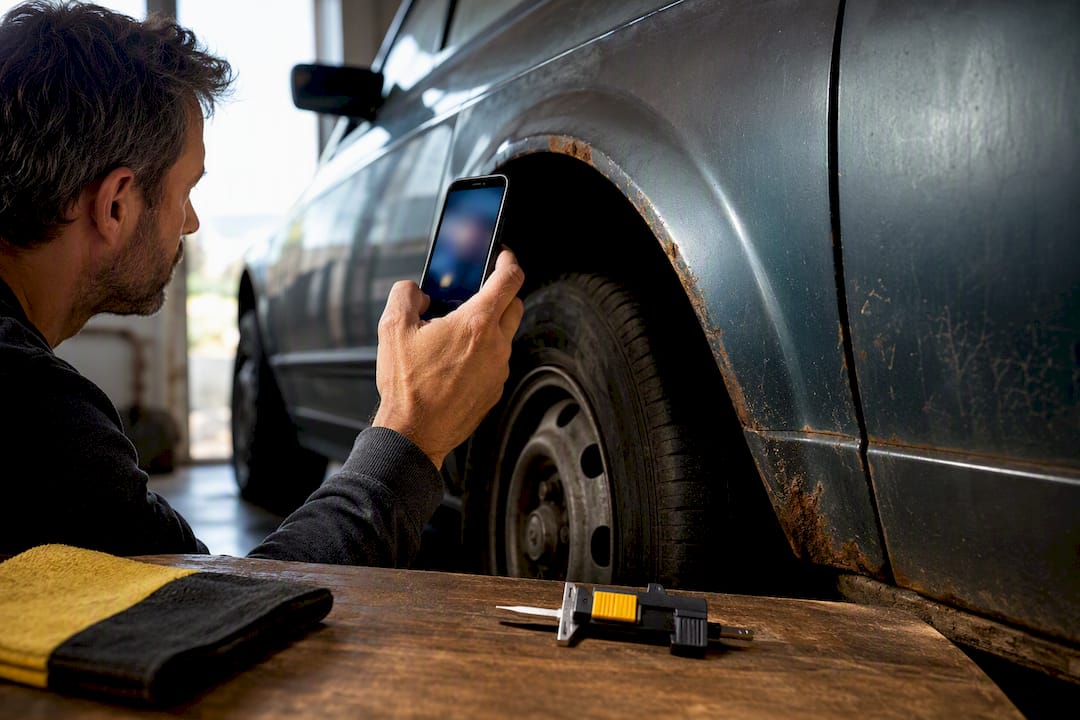
Before you drop coverage in the first place, take photos of your car’s condition and log the mileage. It’s the easiest way to head off a dispute later about whether damage happened during the gap or before it. And if you’re planning to replace the car within a year or two anyway, it’s worth revisiting your coverage choice at the time of purchase rather than locking in a decision now that won’t fit the next vehicle.
Why the 10% Rule Only Gets You Halfway There
Most articles on this topic stop at the math. That’s a mistake. A single earner with one car and no emergency fund should weigh a total loss very differently than a two-car household with savings to spare, even if their premiums and car values look identical on paper.
What gets underestimated is how much modern repair costs have moved the goalposts. A rule of thumb built around $5,000 vehicles and $500 windshields doesn’t hold up as well against ADAS sensors and $3,000 fender repairs. The math still works, but the threshold where dropping makes sense has crept higher than a lot of older advice assumes.
If you’re running these numbers, start with a real market value from a tool like Frenzycars, not a guess based on what you paid five years ago. Pair that with an honest look at your emergency fund, and the decision usually becomes obvious. It’s the households that skip the savings check who end up regretting it.
Run Your Own Numbers Before You Decide
Everything in this guide comes down to one number: what your car is actually worth today. Before you call your insurer, check your vehicle’s current market value using Frenzycars’ car specs and value tool, which pulls make and model data so you’re comparing your premium against a real figure instead of a guess. If raising your deductible looks like the smarter middle ground, our deductible breakdown walks through exactly how that trade-off plays out on your bill. And if you’re already eyeing a replacement vehicle down the line, browse Frenzycars’ best-cars guides to see what fits your budget before you’re forced into a decision by a wrecked car sitting in a tow lot.
This article is general information, not a substitute for advice from a qualified financial advisor. Consult a qualified financial professional about your own circumstances before acting on anything here.
Sources
- Collision insurance coverage guide for 2026
- When to drop collision and comprehensive insurance on a car
- When to Drop Collision and Comprehensive (Full Coverage)