
New car replacement insurance pays to replace your totaled or stolen new car with a brand-new equivalent, not the depreciated cash value of the old one, minus your deductible. Eligibility is limited, typically to cars between one and five years old with mileage caps, and it costs extra as an add-on to comprehensive and collision coverage. It matters most in the first year or two of ownership when depreciation outpaces what a standard policy pays out.
TL;DR:
- Eligibility for new car replacement insurance typically ranges from one to five years, with mileage caps usually around 15,000 to 24,000 miles, and leased vehicles are often excluded.
- The endorsement usually increases your insurer’s initial payout from actual cash value to the cost of a new equivalent vehicle, minus your deductible, with a premium increase around 5 to 10 percent.
- This coverage is most valuable within the first two years of ownership when depreciation exceeds the payout of standard policies, especially for financed vehicles with high depreciation rates.
- Combining new car replacement with gap insurance is advisable for financed buyers to cover both depreciation loss and remaining loan balance, but they serve different purposes.
- Eligibility criteria and coverage limits vary widely across carriers, so confirming specifics before purchasing and reading the terms carefully is essential to avoid surprises.
How Does New Car Replacement Coverage Work?
Standard comprehensive and collision coverage pays actual cash value, or ACV, when your car is totaled. That figure accounts for depreciation, mileage, and condition, so it almost always lands below what you paid at the dealership. New car replacement coverage closes that gap by paying for a new vehicle of the same make and model instead.
The claim sequence looks like this:
- The insurer inspects the vehicle and confirms it’s a total loss.
- An adjuster calculates the ACV as a baseline.
- The new car replacement endorsement raises that payout to cover a new equivalent vehicle.
- Your deductible gets subtracted from the final settlement.
- If you still owe money on a loan, the lender gets paid first from the proceeds.
Coverage only kicks in on total losses declared by the insurer, not on repairable damage, and it generally requires both collision and comprehensive coverage to be active. If your exact trim was discontinued or the model year sold out, don’t expect a delivery truck at your door. Insurers typically substitute the closest comparable model or cut a cash check instead, according to Kin.
What Are the Eligibility Rules and Common Exclusions?
Carriers don’t all draw the line the same way, and that inconsistency trips up a lot of shoppers who assume “new car replacement” means the same thing everywhere. Eligibility windows vary from about one year and 15,000 miles up to five years, depending on the insurer.
- Liberty Mutual caps its New Car Replacement™ endorsement at one year or 15,000 miles, whichever comes first.
- Travelers extends coverage up to five years under its Premier package.
- Farmers and Erie commonly set the window around two years or 24,000 miles.
Most carriers require you to be the original owner and carry comprehensive and collision. Leased vehicles are frequently excluded outright, since the leasing company already owns the depreciation risk. Salvage or rebuilt titles disqualify a car automatically, and certain aftermarket modifications can void the endorsement. Once you cross the age or mileage threshold, the coverage simply expires, even if you never filed a claim. If your model is discontinued by claim time, expect a substitute vehicle rather than an identical replacement.
Is New Car Replacement Insurance Worth the Cost?
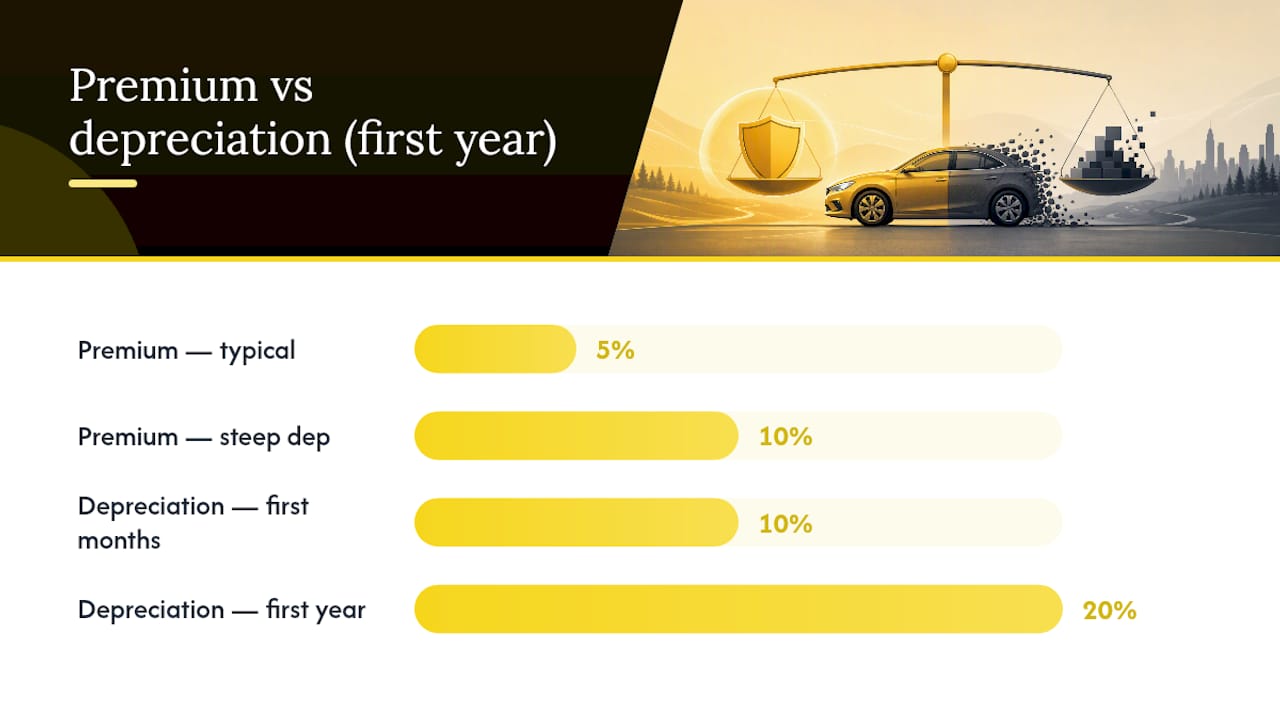
Adding this endorsement typically raises your premium by about 5%, though the exact bump depends on your base premium, your driving record, and how fast your specific model depreciates. Some insurers price it closer to 10% for vehicles with steep first-year depreciation curves.
It earns its keep for financed buyers, high-depreciation models, and anyone without a cash cushion to cover a payout shortfall. It’s less useful for older vehicles, cars with slow depreciation curves like some trucks and SUVs, or drivers who could self-fund the gap without much strain.
New vehicles can lose roughly 10% of their value in the first few months and around 20% within the first year. Picture a $40,000 car totaled at month eight: ACV might land near $34,000, but replacing it new could run closer to $41,000 with taxes and fees. That $7,000 gap dwarfs a premium increase that might only add $50 to $80 a year.

Pro Tip: Ask your insurer for a specific dollar quote on the endorsement rather than accepting “about 5%” as gospel. Depreciation curves differ wildly by model, and so does the actual premium impact.
Truckplant’s guide on how premiums are calculated breaks down the risk factors insurers weigh when pricing add-ons like this one.
Is New Car Replacement Insurance the Same as Gap Insurance?
They solve different problems, and mixing them up is one of the most expensive mistakes a financed buyer can make. New car replacement pays to buy a new equivalent vehicle after a total loss. Gap insurance covers the difference between your ACV payout and what you still owe on your loan or lease, nothing more.
- If you owe more than the car is worth, gap insurance protects your loan balance.
- If you want an actual new car instead of depreciated cash, replacement coverage does that job.
- Neither product automatically covers what the other does.
| Product | Pays for | Covers loan gap? | Buys a new car? |
|---|---|---|---|
| New car replacement | Cost of a new equivalent vehicle | No | Yes |
| Gap insurance | Loan/lease balance minus ACV | Yes | No |
Financed buyers with little equity often need both, since carriers and comparison guides recommend pairing the two when the loan balance and depreciation risk are both high. Read our gap insurance guide for the mechanics.
How Do You Add New Car Replacement Coverage to Your Policy?
Call your carrier or agent and work through this list before you sign anything:
- Ask the exact eligibility window: is it age-based, mileage-based, or both?
- Confirm the mileage cap and what happens the day you cross it.
- Ask how the deductible applies to the uplifted payout, not just the ACV base.
- Ask what happens if your exact trim is discontinued by claim time.
- Ask whether gap coverage can be bundled in for financed vehicles.
Once you’ve got quotes, pull up your declarations page and confirm the endorsement is actually listed by name, not just implied by a sales rep. Dealer-sold gap add-ons bundled into your loan often cost more than a carrier’s own endorsement and can duplicate coverage you already have. Compare the dealer’s paperwork against a direct quote from your insurer before committing.
Pro Tip: If a dealer quotes gap or replacement coverage as part of your financing paperwork, ask your existing auto insurer for a competing quote first. It’s common for the same coverage to run cheaper through your regular carrier.
What Happens After You File a Total-Loss Claim?
The process runs through a predictable sequence, though the timeline can stretch depending on how contested the valuation gets. Total-loss claims commonly settle within a few weeks after inspection and valuation, assuming no disputes arise.
- The insurer inspects the vehicle and issues an ACV offer.
- The new car replacement endorsement, if active, raises that offer to new-vehicle cost.
- Your lender is paid directly from the settlement if you still owe on the loan.
- Any remaining loan balance beyond the payout becomes your responsibility unless gap insurance covers it.
- You can dispute an ACV offer by submitting comparable listings, recent sales data, or an independent appraisal.
Keep your original purchase invoice and option list on hand. Documented dealer listings for the same trim strengthen a dispute if the insurer’s number looks low. If the insurer and you can’t agree, most states allow an appraisal clause process or a complaint to the state insurance regulator. Our claim filing guide walks through documentation steps in more detail.
Frenzycars Perspective: What New Buyers Get Wrong
Most new-car buyers shop for the sticker price and skip the insurance conversation until after the paperwork’s signed, which is exactly backward. Check eligibility windows before you buy, not after, since a five-year gap between what you assumed and what your carrier actually offers can leave you exposed right when depreciation hits hardest.
Compare real ACV examples for your specific model, not generic depreciation averages. Pair replacement coverage with gap insurance if you’re financing with a small down payment. And read the deductible language twice. Some buyers assume replacement coverage means “new car, no strings,” then get surprised when their standard deductible still applies to the uplifted payout.
The biggest mistake we see: buyers assume all “new car replacement” policies work identically across carriers. They don’t. One insurer’s one-year window is another’s five-year window, and that difference alone can determine whether you’re covered when it matters. Once you’ve settled a claim and you’re shopping for the next vehicle, browsing specs by make and model helps you factor depreciation curves into your next purchase decision, or check our best cars by category guides if you’re replacing an SUV or sedan.
Why This Coverage Rewards Speed, Not Just Ownership
The conventional advice tells buyers to “consider” new car replacement coverage as a nice-to-have. That undersells it. The math only works in a narrow window, generally the first one to two years of ownership, when depreciation is steepest and the gap between ACV and replacement cost is largest. After three years, that gap typically narrows enough that the endorsement stops paying for itself.
It isn’t. A high-depreciation EV or a fast-selling trim can justify a bigger premium hit than a slow-depreciating truck, so the real question isn’t “does this cost 5%?” It’s “what’s my model’s actual depreciation curve, and does that gap justify the quote in front of me?”
If you’re financing a new car in 2026 with less than 10% down, prioritize gap coverage first, then layer in new car replacement if your carrier’s eligibility window still fits your ownership timeline. Buyers who skip that order often end up paying for overlapping protection they didn’t need.
Sources
- New car replacement coverage — Kin
- New Car Replacement Insurance – Forbes Advisor
- New Car Replacement Insurance: Is It Worth the Cost? — Business Insider
- New Car Replacement™ Insurance — Liberty Mutual