
TL;DR:
- The best time to buy a car is during the last few days of December due to stacked dealer pressures and deeper discounts.
- Preparedness, such as preapproved financing and timing visits on lighter traffic days, significantly enhances negotiation power.
The best time to buy a car is the last few days of any month, with late december offering the deepest discounts of the year. Knowing what is best time buy car means understanding how dealer sales quotas, manufacturer holdback bonuses, and inventory pressure create predictable windows of savings. The last 3–5 days of any month produce out-the-door prices 4–8% lower than mid-month, saving $1,600–$3,200 on a $40,000 vehicle. That gap exists because dealers are chasing monthly targets, not just trying to move metal. Pair that timing with financial readiness and disciplined negotiation, and you can walk away with a deal most buyers never see.
Why end of month and end of quarter are the best times to buy a car
Dealer motivation is the engine behind every discount. Each month, manufacturers set volume targets for their dealers. Hit those targets and the dealer unlocks a holdback bonus worth tens of thousands of dollars. Miss them and that money disappears entirely.

That math changes everything at the end of the month. A dealer bonus for monthly volume can offset a $500 loss per unit sold. That means a salesperson will accept a deal that loses money on paper if it pushes the store over the quota line. Buyers who show up on the 28th, 29th, or 30th of the month are negotiating with a dealer who is financially motivated to say yes.
Quarter-end months, specifically march, june, september, and december, add another layer of pressure. Dealers face both monthly and quarterly targets at the same time. That stacking effect means the discounts available at the end of a quarter are reliably larger than those at the end of a regular month.
Here is what drives the end-of-period discount window:
- Monthly quota pressure: Dealers need a set number of sales to unlock manufacturer bonuses.
- Holdback mechanics: A $500 per-unit loss is acceptable when a $30,000+ bonus is on the line.
- Quarterly layering: March, june, september, and december combine monthly and quarterly targets simultaneously.
- Low weekend traffic: Fewer competing buyers on weekday evenings near month-end means dealers focus more attention on each prospect.
Pro Tip: Visit the dealership on a Tuesday or Wednesday evening in the last week of the month. Tuesday and Wednesday are the best days to shop because dealer traffic is lighter and manager responsiveness is higher. You get more attention and more flexibility on price.
Why late december is the single strongest buying window
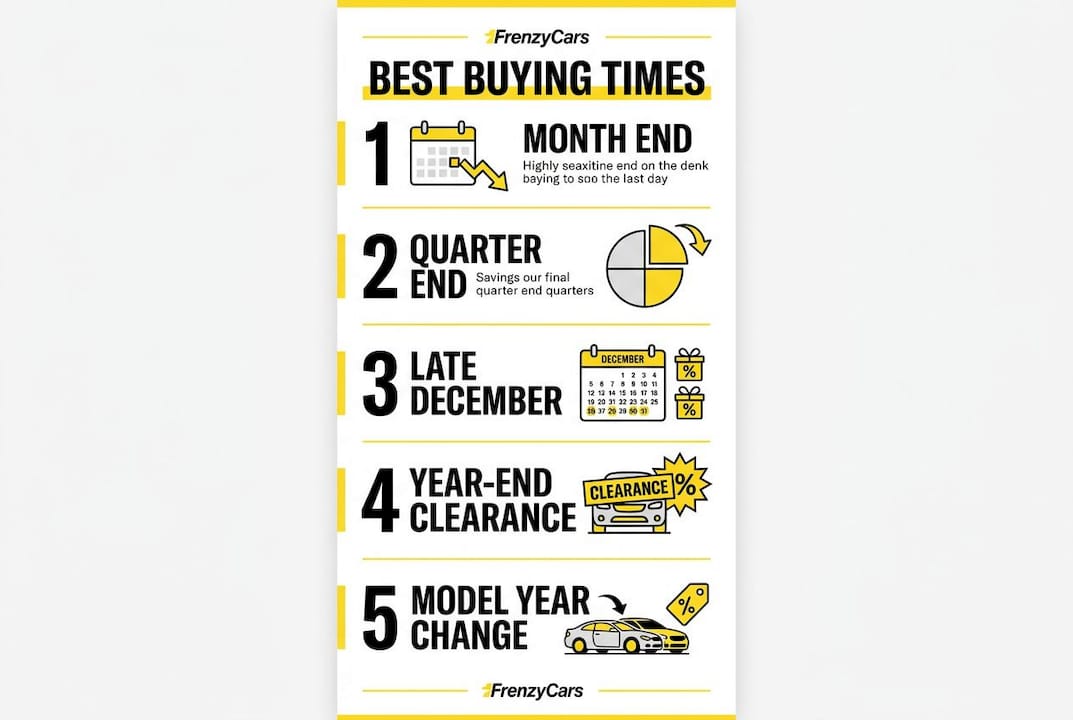
December 26–31 is the most powerful buying window of the year. No other period stacks as many dealer motivators at once. End of month, end of quarter, end of year, and manufacturer bonus periods all converge in those final six days.
December 26–31 offers 6–12% discounts by combining every pressure point a dealer faces. That range translates to $2,400–$4,800 off a $40,000 vehicle before any negotiation. Reduced buyer traffic during the holiday week makes dealers even more eager to close deals.
Year-end also triggers clearance pricing on aging inventory. Vehicles that have sat on the lot since the summer model-year changeover are now a full calendar year old. Dealers want them gone before January, when those cars officially become “last year’s model” on paper. Manufacturers add fuel to this fire with year-end incentives including cashback offers and low APR financing, sometimes as low as 0% on select models.
| Timing window | Discount range | Key driver |
|---|---|---|
| Last 3–5 days of any month | 4–8% | Monthly quota pressure |
| End of quarter (march, june, sept, dec) | 5–9% | Monthly + quarterly targets stacked |
| December 26–31 | 6–12% | Month + quarter + year + holiday overlap |
| Model-year changeover (aug–oct) | 5–10% on prior models | New inventory arrival, clearance pricing |
One real limitation exists in late december: inventory selection shrinks. Popular trims and colors sell out first. If you need a specific configuration, shop earlier in december to lock in the model you want, then negotiate hard on price.
Pro Tip: Contact the internet sales manager by email before you visit. Pre-negotiating out-the-door prices by email removes surprises and gives you a written baseline to work from before you step on the lot.
How model-year changeover creates discount opportunities
The model-year changeover window runs from august through october. New model-year vehicles begin arriving at dealerships, and dealers need floor space. Prior-year models suddenly become a liability rather than an asset.
August through october is when dealers discount last year’s models most aggressively to clear inventory. The savings are real, but the depth of the discount depends on one key factor: whether the new model received a major redesign or just a minor refresh.
A heavily redesigned model creates the biggest opportunity. When a manufacturer releases a completely new generation of a vehicle, the outgoing model looks dated immediately. Dealers know buyers will compare the two, so they cut prices sharply to move the old stock. A minor refresh, like updated trim levels or a new color option, creates far less urgency.
Key points to understand about the changeover window:
- Timing: New model-year vehicles typically arrive between august and october, varying by manufacturer.
- Redesign effect: Fully redesigned models see steeper discounts on the outgoing generation than lightly refreshed ones.
- Inventory risk: Popular trims of the outgoing model sell quickly once discounts go deep. Act early in the window for the best selection.
- Hybrid and electric models: These segments see faster model evolution, making the hybrid vs. electric choice worth researching before the changeover window opens.
The changeover window is especially useful for buyers who are flexible on model year. Buying a prior-year vehicle at a 7–10% discount is often a better financial decision than paying full price for the newest version of the same car.
How buyer preparedness strengthens your timing advantage
Timing alone does not guarantee a good deal. Preapproved financing and a clear budget are often more effective than timing alone for securing a favorable deal. Experian and NerdWallet both identify financial preparedness as the top buyer asset in any negotiation.
A preapproval from your bank or credit union does two things. First, it tells you your real budget before a dealer’s finance office gets involved. Second, it gives you leverage. Dealers make money on financing. When you walk in with a competing offer, they have to beat it or lose that revenue.
Follow this sequence to maximize your position:
- Get preapproved for financing at your bank or credit union before visiting any dealership.
- Set a firm out-the-door budget that includes taxes, fees, and registration, not just the sticker price.
- Email the internet sales manager at multiple dealerships requesting out-the-door price quotes on the specific vehicle you want.
- Use competing quotes as leverage when you visit in person. Dealers respond to written offers from other stores.
- Visit on a Tuesday or Wednesday in the last week of the month for maximum dealer responsiveness.
- Be willing to walk away. A walk-away mindset is your strongest negotiation tool, especially late in the month when dealers need the sale more than you do.
Pro Tip: Never reveal your monthly payment target to a dealer. Dealers use monthly payment framing to obscure the total cost of the vehicle. Always negotiate the out-the-door price first, then discuss financing separately.
Avoid shopping on weekends. Weekend traffic gives dealers more leverage because they have other buyers waiting. A slow Tuesday afternoon in late month puts you in the driver’s seat.
How timing works differently for used cars
Used car pricing follows different rules than new car pricing. Used car pricing relates more to vehicle age in inventory than to the calendar month. A car that has sat on a dealer’s lot for 60–90 days will see discounting regardless of whether it is march or october.
Dealers track days-in-inventory closely. A vehicle aging past 45 days starts costing the dealer money in floor plan interest. Past 90 days, that pressure becomes significant. Buyers who ask how long a specific used vehicle has been on the lot gain real negotiating power.
| Factor | New car timing | Used car timing |
|---|---|---|
| Best calendar window | Late december, end of month | Any time a vehicle is 60–90+ days old |
| Primary discount driver | Dealer quotas and manufacturer bonuses | Days in inventory and floor plan costs |
| Spring buying season | Expensive due to tax refund demand | Spring is peak demand, avoid if possible |
| Year-end advantage | Strong, multiple motivators stack | Moderate, more trade-ins available |
Spring, from march through may, is the most expensive time to buy any car. Tax refunds fuel demand, and dealers feel no urgency to discount. Used car buyers should avoid this window unless they find a specific vehicle with high days-in-inventory that offsets the seasonal premium.
Late year does bring one used car benefit: higher trade-in volume. When new car sales peak in december, dealers take in more trade-ins. That increased supply can create better selection and slightly softer pricing on used inventory in january and february. For used car buyers, checking the trade-in value guide before you shop helps you understand what dealers paid for the vehicles on their lot.
Key Takeaways
The best time to buy a car is the last few days of december, when end-of-month, end-of-quarter, and year-end dealer pressures stack together to produce the deepest discounts of the year.
| Point | Details |
|---|---|
| Late december is the strongest window | December 26–31 stacks month, quarter, and year-end pressure for 6–12% discounts. |
| End of any month saves money | The last 3–5 days of each month produce 4–8% lower out-the-door prices due to quota pressure. |
| Model-year changeover opens savings | August through october brings steep discounts on prior-year models as new inventory arrives. |
| Financial readiness multiplies timing | Preapproved financing and a firm budget give buyers leverage that calendar timing alone cannot provide. |
| Used cars follow inventory age, not seasons | Vehicles aged 60–90+ days on a dealer’s lot discount regardless of the time of year. |
The timing trap most buyers fall into
I have watched buyers obsess over the calendar and completely ignore their own financial position. They wait for late december, show up at a dealership with no preapproval and no competing quotes, and then wonder why the deal felt flat. Timing opens the door. Preparation is what walks you through it.
The real insight I have gained from years of tracking car deals is this: dealer motivation is predictable, but it only works in your favor when you are ready to close. A dealer who needs one more sale to hit quota will give you a real discount, but only if you look like a buyer who can actually sign today. Vague interest gets vague pricing. A preapproval letter and a written competing quote get a manager in the room.
I am also cautious about high-demand vehicles. A scarce model, a newly released electric vehicle, or a limited trim does not discount well even in late december. Supply and demand fundamentals override calendar timing when inventory is tight. If the car you want has a waiting list, timing strategy is largely irrelevant. Your energy is better spent on evaluating safety ratings and confirming the right model before you negotiate.
Patience is the underrated skill in car buying. The buyers who get the best deals are not the most aggressive. They are the most prepared, the most flexible on timing, and the most willing to walk away.
How Frenzycars helps you buy smarter
Knowing when to buy is only half the equation. Knowing exactly what to buy, and what it should cost, is where most buyers lose ground. Frenzycars publishes detailed car specs by make and model so you can compare trims, features, and configurations before you walk into a dealership. That preparation stops dealers from upselling you on packages you do not need. The best cars by category section helps you identify which models offer the strongest value during discount windows like the model-year changeover and year-end sales. Use both resources to build your shortlist before you start negotiating.