
TL;DR:
- Consumers should consider NHTSA, IIHS, and Consumer Reports for comprehensive vehicle safety insights. Ratings reflect specific test conditions and trim levels, so verifying standard features on the exact vehicle is essential. Using multiple sources before buying ensures a complete understanding of a car’s safety performance.
For any car buyer in the U.S., three sources cover the ground that matters: NHTSA’s 5-Star Safety Ratings, the IIHS grading system with its Top Safety Pick awards, and Consumer Reports’ independent evaluations. Together they tell you how a vehicle holds up in a crash, whether its crash-avoidance tech actually works, and how it has performed over years of real-world ownership. No single source gives you the complete picture on its own.
The three must-watch rating sources for U.S. buyers:
- NHTSA (National Highway Traffic Safety Administration): Government-mandated 1–5 star ratings for frontal crash, side crash, and rollover resistance. Scores appear directly on the Monroney window sticker.
- IIHS (Insurance Institute for Highway Safety): Independent nonprofit using a Good/Acceptable/Marginal/Poor scale, plus Top Safety Pick (TSP) and Top Safety Pick+ (TSP+) awards that factor in crash-avoidance tech and headlight performance.
- Consumer Reports: Independent evaluations combining crash-test data, reliability surveys, and owner-reported repair histories for a long-term ownership perspective.
Pro Tip: A TSP+ badge on a vehicle’s marketing materials means nothing if the headlights or automatic emergency braking that earned it are optional on the trim you’re actually buying. Always confirm which features are standard on your specific trim before you sign.
## 1. What NHTSA’s 5-Star ratings actually measure
NHTSA runs the New Car Assessment Program (NCAP), the federal government’s consumer-facing crash-test program. Every new vehicle sold in the U.S. must display its NHTSA star ratings on the Monroney label, the window sticker you see at every dealership. That mandatory placement is what makes NHTSA the baseline: you can check a vehicle’s score before you even sit down with a salesperson.
The program assigns 1–5 stars across three test categories: frontal crash, side crash, and rollover resistance. Frontal crash ratings are reported separately for the driver and front passenger, and NHTSA also publishes an Overall Vehicle Score that combines frontal, side, and rollover results. Five stars is the highest achievable in any single category.
One critical comparability rule: frontal crash tests are run into a fixed barrier at 35 mph, and the results are only directly comparable between vehicles within roughly 250 pounds of each other. A compact sedan and a full-size SUV can both earn 5 stars, but that does not mean they would perform identically in a real collision between the two. NHTSA recently finalized significant updates to NCAP, adding pedestrian protection and a roadmap for incorporating advanced driver assistance technologies over the next decade.
| NHTSA Test | What It Measures | Comparability Note |
|---|---|---|
| Frontal crash (driver) | Injury risk to driver in a head-on collision at 35 mph | Compare only within ±250 lbs of vehicle weight |
| Frontal crash (passenger) | Injury risk to front passenger in same scenario | Reported separately from driver score |
| Side barrier crash | Protection in a side-impact from another vehicle | Front and rear seat ratings reported separately |
| Side pole crash | Protection when striking a narrow object (e.g., a tree) | Combined with barrier for front/rear seat scores |
| Rollover resistance | Likelihood of rolling over in a single-vehicle crash | Includes dynamic handling test; “tip-up” noted if applicable |
Practical tips for reading NHTSA scores:
- Check the Overall Vehicle Score first, then drill into individual test scores for any category that concerns you.
- Never add driver and passenger frontal scores together; a 5-star driver score plus a 5-star passenger score is not a “10-star” rating.
- Use the NHTSA ratings search tool to look up any model by year, make, and model before visiting a dealership.
- A vehicle rated “Not Rated” still meets all Federal Motor Vehicle Safety Standards (FMVSS); it simply has not gone through NCAP supplemental testing yet.
## 2. How IIHS ratings and TSP/TSP+ awards work
The Insurance Institute for Highway Safety is an independent nonprofit funded by auto insurers, which means its incentives are aligned with reducing real-world crash costs rather than meeting a government mandate. Where NHTSA uses stars, IIHS uses a four-tier scale: Good, Acceptable, Marginal, and Poor. Good is the top grade; Poor is the bottom.
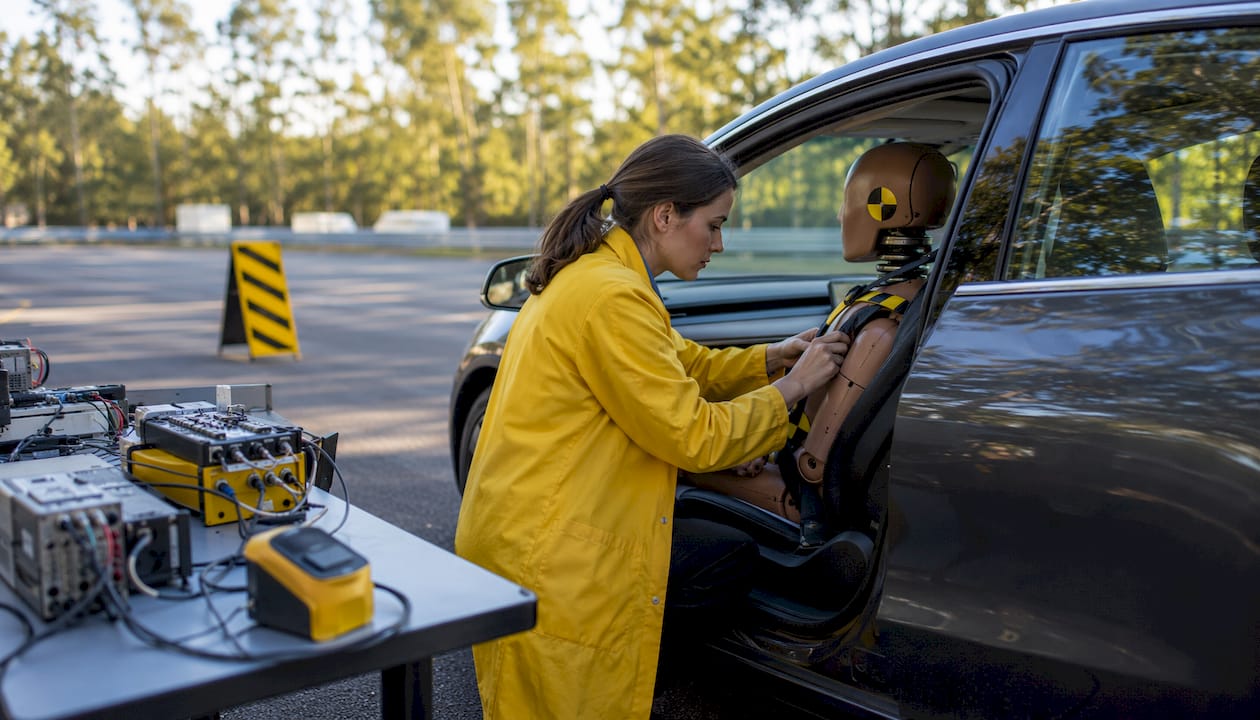
The TSP and TSP+ awards layer on top of those grades. To earn a TSP, a vehicle needs Good ratings across the major crashworthiness tests and at least an Advanced rating in front crash prevention. TSP+ is the higher tier: it requires the same crashworthiness performance plus standard, high-performing headlights. That headlight requirement is the single most common reason a vehicle earns TSP but not TSP+. Headlights that are only available as an upgrade on higher trims will not qualify a base-trim vehicle for TSP+.
IIHS runs a broader test menu than NHTSA, specifically designed to reveal vulnerabilities that federal tests do not yet cover:
- Small overlap front (driver side)
- Small overlap front (passenger side)
- Moderate overlap front
- Side barrier
- Roof strength
- Head restraints and seats
- Headlight evaluation
- Front crash prevention (vehicle-to-vehicle and vehicle-to-pedestrian)
Pro Tip: Before you finalize a trim choice, pull up the IIHS award page for that exact model and year and check whether the headlights and AEB listed as qualifying equipment are standard or optional on the trim you’re considering. That one check can change your decision.
| IIHS Test / Criterion | What It Evaluates | Buyer Action |
|---|---|---|
| Small overlap front (driver) | Structural integrity in a small overlap frontal crash | Check for Good rating; Acceptable or below is a concern |
| Small overlap front (passenger) | Same scenario for the passenger side | Newer test; fewer vehicles have been evaluated |
| Moderate overlap front | Broader frontal impact, moderate overlap | Core crashworthiness indicator |
| Side barrier | Lateral impact protection | Look for Good; compare to NHTSA side score |
| Roof strength | Crush resistance in a rollover | Good = roof holds at least 4× vehicle weight |
| Headlights | Visibility at night on curves and straights | Must be standard for TSP+ eligibility |
| Front crash prevention | AEB performance, vehicle and pedestrian | Must rate Advanced or Superior for TSP; Superior for TSP+ |
Understanding how optional packages affect standard equipment is directly relevant here: a feature listed in IIHS award criteria must be standard on your trim to count.
## 3. Other rating sources worth checking
NHTSA and IIHS cover the core of what U.S. buyers need, but three additional sources fill specific gaps.
Consumer Reports synthesizes crash-test data from both NHTSA and IIHS, layers in reliability data from hundreds of thousands of owner surveys, and tracks repair frequency by model year. That combination is particularly useful when you’re comparing two vehicles that both carry TSP+ awards but have different ownership histories. Consumer Reports also flags models with unusually high rates of specific system failures, which no crash-test score captures.
Euro NCAP is the European equivalent of NHTSA’s NCAP program. It runs its own test protocols, which differ from U.S. standards in meaningful ways. Euro NCAP scores are worth checking when you’re researching a model sold in both markets, particularly European-origin vehicles, but treat them as supplemental context rather than a direct substitute for U.S. ratings. Test conditions, barrier types, and scoring criteria are not identical.
SaferCar and NHTSA’s recall database round out the picture. A vehicle can score 5 stars across every NHTSA test and still have an open recall affecting a safety-critical system. Checking recall history is a separate step from reading crash-test scores.
When to consult each source:
- Consumer Reports: When comparing two similarly rated vehicles and you want long-term reliability and repair data to break the tie.
- Euro NCAP: When researching a European-market model or a vehicle sold globally, as a secondary reference only.
- SaferCar / NHTSA recall database: For every vehicle, every time, before purchase. An open recall is a safety issue that ratings do not reflect.
- NHTSA + IIHS together: The primary combination for any U.S. new-car purchase decision.
## 4. Every crash test type explained
Understanding what each test actually simulates helps you read ratings with more precision than a star count alone provides.
| Test Type | What It Simulates | Primary Injury Risk Measured |
|---|---|---|
| Frontal full-overlap | Head-on collision with another vehicle or barrier | Head, chest, and leg injuries to front occupants |
| Moderate overlap front | Offset frontal crash (40% of front end) | Structural intrusion, airbag performance |
| Small overlap front | Corner impact (small overlap on driver or passenger side) | A-pillar and footwell intrusion; door hinge integrity |
| Side barrier | Another vehicle striking the door at speed | Thorax and head injuries to near-side occupants |
| Side pole | Narrow-object side impact (tree, utility pole) | Head injury; curtain airbag deployment |
| Roof strength | Crush load applied to roof in a rollover | Occupant headroom survival space |
| Rollover resistance | Dynamic handling maneuver plus static stability factor | Likelihood of rollover in a single-vehicle crash |
| Pedestrian AEB | Vehicle approaching a pedestrian dummy at test speeds | Automatic braking effectiveness before impact |
A few distinctions worth knowing: structural tests (small overlap, roof strength) reveal whether the vehicle’s body holds its shape under load, while restraint tests (frontal, side) measure how well airbags and seatbelts manage occupant movement once the structure has done its job. Both matter, but they reveal different things. A vehicle can have a strong structure and mediocre restraint performance, or vice versa.
Shopping implications from the test lineup:
- If rollover risk concerns you (SUVs, taller vehicles), prioritize the NHTSA rollover star rating and roof strength score.
- Small overlap scores matter most for the kind of offset frontal crashes that happen when vehicles drift across the center line.
- Side pole scores are especially relevant for urban driving, where narrow-object impacts are more common.
- Pedestrian AEB evaluations are increasingly important as more crashes involve pedestrians and cyclists.
## 5. Crash avoidance and mitigation: what gets tested and why it matters
Crash-avoidance technology has become a central part of how both NHTSA and IIHS evaluate vehicles, not just a bonus feature. IIHS evaluates front crash prevention in two scenarios: vehicle-to-vehicle and vehicle-to-pedestrian. Performance is rated on a tiered scale: Basic, Advanced, or Superior. TSP requires at least Advanced; TSP+ requires Superior in the relevant categories.
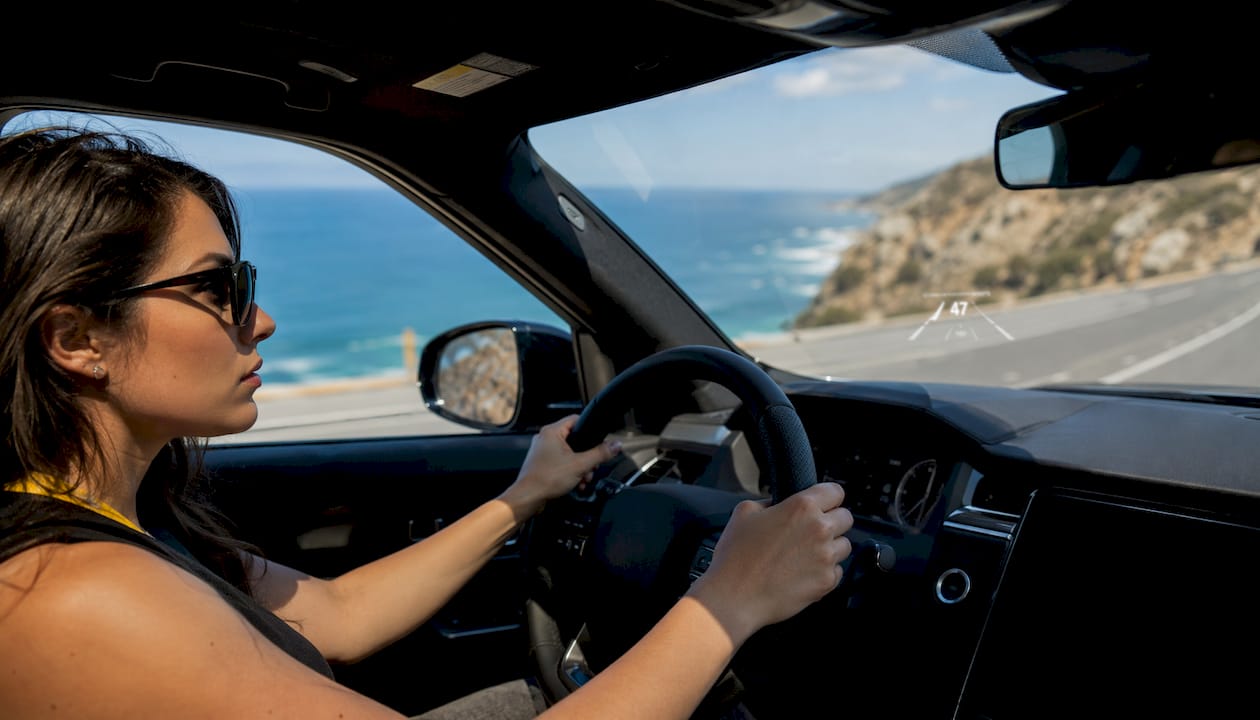
NHTSA’s updated NCAP program now incorporates advanced driver assistance systems (ADAS) into its evaluation framework, reflecting a broader shift toward assessing technologies like automatic emergency braking, lane-keeping assist, and blind-spot monitoring as part of overall vehicle safety. For a deeper look at how ADAS sensors interact with vehicle systems, ADAS windshield technology explains the hardware side of how these systems work.
The crash-avoidance features buyers should prioritize:
- Automatic emergency braking (AEB), vehicle-to-vehicle: The single most impactful active safety feature in real-world crash reduction. Confirm it is standard, not a package add-on.
- Automatic emergency braking, vehicle-to-pedestrian: Increasingly tested by IIHS; performance varies significantly between models.
- Adaptive headlights / advanced headlights: IIHS headlight evaluations have revealed wide performance gaps between models that look identical on paper. This is the feature most likely to separate TSP from TSP+.
- Lane-keeping assist: Evaluated differently by NHTSA and IIHS; useful but less decisive for award eligibility than AEB.
- Blind-spot monitoring: Not currently a primary award criterion but relevant for real-world driving.
Pro Tip: When you’re at the dealership, ask the salesperson to show you the window sticker and point to each safety feature you care about. If it says “available” or lists a package name next to it, it is not standard on that trim.
## 6. How NHTSA stars and IIHS grades map to each other
The two scales measure overlapping but not identical things, and treating them as a direct translation leads to mistakes.
| NHTSA Stars | General Meaning | Closest IIHS Equivalent | Key Caveat |
|---|---|---|---|
| 5 stars | Lowest injury risk in that test category | Good | Tests differ; a 5-star NHTSA score and a Good IIHS score are not the same test |
| 4 stars | Low injury risk | Acceptable | IIHS Acceptable can still indicate structural concerns |
| 3 stars | Moderate injury risk | Marginal | A 3-star NHTSA score warrants closer review |
| 1–2 stars | Higher injury risk | Poor | Rare in modern vehicles; a serious red flag |
| Not Rated | No NCAP test conducted | Not Evaluated | Does not mean unsafe; FMVSS compliance still required |
Three limits to keep in mind when reading both scales together. First, the test sets are different: NHTSA does not run a small-overlap test, and IIHS does not produce a rollover star rating. Second, NHTSA frontal results are only comparable within similar weight classes, a caveat that does not apply to IIHS grades in the same way. Third, protocols evolve. A vehicle rated under a 2019 protocol is not directly comparable to one rated under a 2024 protocol, even if both show 5 stars or Good. Consumer-facing guides consistently frame NHTSA and IIHS as complementary rather than redundant, with IIHS providing more demanding supplemental evaluations that push manufacturers beyond federal minimums.
## 7. How to use safety ratings when buying: a model/year/trim checklist
Safety ratings only protect you if you apply them to the exact vehicle you’re buying, not the nameplate in general. A rating earned by a fully loaded trim with standard AEB and premium headlights does not automatically apply to the base trim with those features listed as optional.
- Check the Monroney window sticker for NHTSA stars before you negotiate. The sticker is legally required to display them.
- Look up the IIHS award status for the exact model year and trim at iihs.org. Confirm whether the award applies to the trim level you’re considering.
- Verify AEB and headlights are standard on your trim, not listed under an optional package. This is the step most buyers skip.
- Compare the test date and protocol version for both NHTSA and IIHS scores. A rating from several years ago may have been earned under less demanding criteria.
- Check the NHTSA recall database for open recalls on that model and year. A 5-star vehicle with an unresolved safety recall is not a 5-star vehicle in practice.
- Cross-reference trim-level standard equipment using Frenzycars’ car specs database to confirm which features are included before you visit the dealership.
Pro Tip: Frenzycars’ car specs pages let you filter by make, model, and trim to see exactly what safety features come standard. Running that check before you walk into a dealership puts you in a much stronger position.
## 8. Common misconceptions buyers should avoid
A few persistent misunderstandings cause buyers to either over-trust or under-use safety ratings.
- Stars are not absolute guarantees. A 5-star rating means the vehicle performed well in specific test conditions at specific speeds. Real crashes vary enormously. Treat ratings as comparative signals, not promises of survivability.
- You cannot compare stars across weight classes. A compact car and a large SUV can both earn 5 stars in NHTSA’s frontal test, but that does not mean they are equally safe in a collision with each other. The fixed-barrier test is weight-class-specific.
- “Not Rated” does not mean unsafe. As NHTSA notes, a vehicle listed as Not Rated still meets all Federal Motor Vehicle Safety Standards. NCAP testing is supplemental; the absence of a score is not a failing grade.
- Optional features do not count toward IIHS awards. If AEB or high-performing headlights are available only on upper trims or packages, the base trim does not qualify for TSP+ regardless of what the marketing says.
- Older ratings are not always comparable to newer ones. IIHS and NHTSA periodically tighten their protocols. A Good rating from 2018 was earned against different criteria than a Good rating from 2024.
- Rebuilt-title vehicles are a separate concern. Post-accident repairs can alter structural integrity in ways that no crash-test score reflects. Rebuilt-title risks deserve their own research step.
## 9. Why ratings change over time and how to verify a rating is still relevant
IIHS and NHTSA both update their test protocols to reflect new crash patterns, new vehicle technologies, and gaps revealed by real-world data. IIHS introduced the small overlap driver-side test in 2012 and added the passenger-side version years later, specifically because real crashes showed that corner impacts were causing serious injuries that the moderate overlap test did not fully capture. NHTSA’s recent NCAP overhaul adds pedestrian protection and a 10-year roadmap for incorporating ADAS evaluations. Each update raises the bar, which means a vehicle that earned top marks under an older protocol may not perform as well under the current one.
Checklist for verifying whether a rating applies to the vehicle you’re considering:
- Confirm the test date and protocol version for both NHTSA and IIHS scores. Look for the model year the test was conducted on, not just the model name.
- Check whether the manufacturer made mid-year changes that could affect structural performance. NHTSA’s guidelines address mid-year changes explicitly.
- Verify trim-standard equipment one more time, particularly for any model year where the manufacturer updated available packages.
- Review recall history for the specific model year, not just the nameplate. A recall resolved by a software update is different from one requiring a structural repair.
- Look for documented retests when a manufacturer makes a significant structural change to a revised model year. IIHS sometimes retests updated models.
Pro Tip: When comparing two model years of the same vehicle, check whether IIHS retested the newer year. Manufacturers sometimes make structural changes between model years specifically to improve scores, and a retest will tell you whether those changes worked.
The same principle applies to fuel economy ratings: lab scores and real-world results can diverge when conditions change, as Frenzycars covers in its fuel economy ratings explainer. Safety ratings carry the same caveat.
Key Takeaways
Use NHTSA and IIHS together for every new-car purchase: NHTSA gives you the government-mandated baseline on the window sticker, while IIHS reveals whether crash-avoidance tech and headlights are actually standard on the trim you’re buying.
| Point | Details |
|---|---|
| Use both NHTSA and IIHS | NHTSA provides mandatory baseline stars; IIHS adds deeper crash and tech evaluations. |
| Verify trim-level equipment | TSP+ and AEB ratings apply only when qualifying features are standard, not optional. |
| Treat ratings as comparative signals | Stars and grades reflect specific test conditions, not absolute crash survival guarantees. |
| Check test dates and protocols | Newer protocols are more demanding; a 2018 Good rating is not equivalent to a 2024 Good rating. |
| Frenzycars car specs | Use Frenzycars’ specs database to confirm standard equipment by trim before visiting a dealership. |
The part of safety ratings most buyers get wrong
There is a version of car-safety research that ends at the star count, and it is the version most likely to leave a buyer with a false sense of security. The rating on the window sticker is real and useful. But it describes a specific vehicle configuration, tested under specific conditions, against a protocol that may have been written years before the car you’re looking at was built.
The detail that actually separates a well-protected buyer from a poorly protected one is not whether the vehicle scored 5 stars or Good. It is whether the features that earned those scores are sitting in the car they’re about to drive off the lot. IIHS has been explicit about this for years: awards distinguish between standard and optional equipment, and optional equipment does not protect the buyer who chose the base trim to save money.
The headlight evaluation is the clearest example. Two trims of the same model can carry the same nameplate, the same IIHS crashworthiness grades, and completely different headlight systems. One earns TSP+. The other does not. The buyer who skips the trim-level check never knows the difference until they’re driving on a dark rural road.
Ratings are tools. Like any tool, they work only when you use them correctly, which means reading the fine print about what trim was tested, when it was tested, and what equipment was standard at the time.
Frenzycars helps you verify safety before you buy
Knowing which rating systems matter is step one. Applying them to the exact vehicle you’re considering is where most buyers lose time. Frenzycars cuts that process down significantly. The car specs database lets you search by make, model, and trim to see standard safety features side by side, so you’re not relying on a salesperson’s memory of what comes on which package. For buyers who want curated recommendations already filtered by safety performance, the best cars by category pages pull together top-rated picks across segments. Start with the specs tool, confirm your trim’s standard equipment, and use the buying checklist at Frenzycars to walk into the dealership with the answers already in hand.
Useful sources for model-specific ratings
Every source below serves a different purpose. Using two or more together gives you a more complete picture than any single score.
- NHTSA Ratings Search: Look up any vehicle by year, make, and model for official 5-star scores. Best for: window-sticker verification and rollover ratings.
- IIHS Ratings Pages: Full test results, award status, and headlight evaluations by model and trim. Best for: confirming TSP/TSP+ eligibility and AEB performance tiers.
- Consumer Reports: Combines crash-test data with reliability surveys and owner repair histories. Best for: long-term ownership comparisons between similarly rated vehicles.
- SaferCar / NHTSA Recall Database: Search open and resolved recalls by VIN or model. Best for: identifying safety issues that crash-test scores do not capture.
- Frenzycars Car Specs: Trim-level standard equipment and safety feature details. Best for: confirming which features are actually included before you buy.
For any purchase, the minimum research stack is NHTSA stars plus IIHS award status plus a recall check. Add Consumer Reports when you’re comparing two finalists with similar scores.