
Twelve states run mandatory no-fault car insurance systems: Florida, Hawaii, Kansas, Kentucky, Massachusetts, Michigan, Minnesota, New Jersey, New York, North Dakota, Pennsylvania, and Utah. In these states, your own insurer pays your medical bills and lost wages through personal injury protection (PIP) no matter who caused the crash, and you can only sue the other driver if your injury clears a specific legal bar. Vehicle damage still gets sorted out the old-fashioned way, through the at-fault driver’s liability coverage.
TL;DR:
- Drivers in choice no-fault states like New Jersey and Pennsylvania often do not realize they waive lawsuit rights unless they actively select full tort coverage at purchase.
- Minimum PIP coverage varies widely, with New York requiring high coverage, Florida setting a low minimum, and Michigan allowing lower tiers since 2020.
- No-fault only covers injury-related expenses, while vehicle damage claims are handled through the traditional at-fault liability system, which can lead to fault disputes.
- States with stricter injury thresholds tend to reduce litigation and costs, but lower thresholds often result in higher insurance premiums despite faster payouts.
- Carrying more than the minimum PIP coverage is advisable for drivers with dependents, regular hospitalizations, or significant savings, as minimums may fall short of actual injuries.
Which States Have No-Fault Insurance Laws?
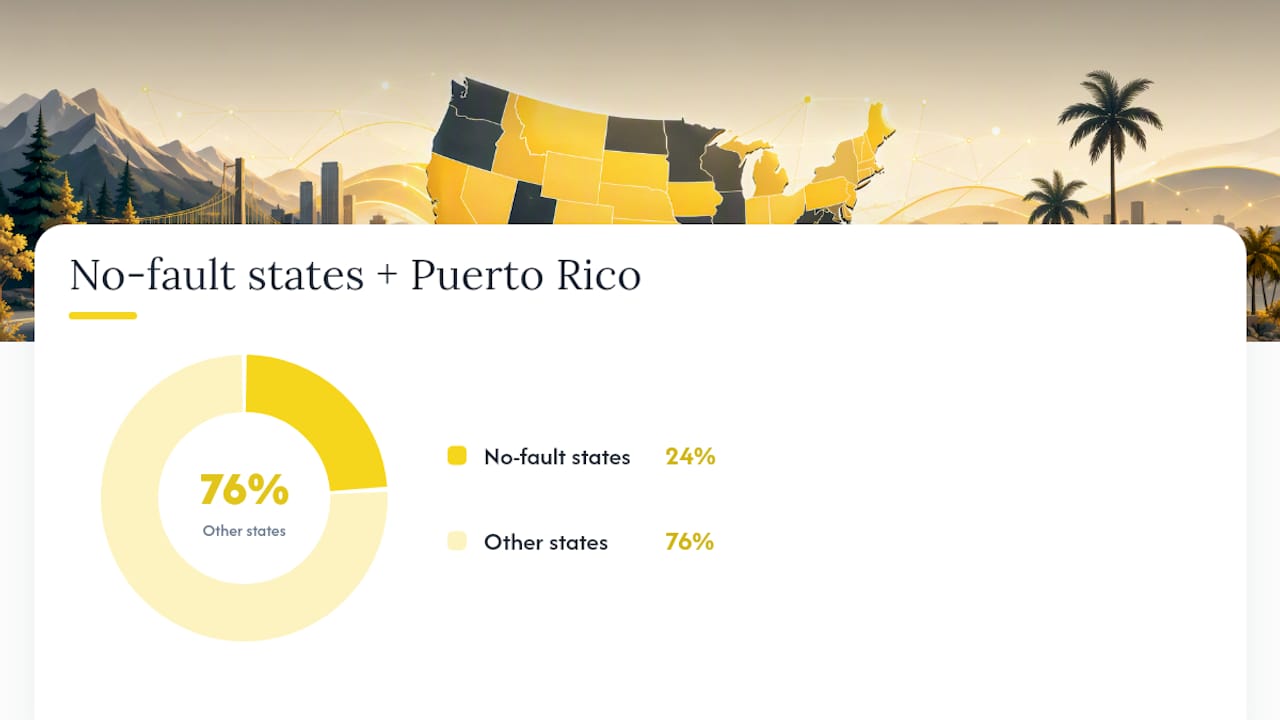
The list of no-fault states hasn’t changed much over the past decade, and it still sits at twelve: Florida, Hawaii, Kansas, Kentucky, Massachusetts, Michigan, Minnesota, New Jersey, New York, North Dakota, Pennsylvania, and Utah. Puerto Rico also runs a mandatory no-fault system, though it’s not one of the 50 states.
Three of these, Kentucky, New Jersey, and Pennsylvania, are “choice” no-fault states. Drivers there pick, at the time they buy a policy, whether they want the limited right to sue that comes with no-fault or whether they’d rather pay for full tort rights and keep the ability to sue for any injury an at-fault driver causes. It’s an underused option: plenty of drivers in these three states don’t realize they’re signing away lawsuit rights by default and never actively make the choice.
PIP minimums swing wildly from state to state, which is where things get interesting for anyone comparing a policy against a neighbor’s:
- New York requires a comparatively high minimum PIP coverage.
- Michigan dropped its unlimited PIP mandate in 2020 and now lets drivers choose lower tiers, including options for qualifying Medicaid recipients.
- Florida sets a comparatively low minimum PIP coverage level.
- Kansas and North Dakota have PIP minimums that fall in the mid-range compared to other states.
If you’re shopping across state lines or just curious how your coverage stacks up, it’s worth checking your declarations page against these figures directly.
No-Fault, Add-On, and Choice Systems Explained
Not every no-fault state works the same way, and the differences hinge on something called a tort threshold, the legal bar an injury has to clear before you can sue.
A verbal threshold requires meeting a statutory description of “serious injury,” things like permanent disfigurement, a fracture, or loss of a body function. A monetary threshold ties your right to sue directly to a dollar figure in medical bills. Cross that number and the lawsuit door opens.
Cornell Law’s overview of no-fault insurance breaks the underlying systems into three categories:
- True no-fault: PIP is mandatory and lawsuit rights are genuinely restricted until a threshold is met.
- Add-on: PIP is available or required, but the state places no real limit on suing, so the “no-fault” label is mostly about who pays first.
- Choice: drivers actively pick between limited-tort no-fault and full tort rights, as in Kentucky, New Jersey, and Pennsylvania.
The threshold design isn’t a minor technicality. Duke Law scholarship on threshold structure has found that whether a state uses a verbal or monetary bar, and how high that bar sits, materially changes how much litigation and cost the system actually produces.
What PIP Actually Pays For
PIP is broader than most drivers expect, and understanding its scope helps explain why premiums differ so much between no-fault and at-fault states.
- Medical expenses for treatment tied to the crash, from ER visits to physical therapy.
- Lost wages, usually capped at a percentage of your income, often 80% or less, and subject to a weekly maximum.
- Funeral costs when a crash is fatal.
- Replacement household services, covering the cost of hiring help for tasks the injured person can no longer perform, like childcare or home maintenance.
State minimums for these benefits vary enormously. Progressive’s explainer on no-fault coverage notes that New York’s PIP minimum sits far above Florida’s, even though both are no-fault states with mandatory coverage. Most policies also carry exclusions: PIP typically won’t cover injuries from intentional acts, and many states reduce or deny benefits if you were driving without a license or committing a crime at the time of the crash.
How Claims and Property Damage Really Work
Here’s where a lot of drivers get confused: no-fault only governs injury payments. Vehicle damage still runs through the traditional at-fault system.

If another driver hits your car, their liability insurance pays for your repairs, not your own PIP coverage. Insurers still investigate and assign fault for these property claims, and if your insurer pays out first, it can pursue subrogation, recovering costs from the at-fault driver’s insurer afterward. CollisionHelp’s breakdown of at-fault versus no-fault claims makes clear that fault determination never disappears in a no-fault state. It just gets separated from how medical bills are initially paid.
The lawsuit door reopens once an injury crosses the state’s threshold, whether that’s a verbal standard like permanent injury or a dollar figure in medical costs. At that point, the case functions much like it would in a traditional at-fault state, with the injured party pursuing the at-fault driver directly for pain, suffering, and damages beyond what PIP covers.
Costs, Trade-offs, and Whether No-Fault Actually Saves Money
Statistic to know: WalletHub’s analysis of no-fault insurance costs finds that states with mandatory PIP frequently post higher average premiums than at-fault states, largely because PIP requires broader baseline coverage than standard bodily-injury liability.
That single fact undercuts the idea that no-fault automatically means cheaper insurance. Whether it actually helps you depend on two things: how generous the benefits are and how strict the lawsuit threshold is.
- Advantages: faster payouts for medical bills and lost wages, no waiting on a fault investigation, fewer small claims clogging the courts.
- Disadvantages: restricted ability to sue for pain and suffering, and premiums that can run higher than a comparable at-fault policy.
Weak thresholds make things worse on both fronts. The Insurance Information Institute’s history of no-fault laws points out that several states repealed their no-fault systems entirely after finding that low thresholds let lawsuits through anyway, so drivers paid for PIP without getting the litigation relief the system promised.
What to Do After an Accident in a No-Fault State
- File a PIP claim with your own insurer immediately. Document every medical visit, prescription, and missed workday from day one.
- Report vehicle damage to the at-fault driver’s insurer, and photograph the damage and get a repair estimate before anything gets fixed.
- If your injury might clear the state’s threshold, preserve every piece of evidence, medical records, photos, witness contacts, and talk to an attorney before accepting any settlement.
Pro Tip: Keep a simple folder, physical or digital, for every receipt, bill, and note from a doctor’s visit. Insurers move faster on PIP claims when the paperwork arrives complete the first time, not in pieces over three weeks.
For the mechanics of filing itself, Frenzycars’ step-by-step claim guide walks through the process in more detail, and a common auto insurance claim mistakes guide covers the errors that slow down payouts the most.
Should You Carry More Than the State Minimum?
State PIP minimums exist as a floor, not a recommendation. If you have dependents, a demanding job, or savings you can’t afford to burn through during a slow recovery, higher PIP limits or full-tort coverage (where your state offers the choice) are worth the extra premium. The gap between Florida’s $10,000 minimum and a serious injury’s actual cost is the kind of math that only feels abstract until you’re the one living it.
Compare Your Coverage Before You Need It
There’s no single right policy for a no-fault state. What works depends on your state’s threshold, your PIP minimum, and how much risk you’re comfortable carrying if a lawsuit door stays closed. Frenzycars breaks down that decision without the sales pitch: our guide to liability coverage versus full coverage walks through what each tier actually protects, and our piece on insurance for new drivers unpacks why premiums differ so much by state and driver profile. If a claim ever leaves you shopping for a replacement vehicle, our car specs database is a solid place to start comparing options before you sign anything.
Primary Sources and Further Reading
For the legal mechanics, see Cornell Law’s no-fault insurance overview. For state history and context, see the Insurance Information Institute.
This article is general information, not a substitute for advice from a qualified financial advisor. Consult a qualified financial professional about your own circumstances before acting on anything here.
Sources
- List of No-Fault States for Car Insurance in 2026 • WalletHub
- No-fault insurance — Legal Information Institute (Cornell Law)
- What does no-fault state mean? — Progressive