
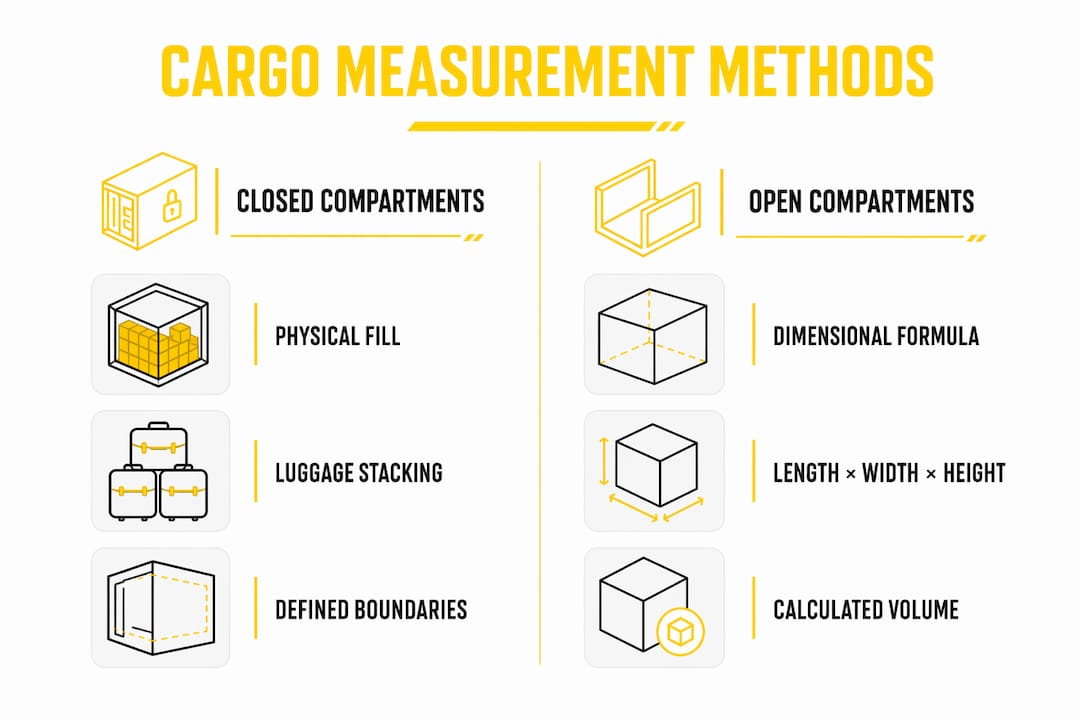
Cargo space in vehicles is measured using two primary approaches: a dimensional formula that multiplies length by width by height, and a physical simulation that stacks standardized luggage pieces inside a closed compartment. The result is a volume figure expressed in cubic feet (the US standard) or liters. These numbers represent estimated stowage potential, not the exact usable space you’ll actually pack into. The authoritative standard governing this process in the United States is SAE J1100, first published in 1973, which defines measurement procedures for both closed compartments like sedan trunks and open compartments like SUV cargo areas.
Here’s what that breaks down to in practice:
- Closed compartments (sedan trunks, coupe trunks, convertible trunks): volume is determined by physically stacking simulated luggage pieces
- Open compartments (SUVs, minivans, hatchbacks, station wagons): volume is estimated by multiplying representative length, width, and height dimensions
- Units: cubic feet in the US market, liters in most other markets; one cubic foot equals approximately 28.3 liters
- Baseline conditions: measurements are taken at curb weight, with all rear seats and head restraints stowed
- Key caveat: the resulting figure is a design estimate, not a guarantee of real-world packing capacity
How cargo space is measured in vehicles: standardized methods explained
Two distinct techniques cover the full range of vehicle cargo measurement, and knowing which one applies to a given vehicle changes how you interpret the number on a spec sheet.
Dimensional calculation is the method applied to open compartments. Engineers identify the longest unobstructed floor length, the widest usable width, and the tallest usable height, then apply the SAE J1100 formula: (Length in inches × Width in inches × Height in inches) ÷ 1728 = cubic feet. All dimensions are measured perpendicular to a defined three-dimensional reference system, with ground-related dimensions measured normal to the ground plane. For cargo length specifically, the floor surface to the rear of the forward measurement point must be completely unobstructed.
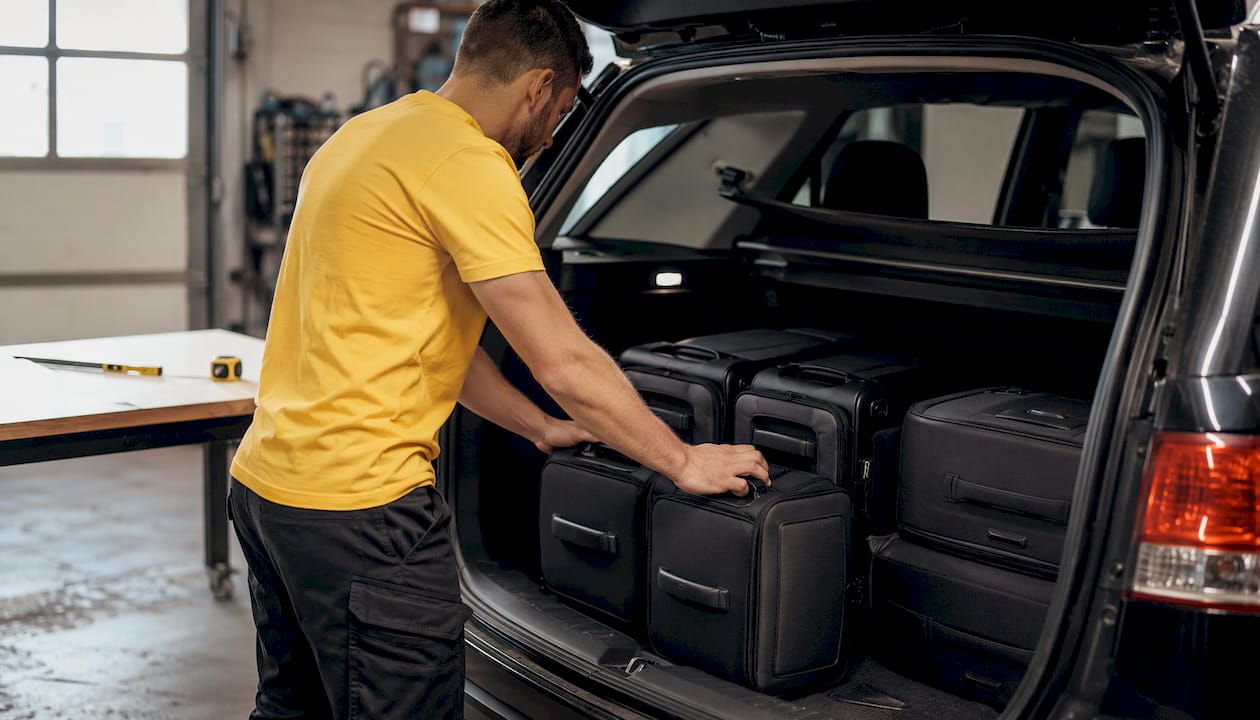
Physical luggage simulation applies to closed compartments like sedan trunks. A standardized set of luggage pieces (labeled A through G) is loaded randomly into the compartment. Once no more full pieces fit, H-boxes fill the remaining gaps. The trunk lid must close and latch freely after loading. This method approximates total stowage capacity more concretely than a pure formula, though it still reflects a best-case packing scenario.
- Dimensional calculation applies to SUVs, minivans, hatchbacks, and station wagons
- Physical luggage simulation applies to coupes, sedans, and convertibles
- Both methods require seats stowed and head restraints in the down position
- Measurements are taken on the base vehicle, excluding optional accessories or production upgrades
- For metric calculations, the formula shifts to (L × W × H in millimeters) ÷ 1,000,000 = liters
Pro Tip: When you read a cargo volume spec, check whether the manufacturer used a dimensional formula or a physical fill method. A sedan’s trunk figure came from actual luggage stacking; an SUV’s figure came from a math formula applied to a box-shaped approximation of an irregular space. They are not directly comparable.
How cargo space varies by vehicle type and seating configuration
Vehicle body style fundamentally changes how cargo volume is calculated and what the resulting number actually means for you.

Sedans, coupes, and convertibles have physically separated trunks. The cargo area is walled off from the passenger cabin, which limits total volume but also means the figure you see reflects a real, enclosed space. SUVs, minivans, and hatchbacks are a different story entirely. Their cargo areas are open to the passenger compartment, which creates flexibility but also makes the volume estimate more abstract. The same interior space can function as seating or storage depending on seat position.
Three-row SUVs illustrate this complexity best. Manufacturers typically report two cargo figures: the space behind the third row with all seats up, and the maximum load volume with all rear seats folded flat. The gap between those two numbers can be dramatic. Behind the third row, you might have just enough room for a few grocery bags. Fold everything flat, and the same vehicle swallows luggage for a family road trip. For real-world van and SUV cargo planning, van size considerations follow similar logic when evaluating open compartment vehicles.
- Closed compartments (sedans): one static figure based on physical luggage fill
- Open compartments (SUVs, minivans): multiple figures based on seat row configurations
- Third-row SUVs report cargo space behind row 3, behind row 2 (row 3 folded), and maximum load volume
- Hatchbacks and station wagons often report cargo space with the rear seat up and with it folded
- Seat folding complexity directly affects how many valid cargo figures a vehicle generates
Common misconceptions about cargo volume figures
The number on a spec sheet almost never matches what you can actually fit in a vehicle, and the gap is not random.
SAE J1100’s cargo volume indices are designed to give reasonable estimates of stowage potential, not actual cargo volumes. The dimensional formula treats the cargo area as a clean rectangular box. Real cargo areas have wheel well intrusions, spare tire housings, subwoofer enclosures, and angled rear walls. None of those intrusions reduce the calculated figure, but all of them reduce the space you can actually use. This same dynamic appears in fuel economy ratings, where official figures diverge from real-world results for structurally similar reasons.
Interior design innovations compound the problem. Adjustable load floors, split-folding seat configurations, and complex seat mechanisms create ambiguous measurement scenarios where the same vehicle could legitimately report different cargo figures depending on which configuration the manufacturer chose to measure. SAE acknowledges this directly: innovations to interior design can result in equivocal interpretations of the standard.
- Volume figures are mathematical estimates, not physical displacement measurements
- Wheel wells, tire storage, and structural intrusions reduce real usable space without affecting the calculated figure
- Different manufacturers may measure the same configuration type differently
- SAE (mathematical) and VDA (physical standardized blocks) produce incomparable figures; never compare them directly
- Consumer Reports addresses this gap by physically measuring cargo room in SUVs and minivans rather than relying solely on manufacturer-reported specs
Pro Tip: Before buying, look up the cargo floor length and width in addition to the cubic-foot figure. A vehicle with 40 cubic feet of cargo space but a narrow opening or a high load floor may carry less than a vehicle rated at 35 cubic feet with a flat, wide floor.
How SAE J1100 defines and governs cargo measurement in the US
SAE J1100, formally titled Motor Vehicle Dimensions, has been the foundational standard for vehicle cargo measurement in the United States since September 1973. Its 2009 revision is the version most commonly referenced today.
The standard’s core purpose is to provide uniform cargo volume indices for use during vehicle design and engineering, primarily in a CAD environment. The formula is straightforward: (L × W × H) ÷ 1728 = cubic feet, with all dimensions in inches. For metric output, the same dimensions in millimeters are divided by 1,000,000 to yield liters. All measurements are taken at curb weight, with all rear seats and head restraints in their stowed positions.
| Element | SAE J1100 Specification |
|---|---|
| Formula (US) | (L × W × H in inches) ÷ 1728 = cubic feet |
| Formula (metric) | — |
| Closed compartment method | Physical luggage stack with H-boxes |
| Open compartment method | Dimensional calculation |
| Measurement condition | Curb weight, seats and head restraints stowed |
| Dimension orientation | Perpendicular to 3D reference system |
| Stated intent | Stowage potential estimate, not actual cargo volume |
SAE J1100 explicitly states that its cargo volume indices do not yield actual cargo volumes. The standard’s own language calls them “reasonable estimates of stowage potential.” That distinction matters when you’re comparing vehicles on a spec sheet. Two vehicles with identical cubic-foot ratings can feel completely different inside because one has a flat, rectangular cargo floor and the other has significant intrusions. Checking car specs by make and model alongside the raw volume figure gives you a much clearer picture of what a vehicle actually carries.
Key Takeaways
Cargo space figures are engineering estimates built on standardized formulas, not measurements of the space you can actually fill with luggage.
| Point | Details |
|---|---|
| Two core methods | Closed compartments use physical luggage stacking; open compartments use a dimensional formula. |
| SAE J1100 formula | (L × W × H in inches) ÷ 1728 = cubic feet, measured at curb weight with seats stowed. |
| Figures overstate usable space | Wheel wells, intrusions, and irregular shapes reduce real capacity without affecting the calculated number. |
| Seat configuration multiplies figures | Three-row SUVs report multiple cargo volumes depending on which rows are folded. |
| SAE vs. VDA are incomparable | Mathematical SAE figures and physical-block VDA figures cannot be directly compared across vehicles. |