
Banks, credit unions, and online lenders usually beat dealer financing on total loan cost. Dealer financing wins when a manufacturer is running a promotional rate like 0% APR, when your credit is rough enough that dealer subprime networks are your best shot, or when you simply need the deal done today. Two exceptions matter most: captive manufacturer promotions can genuinely beat a bank rate, while buy-here-pay-here lots are almost always the most expensive route on the table.
- Get preapproved first. A soft-quote from a bank or credit union before you set foot on a lot gives you a real number to negotiate against.
- Watch for the promo trap. A 0% APR offer sounds unbeatable, but confirm the vehicle price is the same as what a cash or bank-financed buyer would pay.
Key Takeaways
Direct lending from a bank or credit union usually costs less than dealer-arranged financing, but manufacturer promotions and urgent, low-credit situations can flip that outcome.
| Point | Details |
|---|---|
| Preapprove before shopping | Get quotes from two or three lenders so you walk in with real leverage. |
| Compare total interest, not payment | Multiply payment by term length to see the true cost of any offer. |
| Watch for dealer markup | Ask directly about the buy rate versus the contract rate you’re offered. |
| Captive promos can win | A qualifying 0% APR deal often beats every bank rate available. |
| Avoid BHPH when possible | In-house dealer financing carries the highest rates and repossession risk. |
Where to Read More on Auto Financing
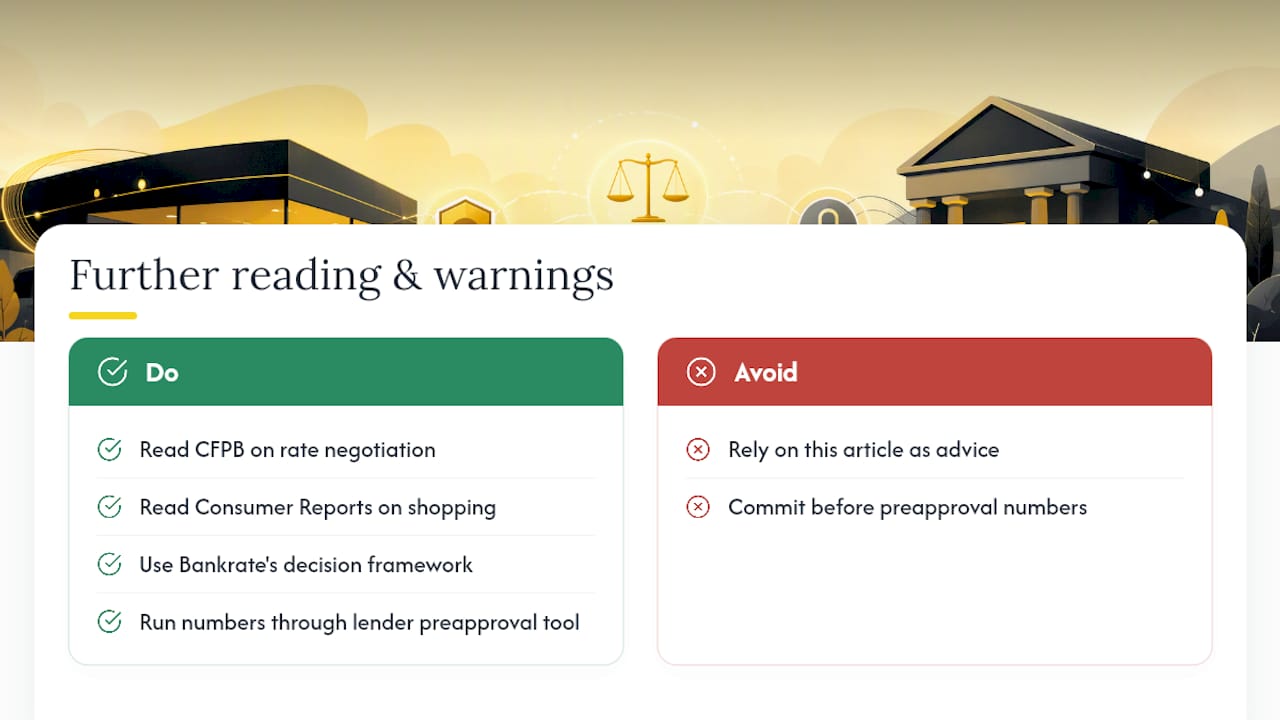
The CFPB covers your rights around rate negotiation, Consumer Reports breaks down the shopping process, and Bankrate offers a practical decision framework. Run your own numbers through a lender’s preapproval tool before committing to any offer.
This article is general information, not a substitute for advice from a qualified financial advisor. Consult a qualified financial professional about your own circumstances before acting on anything here.
Dealer vs Bank Financing: The Four Paths Your Loan Can Take
Every auto loan traces back to one of four sources, and knowing which one you’re dealing with changes how much leverage you have.
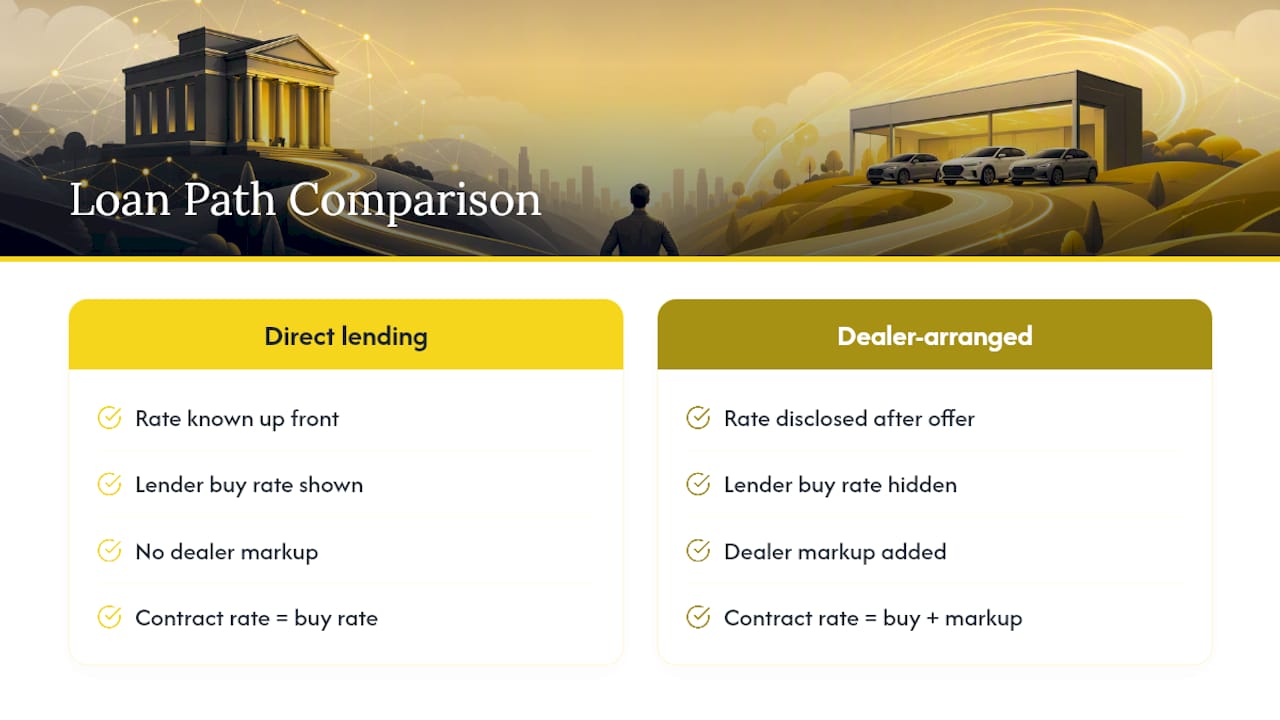
Direct lending is what happens when you apply straight to a bank, credit union, or online lender and get preapproved before you ever talk to a salesperson. You know your rate walking in.
Dealer-arranged financing, also called indirect financing, is what most buyers actually use. The dealer takes your application and shops it to a network of lenders, then presents you with an offer. What often goes unmentioned is that dealers can add a markup on top of the lender’s approved buy rate, turning it into your contract rate.
Captive or manufacturer financing comes from lenders owned by the automakers themselves, such as Ford Motor Credit or Toyota Financial Services. These outfits sometimes run promotional rates, including 0% APR, for buyers who qualify on credit and vehicle choice.
Buy-here-pay-here (BHPH) is in-house financing straight from the dealer’s own books, aimed at subprime buyers who can’t qualify anywhere else. Rates run high, and repossession risk runs higher, since the dealer holds the loan directly.
How Do Bank Loans Compare to Dealer Financing?
Line these two paths up side by side and the tradeoffs get obvious fast.
| Factor | Bank / Credit Union / Online Lender | Dealer-Arranged Financing |
|---|---|---|
| APR / interest rate | Often lower, especially through credit unions | Can include a markup over the buy rate |
| Loan term & total interest | Set upfront, easy to compare | May be stretched to lower monthly payment, raising total interest |
| Fees & origination charges | Typically minimal or disclosed clearly | Can include add-on packages bundled into the loan |
| Convenience / timeline | Requires a separate application before shopping | One-stop, same-day approval at the lot |
| Eligibility / credit requirements | Stricter for the best rates | Wider net, including subprime lenders |
| Promotional offers | Rare | 0% APR or cash rebates possible through captive lenders |
| Negotiating leverage | High, since you’re a cash buyer to the dealer | Lower, unless you already have a competing preapproval |
The mechanism behind that markup is called dealer reserve. A lender approves you at a buy rate, say 5%, and the dealer is allowed to mark that up to 7% on your contract. That two-point spread is pure profit for the dealer, not the lender.
- Credit unions frequently undercut bank rates because they’re nonprofit cooperatives passing savings to members.
- Captive lenders win outright when a 0% or near-0% promo applies to the exact trim and model you want.
- Dealer-arranged loans win on speed alone, not on price, in the vast majority of cases.
What’s the Real Cost Difference Once You Run the Math?
Monthly payment is the number dealers lean on, and it’s the wrong number to compare offers by. APR captures the true cost of borrowing, and total interest paid tells you what the loan actually costs over its life. Two loans can carry the same monthly payment and differ by thousands of dollars once you stretch one of them out over a longer term.
Here’s the math, step by step:
- Multiply your monthly payment by the number of months in the loan to get total payments.
- Subtract the loan principal (what you actually financed) from total payments to get total interest.
- Repeat for every offer you’re comparing, using the same loan amount and term where possible.
- Compare total interest, not monthly payment, to find the genuinely cheaper loan.
A markup that looks small on paper adds up fast. On a $35,000 loan over a typical term, a rate difference of a couple percentage points changes the total interest bill significantly, and lenders are required to show APR on your paperwork even though they aren’t required to disclose the buy rate underneath it.
That two-point spread costs roughly $1,900 extra over the life of the loan, on the same $35,000 principal. Stretching the term to 72 or 84 months lowers the monthly number further but adds even more total interest, which is exactly how a “great deal” on paper turns into a bad one over six or seven years.
Pro Tip: Bring your preapproval paperwork into the finance office and ask the manager to beat it in writing. If they can’t, you already know which offer to sign.
When Does Dealer Financing Actually Make Sense?
Dealer financing earns its place in a few specific situations, not as a default.
- New-car promo deals. A 0% or 1.9% captive rate on a new model beats almost any bank offer you’ll find, assuming you qualify for the promotion.
- The dealer matches your preapproval. If they can meet or beat your bank rate, there’s no cost penalty to signing at the lot.
- You need the car today. A same-day purchase with no time to shop leaves dealer financing as the practical option.
- Your credit is genuinely poor. Dealer networks sometimes reach subprime lenders that a local bank won’t touch, though BHPH lots should be a last resort given the repossession risk involved.
Good credit, a used car purchase, or a private-party sale almost always tip the scale toward a bank, credit union, or online lender instead. Checking where your credit score lands before you apply anywhere tells you which lenders are realistic.
What Should You Do Before and During the Finance Office Visit?
Before you go:
- Get preapproved with two or three lenders, including at least one credit union, so you have real numbers to compare.
- Pull your own credit report so nothing in the finance office catches you off guard.
- Decide your target APR and your absolute maximum monthly payment before you’re sitting across from a salesperson.
- Gather your documents: driver’s license, recent pay stubs or proof of income, proof of insurance, your preapproval letter, and a recent bank statement.
At the dealer:
- Negotiate the vehicle’s price first, as if you’re paying cash, before financing enters the conversation at all.
- Only bring up your preapproval once the price is locked in.
- Ask directly which lender approved the loan and whether any markup was applied over the buy rate.
- Ask the finance manager to beat your preapproval in writing rather than accepting a verbal promise.
A few short scripts go a long way here. Try: “What’s the buy rate on this loan before any dealer markup?” Or: “Can you show me the APR breakdown compared to my preapproval?” And when the add-ons come out: “I’ll pass on the extended warranty and paint protection.” Running through a broader shopping checklist before you ever walk in keeps price negotiation and financing negotiation from blurring together.
What Warning Signs Mean You’re About to Overpay?
A few patterns show up again and again in loans that turn out to be more expensive than they needed to be.
- The finance manager won’t name the lender or disclose the buy rate when asked directly.
- Add-on packages like extended warranties or paint protection are presented as mandatory rather than optional.
- You’re asked to sign and drive home before financing is fully finalized, known as spot delivery, which can lead to a worse rate days later.
- The loan term stretches to 72, 84, or even 96 months, a common way to mask a high APR behind a smaller monthly number.
If you hear any of these, slow down. Ask who the lender is, what the buy rate was, and whether any broker or origination fees got folded into the loan. A dealer confident in their numbers will answer plainly; one that dodges the question usually has something to hide, and declining unnecessary add-ons is always your right.
A Practical Note on Preparation
Preapproval is the closest thing to a guaranteed advantage in this whole process. It turns you into a cash buyer in the dealer’s eyes, which changes the entire negotiation dynamic in your favor. Convenience is worth something, sure, and I get why some buyers pay a small premium for it. But that premium should never be an opaque rate you can’t explain to yourself on the drive home.
Sources
- What is the difference between dealer-arranged and bank financing? | CFPB
- Shop auto loan financing | Consumer Reports
- Do car dealers make money on financing? | NerdWallet
- Is it better to finance a car through a bank or a dealership? | Experian