
A flashing TPMS light almost always points to a system malfunction, not a low tire. When it blinks for about 60 to 90 seconds at startup and then stays solid, a sensor or module has failed. Check every tire’s pressure with a gauge right now. If none are visibly flat, you can usually keep driving, but get the system diagnosed soon since it can no longer warn you about real pressure loss.
TL;DR:
- A flashing TPMS light for 60 to 90 seconds followed by a solid light indicates a system fault, often from dead or damaged sensors, not a low tire.
- You can usually continue driving if tires appear normal and pressures are within 5 PSI of specifications, but should schedule professional diagnosis soon.
- Signal interference near certain areas can cause false flashes, and sensor batteries often fail after 5 to 10 years, requiring sensor replacement.
- Manual checks of all tires, including the spare, help identify if a low pressure exists or if the issue is sensor-related, saving diagnostic costs.
- The flashing pattern reveals system failure, meaning you need to manually monitor tire pressure until the sensors are repaired or replaced.
Why Your TPMS Light Flashing Actually Means a System Fault
The blink pattern is not random. Federal rules require the TPMS telltale to flash for at least 60 seconds but no more than 90 seconds once the vehicle detects a malfunction, then stay solid until the fault clears. That specific timing comes from 49 C.F.R. § 571.138, the federal motor vehicle safety standard that governs how tire pressure monitoring systems must behave. Most automakers build their software around that exact window, so a Honda, a Ford, and a Toyota will all flash in roughly the same rhythm before locking solid.
Here’s what separates a flashing light from a steady one:
- Solid light, no flash first: The system is working and telling you a tire is genuinely low.
- Flash for 60 to 90 seconds, then solid: The system itself has a fault, often a sensor that’s stopped transmitting.
- Flashing every time you start the car: The malfunction is ongoing, not a one-time glitch.
Once it locks into that malfunction state, the TPMS stops monitoring pressure altogether, according to Bridgestone’s tire maintenance guidance. You lose the safety net until someone fixes the sensor.
Can You Keep Driving With a Flashing TPMS Light?
In most cases, yes, but only after you’ve ruled out an actual flat. Walk around the car and look for a tire that’s visibly sagging or damaged. If one is, stop and deal with it before you drive anywhere.
Use this quick decision guide:
- Tire looks normal, pressure reads within 5 PSI of placard spec: Safe to drive normally, schedule a TPMS check within a week or two.
- Pressure has dropped 15 PSI or more below spec, or you see sidewall bulging: Reduce speed, avoid highways, and get to a shop or tire store the same day.
- A tire is flat or the sidewall is torn: Do not drive. Change it or call for a tow.
Pro Tip: Cold weather alone can trigger a TPMS warning even when nothing is actually wrong. Tire pressure drops roughly 1 PSI for every 10°F the temperature falls, so a 30 degree overnight swing can knock several PSI off every tire and set off a low-pressure alert that has nothing to do with a sensor failure.
The real danger with a flashing light is what it takes away, not what it adds. Because the system has disabled its pressure warning function, per Bridgestone, you’re driving without the safety net most people rely on. Check pressures by hand until it’s fixed.
Quick Checks You Can Run Before Booking a Shop Visit
Before you spend money on a diagnostic appointment, run through this yourself. Most of it takes fifteen minutes.
- Check all four tires cold, plus the spare if it has a sensor. Use a reliable tire pressure gauge and match the number on the driver’s door jamb sticker, not the number on the tire’s sidewall.
- Inflate or deflate to the placard spec. Even 3 to 4 PSI off can trip a warning on newer, more sensitive systems.
- Drive 10 to 20 minutes at a steady speed above 15 mph. Sensors transmit periodically, and a drive cycle often lets them resync if the issue was a temporary lost signal rather than a dead unit.
- Try the manufacturer’s relearn procedure. Most owner’s manuals list an ignition sequence (key on, hold the TPMS reset button until the light blinks twice, for example) that forces the module to relearn sensor IDs. This works for someone knowing how to reset TPMS light after rotating tires or swapping wheels, but not for a genuinely dead sensor.
- If the light is still flashing after a full drive cycle and a manual reset attempt, stop troubleshooting yourself. That’s the signal a TPMS scan tool and a technician are needed to pull actual fault codes.
Pro Tip: If you just rotated your own tires and the light started flashing right after, try the relearn procedure first. Lost sync after rotation is one of the most common and easiest fixes, and it costs nothing.
What’s Actually Broken: Common Causes and How Shops Find Them
A flashing light almost never means “buy four new tires.” It means something in the monitoring chain has failed, and there are only a handful of usual suspects.
- Dead sensor battery. TPMS sensors run on sealed batteries that typically last 5 to 10 years. Because the battery is sealed inside the unit, the whole sensor gets replaced rather than repaired.
- Damaged or missing sensor. A sensor knocked loose during tire service, or never reinstalled after a repair, will show up as a flashing light within one drive cycle. This is one of the most frequent causes cited in TPMS troubleshooting guides.
- Lost sync after rotation or a wheel swap. The module still expects sensors in their old positions and needs a relearn.
- Mismatched or wrong sensor installed. A universal or aftermarket sensor programmed incorrectly during a tire change will never talk to the module properly.
- Receiver or module fault. Rarer, but a corroded connector or a failed receiver unit can cause the same flashing symptom as a bad sensor.
- Signal interference. Nearby high-power transmitters or certain electronic equipment can occasionally scramble the signal, something Kia’s owner documentation specifically calls out as a source of intermittent faults.
Technicians don’t guess at which sensor is bad. They plug in a TPMS scan tool that reads each sensor’s individual ID and pulls diagnostic trouble codes, usually in the C0750 to C0775 range, pinpointing exactly which wheel position has stopped communicating. That’s how a 20-minute shop visit replaces hours of guesswork.
What TPMS Repairs Actually Cost and How Long They Take
A basic TPMS diagnostic scan is often a flat fee at most tire shops and quick lube chains, frequently rolled into the price of an oil change or tire rotation if you ask. A single sensor replacement adds parts, programming time, and the labor to demount and remount the tire, so the total climbs when you factor all three together.
A few things shape the final bill:
- One sensor failing rarely means it’s the only one close to failure. If your tires and sensors are the same age, a shop will often recommend replacing sensors as a set to avoid paying dismount and remount labor twice within a year or two.
- Service kit replacement matters more than people think. Whenever a sensor comes out, the valve stem’s rubber grommet, nut, and cap should be replaced too. Skipping that step is a known cause of slow leaks and repeat labor bills, according to REDI-Sensor’s technical guidance.
- Turnaround is usually same-day. Diagnosis takes minutes; if a sensor needs ordering for a less common vehicle, expect a day or two wait.
How a Flashing TPMS Light Hurts Fuel Economy and Tire Life
Once the system stops monitoring pressure, you lose the early warning that normally keeps you from driving on underinflated tires, and underinflation is expensive in ways most drivers never connect back to a dashboard light.
A tire that’s 20% below its recommended pressure increases rolling resistance measurably, forcing the engine to work harder to maintain speed. Over months of unnoticed low pressure, that translates into a real dent in miles per gallon. It also changes how the tire contacts the road. Underinflated tires flex more at the sidewall and wear unevenly along the outer edges of the tread, while overinflated tires wear faster down the center. Either pattern shortens the tire’s usable life by thousands of miles compared to one running at the correct pressure the whole time.
The insidious part is that a flashing TPMS light hides this problem instead of revealing it. With a working system, a slow leak triggers a solid warning long before the tire wears unevenly or drags down fuel economy. With the system disabled by its own malfunction, you’re driving blind. That’s why manually checking pressure with a gauge every couple of weeks matters more, not less, while the warning light is stuck in fault mode. It’s a five-minute habit that replaces a system that’s temporarily not doing its job.

Direct vs. Indirect TPMS: Why Your Car’s System Might Work Differently
Not every vehicle monitors tire pressure the same way, and that difference explains a lot of confusing forum advice about resets that don’t apply to your car.
Direct TPMS uses a physical pressure sensor mounted inside each wheel, usually attached to the valve stem, that measures actual air pressure and transmits it wirelessly to the vehicle’s receiver module. This is the more common setup on newer vehicles and the type most of this article addresses. Direct systems can tell you exactly which tire is low and by how much, and they’re also the ones with batteries that eventually die after 5 to 10 years.
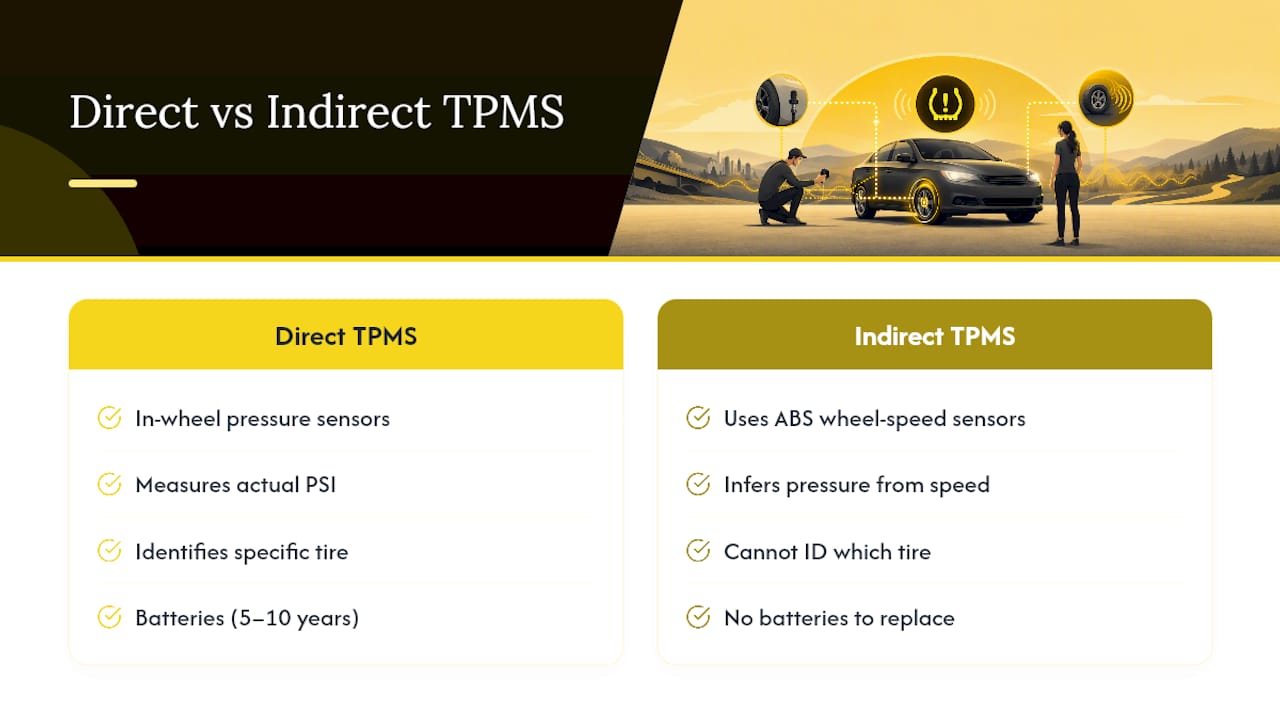
Indirect TPMS has no physical sensors in the wheels at all. Instead, it uses the wheel speed sensors already built into the anti-lock brake system. A underinflated tire has a slightly smaller rolling diameter than a properly inflated one, so it spins a little faster to cover the same distance. The system detects that speed difference and infers a pressure problem. Indirect systems are cheaper to build and have no batteries to replace, but they can’t tell you which specific tire is affected, and they need periodic recalibration, usually through a menu in the dashboard, especially after rotating tires or changing tire size.
If your reset attempts through the ignition sequence described earlier aren’t working, check your owner’s manual for which type you have. Indirect systems often need a completely different recalibration procedure, sometimes just a dashboard menu setting rather than anything involving the tires themselves.
The Legal Side of TPMS: What Automakers Are Required to Do
TPMS isn’t optional equipment on modern vehicles sold in the United States. Under 49 C.F.R. § 571.138, every new passenger vehicle under 10,000 pounds gross weight has been required to include a functioning tire pressure monitoring system since the mid-2000s, a mandate that followed a wave of tire-related accidents in the late 1990s. The regulation is specific about performance too: the system must detect and warn when one or more tires are significantly underinflated, and it must alert the driver within a set time window through that dashboard telltale.
The flashing behavior itself is part of that same regulation. Automakers don’t get to design their own warning logic from scratch. The 60 to 90 second flash, followed by a solid light indicating malfunction, is a federally specified requirement, which is why the pattern looks nearly identical across brands.
What the law doesn’t require is a specific repair timeline once your system malfunctions. Driving with a flashing or malfunction-indicating TPMS light is not itself illegal in most states, since the underlying tires may be perfectly fine. Some state vehicle inspection programs, however, will flag an illuminated TPMS malfunction light as a failure point during annual safety or emissions inspections, so a fault you’ve been ignoring for months can turn into a failed inspection with no warning.
FrenzyCars’ Pro Tips for Avoiding a Repeat TPMS Visit
We’ve seen the same mistakes trip up owners again and again, and most of them are avoidable with a little attention before you ever call a shop.
First, if you’re having a sensor replaced, insist the shop swaps the full service kit (valve stem, nut, seal, and cap) rather than just the sensor unit itself. Skipping that step is a known cause of slow leaks and a second labor bill down the road. Second, if your spare tire has its own TPMS sensor, ask the technician to check it too. Spares get ignored for years and their batteries die just like the ones in daily-driven wheels.
Pay attention to when the light flashes. If it only happens near certain buildings, cell towers, or industrial areas and disappears elsewhere, that pattern points to signal interference rather than a failed sensor, a phenomenon OEM manuals specifically acknowledge.
Pro Tip: Build TPMS into your seasonal maintenance routine. Check sensor function before winter, when cold weather stress-tests weak batteries the hardest, and start budgeting for replacement once sensors pass the five-year mark.
Our Take: Stop Treating Every Warning Light the Same Way
Most advice online treats “TPMS light on” as a single problem with a single fix, and that’s exactly backward. A solid light and a flashing light are different diagnoses entirely, and conflating them sends people either into needless panic over a light that will clear itself after a temperature swing, or into false confidence when they should be booking a scan.
The conventional wisdom oversells the DIY reset. Drive cycles and ignition sequences genuinely fix lost-sync issues after rotations, and every owner should try that first since it costs nothing. But when a sensor battery is actually dead, no amount of driving or button-holding brings it back. That’s a parts-and-labor job, full stop.
What we’d prioritize differently than most guides: don’t wait for the light to go solid before you act. The flashing pattern itself is the useful data point. It’s telling you the system has already given up on protecting you, which means the burden of catching a real pressure problem has quietly shifted onto you and a $15 gauge. Treat that shift seriously, and the rest of the repair is straightforward.
Sources
- 49 C.F.R. § 571.138 — Federal Motor Vehicle Safety Standards (TPMS telltale behavior)
- Solid vs flashing TPMS Warning Light - REDI-Sensor
- TPMS Light On? Complete Tire Pressure Guide + Reset - Steer
- TPMS Light On? What it Means and What You Need to Do - Bridgestone