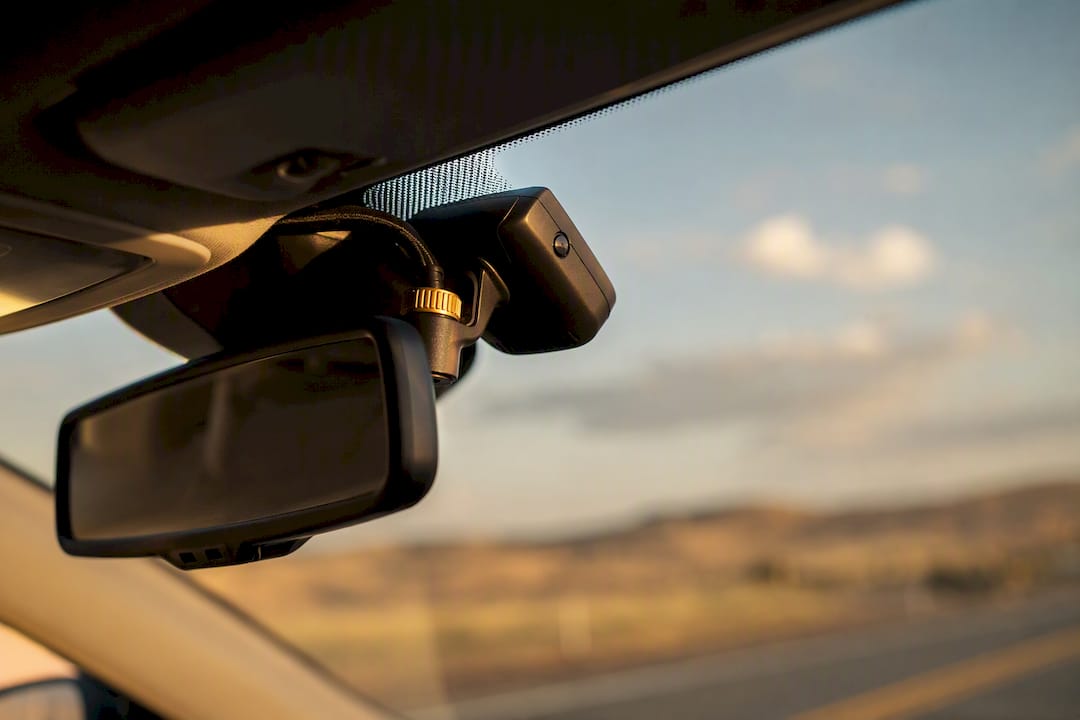
Dash cams are legal in all 50 U.S. states, but where you mount one, whether it records audio, and how you preserve the footage afterward all come down to state law. Get the mount wrong and you risk an obstruction ticket. Get the audio settings wrong in the wrong state and you risk criminal exposure. Three habits keep you covered almost everywhere: mount low and small near the rearview mirror, switch the microphone off if you drive through an all-party consent state, and never touch the original file once something happens worth keeping.
TL;DR:
- Dash cams are legal in all states, but mounting position and audio recording settings must comply with specific state laws to avoid fines or liability.
- Nearly every state restricts windshield obstruction, recommending small, high mounts behind the rearview mirror or in designated corner zones to stay compliant.
- Recording audio in states with all-party consent laws requires turning off the microphone or obtaining consent from all occupants to avoid criminal or civil penalties.
- Proper evidence handling, including preserving original footage and avoiding editing, is more critical than camera specifications for admissibility in court.
- If pulled over, drivers should confirm their dash cam’s position and audio status within legal limits, avoid surrendering the device, and document the interaction for legal protection.
Are Dash Cams Legal? A State-by-State Quick Reference
Every state permits dash cams. None ban the devices outright. What varies is the fine print on mounting position and audio recording, and that fine print is where drivers get tripped up.
The Expertmarket confirms the nationwide baseline: legal everywhere, restricted by placement and consent rules in nearly every state. Below is a working reference. Statutes shift, so treat this as a starting point and confirm with your state’s DMV or legislature page before a road trip through unfamiliar territory.
Pro Tip: If you drive across state lines regularly, set up your dash cam for the strictest rules in your route. A mount that satisfies California’s tight windshield zones and audio that defaults off will pass muster almost anywhere else, too.
States with tighter mounting or audio rules
- Arizona: Windshield obstruction is restricted under the Arizona Revised Statutes, which specify allowable mounting zones and size limits for small devices attached to the glass. One-party audio consent applies. If stopped, keep the cam mounted exactly where the statute permits and be ready to point to the size and placement as compliant.
- California: This is the strictest state in the country for both mounting and audio. California Vehicle Code §26708 confines windshield attachments to small zones, typically a 5-inch square in the lower corner on the passenger side or a 7-inch square in the lower corner on the driver’s side, according to California DMV guidance. California Penal Code §632 also requires all-party consent for audio recording of confidential communications. If an officer flags your mount, point out it sits inside the designated corner zone; if asked about recording, be ready to explain the microphone is off unless every party in the car agreed to it.
- Illinois: An all-party consent state for audio. Mounting must not obstruct the driver’s direct forward view, meaning low, small placement behind the mirror is the safer bet.
- Connecticut, Florida, Massachusetts, Michigan, Montana, Nevada, New Hampshire, Oregon, Pennsylvania, Washington: These round out the list of all-party consent states, where recording audio without every occupant’s knowledge can expose you to civil or criminal liability, not just an evidence problem. Mounting rules in these states generally track the same “don’t block the driver’s view” standard used nationwide.
States with more permissive rules
Most of the remaining states, including Texas, New York, Ohio, Georgia, and the bulk of the Midwest and South, follow one-party consent for audio (meaning you, as one party to the conversation, can legally record it) and a general obstruction standard for mounting rather than a specific inch-by-inch carve-out. That does not mean anything goes. Every state vehicle code includes some version of a rule against blocking the driver’s line of sight, and officers still write tickets for cams mounted dead center or hanging low enough to interfere with wipers or airbags.
A useful shortcut: if you are unsure whether your state specifies exact mounting zones, assume it does not and instead follow the universal “small, high, out of the direct sightline” rule that satisfies almost every code on the books.
What to do if you’re stopped in a restrictive state
If you’re pulled over in California, Illinois, or any other all-party consent state and the officer asks about your dash cam, stay calm and specific. Confirm the device is mounted within the size and zone the state allows. If audio comes up, state plainly whether the microphone was recording and whether all occupants consented. You are not obligated to explain your recording habits beyond what is relevant to the stop, and you should never volunteer more detail than asked.
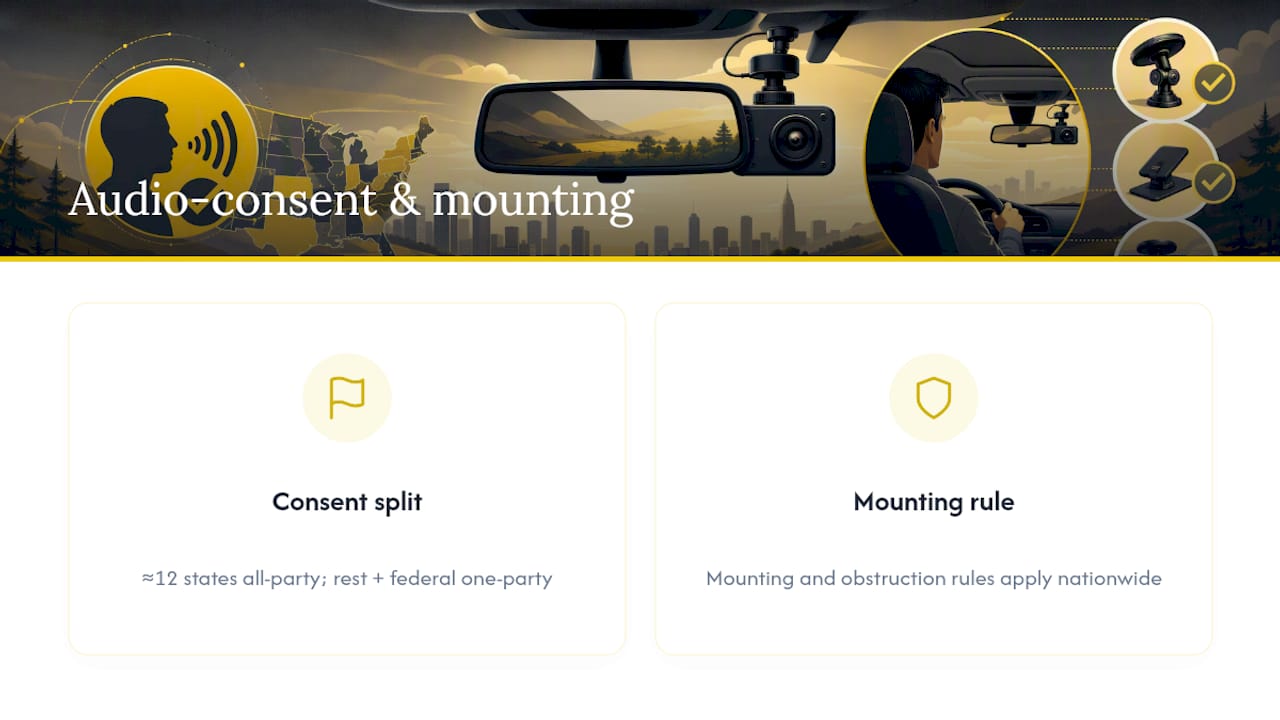
Quick fact: According to DashCamInsight’s state-by-state breakdown, roughly a dozen states require all-party consent for audio recording, while the remaining states, plus federal law, set the floor at one-party consent. That single distinction accounts for most of the legal risk in this entire topic.
How Do Windshield Obstruction Laws Affect Dash Cam Placement?
Every state vehicle code includes some version of the same principle: nothing may obstruct the driver’s clear view through the windshield. Dash cam mounting law is really just this one rule applied to a small electronic box.
States differ mainly in how specific they get. Arizona and California spell out exact inch measurements and corner zones. Most other states leave “obstruction” undefined and let officer discretion and case law fill the gap, which sounds looser but actually calls for more caution, not less, since you cannot point to a precise legal safe harbor.
Three placements clear the bar in nearly every jurisdiction:
- Behind the rearview mirror. This is the gold standard. The mirror already occupies that sightline, so a slim cam mounted directly behind it adds almost no additional obstruction.
- Lower corner of the windshield. California’s 5 inch and 7 inch corner squares are the model most other states informally follow even without codifying the exact measurement. Staying small and low keeps you defensible almost everywhere.
- Dashboard mount. A cam sitting on the dash rather than suction cupped to the glass avoids windshield obstruction laws entirely in most states, though you lose some of the wide-angle advantage of a windshield placement.
Avoid mounting anywhere near the airbag deployment zone. Most owner’s manuals mark this area clearly, and a cam that ends up as shrapnel during a crash is a liability problem no legal compliance checklist can fix.
If an officer questions your setup, three things help immediately: the device’s size relative to the windshield, its position relative to your direct forward sightline, and whether it sits within any state-specified zone. Photographing your installed mount before a long trip is not a bad habit, either. It gives you a timestamped record of exactly how the cam was positioned if a dispute ever comes up later.
Do You Need Consent to Record Audio in the Car?
Federal law sets a one-party consent floor for recording conversations, meaning that as long as you are a participant in the conversation, you can generally record it without telling anyone else in the vehicle. States are free to raise that bar, and roughly a dozen have.
The all-party consent states, again per DashCamInsight’s compiled matrix and confirmed by California’s own Penal Code §632, include California, Illinois, Connecticut, Florida, Massachusetts, Michigan, Montana, Nevada, New Hampshire, Oregon, Pennsylvania, and Washington. In these states, recording a conversation without every participant’s knowledge and agreement can carry criminal exposure, not just an evidentiary downside.
That distinction matters most for two groups of drivers:
- Rideshare drivers carry strangers who have no idea the cam is running unless told. A visible notice sticker on the dashboard or door, stating that audio and video are recorded, satisfies disclosure in most jurisdictions and heads off disputes before they start.
- Fleet operators should build a written policy that spells out when audio recording is active, who has access to footage, and how long it is retained, especially if drivers cross between one-party and all-party states during normal routes.
Practical compliance is simpler than the legal language suggests. Many consumer dash cams now ship with the microphone off by default specifically to reduce cross-state liability, an insight DashCamInsight highlights as one of the more effective ways manufacturers have reduced legal risk for ordinary drivers. Leaving that default alone, rather than switching audio on for the novelty of it, is the single easiest compliance move available.
Cloud storage adds a layer worth a second thought. If your dash cam automatically uploads footage to a manufacturer’s servers, that footage may fall under state consumer privacy statutes governing how long companies can retain recordings and who they can share them with. Read the retention terms in your cam’s app before assuming the footage disappears after a set number of days.
Is Dash Cam Footage Admissible in Court?
Yes, dash cam footage is regularly admitted in court and in insurance claims, but only when it clears the same evidentiary hurdles as any other recording: relevance, authenticity, and reliability, according to the evidentiary standards outlined by Catalyst Legal. Courts do not exclude dash cam footage because the device itself is suspect. They exclude it when the chain of custody breaks down or when a clip has been edited or shared publicly before ever reaching a courtroom, a pattern confirmed by Enjuris’s review of dashcam use in litigation.
That means the technical quality of your footage matters less than how carefully you handle it afterward. A grainy clip with an intact chain of custody often carries more weight than a crisp one that got edited, cropped, or posted to social media before anyone asked for it.
Build these habits into your routine the moment footage becomes relevant to a crash, a dispute, or a claim:
- Pull the original microSD card and store it in a sealed envelope rather than continuing to record over it.
- Log every transfer of the file, including date, time, and who received it.
- Export a copy with metadata intact rather than a screen recording or a cropped clip.
- Note the G-sensor incident file separately, since most cams lock that segment automatically during a hard brake or collision.
- If a formal claim or lawsuit develops, provide an affidavit describing the device model, firmware version, timestamp source, and export method, a practice Catalyst Legal recommends as best evidentiary practice.
The most common reason courts throw out dash cam footage has nothing to do with the recording device. It’s a broken chain of custody or a file that was edited or shared online before being formally produced as evidence.
Insurance adjusters apply a lighter standard than courts, but the same discipline pays off. A file with intact metadata and a clear timeline of custody settles disputes faster than a version that has been trimmed to the “good part.” If you’re filing a claim after a collision, our step-by-step guide to filing a car insurance claim walks through how footage fits into the broader claims process, including how no-fault versus tort states can shape what your footage actually needs to prove.
What Happens if Police Ask to See Your Dash Cam?
Windshield obstruction tickets are the most common enforcement outcome, typically a modest fine similar to other equipment violations. Where audio comes into play, the exposure gets more serious. Recording a conversation without consent in an all-party state can carry criminal liability, and sharing a private conversation captured that way, even accidentally through a social media post, can create separate civil risk.
Police generally cannot force you to hand over your device or delete footage during a routine stop without a warrant, according to reporting from SpeedwayMedia’s 2026 review of dash cam laws. Voluntary consent is a different matter. If you agree to hand over the device, you have waived that protection, so know the difference before you agree to anything.
If an officer asks to review your footage:
- Politely decline to physically hand over the device itself.
- Offer to play the relevant clip on the device’s screen if you are comfortable doing so, without surrendering the hardware.
- Ask whether the request is voluntary or backed by a warrant, and request a receipt or written record if the device is taken.
- Note the officer’s name, badge number, and the stop’s time and location for your own file.
Best Practices Checklist for Legal Dash Cam Use
Five habits cover almost every legal risk this topic raises:
- Mount small and high. Behind the rearview mirror or in a state-approved corner zone, never centered low on the glass.
- Default the microphone off whenever you’re driving through or living in an all-party consent state.
- Post a visible notice if you drive rideshare, disclosing that video and audio are recorded.
- Preserve the original file the moment an incident occurs. Do not edit, crop, or repost before a claim or case resolves.
- Enable G-sensor incident locking so a hard brake or collision automatically protects that segment from being overwritten.
Pro Tip: Before a long interstate drive, run through this checklist the same way you’d check tire pressure. A five-minute audit of your mount and mic settings beats a ticket or a suppressed piece of evidence every time.
Fleet operators should layer a written audio policy on top of these basics, spelling out retention windows and access rules. And if you’re thinking about posting a dramatic clip online, blur license plates and faces of bystanders where possible. Public recording is generally legal, but posting identifiable footage of someone without a clear public-interest reason can invite a privacy complaint even when the underlying recording was lawful.
How FrenzyCars Verified These Dash Cam Laws
Frenzycars is an automotive media publication covering car reviews, maintenance guidance, insurance, and ownership topics for U.S. drivers. This guide was compiled by reviewing state vehicle codes, DMV guidance pages, and authoritative legal summaries covering dash cam mounting and audio consent rules, cross-checked against evidentiary standards for how footage holds up in court and insurance claims.
State laws change, and this guide reflects the most current information available at publication. If you’re shopping for hardware that makes compliance easier out of the box, our Dash Cam Buying Guide covers models with mic-off defaults and mounts sized for tight state zones. Spot an outdated statute reference or a state whose rule has changed? Corrections are always welcome.
Why Compliance Beats Convenience on Dash Cam Laws
Most dash cam advice online treats legality as an afterthought behind picture quality and storage capacity. That ordering is backward. A 4K sensor does nothing for you if the footage gets thrown out because the chain of custody fell apart, or if the recording itself exposed you to liability in an all-party consent state.
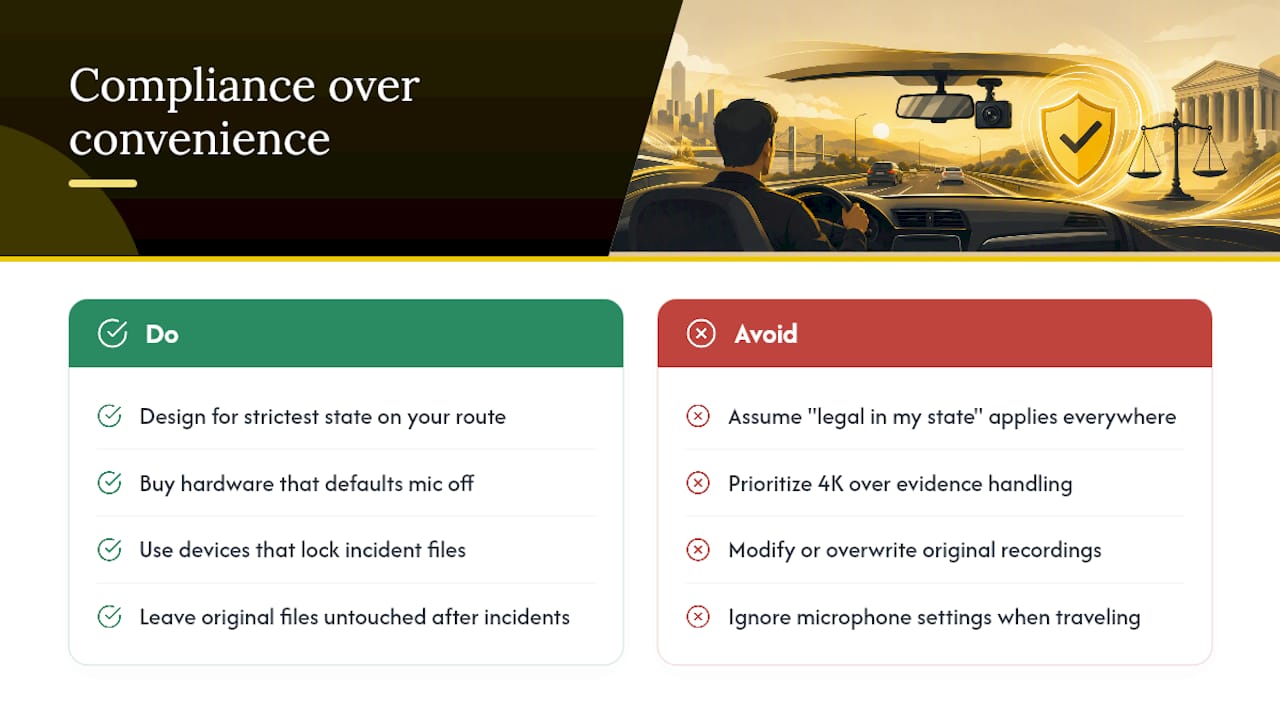
The gap I see most often is drivers assuming “legal in my state” means “legal everywhere I drive.” It doesn’t. Your commute might sit in a one-party consent state while your annual road trip crosses into California or Illinois without you ever thinking about the microphone setting. Build your setup for the strictest state on your route, not just the one on your registration.
The second underrated point: evidence handling matters more than most drivers realize. A broken chain of custody kills more dash cam footage in court than any question about the device’s legality. Buy hardware that defaults to mic off and locks incident files automatically, then leave the original files alone once something happens. That single habit does more for you than any spec upgrade.
This article is general information, not a substitute for advice from a qualified lawyer. Consult a qualified legal professional about your own circumstances before acting on anything here.
Sources
- California DMV — Additional driver rules / windshield attachments
- Arizona Revised Statutes — Windshield obstruction
- Are dash cameras admissible in court? — Catalyst Legal
- Dash Cam Recording Laws by State — DashCamInsight