
The best car under $25,000 right now is the 2026 Honda Civic for most buyers, with the 2026 Toyota Corolla a near-equal choice for anyone who wants a hybrid option or slightly lower running costs, as highlighted by a Yahoo Autos buying guide that spotlights budget models under $25k for 2026 emphasizing maintenance and service for long-term reliability. If you want the most features per dollar, the 2026 Hyundai Elantra is hard to beat. For a small SUV that stays close to the budget ceiling, the 2026 Nissan Kicks and 2026 Chevrolet Trax are the most realistic options.
Here is the short version:
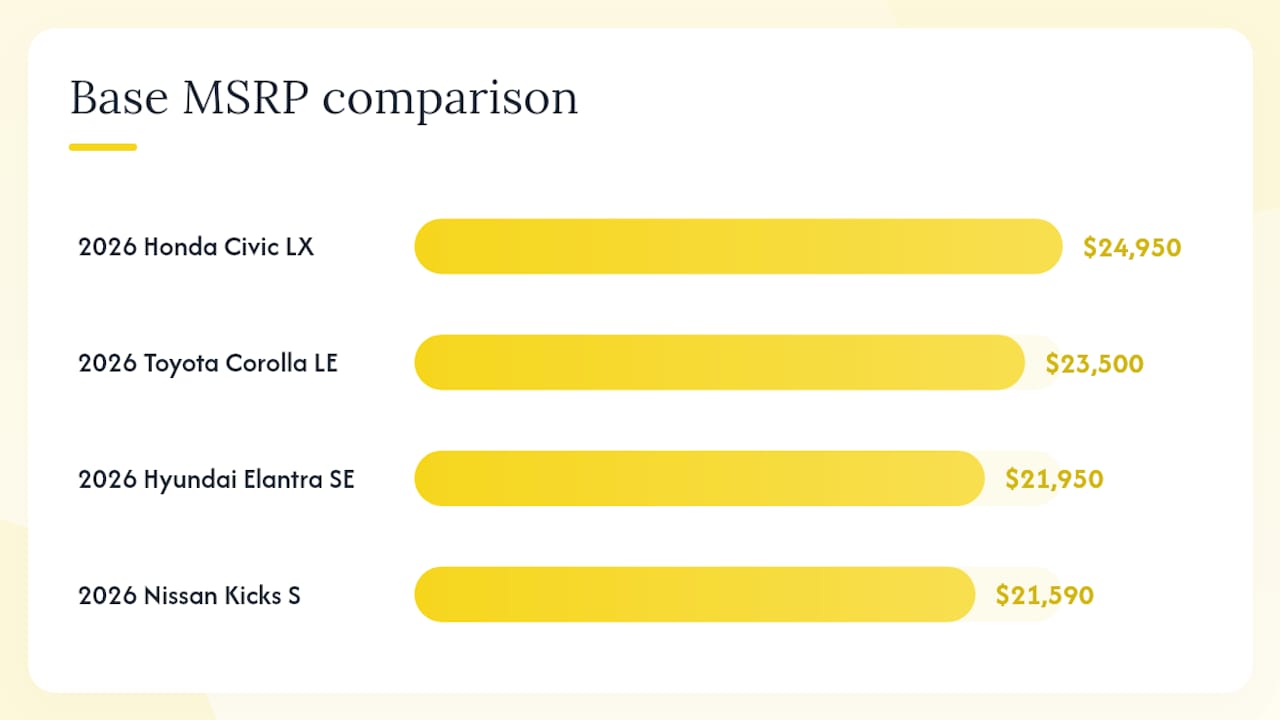
- Best overall: 2026 Honda Civic (LX trim, ~$24,950 before destination) — proven reliability, strong resale, and a powertrain that regularly crosses 200,000 miles with basic maintenance
- Best for low running costs: 2026 Toyota Corolla (LE trim, ~$23,500) — hybrid option available, top-tier predicted reliability, and the lowest insurance premiums in the segment
- Best driving experience: 2026 Mazda3 (2.5 S trim) — the only sub-$25k compact that feels genuinely premium behind the wheel
- Best value for features: 2026 Hyundai Elantra (SE trim, ~$21,950) — more standard tech than anything else at this price
- Best subcompact SUV: 2026 Nissan Kicks (S trim, ~$21,590) — lowest entry price among crossovers, efficient, and practical for urban buyers
All five are close to the $25,000 ceiling on their base or near-base trims before destination charges, though destination charges of roughly $900–$2,000 are non-negotiable and must be added to every MSRP figure you see advertised. Most buyers will land slightly over $25,000 out the door, but these trims are the closest realistic starting points given current market conditions.
Key Takeaways
The 2026 Honda Civic and Toyota Corolla remain the strongest long-term value picks under $25,000, while the Hyundai Elantra leads on warranty coverage and standard features per dollar.
| Point | Details |
|---|---|
| Best overall pick | The 2026 Honda Civic LX delivers the best combination of reliability, resale value, and fuel economy at a price generally considered under $25,000 before destination fees. |
| Best warranty in class | The 2026 Hyundai Elantra and 2026 Kia K4 both carry long-term powertrain warranties, among the strongest at this price point. |
| Destination fees are mandatory | Destination charges of roughly $900–$2,000 are non-negotiable and must be added to any MSRP figure when checking the $25,000 ceiling ceiling. |
| ATP context | The average new-car transaction price sat near $49,758 in June 2026, making a sub-$25k new car roughly half the market average and a genuinely narrow segment. |
| Frenzycars for deeper research | Frenzycars publishes full specs, trim comparisons, and category rankings to help you verify MSRPs and features before visiting a dealer. |
How the top picks compare at a glance
Important caveat: Every MSRP above is the manufacturer’s suggested retail price for the trim noted. Add destination charges (typically $900–$2,000 depending on the brand) and you may land above or below $25,000 depending on your region and dealer. Always request an out-the-door quote before committing. Dealer markups, optional packages, and regional fees can shift any of these figures.
How these cars were selected
Frenzycars applied a consistent set of criteria to every model considered for this list. A car had to clear all five gates to qualify.
Selection criteria:
- MSRP ceiling: At least one trim must have a manufacturer’s suggested retail price at or below $25,000. Destination fees (typically $900–$2,000) must be added to every MSRP, and only cars that stay at or below $25,000 including these required fees are considered to meet the ceiling, per KBB’s guidance on destination charges.
- Safety ratings: IIHS Top Safety Pick or Top Safety Pick+ status, or NHTSA 5-star overall rating, on the qualifying trim.
- Predicted reliability: Signals from iSeeCars, J.D. Power Initial Quality, and SlashGear’s 2026 compact reliability rankings. Models with below-average predicted reliability were noted but not excluded if they offered strong value on other axes.
- Fuel economy: EPA combined rating of at least 28 mpg for sedans; 27 mpg for crossovers/SUVs.
- Standard driver-assistance features: Automatic emergency braking at minimum; preference given to models with full forward-collision warning, lane-keeping assist, and adaptive cruise control as standard equipment.
Data sources used:
| Source | What it informed |
|---|---|
| Manufacturer MSRP (brand websites) | Base price and trim structure |
| EPA fueleconomy.gov | Combined MPG figures |
| IIHS (iihs.org) | Top Safety Pick / TSP+ status |
| NHTSA (nhtsa.gov) | Star safety ratings |
| iSeeCars 2026 reliability study | Predicted reliability and price-per-year ownership |
| Kelley Blue Book (kbb.com) | ATP context, destination fee guidance |
| Cox Automotive inventory data | Market availability and pricing pressure |
Pricing was researched at the time of publication. New-car MSRPs and incentive programs change frequently. Verify current pricing directly with dealers or on manufacturer websites before making any purchase decision.
Pro Tip: Always request the Monroney sticker (window sticker) for any car you are seriously considering. It lists the base MSRP, all factory options, and the destination charge as separate line items, so you can see exactly where the price comes from.
What each top pick is actually best for
2026 Honda Civic
The Civic LX is the default recommendation for most buyers because it combines the lowest long-term ownership costs with a powertrain that iSeeCars ranks at the top of the compact class for reliability and price-per-year value. Honda Sensing — automatic emergency braking, lane-keeping assist, adaptive cruise — comes standard on every trim, which is not a given at this price.
- Best for: Anyone planning to keep the car 7+ years
- Pros: Best-in-class resale value, Honda Sensing standard, 36 mpg combined, strong dealer network
- Cons: Interior materials feel a step below Mazda3; the LX trim lacks wireless CarPlay
- Trim to target: LX sedan (~$24,950 before destination); the Sport trim adds ~$1,500 and typically pushes past $25k with destination
2026 Toyota Corolla
The Corolla LE starts around $23,500, which leaves enough room for destination fees and still clears the ceiling. The hybrid version (LE Hybrid) starts slightly higher but delivers 38 mpg combined and qualifies for some state-level incentives. Toyota Safety Sense 3.0 is standard across the lineup. SlashGear’s 2026 compact reliability rankings list the Corolla alongside the Civic as the segment’s reliability benchmark.
- Best for: Buyers focused on fuel costs and long-term dependability
- Pros: Hybrid option, Toyota Safety Sense 3.0 standard, excellent resale
- Cons: Interior is functional but not exciting; infotainment lags behind Hyundai and Kia
- Trim to target: LE (~$23,500); LE Hybrid (~$24,500 before destination, worth checking)
2026 Mazda3
The Mazda3 is the one car on this list that makes you forget you spent under $25,000. Steering response, cabin refinement, and build quality all punch above the price. The 2.5 S trim sits right at the ceiling before destination, so you need to negotiate or accept a modest overage. AWD is available but pushes the price well past $25k.
- Best for: Buyers who care how a car feels to drive
- Pros: Best driving dynamics in the segment, premium interior materials, strong safety ratings
- Cons: Smallest trunk in the class; 30 mpg combined is the lowest among the top sedans here
- Trim to target: 2.5 S (~$24,800 before destination); avoid the AWD trim if staying under $25k
2026 Hyundai Elantra
At roughly $21,950 for the SE, the Elantra gives you more standard technology than any other car at this price. An 8-inch touchscreen, BlueLink connected services, and a full suite of driver assists come on the base trim. Hyundai’s 10-year/100,000-mile powertrain warranty is the best in the segment by a wide margin.
- Best for: Tech-focused buyers and anyone who values warranty coverage
- Pros: Best warranty in class, most standard tech per dollar, 33 mpg combined
- Cons: Predicted reliability is good but not at Civic/Corolla levels; resale value trails the Japanese brands
- Trim to target: SE (~$21,950); the SEL adds features but typically crosses $25k with destination
2025 Nissan Versa
The Versa S starts at roughly $16,680, which is the lowest new-car entry price you will find anywhere in 2026. It is not a car for road trips or enthusiasts. It is a car for someone who needs reliable, cheap transportation and wants to keep monthly payments as low as possible.
- Best for: First-time buyers, city commuters, buyers with tight monthly budgets
- Pros: Lowest MSRP of any new car, 35 mpg combined, NHTSA 5-star overall
- Cons: Minimal features on the S trim; rear visibility is limited; no wireless CarPlay on base
- Trim to target: S or SV (~$16,680–$19,500); all trims clear $25k easily
2026 Kia K4
The K4 is Kia’s replacement for the Forte, and it arrives with noticeably fresher styling and a 10.25-inch touchscreen standard on the LX trim. The 10-year/100,000-mile powertrain warranty matches the Elantra. Reliability data is still building since this is a newer nameplate, but Kia’s recent quality trajectory is encouraging.
- Best for: Buyers who want current styling and a strong warranty
- Pros: Fresh design, large standard touchscreen, wireless Apple CarPlay, strong warranty
- Cons: Newer model means less long-term reliability data than Civic or Corolla
- Trim to target: LX (~$22,290 before destination)
2025 Kia Seltos
The Seltos LX starts around $24,090, which is tight but workable if you keep destination fees on the lower end. It offers more cargo space and a higher seating position than any compact sedan on this list, which matters for buyers who need small-SUV practicality without the full-size price.
- Best for: Buyers who need cargo flexibility and elevated seating
- Pros: Best cargo space in the subcompact SUV class, 10-year/100k powertrain warranty, practical layout
- Cons: 29 mpg combined is lower than the sedans; destination fees can push the LX over $25k
- Trim to target: LX (~$24,090); confirm out-the-door pricing before committing
2026 Nissan Kicks
At ~$21,590 for the S trim, the Kicks is the most affordable crossover on this list with room to spare before the ceiling. It delivers 33 mpg combined in a package that is easy to park and cheap to insure. The trade-off is a modest powertrain — this is not a car for merging onto highways at speed.
- Best for: Urban buyers who want crossover practicality at sedan prices
- Pros: Low MSRP, 33 mpg combined, easy to maneuver in cities
- Cons: Underpowered for highway driving; base trim is light on features
- Trim to target: S (~$21,590); SR adds features but watch the price
2026 Chevrolet Trax
The Trax LS starts around $20,400, making it one of the cheapest new SUVs you can buy. The 11-inch infotainment screen is a genuine surprise at this price. Fuel economy at 28 mpg combined is the weakest on the list, and the powertrain is modest, but for buyers who need a small SUV footprint and the lowest possible initial outlay, it delivers.
- Best for: Buyers who need a small SUV and want to minimize the purchase price
- Pros: Very low starting MSRP, large standard touchscreen, compact footprint
- Cons: 28 mpg combined; less refined ride than Kicks or Seltos
- Trim to target: LS (~$20,400); watch for dealer-added accessories that inflate the price
2025 Volkswagen Jetta
The Jetta S starts around $22,995 and offers the most composed highway ride in the segment. The trunk is genuinely large for a compact sedan. VW’s 4-year/50,000-mile bumper-to-bumper warranty is better than most Japanese brands on that metric, though service costs at VW dealers tend to run higher than at Honda or Toyota.
- Best for: Highway commuters who value a quiet, settled ride
- Pros: Best-in-class trunk space, composed ride, 34 mpg combined
- Cons: Higher dealer service costs; infotainment can be unintuitive
- Trim to target: S (~$22,995 before destination)
2025 Buick Envista
The Envista Preferred sits around $24,200 and brings heated front seats and an 11-inch display to a price point where those features are rare. It is badge-engineered from a GM platform shared with other brands, so the underlying hardware is not unique, but the comfort-oriented tuning and Buick branding appeal to buyers who want something a step above a base compact.
- Best for: Buyers who prioritize comfort features over driving dynamics
- Pros: Heated seats standard, 11-in display, softer ride tuning
- Cons: Powertrain is modest; not as sporty as Mazda3 or as reliable-long-term as Civic
- Trim to target: Preferred (~$24,200 before destination)
Nissan Sentra
The Sentra S starts around $21,310 and offers the most rear-seat legroom of any compact sedan on this list. If you regularly carry adult passengers in the back, that matters more than any infotainment spec. It earns IIHS Top Safety Pick status and delivers 32 mpg combined.
- Best for: Families or buyers who frequently carry rear-seat passengers
- Pros: Best rear-seat space in the class, IIHS Top Safety Pick, 32 mpg combined
- Cons: Less engaging to drive than Mazda3 or Civic; base trim is light on features
- Trim to target: S or SV (~$21,310–$23,500)
Pro Tip: For buyers considering the Toyota Corolla Hybrid, check your state’s clean vehicle incentives before finalizing a deal. Several states offer rebates on hybrid models that can bring the effective price down by $500–$1,500, making the hybrid trim competitive with the standard LE on total cost.
Deeper details and what to check at the dealer
Trim watch points by model
Honda Civic: The LX is the trim to buy. The Sport adds a larger touchscreen and sportier styling but typically lands $1,200–$1,500 higher before destination, which pushes it past $25k at most dealers. Avoid the EX-L if you are budget-focused.
Toyota Corolla: The LE is the sweet spot. The XLE adds leather and a sunroof but crosses $26k easily. If the LE Hybrid is available in your region, the ~$1,000 premium over the standard LE is usually worth it for the fuel savings over three or more years.
Mazda3: The 2.5 S is the highest trim that can realistically stay under $25k. The Select Sport and Premium trims add features but exceed the ceiling. Do not confuse the 2.5 S with the 2.5 Turbo, which starts well above $30k.
Hyundai Elantra: The SE base trim is the value play. The SEL adds a larger screen and more safety features but typically lands $2,000–$3,000 higher. If you can negotiate the SEL to under $25k out-the-door, take it.
Kia K4: The LX is the only trim that reliably stays under $25k. The EX adds a sunroof and upgraded audio but crosses the ceiling at most dealers.
Test-drive checklist
When you get behind the wheel, check these specifically:
- Acceleration from a stop: Does it feel confident merging onto a highway? The Versa and Trax are the two models where this matters most.
- Steering feel at highway speeds: The Mazda3 is noticeably more connected than the Elantra or Versa.
- Rear visibility: The Civic and Corolla have better sightlines than the Trax or Envista.
- Infotainment responsiveness: Tap through three menus quickly. Slow or laggy systems are a daily frustration.
- Cabin noise at 65 mph: The Jetta and Mazda3 are the quietest; the Trax and Kicks are the loudest.
- Seat comfort over 30 minutes: Sit in the driver’s seat for the full test drive, not just a loop around the block.
Dealer pricing and negotiation
- Ask for the invoice price, not just the MSRP. Dealers typically pay invoice, and the gap between invoice and MSRP is your negotiating room.
- Get pre-approved financing from your bank or credit union before visiting the dealer. The dealer’s financing offer is only worth taking if the rate beats your pre-approval. Your credit score plays a direct role in the rate you are offered.
- Ask specifically about manufacturer incentives and rebates on the trim you want. These are separate from negotiating the price and can stack.
- Avoid dealer-installed accessories (paint protection film, nitrogen in tires, wheel locks) that appear as pre-installed add-ons on the window sticker. These are almost always negotiable or removable.
Pro Tip: End-of-month and end-of-quarter visits to the dealer tend to produce better deals. Sales staff have monthly quotas, and a buyer who shows up on the last two days of the month with pre-approved financing and a clear target trim is in a strong position.
How to choose the right car under $25,000 for your situation
Work through these questions in order before you set foot in a dealership.
- How far do you commute? Over 30 miles each way, fuel economy matters a lot. The Corolla Hybrid (38 mpg combined) or the Civic (36 mpg) will save you meaningfully over the Trax (28 mpg) across a 5-year ownership period.
- How many passengers do you carry regularly? The Sentra has the most rear-seat legroom. The Seltos has the most cargo space. The Versa is tight for adults in the back.
- Do you need SUV ride height? If yes, your realistic options under $25k are the Kicks, Trax, Seltos, Hyundai Venue, and Chevrolet Trailblazer. The Seltos and Trailblazer are the roomiest; the Kicks and Trax are the cheapest.
- How long do you plan to keep the car? Under 3 years: warranty coverage and resale value matter most (Elantra’s 10-year warranty and Civic’s resale are both strong). Over 7 years: reliability and parts availability matter more (Civic, Corolla).
- What is your real monthly budget? A $25,000 car at 6.5% APR over 60 months is roughly $490/month before insurance and registration. Use that as a ceiling, not a target. A used car under $20k might serve you better if that number is too high.
Red flags to watch at the dealer
- A “market adjustment” added above MSRP on a model that is not in short supply
- Pre-installed accessories you did not request listed as non-negotiable on the sticker
- A financing rate offered without first asking for your pre-approval letter
- Pressure to decide same-day on a model that has been sitting on the lot for 60+ days
Use a car comparison shopping checklist to stay organized across multiple dealer visits.
Why finding a new car under $25,000 is harder than it used to be
The average new-car transaction price sat near $49,758 in June 2026, which means a $25,000 new car is now roughly half the market average. That gap has real consequences for availability. Cox Automotive’s June 2026 inventory data shows the largest concentration of available vehicles sitting in the $30,000–$40,000 range, with the sub-$25k segment representing a thin slice of total new-car inventory.

The reason is structural. Automakers earn more margin on trucks, SUVs, and luxury trims. When demand is strong, they allocate production to higher-margin vehicles and reduce output of entry-level trims. KBB notes that while headline ATPs remain high, demand for budget-friendly segments persists, which keeps a handful of manufacturers producing genuinely affordable trims. MoneyGeek’s brand-level pricing data shows a wide spread between the lowest- and highest-priced brands, confirming that affordable options still exist if you know where to look.
Where the deals still are:
- Compact sedans (Civic, Corolla, Elantra, K4, Sentra) remain the most reliably sub-$25k segment
- Subcompact SUVs (Kicks, Trax, Venue) have the lowest entry prices among crossovers
- End-of-model-year clearance on 2025 models (Versa, Jetta, Seltos) can create genuine savings
- Manufacturer loyalty and conquest incentives on slower-selling trims
Practical timing tips:
- Shop in September and October when 2025 model-year clearance overlaps with 2026 arrivals
- Expand your dealer search radius by 50–100 miles; regional inventory varies significantly
- Check manufacturer websites for current incentive programs before visiting any dealer
KBB’s compact car data confirms that compact cars and subcompact SUVs consistently carry the lowest average listing prices in the new-car market, making them the logical starting point for any buyer with a firm $25,000 ceiling.
A Frenzycars editorial perspective on buying cheap and buying smart
There is a version of this article that just lists MSRPs and calls it a day. This is not that article, because the MSRP is almost never what you pay, and the sticker price is almost never the right way to evaluate a car at this price point.
The buyers who get the most out of a sub-$25k purchase are the ones who think in total cost of ownership, not purchase price. A 2025 Nissan Versa at $16,680 looks like a bargain until you factor in that it will depreciate faster, carry slightly higher insurance rates on older trims, and offer less resale value at year five than a Civic that cost $8,000 more to buy. The Civic’s reliability and price-per-year ownership advantage is not a marketing claim. It is a measurable difference in what you spend over a 7-year ownership period.
The other thing most buyers underestimate is how much the warranty structure matters at this price point. Hyundai and Kia’s 10-year/100,000-mile powertrain warranty is not just a marketing differentiator. It is a real financial backstop for a buyer who cannot afford a $3,000 transmission repair in year six. The Japanese brands’ 5-year/60,000-mile powertrain coverage is solid, but it is not the same thing.
My honest recommendation: if you are keeping the car under five years, the Elantra’s warranty and feature set make it the smartest buy per dollar. If you are keeping it longer, the Civic or Corolla will cost you less in the long run, even at a slightly higher purchase price. The Mazda3 is for the buyer who knows exactly what they want and is willing to accept a slightly smaller trunk for a car that is genuinely enjoyable to drive every day. That is a legitimate trade-off, not a compromise.
Where to verify specs, safety ratings, and current pricing
Before you finalize any decision, check these sources directly. Prices and ratings change, and a 10-minute verification step can save you from a bad deal.
- EPA Fuel Economy Guide: Official MPG figures for every trim and powertrain combination
- Iihs: Top Safety Pick and TSP+ ratings, updated annually
- Nhtsa: Star safety ratings and recall history
- Kelley Blue Book (kbb.com): Fair market pricing, incentive tracking, and destination fee guidance
- iSeeCars reliability study: Predicted reliability and price-per-year ownership rankings
- Cox Automotive inventory data: Segment-level inventory and pricing pressure context
- Frenzycars car specs database: Trim-level specs, MSRP, and feature comparisons across all models listed here
A note on local pricing: the MSRPs in this article are manufacturer-published figures. Your actual out-the-door price will include destination charges, state and local taxes, registration fees, and any dealer-installed options. In most states, taxes and fees add $1,500–$3,500 to the purchase price. Always request a complete out-the-door breakdown in writing before signing anything.
Frenzycars helps you research smarter before you buy
Comparing a dozen models across trim levels, safety ratings, and warranty terms is genuinely time-consuming. Frenzycars publishes detailed car specs and trim comparisons for every model on this list, so you can verify MSRPs, MPG figures, and standard features without bouncing between manufacturer websites. The best cars by category section covers compact sedans, subcompact SUVs, and budget picks with the same TCO-focused lens used in this article.
If you are still deciding between a new car under $25,000 and a used option at a similar price, the new vs. used car comparison guide walks through the trade-offs in plain terms. And once you have picked a model, the insurance guides on Frenzycars help you estimate real ownership costs before you sign the paperwork.
Sources
- 5 Of The Most Reliable Compact Cars You Can Buy In 2026
- June New-Vehicle Inventory Holds Steady as Sales Pace Cools
- Iseecars
- 7 Cars Under $25K That Will Last 200,000+ Miles in 2026
- Average price of a new car
- What are destination charges?