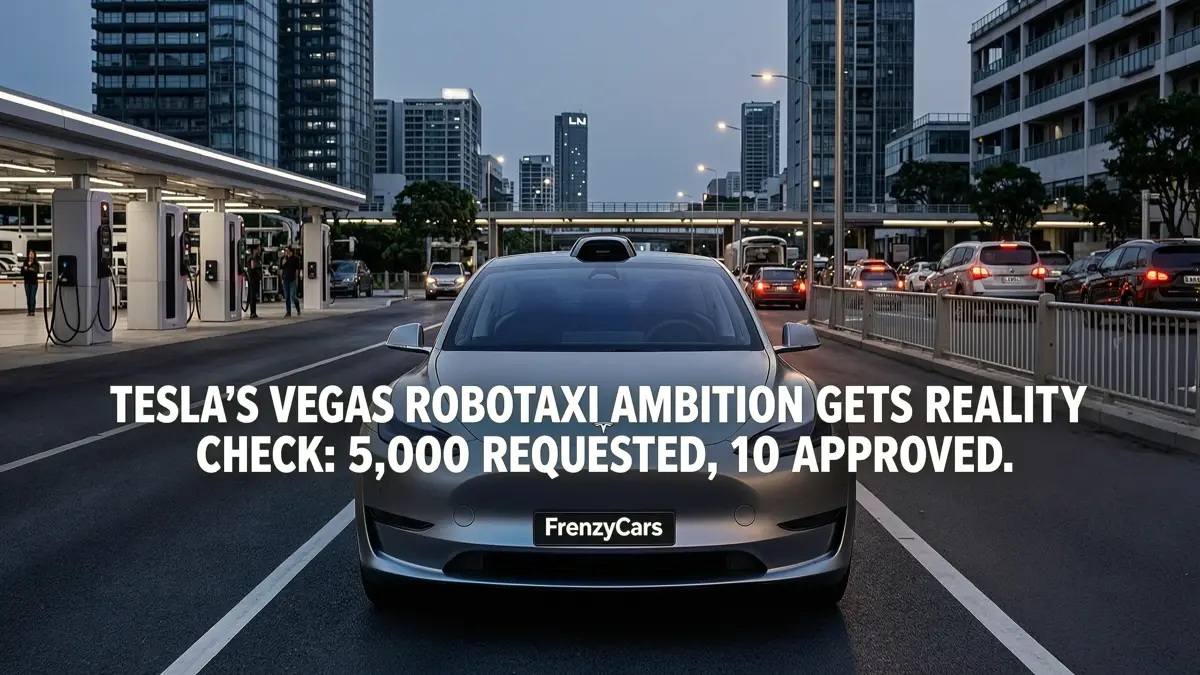
Tesla’s ambitious plan to flood Las Vegas with 5,000 driverless robotaxis has hit a regulatory wall. Nevada state officials have approved only 10 of the vehicles Elon Musk’s company wanted to deploy, according to a report from The Independent. The approval, while a foot in the door for Tesla’s autonomous taxi ambitions, falls drastically short of the fleet size the company envisioned.
The news marks a significant gap between what Tesla wants and what regulators are willing to allow today. Tesla had hoped to operate a massive fleet of robotaxis across Las Vegas, a city that has become a proving ground for autonomous vehicle technology. Instead, it will have to start with a pilot-scale operation of just ten cars — a number that suggests state authorities are taking a cautious approach to letting Tesla’s driverless vehicles loose on public streets.
A Fraction of the Fleet: What Nevada Actually Approved
The contrast is stark: 5,000 requested, 10 approved. That is a tiny fraction of what Tesla asked for, and the decision effectively reduces a would-be citywide transportation network to something resembling a small-scale pilot program. For Tesla, this is likely a first step rather than a final outcome. The company has a history of rolling out features gradually, starting with limited access and expanding as it gathers data and regulatory approval. Ten vehicles could allow Tesla to prove its technology works safely in one of the busiest and most demanding driving environments in the United States, potentially building the case for a larger fleet later.
The approval also highlights the regulatory reality that Tesla faces. Even as the company has pushed the boundaries of semi-autonomous driving with its Full Self-Driving software, regulators have remained cautious about allowing fully driverless vehicles to operate without human oversight. In Nevada, the decision to approve only a small number of robotaxis suggests officials want to see how the vehicles perform before permitting a large-scale deployment. This is consistent with how autonomous vehicle regulation has generally unfolded across the country, with state and local governments opting for incremental approvals rather than blanket permissions. For Tesla, that means the 10 approved vehicles are not just a small victory — they are a foot in the door that could lead to more, provided the pilot goes well.
Why Las Vegas Matters for Tesla’s Robotaxi Push
Las Vegas is not an arbitrary choice for Tesla’s robotaxi ambitions. The city is famous for its dense traffic, unpredictable pedestrians, and constant flow of visitors, making it a challenging and highly visible testing ground. If Tesla’s robotaxis can navigate the Strip and surrounding areas safely, that would be a powerful demonstration of the technology’s readiness. The city has also become a hub for autonomous vehicle testing, with several companies conducting pilots there. That environment gives regulators a baseline of experience to draw from when evaluating new applicants, and it means Tesla will be operating alongside other driverless vehicles rather than introducing the concept to the community for the first time.
For car enthusiasts and potential robotaxi users, the difference between 10 and 5,000 vehicles is also a question of availability. A ten-car fleet in a sprawling metropolitan area like Las Vegas means that catching a Tesla robotaxi will be rare, at least at first. The service will likely be limited in geographic coverage, operating in specific zones rather than across the entire city. This is typical for early-stage robotaxi operations, which often start with geofenced areas before expanding. Tesla’s long-term vision, as described by Musk and the company, involves a future where owners can add their cars to a robotaxi network, allowing the fleet to grow rapidly without direct investment from Tesla itself. However, that vision remains distant, and the Nevada approval shows that regulators are not yet ready to allow it to become a reality at scale.
The decision also matters for the broader autonomous vehicle race. Tesla has been developing its Full Self-Driving system for years, with Musk repeatedly promising that a robotaxi service is just around the corner. The Las Vegas approval, while small, is one of the first concrete regulatory permissions for Tesla to operate a driverless taxi service in a major U.S. city, according to the report. It gives the company a real-world laboratory to test its software, collect data, and refine its approach. But it also sets expectations: a fleet of five thousand was never going to launch overnight, and the modest approval suggests a longer, more incremental road ahead.
For now, Tesla will have to make do with ten robotaxis in Las Vegas. The company will likely use this pilot to gather operational experience, work out kinks, and demonstrate safety to regulators. If the pilot succeeds, Tesla may be able to negotiate a larger fleet in the future. If it stumbles, the path to 5,000 could grow even longer. Either way, the Las Vegas robotaxi story is just beginning.