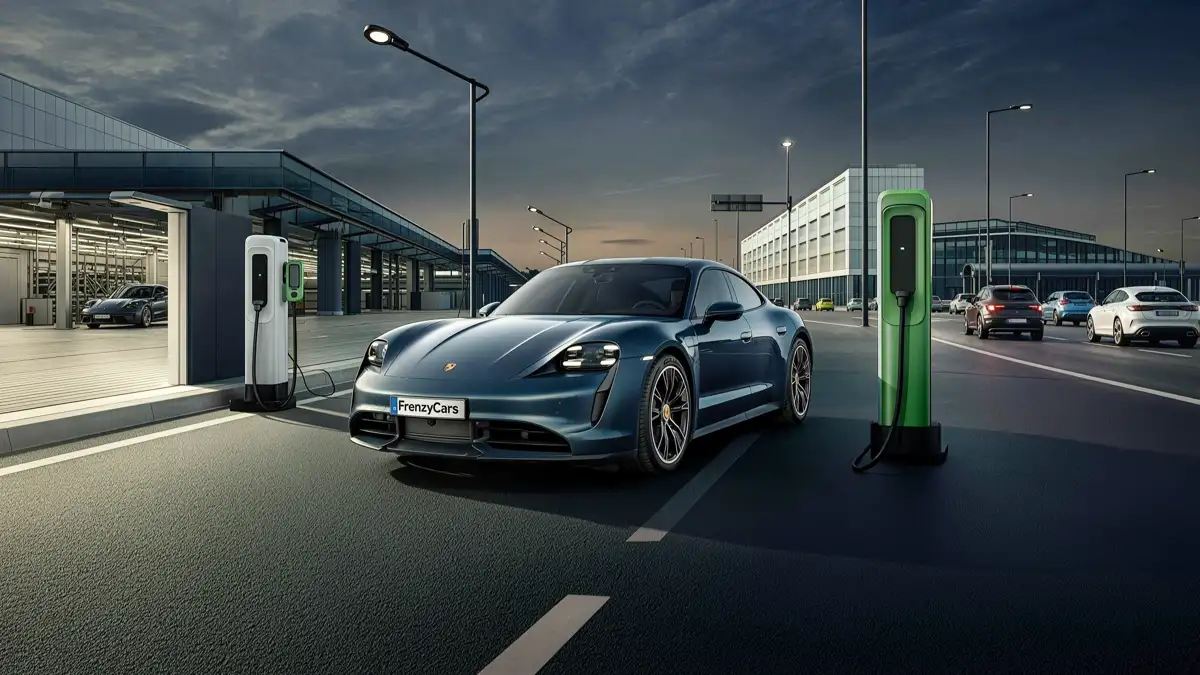
Porsche’s news flow around August 13, 2026, reads like a roadmap for the next decade. German business weekly WirtschaftsWoche reports that Porsche management and the works council have agreed in principle to phase out the all-electric Taycan by 2030. The same day, Singer Vehicle Design and Louis Vuitton unveiled two bespoke, air-cooled Porsche 911 one-offs with custom luggage and detachable clocks. The wider cycle also brought a heavily camouflaged Audi Q5 prototype that could preview a gas-powered Porsche SUV, and a report that Porsche has left Volkswagen Group’s CO2 pool to form an open pool with Xpeng. Taken together, these stories show Porsche juggling a scheduled EV sunset, a combustion icon’s luxury future, and Europe’s emissions rules.
Taycan’s 2030 Phase-Out Is a Directional Change, Even If the Details Aren’t Final
The WirtschaftsWoche report is preliminary, but it still matters. The agreement is described as being “in principle,” which means the broad plan is set even if the hard dates and product details are not. For the once-flagship EV, a phase-out by 2030 is a major directional change. Buyers deciding whether to buy or lease a Taycan today are now looking at a car with a foreseeable end-of-life horizon, and current owners will naturally wonder how that timeline affects residual values. The works council’s role is also telling. In Germany, works councils are involved in decisions that affect production and jobs, so an agreement between management and the employee representatives is a sign the subject has moved from speculation to formal planning. Porsche has not officially confirmed the report, and exact timing for the final production date has not been made public.
Singer and Louis Vuitton Make Two Air-Cooled 911s Into Rolling Luxury Objects
The Louis Vuitton x Singer collaboration is the perfect counterweight. Singer Vehicle Design has never been known for restraint when it comes to craftsmanship, and this project turns that philosophy loose on two Porsche 911s. According to the announcement, the cars feature bespoke interiors, custom luggage, and details inspired by everything from watchmaking to vintage motorboats. The centerpiece is a dashboard clock that started as a small Louis Vuitton detail and grew into a detachable mechanical timepiece inspired by the house’s iconic Tambour watch. That single object captures the whole idea behind the partnership: Singer reimagines air-cooled 911s as ultra-luxe one-off restomods, while Louis Vuitton extends its Art of Travel philosophy into cars, watches, leather interiors, and custom objects. For Porsche enthusiasts, the message is subtle but unmistakable: the 911 remains the brand’s emotional center, and collectors are willing to go to extraordinary lengths to own a one-of-one version.
A Camouflaged Audi Q5 Prototype Could Point to a Gas-Powered Porsche SUV
The camouflaged Audi Q5 prototype points in the other strategic direction. According to the report, the heavily disguised crossover could be an early test mule for Porsche’s next-generation gas-powered SUV. If that’s correct, the new Porsche is expected to share the PPC platform with the Audi Q5 and receive Porsche-specific treatment. The key news for enthusiasts is the powertrain: this is a gasoline SUV, not an electric one. In the context of the Taycan’s reported phase-out, that makes sense. Porsche appears to be keeping a combustion option alive for buyers who want an internal-combustion Porsche beyond the 911.
Leaving VW’s CO2 Pool for Xpeng Says a Lot About Porsche’s Compliance Strategy
European CO2 rules help explain why Porsche is playing all of these angles. According to Electrive, citing documents from the European Commission, Porsche has reportedly left the emissions pool of parent company Volkswagen Group and will instead form an open pool with Xpeng. In Europe, pooling is the mechanism that lets automakers average fleet emissions across brands, so a company selling gas-powered SUVs and combustion 911s can offset that with an EV-heavy partner. With the Taycan reportedly heading for a 2030 exit and a gas SUV apparently in the works, Porsche will need that compliance flexibility for the second half of the decade. The exact terms of the pool should show up in future European Commission filings.
None of these stories is a finished product decision. The Taycan phase-out is an agreement in principle, the gas SUV is a test mule, the Singer and Louis Vuitton 911s are one-offs for private collectors, and the Xpeng pool is a reported regulatory move. Still, the direction is consistent: Porsche is preparing for a decade in which the 911 remains the halo, a gas-powered SUV keeps the combustion line alive, and the all-electric Taycan steps aside. Expect Porsche’s own official statement on the Taycan’s future, and keep an eye on European Commission documents for the details of the Xpeng pool.