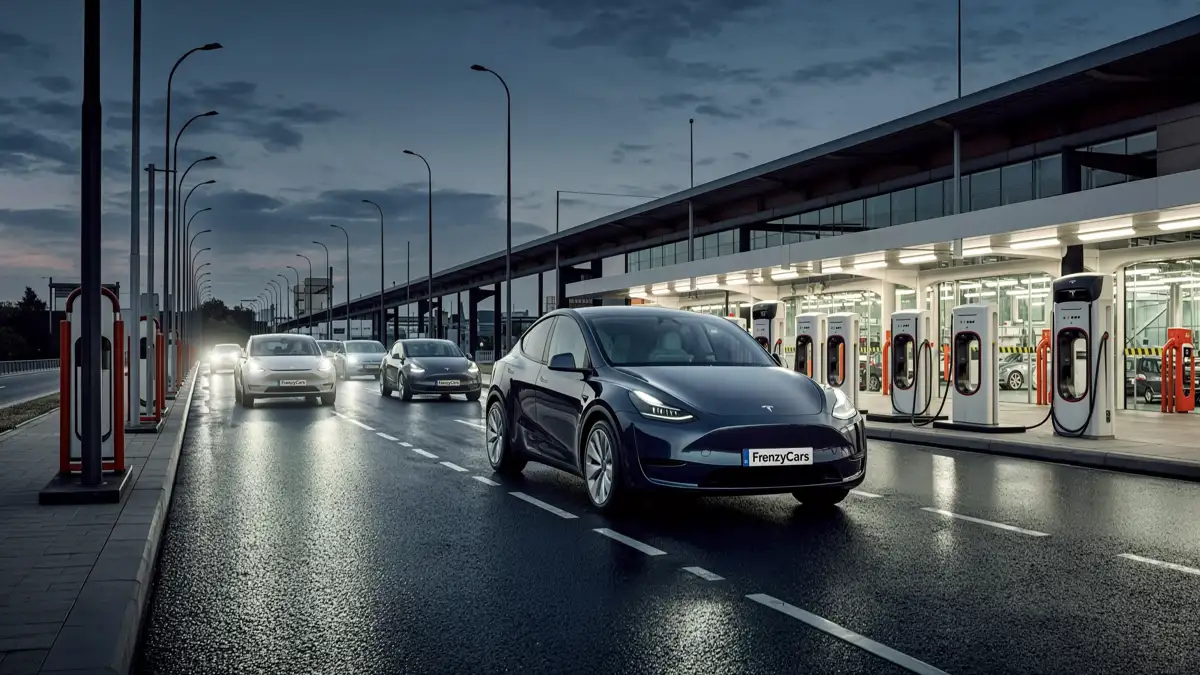
Tesla’s product news this week centers on a car that could bring more shoppers into the electric fold. According to a review from Motoring Matters, the new Model Y Rear-Wheel Drive is built around affordability, pairing extensive re-engineering with a completely redesigned interior and exterior. The same week brought another milestone at Fremont and an unsettling reminder that public charging still carries safety questions. For enthusiasts and EV shoppers, it is a lot to unpack.
A Model Y That Puts Affordability First
Motoring Matters describes the new rear-drive Model Y as a major exercise in re-engineering, with efficiency, comfort, connectivity and safety all named as priorities. That phrase matters. A rear-wheel-drive trim is traditionally the entry point in a carmaker’s lineup — the version that prioritizes value and range per dollar rather than all-out acceleration. By presenting this one as extensively re-engineered rather than simply de-contented, Tesla seems to be making a deliberate argument: the most affordable way into the Model Y should not feel like a compromise. The redesigned cabin and skin reinforce that message. This is not the old Model Y with fewer driven wheels; it is a Model Y reworked for a broader audience. For shoppers who want Tesla ownership without the price of the highest-performance trims, this is the version to watch.
Ten Million EVs and Counting: Fremont Hits the Milestone
According to Tesla Oracle, the Fremont, California factory produced Tesla’s 10-millionth vehicle this week, with employees gathering outside the production line to mark the moment. It is a remarkable scale statement for a company whose first production car was the Roadster. An analysis from Bazaar Times framed the milestone as the start of a software-defined automotive era, and the basic arithmetic supports the idea: there are now 10 million vehicles built, each one a potential node in the company’s software ecosystem. For buyers, the milestone is a confidence signal that Tesla’s production operation has matured well beyond its niche beginnings.
Supercharger Safety: A Twin Falls Incident Raises Hard Questions
The week wasn’t all celebrations. A report on an incident in Twin Falls, Idaho, describes a gunman carrying an AR-style rifle walking past the drive-through at a newly opened In-N-Out Burger before firing toward a row of Tesla vehicles connected to Superchargers. The video, according to the report, reveals a hidden safety vulnerability at Supercharger sites. That should worry anyone who relies on public charging. Unlike a gas station, a charging stall is often unstaffed and exposed, and electric vehicle owners are expected to spend meaningful time there. Teslas themselves carry a sophisticated camera network tied to Autopilot and Full Self-Driving, as GB Times notes, but those cameras are designed to help the car perceive the road, not to guarantee the safety of the surrounding area. The Twin Falls footage is a reminder that charging infrastructure is only as safe as the environment around it.
The Business Side: Musk’s Fortune Drops $600 Billion
On the business side, the week was loud. According to IANS and other reports, Elon Musk has seen his personal fortune fall by more than $600 billion in just over a month as shares of SpaceX and Tesla declined. The reports place his net worth at around $684 billion, down from a high of roughly $1.33 trillion on June 16, when SpaceX briefly made him the world’s first trillionaire. The wealth erosion alone, the reports note, exceeds the total net worth of every other billionaire except Musk himself. For car buyers, the practical effect is indirect, but the context matters: Musk continues to double down on artificial intelligence, autonomous driving and robotics, and Tesla’s story is now tied to those bets as much as to the cars coming off the line.
The Model Y RWD is the product story with the most direct impact on mainstream EV shoppers, and the 10-millionth vehicle in Fremont is a powerful reminder of how far Tesla has come. The Twin Falls incident, however, shows that the charging experience still needs to get safer. For now, the affordability message is clear; the next question is when the new Model Y RWD arrives and how it prices against the rest of a rapidly filling segment.